Introduction
Cyber Insurance Risk Platforms are integrated software solutions designed to quantify, monitor, and mitigate the digital risks that impact an organization’s insurability. Unlike traditional vulnerability scanners that only identify technical flaws, these platforms translate security data into financial risk profiles. They provide a common language for CISOs (who manage the risk), CFOs (who fund the insurance), and Underwriters (who price the risk). By providing real-time telemetry and continuous monitoring, these tools shift the insurance model from “static” (an annual check-up) to “active” (24/7 protection).
The importance of these platforms lies in their ability to unlock better coverage terms and lower premiums by proving a superior security posture. Key real-world use cases include automating the insurance application process, identifying “insurability gaps” before a policy renewal, and providing incident response support during a breach. When evaluating these tools, users should look for features such as automated risk scoring, benchmarking against industry peers, integration with existing security stacks (EDR/MFA), and deep actuarial data that mirrors how insurers actually view risk.
Best for: Mid-to-large enterprises with complex digital footprints, insurance brokers looking to provide data-driven advice to clients, and understaffed SMBs that need a guided path to becoming “insurable.” It is also essential for organizations in highly regulated sectors like fintech, healthcare, and critical infrastructure.
Not ideal for: Micro-businesses with zero digital presence or organizations that rely entirely on a single SaaS provider that handles all security and liability. It may also be overkill for companies that have already achieved near-perfect compliance with frameworks like NIST or ISO and have a direct, long-term relationship with an insurer that doesn’t require third-party platforms.
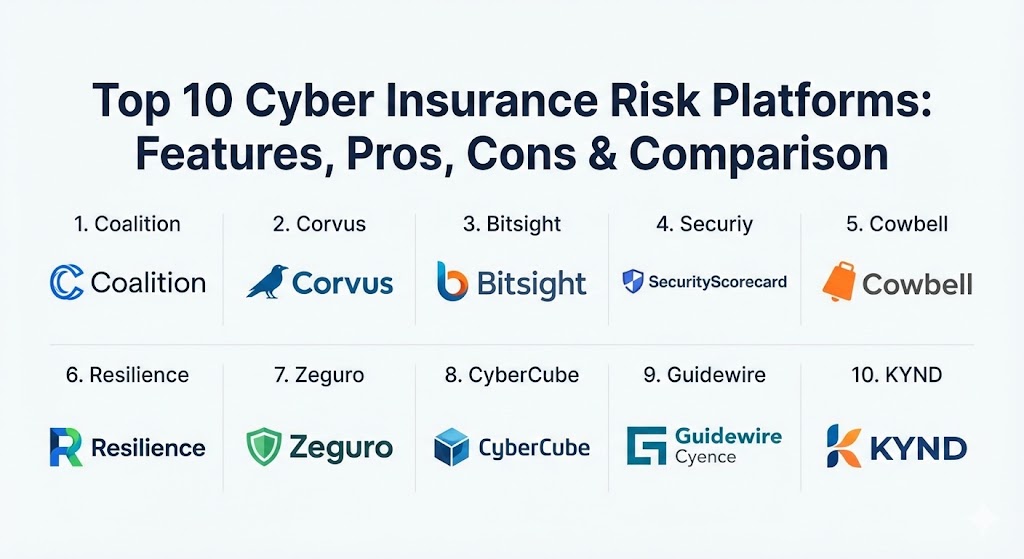
Top 10 Cyber Insurance Risk Platforms
1 — Coalition
Coalition is a leader in “Active Insurance,” combining comprehensive cyber coverage with a proactive risk management platform. It is designed to help businesses stay ahead of threats by monitoring their attack surface and providing the tools to fix vulnerabilities before they can be exploited.
- Key features:
- Continuous automated scanning of the external attack surface.
- Integrated incident response and claims handling within the platform.
- Coalition Control dashboard for tracking security signals in real-time.
- Automated alerts for new vulnerabilities or leaked credentials.
- Direct integration with major cloud providers for deep telemetry.
- Benchmarking tools to compare security posture against similar companies.
- Pros:
- Seamlessly connects insurance coverage with the security tools needed to maintain it.
- The incident response team is highly rated for their speed and technical depth.
- Cons:
- The platform is most powerful when used alongside Coalition’s own insurance policies.
- Can produce a high volume of alerts that may overwhelm very small teams.
- Security & compliance: SOC 2 Type II, GDPR, HIPAA, and ISO 27001 compliant.
- Support & community: Offers 24/7 technical support, a dedicated “Security Labs” research team, and extensive educational webinars for brokers and clients.
2 — Corvus (Smart Underwriting)
Corvus uses AI-driven “Smart Underwriting” to provide transparent risk assessments. Their platform is built around the Corvus Scan, which analyzes thousands of data points to predict the likelihood of a claim, helping brokers and clients understand exactly where they stand.
- Key features:
- Corvus Scan for non-invasive, external risk assessment.
- Smart Cyber Insurance policies that adapt based on the company’s security maturity.
- Personalized “Corvus Signal” reports with actionable remediation advice.
- Aggregated data insights from across the entire Corvus policyholder base.
- Integration with major brokerage workflows for faster quoting.
- Ransomware-specific risk modeling and protection guides.
- Pros:
- Provides some of the most readable and actionable risk reports in the industry.
- The AI modeling is excellent at identifying high-frequency, low-severity risks before they escalate.
- Cons:
- Limited visibility into internal network configurations compared to agent-based tools.
- Focuses primarily on the North American and select European markets.
- Security & compliance: HIPAA and GDPR compliant; features robust audit logs and SSO support.
- Support & community: High-touch onboarding for brokers and a proactive “Risk Engineering” team for policyholders.
3 — Bitsight
Bitsight is arguably the most recognized name in the cyber risk rating space. It provides a credit-score-like rating (ranging from 250 to 900) that is used by underwriters, vendors, and government agencies to gauge the cyber health of an organization.
- Key features:
- Industry-standard cyber risk ratings updated daily.
- Third-party risk management for monitoring vendor ecosystems.
- Financial quantification of risk (through the Bitsight Financial Quantification module).
- Detailed breakdown of risk factors, from patching cadence to botnet infections.
- Benchmarking capabilities against 20+ different risk categories.
- Historical data tracking to show security improvements over time.
- Pros:
- The “credit score” format is incredibly easy to explain to non-technical board members.
- Widely accepted by the global insurance and reinsurance markets as a source of truth.
- Cons:
- Can be expensive for small businesses that only need internal monitoring.
- The rating methodology is proprietary, which can sometimes lead to disputes over “false positives.”
- Security & compliance: ISO 27001, SOC 2, and GDPR compliant.
- Support & community: Robust enterprise-level support, a massive customer community, and extensive technical documentation.
4 — SecurityScorecard
SecurityScorecard provides an easy-to-understand A-through-F grading system for cyber risk. It is a powerful collaboration platform that allows companies to invite their vendors to fix security gaps directly within the tool.
- Key features:
- A-F letter grades across 10 distinct risk factors.
- Publicly available ratings for over 12 million organizations.
- Automatic mapping of security findings to common compliance frameworks.
- Marketplace of integrations with tools like Splunk, ServiceNow, and Slack.
- “Atlas” module for automating security questionnaires.
- Dark web monitoring for leaked corporate credentials.
- Pros:
- The letter grade system drives immediate internal accountability.
- Excellent for managing the “supply chain” risk that often impacts insurance premiums.
- Cons:
- The scanning engine can occasionally flag “orphaned” assets that don’t belong to the company.
- Advanced analytics and questionnaire automation require premium tiers.
- Security & compliance: SOC 2 Type II, GDPR, and FedRAMP authorized.
- Support & community: High-quality customer success managers and a large library of self-service training videos.
5 — Cowbell
Cowbell focuses on the SMB and mid-market sectors, offering “standalone” cyber insurance backed by a platform that emphasizes ease of use and rapid cloud integration.
- Key features:
- “Cowbell Insights” for continuous risk assessment of cloud environments.
- Direct connectors for AWS, Azure, Google Cloud, and Microsoft 365.
- Automated “Cyber Hygiene” scores that reflect real-time configuration.
- Cowbell Academy for training employees on cybersecurity basics.
- Streamlined “click-to-bind” underwriting for fast policy issuance.
- Incident response roadmap provided to every policyholder.
- Pros:
- The best option for companies that are “cloud-only” and need fast, affordable coverage.
- No-nonsense interface that skips the technical jargon.
- Cons:
- Less focus on traditional on-premise infrastructure or complex global networks.
- The risk modeling is optimized for smaller companies rather than Fortune 500s.
- Security & compliance: SOC 2 compliant, GDPR, and HIPAA ready.
- Support & community: Very responsive chat-based support and a focused community of small business owners.
6 — Resilience
Resilience takes a holistic approach, combining insurance, security monitoring, and “Risk Engineering” into a single platform. They focus heavily on high-value enterprises that need a strategic partner rather than just a software vendor.
- Key features:
- Resilience Portal for centralized management of risk and coverage.
- Holistic “Risk Engineering” assessments that go beyond technical scans.
- Claims simulation to help companies understand their financial exposure.
- Integration with EDR and SIEM tools for deep internal visibility.
- Custom-built remediation plans tailored to specific business goals.
- Detailed financial impact modeling for various breach scenarios.
- Pros:
- Exceptional at helping large companies understand the financial impact of cyber risk.
- Provides access to high-level security experts who act as an extension of your team.
- Cons:
- High barrier to entry in terms of cost and complexity.
- Primarily focused on large, complex organizations.
- Security & compliance: ISO 27001, SOC 2, and rigorous data privacy protections.
- Support & community: Elite-level support with dedicated “Risk Engineers” for every enterprise client.
7 — Zeguro
Zeguro is built specifically for small businesses that lack a dedicated IT department. Its “Virtual Cybersecurity Officer” guides users through the process of getting secure and staying insured.
- Key features:
- Step-by-step security policy templates and implementation guides.
- Integrated employee security awareness training.
- Continuous scanning of the external attack surface.
- Automated insurance quoting based on your security progress.
- Compliance tracking for basic frameworks like SOC 2 and HIPAA.
- Simplified “task list” for risk remediation.
- Pros:
- Extremely affordable and easy to use for non-technical founders.
- Acts as a “one-stop-shop” for both security and insurance.
- Cons:
- Lacks the deep analytical power required by large IT teams.
- Limited support for complex, multi-cloud or hybrid environments.
- Security & compliance: SOC 2, GDPR, and HIPAA support features.
- Support & community: Friendly, personalized support tailored to small business needs.
8 — CyberCube
CyberCube is the analytics powerhouse behind many of the world’s largest insurance and reinsurance companies. While it serves insurers, its platform is increasingly used by large brokers and enterprises to model systemic cyber risk.
- Key features:
- Portfolio Manager for insurers to track aggregated cyber risk.
- “Account Manager” for underwriters to deep-dive into specific risks.
- Systemic risk modeling (e.g., predicting the impact of a massive cloud outage).
- Benchmarking data drawn from millions of data points globally.
- Financial quantification of tail-risk and catastrophic events.
- Deep insights into the “threat actor” landscape.
- Pros:
- Unmatched data depth; this is what the actual underwriters are looking at.
- The best tool for modeling “unlikely but catastrophic” cyber events.
- Cons:
- Very high cost; usually only accessible to large financial institutions.
- Not designed as a day-to-day vulnerability management tool.
- Security & compliance: Highest global financial standards, including ISO and SOC.
- Support & community: Professional enterprise support with a focus on data science and actuarial help.
9 — Guidewire (Cyence)
Guidewire’s Cyence platform is a massive data engine that helps the property and casualty (P&C) insurance industry model the financial impact of cyber risk. It uses economic modeling to turn cyber threats into dollars and cents.
- Key features:
- Predictive modeling for cyber loss frequency and severity.
- Data-driven insights into “silent cyber” (unintended cyber risk in non-cyber policies).
- Automated risk selection and pricing recommendations for insurers.
- Global dataset of cyber incidents and insurance claims.
- Integration with Guidewire’s broader InsuranceSuite platform.
- Scenario-based stress testing for insurance portfolios.
- Pros:
- Provides incredible insight into the macro trends of the cyber insurance market.
- Highly respected by actuarial teams worldwide.
- Cons:
- Focused on the insurance industry rather than the individual corporate security team.
- Can be a “black box” in terms of how it reaches certain risk conclusions.
- Security & compliance: ISO 27001, SOC 2, and FISMA compliant where applicable.
- Support & community: Global enterprise support with extensive training programs for insurance professionals.
10 — KYND
KYND is a UK-based platform that prides itself on making cyber risk management “uncomplicated.” It focuses on providing clear, non-technical insights that help companies improve their insurability fast.
- Key features:
- KYND Signals for instant, non-invasive external risk reports.
- KYND Ready for a guided path toward cyber insurance readiness.
- Continuous monitoring of “digital assets” for immediate threat detection.
- Specialized reports for brokers to share with their clients.
- Industry-specific benchmarking for the mid-market.
- Low-friction onboarding with no software to install.
- Pros:
- Probably the most “approachable” platform for a CFO or non-technical business owner.
- Excellent value for money, especially for organizations in the UK and Europe.
- Cons:
- May lack some of the advanced AI-driven predictive features of US-based rivals.
- Less focus on internal “agent-based” deep scanning.
- Security & compliance: GDPR compliant and adheres to Cyber Essentials standards.
- Support & community: Very high customer satisfaction ratings; known for friendly and accessible support.
Comparison Table
| Tool Name | Best For | Platform(s) Supported | Standout Feature | Rating (Gartner/TrueReview) |
| Coalition | Active Insurance | SaaS / Hybrid | Integrated Claims Team | 4.7 / 5 |
| Corvus | Smart Underwriting | SaaS / Cloud | Corvus Signal Reports | 4.6 / 5 |
| Bitsight | Universal Rating | SaaS | Global Rating Credit Score | 4.6 / 5 |
| SecurityScorecard | Supply Chain Risk | SaaS | A-F Letter Grading | 4.4 / 5 |
| Cowbell | Cloud-First SMBs | Cloud-Native | Direct Cloud Connectors | 4.5 / 5 |
| Resilience | Large Enterprise | SaaS / Hybrid | Financial Impact Modeling | 4.7 / 5 |
| Zeguro | Small Business | SaaS | Virtual CISO Guidance | 4.4 / 5 |
| CyberCube | Underwriters / Reinsurers | SaaS / Data | Systemic Risk Modeling | 4.6 / 5 |
| Guidewire (Cyence) | Actuarial Modeling | SaaS / Enterprise | Economic Loss Prediction | 4.5 / 5 |
| KYND | Mid-Market Advisory | SaaS | Uncomplicated Reporting | 4.8 / 5 |
Evaluation & Scoring of Cyber Insurance Risk Platforms
When selecting a platform, it is important to understand the weight of different factors. An enterprise will value depth and integration, while a small business will value ease of use and price.
| Category | Weight | Evaluation Criteria |
| Core Features | 25% | External/internal scanning, risk scoring, and automated alerts. |
| Ease of Use | 15% | Dashboard clarity, non-technical reporting, and onboarding speed. |
| Integrations | 15% | Compatibility with EDR, SIEM, Cloud providers, and Broker platforms. |
| Security & Compliance | 10% | Evidence mapping to NIST/ISO and platform’s own SOC 2 status. |
| Performance | 10% | Accuracy of scans, speed of updates, and lack of false positives. |
| Support & Community | 10% | Access to risk engineers, 24/7 support, and user documentation. |
| Price / Value | 15% | TCO relative to potential premium savings and incident reduction. |
Which Cyber Insurance Risk Platform Is Right for You?
The right choice depends on your specific role in the insurance lifecycle:
- For the Solo Founder or Small Startup: Zeguro or KYND are your best bets. They won’t overwhelm you with data you don’t understand, and they provide a clear “checklist” to help you get your first insurance policy.
- For the Mid-Market IT Manager: SecurityScorecard or Cowbell offer a great balance. You get the technical data you need to fix issues, but the “grading” system makes it easy to report your progress up to the board.
- For the Enterprise CISO: Bitsight or Resilience are the industry standards. You need the deep integrations and the ability to compare your risk profile against other multi-billion dollar peers.
- For the Insurance Broker: Corvus and Coalition are the winners. They provide the tools that make you look like a cybersecurity expert to your clients, which is the key to building long-term trust.
- For the Actuary or Portfolio Manager: CyberCube and Guidewire are non-negotiable. You need the “big data” that explains how a single event (like a global cloud outage) could bankrupt a portfolio.
Frequently Asked Questions (FAQs)
1. Does using one of these platforms guarantee I will get cyber insurance? No, but it significantly increases your chances. Insurers are much more likely to cover an organization that provides “transparent” data from a trusted platform than one that only fills out a manual spreadsheet.
2. Can these tools lower my insurance premiums? Yes. Many insurers offer “discounts” or more favorable terms if you can prove a high score on platforms like Bitsight or if you use an “active” insurer like Coalition.
3. What is the difference between a vulnerability scanner and a risk platform? A scanner (like Nessus) tells you your software is out of date. A risk platform (like Corvus) tells you how that out-of-date software increases your financial probability of a $2M breach.
4. How often are these scores updated? Most platforms perform external scans daily. However, “deep” internal assessments might be updated monthly or whenever you integrate a new security tool.
5. Are “false positives” common in these ratings? They can be. Occasionally, a platform might associate a malicious IP address with your company because of a shared cloud environment. High-quality platforms (like SecurityScorecard) have a process to “dispute” and remove these.
6. Do I need to install software on all my computers? Not necessarily. Many of these tools are “non-invasive” and only scan your public-facing internet presence. However, “enterprise” tools often offer agents or API connectors for deeper insight.
7. Is my data safe with these platforms? Since these platforms hold a map of your vulnerabilities, their own security is paramount. Look for platforms with SOC 2 Type II and ISO 27001 certifications.
8. Can I use these platforms to monitor my vendors? Yes, tools like Bitsight and SecurityScorecard are the market leaders for “Third-Party Risk Management” (TPRM).
9. What is “Active Insurance”? Active insurance is a model where the insurance company provides constant monitoring and security tools to the policyholder throughout the year, not just at renewal time.
10. Why is “Financial Quantification” important? It helps bridge the gap between IT and the Board. Telling a CEO “our firewall is old” is less effective than saying “this specific risk represents a $500,000 expected annual loss.”
Conclusion
Cyber insurance risk platforms have moved the goalposts for enterprise security. In 2026, it is no longer enough to be secure; you must be able to prove it with data that an insurer can trust. Whether you choose the high-speed AI modeling of Corvus, the industry-standard ratings of Bitsight, or the SMB-friendly guidance of Zeguro, the goal is the same: clarity. The best platform for your organization is the one that aligns your technical defenses with your financial risk appetite, ensuring that when the next breach happens, you aren’t just protected by a policy, but by a platform.