Introduction
Claims fraud detection tools are advanced analytical platforms that use a combination of business rules, machine learning (ML), and artificial intelligence (AI) to identify suspicious claims before they are paid. These solutions analyze vast amounts of data—including claimant history, social network connections, geographic patterns, and behavioral biometrics—to flag potential red flags in real-time. By moving detection from a post-payment “pay and chase” model to a pre-payment “detect and prevent” model, insurers can save millions in fraudulent payouts while accelerating the processing of legitimate claims.
Real-world use cases include identifying staged accidents, detecting provider billing abuse (such as double-billing or unbundling), and uncovering complex “fraud rings” where multiple parties are colluding. When choosing a tool, organizations should look for high predictive accuracy, “explainable AI” (so investigators understand why a claim was flagged), and seamless integration with existing core claims systems like Guidewire or Duck Creek.
Best for: Insurance carriers (P&C, Life, Health), Special Investigation Units (SIUs), Third-Party Administrators (TPAs), and large self-insured corporations with high claim volumes.
Not ideal for: Very small niche brokers or startups with minimal claim activity where manual review remains more cost-effective, or organizations that lack the data infrastructure to support an automated analytical platform.
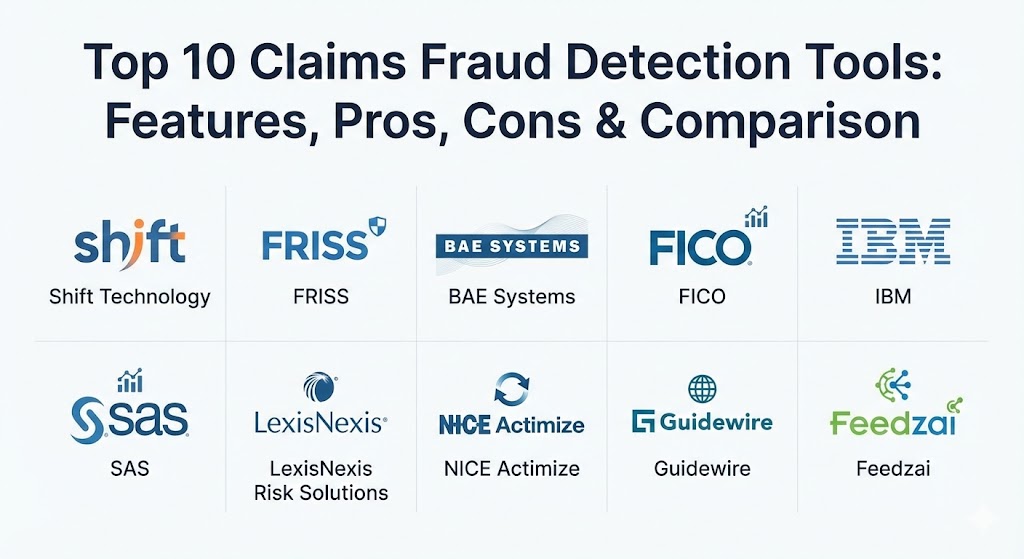
Top 10 Claims Fraud Detection Tools
1 — Shift Technology (Shift Claims Fraud Detection)
Shift Technology is a global leader in AI-native insurance solutions. Its claims fraud detection platform is built specifically for insurers, using advanced data science to replicate the intuition of a human investigator at scale.
- Key features:
- AI-driven fraud scoring with a focus on “explainability” for SIU teams.
- Integration with a massive global Insurance Data Network (IDN) for cross-carrier insights.
- Document analysis using Computer Vision to detect altered or fake invoices.
- Network analysis to uncover hidden relationships and organized fraud rings.
- Real-time claim risk assessment during the First Notice of Loss (FNOL).
- Dynamic investigation workflows that adapt based on the fraud type.
- Pros:
- High hit rate with significantly lower false positives compared to rule-based systems.
- Purpose-built for insurance; no generic “one-size-fits-all” financial fraud models.
- Cons:
- Premium pricing reflects its status as a market leader.
- Implementation can be complex for carriers with highly siloed legacy data.
- Security & compliance: SOC 2 Type II, ISO 27001, GDPR, and HIPAA compliant. Supports SSO and end-to-end encryption.
- Support & community: Extensive documentation, dedicated customer success managers, and regular industry benchmarking reports.
2 — FRISS (Insurance Fraud Detection)
FRISS offers an end-to-end platform that focuses on the entire policy lifecycle, but its claims fraud detection module is widely praised for its “ready-to-use” nature and deep integration with core insurance systems.
- Key features:
- Hybrid detection engine combining expert rules and AI models.
- 600+ pre-defined “risk indicators” specific to different lines of business.
- Real-time scoring integrated directly into the claims workflow.
- Visual network diagrams to map out complex claimant/provider relationships.
- Automated data enrichment from external sources (vehicle registries, weather data).
- Claims health check to monitor the ROI of fraud-fighting efforts.
- Pros:
- Very fast implementation time thanks to pre-built integrations with Guidewire and Duck Creek.
- Highly visual and intuitive interface designed specifically for claims adjusters.
- Cons:
- The heavy reliance on rules (alongside AI) can require more manual “tuning” over time.
- May not be as robust as Shift for highly complex, multi-national fraud rings.
- Security & compliance: ISAE 3402, GDPR compliant, and AES-256 data encryption at rest and in transit.
- Support & community: Strong European and North American support presence; active user community and regular “Fraud Friday” webinars.
3 — BAE Systems Digital Intelligence (NetReveal)
NetReveal by BAE Systems is an enterprise-grade solution that excels in high-volume, multi-channel environments. It is often the choice for massive global insurers who need to manage fraud, compliance, and AML in a single platform.
- Key features:
- Entity resolution that links disparate data points into a single “golden record.”
- Advanced social network analysis (SNA) for identifying organized crime.
- Real-time and batch scoring capabilities for high-velocity claims.
- Scenario-based modeling that allows users to simulate new fraud trends.
- Integrated case management with automated evidence gathering.
- Multi-currency and multi-language support for global operations.
- Pros:
- Unmatched ability to handle massive datasets across diverse lines of business.
- Deep expertise in detecting sophisticated, “low and slow” fraud schemes.
- Cons:
- Higher total cost of ownership (TCO) due to the infrastructure required.
- The interface can feel more technical and less “modern” than SaaS-first competitors.
- Security & compliance: FIPS 140-2, SOC 2, and rigorous compliance with global financial regulations.
- Support & community: Tiered enterprise support with 24/7 global availability; extensive professional services.
4 — FICO (Insurance Fraud Manager)
FICO, the company synonymous with credit scoring, brings its world-class predictive modeling to insurance. FICO Insurance Fraud Manager (IFM) uses patented “Self-Learning Models” to detect emerging fraud patterns.
- Key features:
- Adaptive machine learning that evolves as fraud tactics change.
- Consortium data models that leverage insights from across the FICO network.
- Real-time alerts delivered directly to the investigator’s dashboard.
- Behavioral profiling to identify anomalies in provider and claimant behavior.
- Comprehensive audit trails for every automated decision.
- Cloud-first deployment with high availability.
- Pros:
- The predictive models are among the most accurate in the industry.
- Strong global reputation; highly trusted by regulators and large financial institutions.
- Cons:
- Can feel like a “black box” if the explainability features aren’t fully utilized.
- Implementation often requires a significant data mapping exercise.
- Security & compliance: PCI DSS, SOC 2, HIPAA, and GDPR compliant.
- Support & community: Robust training via FICO University; global community of analytics experts.
5 — IBM (Counter Fraud Management for Insurance)
IBM’s solution leverages the power of the Watson ecosystem to provide a cognitive approach to fraud. It is designed for large-scale enterprises that want to integrate fraud detection into a broader data lake strategy.
- Key features:
- Cognitive analytics that can process unstructured data (e.g., adjuster notes, images).
- Integrated “Case Lifecycle Management” from detection to prosecution.
- Visual analysis tools for mapping out fraud networks.
- Scalable architecture that supports on-premise, cloud, or hybrid deployments.
- Pre-built fraud content packs for specific insurance lines (Auto, Health, Property).
- High-performance scoring engine for millions of daily transactions.
- Pros:
- Exceptional at finding “hidden” patterns in unstructured data like text and images.
- Benefits from IBM’s massive R&D budget and AI advancements (Watson).
- Cons:
- Can be overly complex for mid-market insurers with simpler needs.
- Often requires IBM professional services for optimal configuration.
- Security & compliance: ISO 27001, SOC 2, GDPR, and FedRAMP (for government-adjacent sectors).
- Support & community: Global enterprise support; access to IBM’s massive developer and AI communities.
6 — SAS (Fraud Management)
SAS is a powerhouse in the world of analytics, and its Fraud Management solution is a favorite for insurers who want maximum control over their models and data.
- Key features:
- A unified platform for fraud, compliance, and security.
- “White-box” AI models that allow data scientists to see and tune the underlying logic.
- Network and relationship graphing with real-time interactivity.
- Scenario-based testing to evaluate the impact of new rules before deployment.
- Automated reporting for regulatory compliance.
- Integration with SAS’s broader visual analytics suite.
- Pros:
- Total flexibility; you can build, import, or tune models to your exact specifications.
- The standard-bearer for data science and statistical rigor in the insurance industry.
- Cons:
- Requires a high level of internal technical expertise to manage effectively.
- The cost of licensing can be prohibitive for smaller firms.
- Security & compliance: FIPS 140-2, SOC 2, and rigorous data privacy controls.
- Support & community: Massive global user group (SAS Global Forum) and world-class training programs.
7 — LexisNexis Risk Solutions (Claims Clarity)
LexisNexis focuses on the “data” part of the equation. Claims Clarity uses the company’s vast proprietary database to provide instant risk scores based on the identities and histories of the parties involved.
- Key features:
- Instant identity verification for all parties in a claim.
- Cross-industry data insights (public records, criminal history, financial data).
- Claim-level scoring based on historical “red flags” in the LexisNexis network.
- Batch processing for historical “scrubs” of the claims book.
- Visualization tools for linking claimants to vehicles and addresses.
- Seamless API integration for real-time decisioning.
- Pros:
- No other vendor has access to the same depth of public and proprietary data.
- Excellent for identifying “synthetic identities” and first-party fraud.
- Cons:
- Less focused on “workflow automation” compared to Shift or FRISS.
- Primarily a data-driven score; requires an external platform to manage the full investigation.
- Security & compliance: GLBA, DPPA, HIPAA, and GDPR compliant. SOC 2 Type II certified.
- Support & community: Strong customer support and deep industry expertise in data privacy and regulation.
8 — NICE Actimize (Insurance Fraud Solutions)
NICE Actimize is a leader in financial crime prevention. Its insurance module focuses on “behavioral analytics,” identifying when a provider or claimant deviates from their established baseline.
- Key features:
- Behavioral profiling for claimants, providers, and agents.
- Real-time anomaly detection for high-velocity claims (e.g., travel insurance).
- Integrated case management with automated evidence “bundling.”
- Cross-channel monitoring (online, call center, mobile).
- Advanced machine learning for “unknown” fraud pattern detection.
- Regulatory reporting templates built-in.
- Pros:
- Very strong at detecting internal/agent fraud and provider billing schemes.
- Modern, high-performance architecture that handles real-time alerts with zero lag.
- Cons:
- Historically focused more on banking; insurance-specific features are still expanding.
- Configuration of behavioral baselines can take time to “warm up.”
- Security & compliance: SOC 2, ISO 27001, and FIPS 140-2 compatibility.
- Support & community: Global 24/7 support and a robust “Actimize Community” portal for users.
9 — Guidewire (Fraud Analytics / Predictive Analytics)
Guidewire is the world’s most popular core insurance system. Its native Fraud Analytics module is designed to provide “frictionless” fraud detection without ever leaving the core Guidewire ClaimCenter interface.
- Key features:
- Native integration into Guidewire ClaimCenter workflows.
- Pre-built predictive models for Workers’ Comp, Auto, and Property.
- Automated alert routing to specific SIU investigators based on expertise.
- “Risk scoring” visible directly on the claim summary screen.
- Out-of-the-box dashboards for claims managers.
- Leverages the Guidewire Cloud data platform for real-time processing.
- Pros:
- The best user experience for carriers already using Guidewire; no “context switching.”
- Very low implementation hurdle for existing Guidewire customers.
- Cons:
- Only available to Guidewire customers; not a standalone solution.
- May lack some of the advanced AI “bells and whistles” of niche players like Shift.
- Security & compliance: Fully compliant with Guidewire Cloud’s rigorous security standards (SOC 1/2, PCI).
- Support & community: Backed by Guidewire’s massive global support and partner ecosystem.
10 — Feedzai (RiskOps for Insurance)
Feedzai is a cloud-native platform that uses a “RiskOps” approach to manage fraud across the entire customer journey. It is designed for the modern, digital-first insurer that needs to move fast.
- Key features:
- Real-time anomaly detection using “human-centric” AI.
- Unified platform for account opening, payments, and claims fraud.
- Rapid model deployment (often in weeks, not months).
- Advanced “link analysis” to visualize relationships between claims.
- “Fairness and Bias” monitoring to ensure AI models remain ethical.
- Highly scalable cloud-native architecture.
- Pros:
- Very fast, modern, and highly scalable; built for the era of “instant claims.”
- Strong focus on model transparency and reducing algorithmic bias.
- Cons:
- Newer to the insurance specific market compared to BAE or SAS.
- May require more internal data engineering to feed the “RiskOps” engine.
- Security & compliance: SOC 2 Type II, ISO 27001, GDPR, and HIPAA.
- Support & community: Responsive SaaS-style support; growing presence in North America and Europe.
Comparison Table
| Tool Name | Best For | Platform(s) Supported | Standout Feature | Rating (Gartner Peer Insights) |
| Shift Technology | Purpose-built AI | SaaS / Cloud | Insurance Data Network (IDN) | 4.7 / 5 |
| FRISS | Fast Deployment | Cloud / On-prem | Integrated Risk Indicators | 4.6 / 5 |
| BAE NetReveal | Large-scale Enterprise | On-prem / Hybrid | Sophisticated Entity Resolution | 4.5 / 5 |
| FICO IFM | Predictive Accuracy | Cloud / Hybrid | Self-Learning ML Models | 4.5 / 5 |
| IBM Counter Fraud | Unstructured Data | Cloud / On-prem | Watson Cognitive Analytics | 4.4 / 5 |
| SAS Fraud Mgmt | Data Science Power Users | Multi-cloud / On-prem | White-box Model Transparency | 4.6 / 5 |
| LexisNexis | Identity & Public Data | API / SaaS | Proprietary Global Data Lake | 4.5 / 5 |
| NICE Actimize | Behavioral Monitoring | Cloud / Hybrid | Provider Profiling | 4.3 / 5 |
| Guidewire | Existing Guidewire Users | Cloud Native | Zero-context-switch UI | 4.5 / 5 |
| Feedzai | Digital-First Insurers | Cloud Native | Ethical AI / Bias Detection | 4.4 / 5 |
Evaluation & Scoring of Claims Fraud Detection Tools
When selecting a tool, most insurance carriers use a weighted scoring system similar to the one below to find the best fit for their specific risk appetite.
| Criteria | Weight | Average Industry Score |
| Core Features | 25% | Predictive power, SNA, and real-time scoring. |
| Ease of Use | 15% | Investigator UI, dashboard clarity, and alert “explainability.” |
| Integrations | 15% | Native connectors for Guidewire, Salesforce, and data lakes. |
| Security & Compliance | 10% | GDPR, HIPAA, and data residency support. |
| Performance | 10% | Latency of real-time scores and batch processing speed. |
| Support & Community | 10% | Training, local support, and user group activity. |
| Price / Value | 15% | ROI (Fraud savings vs. total licensing and implementation cost). |
Which Claims Fraud Detection Tool Is Right for You?
The right choice depends heavily on your current infrastructure and the “type” of fraud you are most concerned with.
- The “Guidewire” Shop: If you are already deep in the Guidewire ecosystem, the Guidewire Fraud Analytics module is often the path of least resistance. It offers “good enough” detection with a world-class user experience.
- The “Big Data” Enterprise: For global carriers with massive, messy datasets across multiple countries, BAE NetReveal or IBM Counter Fraud provide the heavy-duty infrastructure needed to link disparate signals.
- The “AI Innovator”: If your goal is to achieve the highest possible hit rate with the lowest false positives, Shift Technology is currently the high-water mark for insurance-specific AI.
- The “Data Science” Firm: If your internal team wants to build and tune their own models rather than buying a “black box,” SAS offers the best sandbox for professional data scientists.
- The “Identity-Focused” Carrier: If you primarily deal with application fraud and “synthetic identities,” LexisNexis should be your first stop for data enrichment.
Frequently Asked Questions (FAQs)
1. Do these tools replace my SIU (Special Investigation Unit) team? No. These tools are designed to be “force multipliers.” They filter out the noise so your investigators can focus their time on the high-risk cases that have the highest probability of a recovery or denial.
2. What is “Explainable AI” in claims fraud? It is a feature that tells the investigator why a claim was flagged (e.g., “This claimant is linked to a known suspicious address” or “This provider’s billing is 30% higher than peers for this procedure”). Without it, investigators often ignore AI alerts.
3. How long does it take to see an ROI? Most carriers see a positive ROI within 6 to 12 months, as the system begins to block fraudulent payouts that previously would have slipped through manual reviews.
4. Can these tools detect “Provider Fraud”? Yes. Modern tools like NICE Actimize and IBM excel at provider profiling, identifying doctors, lawyers, or body shops that are systematically over-billing or staging losses.
5. Is data privacy a concern with these tools? Yes, especially with GDPR and CCPA. Leading vendors use “data masking” and “anonymization” techniques to ensure that sensitive PII is protected while still allowing the AI to look for patterns.
6. Do I need to be in the cloud to use these tools? While many are shifting to SaaS-only (like Shift or Feedzai), several vendors (like BAE and SAS) still offer on-premise or hybrid options for carriers with strict data residency requirements.
7. Can these tools catch “Organized Fraud Rings”? Yes. This is a core strength of tools with Social Network Analysis (SNA). They can “spider” through data to find links between seemingly unrelated claims (e.g., same phone number, same witness, or same doctor).
8. What is the typical “False Positive” rate? Early rule-based systems had high false-positive rates (sometimes 90%+). Modern AI-driven tools aim for much higher precision, often reducing false positives by 50% or more compared to legacy methods.
9. Can I use these tools for Life Insurance as well as P&C? Most vendors offer specific “content packs” for different lines. Life insurance fraud (e.g., faked death, non-disclosure) requires different models than Auto insurance fraud (e.g., staged collisions).
10. How do these tools stay ahead of new fraud tactics? The best tools use “Adaptive Machine Learning,” which learns from the outcome of previous investigations. If an investigator marks a claim as “Not Fraud,” the system automatically adjusts its logic to be smarter next time.
Conclusion
Claims fraud detection is no longer a manual game. In 2026, the carriers who win will be those who can harness AI to act with the speed of a computer and the intuition of an investigator. Whether you prioritize a “zero-context-switch” experience like Guidewire or the industry-wide intelligence of Shift, the goal remains the same: protecting your honest policyholders by ensuring that fraudulent actors have no place in your ecosystem.