Introduction
Healthcare Interoperability APIs are sets of protocols and tools that allow different electronic health record (EHR) systems, mobile apps, and medical devices to “talk” to one another securely. In a world where a patient might see a primary doctor in one system, a specialist in another, and use a wearable device at home, these APIs ensure that clinical data follows the patient seamlessly. By using standardized formats like JSON and XML, these tools enable real-time access to medications, lab results, and diagnostic images.
The importance of these tools is driven by both clinical necessity and regulatory mandates (such as CMS-0057-F and the Cures Act). Key real-world use cases include Patient 360 views (consolidating a patient’s entire history), Smart on FHIR apps that plug directly into physician workflows, and Automated Prior Authorization, which slashes administrative wait times. When evaluating these tools, users should prioritize FHIR R4/R5 compliance, “Bulk Data” capabilities, identity resolution (matching the right patient), and the depth of their pre-built EHR connectors.
Best for: Hospital systems, health tech startups, health insurance payers, and life sciences researchers. It is essential for developers building patient-facing apps and IT directors tasked with legacy system modernization.
Not ideal for: Small, single-provider practices that use an all-in-one EHR with no need for external data exchange, or local wellness clinics that do not handle regulated clinical data (PHI).
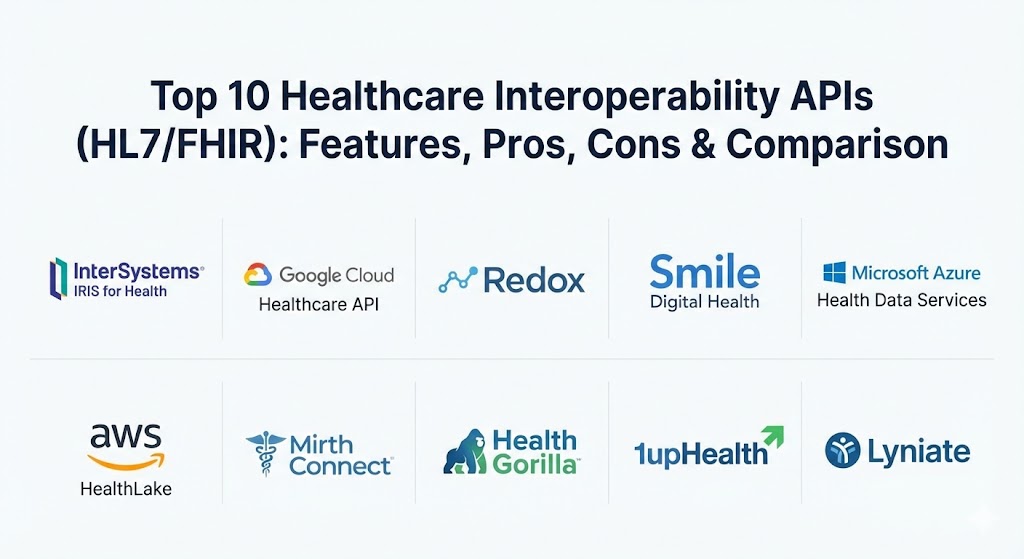
Top 10 Healthcare Interoperability APIs (HL7/FHIR) Tools
1 — InterSystems IRIS for Health
InterSystems is a long-standing titan in healthcare data. IRIS for Health is a specialized multi-model data platform designed specifically to handle the massive scale and complexity of healthcare interoperability.
- Key features:
- High-performance database with a built-in FHIR server.
- Native support for HL7 v2, v3, CDA, DICOM, and X12.
- Integrated FHIR Transformation Service to convert legacy data.
- Advanced “Identity Resolution” to prevent duplicate patient records.
- Support for “SMART on FHIR” application development.
- Built-in machine learning and analytics for population health.
- Pros:
- Proven at massive scale (powers some of the world’s largest HIEs).
- Exceptionally fast message routing and data transformation.
- Cons:
- Steep learning curve for developers new to the InterSystems ecosystem.
- High enterprise-level pricing can be a barrier for smaller startups.
- Security & compliance: HIPAA, GDPR, SOC 2 Type II, and HITRUST certified.
- Support & community: World-class enterprise support; active developer community via the InterSystems Developer Connection.
2 — Google Cloud Healthcare API
Google’s offering is a fully managed service that provides a bridge between care systems and applications built on Google Cloud. It is designed to make healthcare data “AI-ready.”
- Key features:
- Managed FHIR, HL7 v2, and DICOM stores.
- Automatic de-identification of data for research and AI training.
- Integration with BigQuery for large-scale population health analytics.
- Natural Language Processing (NLP) to extract FHIR resources from text.
- Cloud-native scalability with “pay-as-you-go” pricing.
- Support for the latest FHIR R4 specifications.
- Pros:
- Easiest path to applying advanced AI/ML to clinical datasets.
- Highly scalable and reliable global infrastructure.
- Cons:
- Requires data to be moved or mirrored into the Google Cloud environment.
- Can be complex to configure identity and access management (IAM) correctly.
- Security & compliance: HIPAA eligible, SOC 2, ISO 27001, and GDPR compliant.
- Support & community: Extensive documentation and 24/7 Google Cloud premium support options.
3 — Redox
Redox acts as a unified “network” for healthcare data. Instead of building 50 different connections to 50 different hospitals, you build one connection to the Redox API.
- Key features:
- Unified API that standardizes data from over 10,000 facilities.
- Pre-built integrations with major EHRs like Epic, Cerner, and Meditech.
- Real-time “Event-based” data streaming for clinical updates.
- Bi-directional data flow (read and write capabilities).
- Developer-friendly “Dashboard” for monitoring traffic and errors.
- Support for HL7, FHIR, and various proprietary vendor APIs.
- Pros:
- Dramatically reduces “Time to Live” for health tech startups.
- “Build once, connect everywhere” philosophy simplifies scaling.
- Cons:
- Pricing includes platform fees that can be high for low-volume users.
- You are reliant on Redox as a middleman for all data traffic.
- Security & compliance: SOC 2 Type II, HIPAA compliant, and HITRUST certified.
- Support & community: Excellent developer documentation and a dedicated customer success team.
4 — Smile Digital Health
Smile Digital Health is a FHIR-native health data platform. It is built by the team behind HAPI FHIR, the world’s most popular open-source FHIR implementation.
- Key features:
- 100% FHIR-native repository (no internal mapping required).
- Support for all FHIR versions and implementation guides (IGs).
- High-performance “Bulk Data” export for large datasets.
- Advanced Clinical Reasoning (CQL) engine for decision support.
- Flexible deployment: On-premise, Cloud, or Hybrid.
- Native support for CMS Interoperability and Patient Access rules.
- Pros:
- Best-in-class adherence to the pure FHIR standard.
- Zero vendor lock-in due to its open-standards foundation.
- Cons:
- Requires a strong understanding of FHIR architecture to fully utilize.
- Commercial licensing is required for the full “Smile” enterprise suite.
- Security & compliance: HITRUST R2, ISO 27001, SOC 2 Type II, and GDPR.
- Support & community: Deep technical expertise; support for the HAPI FHIR open-source community.
5 — Azure Health Data Services
Microsoft’s suite provides a robust, managed platform for ingesting and persisting various types of health data, with a strong emphasis on enterprise security and the Microsoft ecosystem.
- Key features:
- Managed FHIR service for rapid API deployment.
- DICOM service for medical imaging and MedTech service for IoT.
- Integration with Power BI for clinical dashboards.
- “De-identification” tools for secondary data usage.
- Built-in support for “SMART on FHIR” proxies.
- Tight integration with Microsoft Entra ID (Active Directory).
- Pros:
- The most “Enterprise IT-friendly” interface for existing Windows shops.
- Superior integration with Teams for clinician collaboration.
- Cons:
- Can feel fragmented compared to a single-purpose “Interoperability Engine.”
- Azure-specific terminology can be confusing for non-Microsoft developers.
- Security & compliance: HIPAA, HITRUST, GDPR, and the widest range of global certifications.
- Support & community: Comprehensive Microsoft Learn documentation and enterprise cloud support.
6 — AWS HealthLake
Amazon’s HealthLake is an “eligible” service that allows healthcare and life sciences companies to aggregate, store, and analyze health data at a petabyte scale.
- Key features:
- Integrated medical NLP to “structure” unstructured notes into FHIR.
- Automated data normalization into the FHIR R4 format.
- Chronological “Patient Timeline” views.
- High-speed search and query using SQL-like syntax.
- Integration with AWS SageMaker for building custom health models.
- Secure, high-availability storage in the AWS cloud.
- Pros:
- Best-in-class analytics for population health and research.
- “Auto-structuring” feature saves thousands of hours of manual mapping.
- Cons:
- Heavy focus on “Big Data” over real-time HL7 v2 messaging.
- Cost can scale quickly with high-volume data ingestion.
- Security & compliance: HIPAA eligible, SOC 2, and AWS Identity Management (IAM).
- Support & community: Massive AWS developer ecosystem and professional services support.
7 — Mirth Connect (by NextGen Healthcare)
Mirth Connect is the “Swiss Army Knife” of healthcare integration. It is an open-core integration engine used to route and transform messages across virtually any protocol.
- Key features:
- Visual “Channel” builder for drag-and-drop message routing.
- Support for HL7 v2, v3, FHIR, EDI/X12, and database connectors.
- Custom JavaScript support for complex data transformations.
- Platform-agnostic (runs on Windows, Linux, and macOS).
- Comprehensive monitoring and alerting for interface health.
- Advanced “Clustering” for high availability in the commercial version.
- Pros:
- The industry standard for on-premise HL7 v2 routing.
- Free “Open Source” version is powerful enough for many use cases.
- Cons:
- Managing many complex channels can become difficult without strict documentation.
- The interface can feel dated compared to modern web-based APIs.
- Security & compliance: Varies by deployment; commercial version includes SSL/TLS and audit tools.
- Support & community: Massive user community and a professional certification program.
8 — Health Gorilla
Health Gorilla is an “Aggregator” API that provides a single point of access to a vast network of clinical data, particularly useful for labs and diagnostic imaging.
- Key features:
- Access to over 147 million patient records across the U.S.
- Built-in “Patient 360” dashboard for clinicians.
- Automated lab ordering and results retrieval through a single API.
- FHIR-based data model for all incoming records.
- Integrated “Identity Provider” (IdP) for patient authentication.
- Support for ADT (Admissions, Discharges, Transfers) notifications.
- Pros:
- Excellent for clinical labs and diagnostic clinics.
- Simplifies the “matching” of patients across different lab providers.
- Cons:
- Geographic focus is heavily centered on North America.
- Less flexible for building custom, complex “backend” integrations.
- Security & compliance: SOC 2 Type II, HIPAA, and HITRUST certified.
- Support & community: Dedicated onboarding and technical account management.
9 — 1upHealth
1upHealth focuses on the “Consumer Access” side of interoperability, helping payers and providers meet federal mandates for patient data portability.
- Key features:
- “Patient-authorized” FHIR APIs for data sharing.
- Tools to aggregate data from 10,000+ clinical facilities.
- Support for “Payer-to-Payer” data exchange requirements.
- Developer “Sandbox” with mock clinical data for testing.
- Built-in consent management for patient data usage.
- Bulk FHIR data ingestion for large population groups.
- Pros:
- Leader in meeting CMS Interoperability compliance requirements.
- Very developer-friendly with modern documentation.
- Cons:
- Narrower focus on “Patient Access” over general “Provider Integration.”
- Pricing is geared toward larger insurance payers and health systems.
- Security & compliance: HIPAA compliant and SOC 2 Type II certified.
- Support & community: High-quality technical support and regular developer webinars.
10 — Lyniate (Rhapsody / Corepoint)
Lyniate (now part of Consensus Cloud Solutions) provides high-performance integration engines—Rhapsody for larger systems and Corepoint for smaller clinics.
- Key features:
- Intelligent message routing with high-speed transformation.
- Integrated “FHIR Gateway” for exposing legacy data via FHIR.
- Advanced “Global Monitor” for watching multiple integration sites.
- Visual mapping tools that simplify HL7 v2 to FHIR conversion.
- Built-in clinical terminology management (LOINC, SNOMED).
- Support for complex OFTP2 and PeSIT protocols.
- Pros:
- Unrivaled stability; “set it and forget it” reliability.
- Excellent tools for debugging and tracing individual messages.
- Cons:
- Generally requires specialized training to master the “Rhapsody” IDE.
- Can be expensive compared to cloud-native managed services.
- Security & compliance: Full HIPAA and GDPR compliance with strong audit capabilities.
- Support & community: Exceptional professional services and technical support.
Comparison Table
| Tool Name | Best For | Platform(s) Supported | Standout Feature | Rating (G2 / G-Peer) |
| InterSystems IRIS | Large Systems / Legacy | On-Prem, Cloud | Unified Multi-model DB | 4.6 / 5 |
| Google Health API | AI & Machine Learning | Google Cloud | NLP note-to-FHIR | 4.5 / 5 |
| Redox | Fast App Development | SaaS / Unified API | Network of 10k+ sites | 4.3 / 5 |
| Smile Digital Health | FHIR-Native Projects | Cloud, On-Prem | HAPI FHIR Core | 4.7 / 5 |
| Azure Health Data | Enterprise Security | Microsoft Azure | Microsoft 365 Integration | 4.4 / 5 |
| AWS HealthLake | Population Analytics | AWS Cloud | Chronological Timelines | 4.3 / 5 |
| Mirth Connect | Custom Routing | On-Prem, Cloud | Open-core “Swiss Army Knife” | 4.6 / 5 |
| Health Gorilla | Lab Integrations | SaaS / API | “Patient 360” aggregator | 4.5 / 5 |
| 1upHealth | Compliance / Payers | SaaS / FHIR | Patient-authorized access | 4.4 / 5 |
| Lyniate | High Reliability | On-Prem, Hybrid | Visual Mapping & Tracing | 4.5 / 5 |
Evaluation & Scoring of Healthcare Interoperability APIs
| Category | Weight | Evaluation Logic |
| Core Features | 25% | Depth of FHIR R4/R5 support and ability to handle legacy HL7 v2. |
| Ease of Use | 15% | Quality of the developer portal, “sandbox” availability, and SDKs. |
| Integrations | 15% | Number of pre-built “connectors” for Epic, Cerner, and other EHRs. |
| Security & Compliance | 10% | HIPAA/GDPR readiness and HITRUST or SOC 2 certifications. |
| Performance | 10% | Latency of API calls and support for “Bulk Data” exports. |
| Support & Community | 10% | Quality of documentation and size of the user community. |
| Price / Value | 15% | Flexibility of pricing (Pay-as-you-go vs. Enterprise Licensing). |
Which Healthcare Interoperability Tool Is Right for You?
- Startups & App Developers: If you need to build a single app that connects to many hospitals, Redox is your best bet to avoid building custom interfaces. For FHIR-specific app testing, 1upHealth‘s sandbox is invaluable.
- Large Health Systems: If you have massive amounts of legacy data (HL7 v2) and need to modernize, InterSystems IRIS for Health provides the most powerful engine. For purely clinical routing, Mirth Connect or Lyniate are the industry workhorses.
- Researchers & Population Health: If your goal is to use AI to predict outcomes, Google Cloud Healthcare API and AWS HealthLake are superior because of their integration with BigQuery and SageMaker.
- FHIR Purists: If you want a platform built entirely on open standards with no proprietary “shortcuts,” Smile Digital Health is the standard-bearer.
- Small Clinics & Labs: Health Gorilla or Mirth Connect (open source) offer the most direct path to connecting with larger entities without an enterprise-scale budget.
Frequently Asked Questions (FAQs)
1. What is the difference between HL7 and FHIR? HL7 (specifically v2) is a legacy messaging standard that uses a delimited format. FHIR is a modern, RESTful API standard that uses JSON/XML and is much easier for web developers to work with.
2. Is FHIR mandatory? In many jurisdictions, yes. Federal mandates like the CMS Interoperability Rule require payers and providers to use FHIR-based APIs to give patients access to their own data.
3. Can these tools connect to “old” EHRs? Yes. Most of these tools (like Mirth or InterSystems) have “transformation” layers that take old HL7 v2 messages and “map” them into modern FHIR resources.
4. What is “SMART on FHIR”? It is a standard framework that allows healthcare apps to launch directly inside an EHR interface (like Epic) using the user’s existing login and clinical context.
5. How do these tools handle patient privacy? They use “encryption at rest” and “encryption in transit,” combined with “De-identification” engines that strip out names and IDs for research purposes while keeping clinical data.
6. Do I need a FHIR server? If you want to store health data in a standard format, yes. If you are just “moving” data from one place to another, an integration engine like Mirth may be enough.
7. What is “Bulk FHIR”? It is a way to export data for thousands of patients at once (e.g., for an insurance audit or research study) rather than requesting one patient record at a time.
8. Can I build a patient portal with these APIs? Absolutely. Many modern patient portals are built using tools like 1upHealth or Health Gorilla to pull data from multiple doctors into one view.
9. How do these tools handle duplicate patients? Most use “MPI” (Master Patient Index) logic, which uses sophisticated algorithms to match records based on phone numbers, addresses, and birth dates.
10. Are there free versions of these tools? Mirth Connect has a powerful open-source version. HAPI FHIR is a free open-source library. Most cloud providers offer a free trial tier for their healthcare APIs.
Conclusion
The “Holy Grail” of healthcare has always been a complete, real-time picture of patient health. In 2026, Healthcare Interoperability APIs have turned that dream into a technical reality. Whether you are choosing a FHIR-native powerhouse like Smile Digital Health or a cloud-intelligence leader like Google, the key is to choose a tool that balances compliance with developer agility. Interoperability is no longer a “nice to have”—it is the fundamental plumbing of modern medicine.