Introduction
Regulatory Submission Management Tools are enterprise software solutions designed to streamline the planning, authoring, assembly, validation, and archival of regulatory dossiers. The industry standard for these dossiers is the eCTD (Electronic Common Technical Document), a highly structured XML-based format. Modern tools do more than just “publish” files; they provide a unified environment where global teams can collaborate on documents in real-time, track health authority correspondence, and manage product registration lifecycles across hundreds of countries.
The importance of these tools lies in their ability to reduce “Time to Market.” A single missing hyperlink or an incorrect document version can lead to a “Refusal to File,” delaying a drug launch by months and costing millions in lost revenue. Key real-world use cases include managing Investigational New Drug (IND) applications, New Drug Applications (NDA), and post-approval variations. When evaluating tools, organizations should look for cloud-native scalability, real-time validation engines, AI-driven content automation, and seamless integration with Clinical and Quality systems.
Best for: Pharmaceutical, biotechnology, and medical device companies of all sizes, as well as Contract Research Organizations (CROs). It is essential for Regulatory Affairs professionals, Submission Managers, and IT Compliance officers who must ensure 21 CFR Part 11 and Annex 11 compliance.
Not ideal for: Early-stage startups that have not yet reached the clinical trial phase, or companies producing non-regulated consumer goods where standard document management (like SharePoint) is sufficient.
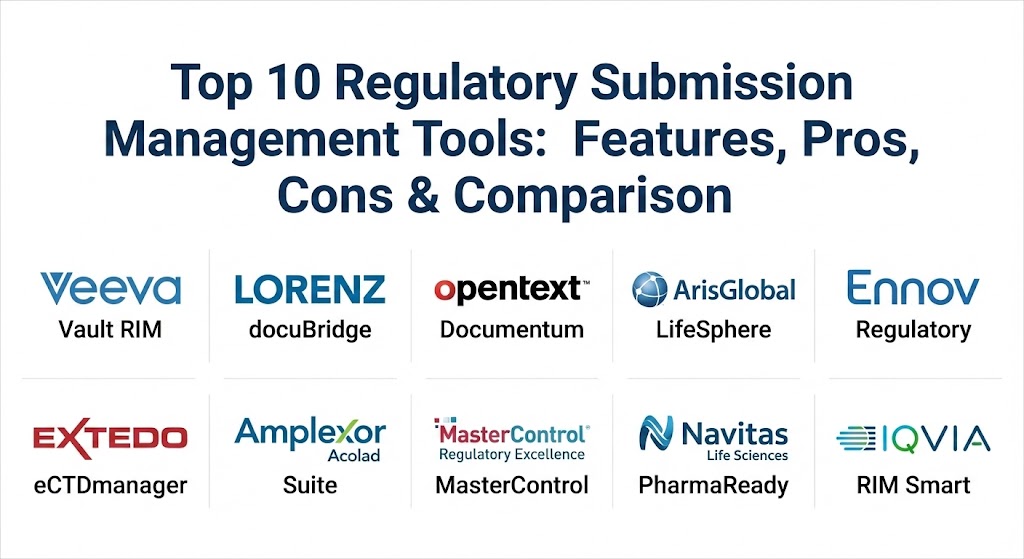
Top 10 Regulatory Submission Management Tools
1 — Veeva Vault RIM
Veeva Vault RIM is widely considered the market leader, providing a unified, cloud-native suite that combines submission development, registration tracking, and health authority interactions in a single ecosystem.
- Key features:
- Unified platform for RIM, Clinical, Quality, and Safety data.
- Collaborative real-time authoring and review workflows.
- Automated rendering of submission-ready PDFs.
- Continuous publishing model that builds dossiers incrementally.
- Real-time dashboards for tracking global filing statuses.
- Integrated health authority correspondence and commitment tracking.
- Pros:
- Eliminates manual data reconciliation by using a shared data model.
- Rapid, frequent updates ensure the system always meets the latest agency rules.
- Cons:
- Premium pricing makes it one of the most expensive options on the market.
- High complexity often requires specialized Veeva administrators.
- Security & compliance: 21 CFR Part 11, Annex 11, SOC 2 Type II, ISO 27001, and HIPAA compliant.
- Support & community: Extensive “Veeva Community” portal, world-class enterprise support, and a vast ecosystem of certified third-party consultants.
2 — LORENZ docuBridge
LORENZ docuBridge is a veteran in the eCTD space, known for its extreme robustness and its “one sequence, multi-region” approach. It is used by many major health authorities themselves to review submissions.
- Key features:
- Multi-format publishing (eCTD, NeeS, Paper, PDF) from a single source.
- Automated specification updates without re-installing software.
- Advanced “cloning” of submissions for rapid multi-country filings.
- Built-in eValidator engine for pre-submission technical checks.
- Modular architecture (ONE, TWO, or FIVE) to fit different company sizes.
- High-speed rendering for dossiers containing millions of pages.
- Pros:
- Highly trusted by regulators; if it passes docuBridge validation, it’s likely safe to submit.
- Exceptional at managing the lifecycle of complex, long-running submission sequences.
- Cons:
- The user interface is functional but can feel “legacy” compared to modern SaaS.
- Requires a significant initial training investment to master its deep feature set.
- Security & compliance: 21 CFR Part 11, GAMP 5, and GDPR compliant.
- Support & community: Offers flexible training (online/on-site), a robust knowledge base, and reliable twice-yearly major releases.
3 — OpenText Documentum for Life Sciences
Documentum is a powerhouse in the enterprise content management (ECM) world. Its specialized Life Sciences suite provides a “single source of truth” for GxP-related content across the entire product lifecycle.
- Key features:
- Purpose-built industry data model (based on DIA Reference Models).
- Integrated workflows for controlled document authoring and approval.
- Role-based access and collaborative editing with full audit trails.
- Seamless transfer of documents from Quality to Regulatory domains.
- Hybrid deployment options (On-premises, Private Cloud, or Hybrid).
- Automated technical transfer processes for consistent content.
- Pros:
- Unmatched scalability for the world’s largest global pharmaceutical firms.
- Deeply integrated with long-standing enterprise IT infrastructures.
- Cons:
- Known for a very high Total Cost of Ownership (TCO).
- Can be perceived as slower and less agile than cloud-native competitors.
- Security & compliance: ISO 27001, 21 CFR Part 11, and Annex 11 compliant.
- Support & community: Mature global support network with extensive documentation and a massive professional services wing.
4 — ArisGlobal LifeSphere Regulatory
ArisGlobal’s LifeSphere platform is a modern, AI-driven suite that focuses on “cognitive automation” to reduce the manual effort involved in regulatory operations.
- Key features:
- AI-powered submission content planning and tracking.
- Automated IDMP (Identification of Medicinal Products) data extraction.
- Integrated RIM, Safety, and Quality in a single AI-native ecosystem.
- Advanced eCTD publishing with multi-region global validation.
- Cloud-native architecture with seamless, automatic updates.
- Real-time tracking of health authority interactions and commitments.
- Pros:
- Strong focus on using machine learning to automate repetitive data entry.
- Offers a unified experience across the entire R&D and Safety spectrum.
- Cons:
- Best used as a full suite; standalone efficiency is lower.
- Implementation can be resource-intensive for smaller teams.
- Security & compliance: SOC 2 Type II, ISO 27001, HIPAA, and GDPR.
- Support & community: Growing customer base with high-quality documentation and a focus on digital transformation.
5 — Ennov Regulatory Suite
Ennov provides a unified, 100% web-based solution that is particularly popular in Europe for its flexibility and rapid deployment timelines.
- Key features:
- Unified RIM, Document Management, and Publishing in one application.
- AI-enabled document summarization and translation tools.
- Highly configurable lifecycles without the need for IT/coding skills.
- Integrated “Artwork Management” for labeling consistency.
- Support for all global submission formats (eCTD, NeeS, vNeeS, Paper).
- Pre-configured document inventory aligned with DIA models.
- Pros:
- Very intuitive user interface with a minimal learning curve for new users.
- Excellent value-to-performance ratio for mid-market pharma and biotech.
- Cons:
- Smaller presence and consultant pool in North America compared to Veeva.
- Advanced AI/ML features are still maturing compared to ArisGlobal.
- Security & compliance: ISO 9001:2015, 21 CFR Part 11, and GDPR compliant.
- Support & community: Highly responsive technical support and a simplified onboarding process.
6 — EXTEDO eCTDmanager
EXTEDO is a widely respected provider, especially known for its validation technology, which is used by over 35 regulatory agencies worldwide.
- Key features:
- Real-time validation that flags errors during the compilation process.
- Support for multiple regulatory agencies (FDA, EMA, TGA, etc.).
- Advanced PDF manipulation, hyperlinking, and bookmarking engine.
- eCTD v4.0 readiness and compatibility with modern gateways.
- Region-aware templates for rapid configuration in new markets.
- Available as locally deployable software or via EXTEDOcloud.
- Pros:
- Using the “agency-standard” validator gives high confidence in technical compliance.
- Very user-friendly interface that simplifies the XML-heavy submission process.
- Cons:
- Lacks a full enterprise-scale RIM as part of the core eCTD tool.
- Often requires integration with a third-party DMS for robust content management.
- Security & compliance: 21 CFR Part 11, Annex 11, and ICH compliant.
- Support & community: Excellent training and professional services with a focus on regulatory best practices.
7 — Amplexor Life Sciences Suite
Amplexor (now part of Acolad) offers a comprehensive RIM platform that excels in centralized data management and labeling automation.
- Key features:
- Unified system for RIM, Quality, and Labeling management.
- “MyHealthCloud” SaaS platform for remote accessibility.
- Automated compliance checks against evolving global standards.
- Centralized labeling management with automated change tracking.
- Advanced analytics for tracking submission performance KPIs.
- Robust translation and localization services integration.
- Pros:
- Strongest focus on the labeling and global content localization aspect of RIM.
- Scalable architecture suitable for large global pharmaceutical manufacturers.
- Cons:
- The transition to a unified cloud platform has been a multi-year process.
- Pricing models can be complex and less transparent than pure SaaS rivals.
- Security & compliance: ISO 27001, SOC 2, and GDPR compliant.
- Support & community: Global reach with localized support teams in Europe and North America.
8 — MasterControl Regulatory Excellence
MasterControl is a QMS giant that has expanded into the regulatory space, offering a unique “closed-loop” link between quality events and regulatory filings.
- Key features:
- Direct link between Quality events (CAPA, Change Control) and filings.
- Automated submission content collection from the QMS environment.
- Integrated document management with 21 CFR Part 11 signatures.
- Simplified eCTD publishing specifically designed for IND/NDA filings.
- Real-time tracking of post-market surveillance and labeling updates.
- Automated notification system to ensure approval timelines are met.
- Pros:
- Perfect for companies that want a “Quality-First” approach to regulatory affairs.
- One of the fastest implementation and validation timelines in the industry.
- Cons:
- Less specialized for massive, multi-country eCTD lifecycle management.
- User interface can occasionally feel slow in very large data environments.
- Security & compliance: 21 CFR Part 11, ISO 13485, and FDA compliant.
- Support & community: Large user community and a very robust training/certification program.
9 — PharmaReady (Navitas Life Sciences)
PharmaReady is a web-based, fully integrated regulatory suite designed for ease of use and low total cost of ownership (TCO).
- Key features:
- Fully integrated DMS, eCTD, SPL, and Training modules.
- Lowest TCO in the industry compared to similar enterprise suites.
- Implementation and validation typically completed within 3-4 weeks.
- Batch import utility for rapid migration of legacy submissions.
- Supports submissions to FDA, EMA, Health Canada, TGA, and more.
- Automated file naming based on ICH and regional guidelines.
- Pros:
- Ideal for SMBs and biotechs that need to be “submission-ready” quickly.
- The “First-Time-Right” philosophy is backed by 24/7 expert application support.
- Cons:
- Fewer advanced AI/ML capabilities compared to high-end enterprise platforms.
- Interface is functional and simple, but lacks the “gloss” of Veeva or ArisGlobal.
- Security & compliance: 21 CFR Part 11, Annex 11, HIPAA, and cGMP compliant.
- Support & community: 24/7 world-class support and a dedicated “PharmaReady Community” portal.
10 — IQVIA RIM Smart
IQVIA combines its massive global regulatory intelligence database with a modern, cloud-native RIM platform to provide “intelligent” submission management.
- Key features:
- Integrated regulatory intelligence for over 100+ countries.
- AI-driven “Smart” content planning and requirement mapping.
- Automated IDMP data collection and reporting tools.
- Seamless integration with IQVIA’s broader Safety and Clinical suites.
- Advanced PDF and eCTD validation tools (formerly GPG/LIQUENT technology).
- Global registration and commitment management dashboard.
- Pros:
- Built-in regulatory intelligence saves hours of research on country-specific rules.
- Exceptionally strong for companies with a footprint in emerging markets.
- Cons:
- Primarily advantageous for those already using IQVIA services.
- Pricing can be complex depending on the number of countries and modules.
- Security & compliance: SOC 2, ISO 27001, HIPAA, and GDPR compliant.
- Support & community: Backed by IQVIA’s global scale; includes deep domain expert consulting.
Comparison Table
| Tool Name | Best For | Platform(s) Supported | Standout Feature | Rating (Gartner Peer Insights) |
| Veeva Vault RIM | Large Enterprises | Cloud SaaS | Unified R&D Ecosystem | 4.6 / 5 |
| LORENZ docuBridge | Technical Publishing | Cloud / On-Prem | Agency-Standard Validation | 4.5 / 5 |
| OpenText Documentum | Global Scalability | Hybrid Cloud | Single Source of GxP Truth | 4.2 / 5 |
| ArisGlobal LifeSphere | AI Automation | Cloud SaaS | Cognitive Data Intake | 4.4 / 5 |
| Ennov Regulatory | Mid-Market / Europe | Web / Cloud | 100% No-Code Config | 4.7 / 5 |
| EXTEDO eCTDmanager | Agency Compliance | Cloud / On-Prem | Integrated Agency Validator | 4.6 / 5 |
| Amplexor Suite | Global Labeling | Cloud / SaaS | Centralized Content Hub | 4.3 / 5 |
| MasterControl | Quality Integration | Cloud SaaS | QMS-to-Reg Connection | 4.5 / 5 |
| PharmaReady | SMBs / Startups | Web / Cloud | Low TCO / Fast Setup | 4.6 / 5 |
| IQVIA RIM Smart | Global Intelligence | Cloud SaaS | Built-in Country Intelligence | 4.4 / 5 |
Evaluation & Scoring of Regulatory Submission Management Tools
In the life sciences sector, evaluation is often a multi-departmental effort involving RA, IT, and Quality teams.
| Category | Weight | Evaluation Criteria |
| Core Features | 25% | eCTD v4.0 readiness, IDMP support, multi-region validation, and planning depth. |
| Ease of Use | 15% | Intuitiveness of the UI, speed of dossier assembly, and search functionality. |
| Integrations | 15% | Out-of-the-box connectivity with QMS, TMS, and Clinical Data Management. |
| Security & Compliance | 10% | 21 CFR Part 11 readiness, audit trails, and data residency guarantees. |
| Performance | 10% | System uptime, dossier rendering speed, and parallel processing capability. |
| Support & Community | 10% | Vendor response times, user group active levels, and training resources. |
| Price / Value | 15% | Total cost of ownership (license + validation + implementation) vs. ROI. |
Which Regulatory Submission Management Tool Is Right for You?
The right choice depends on your current “regulatory maturity” and your long-term IT roadmap.
- Startups & Small Biotechs: If you have one or two products in Phase I/II, your primary goal is to remain compliant without breaking the bank. PharmaReady or Ennov are excellent choices for their fast setup and lower cost entry points.
- Mid-Market & Rapidly Growing Firms: If you are preparing for your first NDA and have a growing global footprint, EXTEDO or IQVIA RIM Smart offer the perfect balance of advanced features and manageable complexity.
- Large Global Enterprises: If you need to manage hundreds of products and thousands of users across the globe, Veeva Vault RIM is the gold standard for ecosystem unity. OpenText Documentum remains a strong contender for those with deep legacy IT roots.
- Quality-Driven Organizations: If your regulatory team is small and works closely with Quality Assurance, MasterControl offers a unique advantage by pulling submission data directly from your QMS events.
- Technical Specialists: For teams that handle “rescue missions” or high-volume publishing for multiple clients, LORENZ docuBridge provides the specific “under-the-hood” control that specialized publishers demand.
Frequently Asked Questions (FAQs)
1. What is the difference between a RIM system and a Submission tool? A RIM (Regulatory Information Management) system is the broad “command center” for registrations and strategy. A Submission tool is the specific “engine” used to compile and publish the eCTD files for agencies. Most modern platforms now combine both.
2. Is eCTD v4.0 support necessary in 2026? Yes. While v3.2.2 is still in use, v4.0 is the modern standard focused on “data-centricity.” Choosing a tool that is not v4.0 ready would create significant technical debt.
3. Can these tools handle medical device submissions (MDR/IVDR)? Many of them (like Ennov and MasterControl) have specialized modules for device-specific formats like STED or IMDRF, which differ significantly from pharmaceutical eCTDs.
4. How long does a typical implementation take? For SMB-focused tools like PharmaReady, it can be 4 weeks. For enterprise-wide Veeva or Documentum rollouts, it can take 6 to 12 months including validation.
5. What does “validated cloud” mean? It means the software vendor has performed IQ/OQ/PQ (Installation, Operational, and Performance Qualification) on their servers to prove to regulators that the software functions as intended and data is secure.
6. Do I need an internal IT team to run these? Pure SaaS solutions like Veeva or ArisGlobal require very little IT infrastructure, but you will still need “Business Administrators” to manage users and workflows.
7. Can I migrate data from an old system to a new one? Yes, most vendors provide migration utilities (like Navitas’ batch import tool). However, regulatory data migration is complex and often requires a specialized partner.
8. What is IDMP and why does my tool need it? IDMP (Identification of Medicinal Products) is a set of ISO standards for identifying drugs. European regulators now require IDMP data, making it a critical feature for any tool used for EU filings.
9. Are these tools 21 CFR Part 11 compliant? Every tool on this list is designed to meet 21 CFR Part 11, which covers electronic records and signatures, including audit trails and restricted access.
10. Can I use these tools for health authority correspondence? Most modern RIM/Submission suites (like Veeva or IQVIA) include a module to track every email, letter, and meeting with health authorities to maintain a full history of the product.
Conclusion
Selecting a Regulatory Submission Management Tool is one of the most consequential decisions a life sciences organization will make. In 2026, the trend is clear: Data is replacing documents. The “best” tool is no longer just the one that produces a valid XML file; it’s the one that breaks down silos between your Clinical, Quality, and Regulatory departments. Whether you prioritize the unified ecosystem of Veeva, the technical precision of LORENZ, or the AI innovation of ArisGlobal, ensure your choice is a platform that can scale as fast as your science.