Introduction
Pharmaceutical Supply Chain Compliance Tools are specialized software platforms designed to ensure that every drug product is tracked, traced, and verified as it moves from the manufacturer to the patient. These tools act as a digital shield against counterfeit medications, unauthorized diversions, and environmental spoilage. They automate the massive data exchange required for serialization (assigning unique identities to individual units) and maintain a “pedigree” or electronic record of a product’s journey.
The importance of these tools cannot be overstated. In 2026, compliance is no longer just about avoiding fines; it is about maintaining “licensure to operate.” Key real-world use cases include real-time DSCSA interoperability, cold chain monitoring for temperature-sensitive biologics, and automated recall management that can pinpoint a specific batch across global distributors in seconds. When evaluating these tools, users should look for interoperability (the ability to “talk” to partners), data integrity (21 CFR Part 11 compliance), scalability, and regulatory agility—the speed at which the vendor updates the software as laws change in different countries.
Best for: Pharmaceutical manufacturers, Contract Manufacturing Organizations (CMOs), wholesale distributors, and hospital systems that must comply with global serialization mandates. It is essential for Quality Assurance (QA) teams, supply chain directors, and regulatory affairs officers who need a single source of truth for audit readiness.
Not ideal for: Small, non-regulated consumer goods companies or local pharmacies that do not handle prescription medication (e.g., those focused solely on over-the-counter wellness products where serialization isn’t legally mandated).
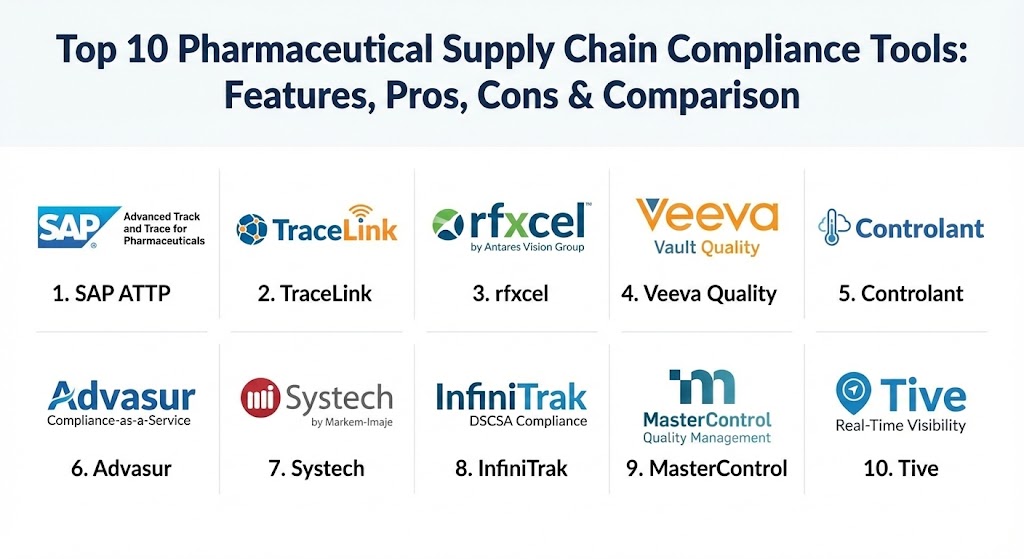
Top 10 Pharmaceutical Supply Chain Compliance Tools
1 — SAP Advanced Track and Trace for Pharmaceuticals (ATTP)
SAP ATTP is a dedicated enterprise application designed to manage the high-volume serialization and regulatory reporting requirements of global pharmaceutical companies. It sits atop the SAP ecosystem, integrating directly with ERP and warehouse management systems.
- Key features:
- Corporate serialization repository for managing billions of unique serial numbers.
- Native integration with SAP S/4HANA and SAP Plant Connectivity.
- Country-specific compliance reporting packages (USA, EU, Russia, Brazil).
- Automated aggregation management (tracking units within cases and pallets).
- Robust master data synchronization across global production sites.
- Integration with GS1 standards for seamless data exchange with trading partners.
- Pros:
- Unmatched scalability for the world’s largest pharmaceutical manufacturers.
- Eliminates data silos by keeping compliance and logistics within a unified SAP environment.
- Cons:
- High cost of implementation and licensing makes it inaccessible for many SMBs.
- Requires a high level of technical expertise to configure and maintain.
- Security & compliance: 21 CFR Part 11, GxP, ISO 27001, and SOC 2 compliant. Includes deep audit trails and electronic signatures.
- Support & community: Extensive global support network; access to SAP’s Life Sciences Info Collaboration Hub for partner networking.
2 — TraceLink (Opus Digital Network)
TraceLink is the world’s largest integrated digital supply chain network for the life sciences industry. Rather than just being software, it functions as a “cloud network” that connects manufacturers, distributors, and pharmacies.
- Key features:
- Network-centric architecture connecting over 290,000 supply chain entities.
- Digital Recalls module for rapid, automated notification across the network.
- Smart Inventory Tracker for real-time edge serialization management.
- Multichain support for end-to-end visibility of ingredients and finished goods.
- Integrated DSCSA compliance for independent and retail pharmacies.
- Product Information Exchange for seamless master data sharing.
- Pros:
- “Connect once, link to many” model significantly reduces partner onboarding time.
- Highly agile; compliance updates are pushed to all users simultaneously as laws change.
- Cons:
- Users are somewhat dependent on the stability and security of the TraceLink network itself.
- Advanced analytics features often require separate, higher-tier subscriptions.
- Security & compliance: SOC 2 Type II, HIPAA, GDPR, and 21 CFR Part 11 compliant.
- Support & community: Excellent “TraceLink University” educational platform and a very active global user community.
3 — rfxcel (by Antares Vision Group)
rfxcel is a highly flexible serialization and traceability platform known for its “data-first” approach. It focuses on ensuring data integrity at every point in the supply chain to prevent errors before they become compliance issues.
- Key features:
- Advanced “Verification” system that checks data for errors before it’s reported.
- Integrated environmental monitoring for cold chain (temperature/humidity).
- Upstream compliance for managing raw material and API suppliers.
- Automated regulatory reporting for dozens of global markets.
- Mobile-friendly interface for warehouse and field personnel.
- Native support for “VRS” (Verification Router Service) for saleable returns.
- Pros:
- Strong emphasis on data accuracy, reducing the risk of reporting failed verification.
- Offers a more personalized, high-touch implementation experience for mid-market firms.
- Cons:
- Interface can feel less “modern” compared to some newer SaaS-only entrants.
- Integration with non-SAP ERPs may require custom configuration work.
- Security & compliance: 21 CFR Part 11, GxP, ISO 9001/27001, and HIPAA compliant.
- Support & community: Strong reputation for customer service and dedicated account management for enterprise clients.
4 — Veeva Vault Quality
While some tools focus on the “physical” box, Veeva Vault Quality focuses on the “compliance paperwork.” It is an industry-standard for managing quality events, deviations, and audit readiness in a cloud-native environment.
- Key features:
- Unified Quality Management System (QMS) and Document Control.
- Automated CAPA (Corrective and Preventive Actions) workflows.
- Supplier Quality Management for oversight of CMOs and logistics partners.
- Integrated training management to ensure all staff are compliance-certified.
- Audit and inspection readiness dashboards for real-time visibility.
- Mobile access for on-site quality inspections.
- Pros:
- The most widely adopted quality platform in the biotech and pharmaceutical space.
- Simplifies the “audit trail” by linking documents directly to supply chain events.
- Cons:
- Not a serialization tool; it must be paired with a tool like TraceLink or SAP ATTP.
- Pricing is premium and typically geared toward mid-to-large-scale firms.
- Security & compliance: SOC 2 Type II, ISO 27001, HIPAA, and 21 CFR Part 11.
- Support & community: World-class enterprise support and a massive “Veeva Community” of QA professionals.
5 — Controlant
Controlant is the leader in “Real-Time Visibility” for the pharmaceutical cold chain. In an era where mRNA vaccines and biologics dominate, Controlant’s focus on temperature compliance is critical.
- Key features:
- IoT-enabled sensors that track location and temperature in real-time.
- Predictive “excursion” alerts (notifying you before a product spoils).
- Automated “Product Release” reporting based on environmental data.
- End-to-end visibility from the factory gate to the patient clinic.
- Integrated waste reduction analytics for ESG reporting.
- Fully managed service option (Controlant handles the hardware logistics).
- Pros:
- Significantly reduces product loss due to temperature deviations.
- Hardware and software are pre-validated for GxP environments.
- Cons:
- Focused strictly on environmental compliance; does not handle serialization data.
- Recurring cost of IoT hardware/monitoring can be high for low-value drugs.
- Security & compliance: GxP certified, ISO 9001, and secure data portals for audit.
- Support & community: 24/7 “Command Center” support that monitors shipments on your behalf.
6 — Advasur
Advasur is a specialized compliance solution primarily designed for dispensers, small-to-mid-sized wholesalers, and manufacturers who need a “Compliance-as-a-Service” model for DSCSA.
- Key features:
- “Advasur 360” platform for end-to-end DSCSA interoperability.
- Specialized support for small dispensers and independent pharmacies.
- Automated verification of Trading Partner licensure.
- Secure storage of Transaction Information (TI) for the required 6 years.
- High-touch regulatory consulting included with the platform.
- Simple, web-based interface requiring minimal IT infrastructure.
- Pros:
- Very affordable and accessible for smaller players in the supply chain.
- Excellent for companies that don’t have their own in-house regulatory team.
- Cons:
- Not designed for global multi-country compliance (focused heavily on the US).
- Lacks the deep automation features needed by multi-national manufacturers.
- Security & compliance: DSCSA compliant, HIPAA, and secure audit logs.
- Support & community: Known for its “concierge” style support and regulatory advocacy.
7 — Systech (by Markem-Imaje)
Systech is a veteran in the packaging line and serialization space. It provides a unique bridge between the physical printing on the bottle and the digital compliance record.
- Key features:
- UniTrace platform for enterprise-level traceability.
- UniSeries for managing packaging line serialization hardware.
- Anti-counterfeiting “e-Fingerprint” technology (non-additive security).
- Integrated vision inspection systems for packaging accuracy.
- Automated compliance reporting for global mandates.
- Strong “exception management” for handling damaged or rejected units.
- Pros:
- Best-in-class integration with physical packaging and labeling hardware.
- “Non-additive” security features provide protection without changing packaging design.
- Cons:
- Can be complex to integrate if you are not using Systech-compatible line hardware.
- The software suite can feel fragmented across different modules.
- Security & compliance: 21 CFR Part 11, GxP, and ISO 27001 compliant.
- Support & community: Global presence with on-site engineering support for hardware-software integration.
8 — InfiniTrak
InfiniTrak is a cloud-based solution that was built from the ground up specifically for the DSCSA requirements of dispensers and healthcare systems.
- Key features:
- Intuitive 2D barcode scanning for rapid warehouse check-in.
- Automated “Suspect Product” workflow to guide staff through investigations.
- Full interoperability with all major wholesalers and manufacturers.
- “CSTS” module for tracking controlled substances (opioid compliance).
- Centralized license management for all trading partners.
- Zero-install SaaS architecture for fast deployment.
- Pros:
- One of the most user-friendly interfaces for hospital and pharmacy staff.
- Highly cost-effective for retail and healthcare system dispensers.
- Cons:
- Does not have a global footprint; strictly focused on US DSCSA.
- Limited features for manufacturing-scale serialization.
- Security & compliance: DSCSA 2023/2026 ready, HIPAA, and SOC 2.
- Support & community: Excellent training resources and a focused community of US pharmacists.
9 — MasterControl
MasterControl is a comprehensive Quality Management System (QMS) that helps pharmaceutical companies digitize their compliance life cycle, from R&D through to supply chain distribution.
- Key features:
- “Manufacturing Excellence” module for digital batch records.
- Automated supplier qualification and performance tracking.
- Integrated risk management and audit tools.
- Document control with automated approval routing.
- Real-time compliance dashboards for executive oversight.
- Training and certification tracking for supply chain personnel.
- Pros:
- Excellent for bridging the gap between manufacturing and supply chain quality.
- Highly reliable and trusted by the FDA for its own internal systems.
- Cons:
- Implementation can be a major undertaking for smaller organizations.
- The licensing model is premium and reflects its enterprise-tier status.
- Security & compliance: ISO 9001, 21 CFR Part 11, and GDPR compliant.
- Support & community: Dedicated customer success managers and a large global user base.
10 — Tive
Tive provides modern, real-time visibility for shipments, focusing on “multi-sensor” data that is crucial for maintaining the integrity of pharmaceutical logistics.
- Key features:
- Real-time tracking of location, temperature, humidity, and “shock” (impact).
- Long-life “Solo 5G” trackers that work globally.
- Automated alerts for any deviation from the defined “safe zones.”
- Collaborative “shipment sharing” with customers or regulatory bodies.
- Advanced analytics on carrier performance and “high-risk” routes.
- API-first design for easy integration into existing MFT or WMS tools.
- Pros:
- Extremely fast to deploy; trackers are “start and go.”
- Hardware is highly reliable and provides data in areas where others struggle.
- Cons:
- Like Controlant, it is an environmental tool, not a serialization platform.
- Requires a logistics team to manage hardware recovery or disposal.
- Security & compliance: SOC 2 compliant, secure data encryption in transit.
- Support & community: Known for its modern, responsive chat support and agile development cycle.
Comparison Table
| Tool Name | Best For | Platform(s) Supported | Standout Feature | Rating (Gartner/Review) |
| SAP ATTP | Large SAP Enterprises | On-Prem / Cloud | Deep ERP Integration | 4.7 / 5 |
| TraceLink | Network Connectivity | Cloud / SaaS | 290k+ Partner Network | 4.6 / 5 |
| rfxcel | Data Integrity | SaaS / Hybrid | Built-in Verification | 4.5 / 5 |
| Veeva Quality | Quality Document Mgmt | Cloud-Native | Life Sciences Specialization | 4.8 / 5 |
| Controlant | Cold Chain Safety | IoT / Cloud | Predictive Excursion Alerts | 4.6 / 5 |
| Advasur | Small Wholesalers | Web-based SaaS | Concierge Compliance | N/A |
| Systech | Packaging Integration | Hybrid | Anti-Counterfeit e-Fingerprint | 4.4 / 5 |
| InfiniTrak | US Pharmacies | SaaS | Controlled Substance Tracking | 4.7 / 5 |
| MasterControl | Manufacturing QMS | Cloud / Hybrid | Digital Batch Records | 4.6 / 5 |
| Tive | Shipment Visibility | IoT / SaaS | 5G Multi-Sensor Tracking | 4.5 / 5 |
Evaluation & Scoring of Pharmaceutical Supply Chain Compliance Tools
Choosing a tool in this category is unique because a “failure” in performance isn’t just an inconvenience—it’s a legal event. Use the weighted rubric below to score potential vendors based on your specific risk profile.
| Category | Weight | Evaluation Criteria |
| Core Features | 25% | Serialization, aggregation, and regulatory reporting for your specific markets. |
| Ease of Use | 15% | Intuitiveness for warehouse staff and clarity of executive dashboards. |
| Integrations | 15% | Ability to connect to your ERP (SAP/Oracle) and your trading partners’ systems. |
| Security & Compliance | 10% | 21 CFR Part 11, data residency, and validatable software environment. |
| Performance | 10% | System uptime and speed of processing billions of serial numbers. |
| Support & Community | 10% | Regulatory consulting availability and technical support responsiveness. |
| Price / Value | 15% | Total cost of ownership vs. the risk of a single product loss or audit failure. |
Which Pharmaceutical Supply Chain Compliance Tool Is Right for You?
The regulatory landscape of 2026 requires a tailored approach based on where you sit in the “cradle-to-grave” journey of a drug.
- Manufacturers (The “Source”): If you already run SAP, SAP ATTP is the logical choice for internal control. If you rely heavily on CMOs and need to see data across many partners, TraceLink offers the best network visibility.
- Mid-Market Wholesalers: rfxcel is highly recommended here because it doesn’t just “store” data; it verifies it, ensuring you don’t inherit a compliance problem from a manufacturer.
- Independent & Retail Pharmacies: Tools like InfiniTrak or Advasur are designed specifically for the limited IT resources of a pharmacy. They simplify the complex “Transaction Statement” (TS) requirements into a simple scan-and-store process.
- Biologics & Specialty Pharma: If you handle expensive, temperature-sensitive products (like cell therapies), you should prioritize Controlant or Tive. The “compliance” here is physical; you must prove the product never went out of range.
- Budget vs. Premium: Veeva and MasterControl are premium investments for those who want a “gold standard” QMS. For those looking strictly for US DSCSA compliance at a lower entry point, Advasur is a highly effective alternative.
Frequently Asked Questions (FAQs)
1. What is the Drug Supply Chain Security Act (DSCSA)? The DSCSA is a US law requiring the pharmaceutical industry to implement an electronic, interoperable system to identify and trace prescription drugs at the package level. Full implementation deadlines for all segments (including small dispensers) extend into 2026.
2. Is Managed File Transfer (MFT) the same as a Compliance Tool? No. MFT is the “pipeline” that moves data. A Compliance Tool (like TraceLink) is the “intelligence” that understands the data, verifies serial numbers, and reports them to the government.
3. Do these tools handle international compliance (e.g., Brazil or Russia)? Some do. SAP ATTP and TraceLink have specialized modules for global markets. Others, like InfiniTrak, are strictly focused on the US market. Always verify a vendor’s “compliance pack” for your specific regions.
4. What does “21 CFR Part 11” mean? This is an FDA regulation that sets the criteria under which electronic records and electronic signatures are considered trustworthy and equivalent to paper records.
5. How do these tools help during a drug recall? Instead of calling every warehouse, you can search your database (using a lot number or serial number) to see exactly which distributor has the affected product, allowing for a targeted, rapid recall.
6. Can I use a generic ERP for pharmaceutical compliance? Generally, no. Standard ERPs lack the “serialization engine” required to manage billions of unique IDs and the specific “audit trail” capabilities mandated by GxP standards.
7. What is “Verification Router Service” (VRS)? VRS is a specialized system that allows wholesalers to instantly verify if a returned bottle of medicine is legitimate by checking the manufacturer’s database in real-time.
8. Do these tools require specialized hardware? Serialization tools require 2D barcode scanners. Cold chain tools (like Tive) require IoT sensors. Most of the management software itself is “SaaS” and runs in a standard web browser.
9. Is training included with these tools? Most enterprise vendors (Veeva, TraceLink) offer extensive training. For smaller tools, training is usually minimal as the interfaces are designed to be as simple as using a smartphone app.
10. What happens if the compliance software goes down? In the pharma industry, “if you didn’t document it, it didn’t happen.” Most enterprise compliance tools have 99.9% uptime SLAs and “offline modes” to ensure data is captured even if the internet connection drops.
Conclusion
Pharmaceutical supply chain compliance has transitioned from a back-office administrative task to a front-line strategic pillar. In 2026, the “best” tool is the one that removes the friction from your operations—turning the burden of regulation into a competitive advantage through better visibility and reduced waste. Whether you choose the massive network of TraceLink, the enterprise depth of SAP, or the real-time vigilance of Controlant, remember that the ultimate goal is not just to satisfy an auditor, but to ensure that the patient at the end of the line receives exactly what they need, exactly when they need it.