Introduction
A Cold Chain Monitoring Platform is an integrated system of IoT hardware (sensors and trackers) and cloud-based software designed to track the environmental conditions of perishable goods in real-time. These platforms monitor temperature, humidity, shock, and location as products move through warehouses, trucks, ships, and planes. By providing an unbroken digital record of a product’s journey, these tools ensure that safety standards are met and that any “temperature excursions” are met with immediate corrective action.
The importance of these platforms cannot be overstated. According to industry research, roughly one-third of the world’s food supply is lost due to poor cold chain management, and the pharmaceutical industry loses billions annually to temperature-related damage. Key real-world use cases include global vaccine distribution, clinical trial logistics, “farm-to-fork” food traceability, and high-end chemical transport. When evaluating these tools, organizations should look for sensor accuracy, battery life of hardware, “dark spot” connectivity (the ability to track in remote areas), and seamless integration with existing Warehouse Management Systems (WMS).
Best for: Pharmaceutical companies, global food distributors, 3PL (Third Party Logistics) providers, and clinical research organizations that handle high-value, temperature-sensitive inventory.
Not ideal for: Local small-scale delivery businesses that do not require real-time data or companies shipping non-perishable “ambient” goods where a simple, low-cost passive data logger (USB) is sufficient.
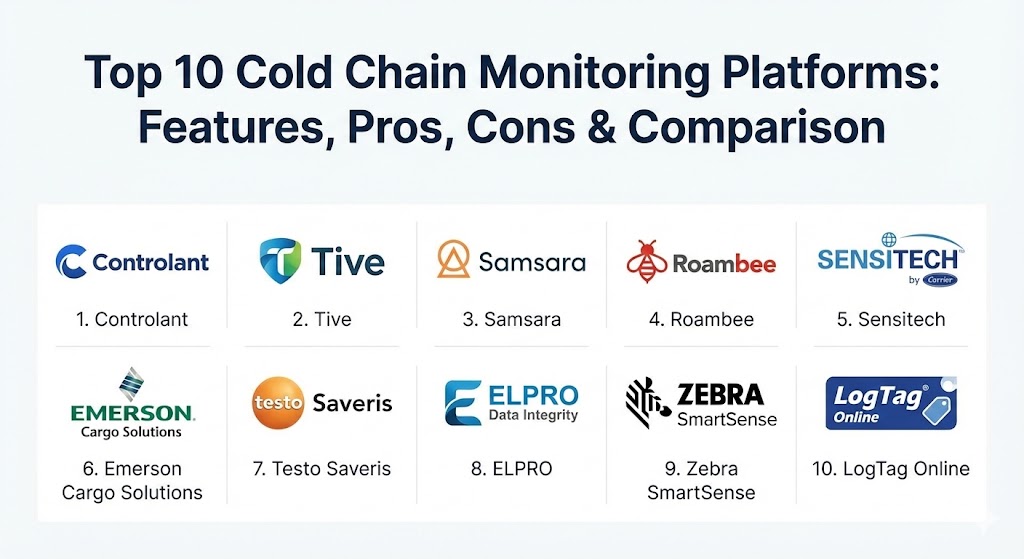
Top 10 Cold Chain Monitoring Platforms
1 — Controlant
Controlant is a leader in high-stakes cold chain logistics, famously known for managing the global distribution of critical vaccines. It offers a “Cold Chain as a Service” (CCaaS) model that combines high-tech hardware with managed services.
- Key features:
- Real-time IoT trackers with global cellular connectivity.
- Validated cloud platform (21 CFR Part 11 compliant).
- Automated “Product Release” reporting for pharma.
- 24/7 monitoring and response services to intervene in excursions.
- Predictive risk analytics for shipping lane performance.
- Seamless API integration with enterprise ERP systems.
- Pros:
- Exceptional reliability in the pharmaceutical sector; a true “hands-off” managed solution.
- The automated reporting significantly reduces manual labor for quality teams.
- Cons:
- Premium pricing reflects its enterprise-grade, high-compliance focus.
- May be over-engineered for simple food logistics.
- Security & compliance: GxP, 21 CFR Part 11, ISO 27001, and SOC 2 Type II.
- Support & community: Dedicated account managers, 24/7 global support, and extensive technical training.
2 — Tive
Tive is a cloud-native platform that focuses on “multi-sensor” visibility. It is popular among logistics managers who need to know not just the temperature, but also if a container was dropped (shock) or opened (light).
- Key features:
- Solo 5G non-lithium trackers for eco-friendly, global tracking.
- Light, shock, and humidity monitoring in a single device.
- Publicly shareable tracking links for customer transparency.
- Geofencing alerts for arrival and departure notifications.
- “Open box” detection via high-sensitivity light sensors.
- Pros:
- Extremely easy to use; “start” a tracker and drop it in—no complex setup.
- Great for high-value electronics and food where theft/handling are concerns.
- Cons:
- Battery life can be shorter when polling high-frequency shock data.
- While good for pharma, it lacks some of the deep “consultative” GxP features of Controlant.
- Security & compliance: SOC 2, ISO 9001, and enterprise-grade data encryption.
- Support & community: Strong online knowledge base and 24/7 technical support for enterprise tiers.
3 — Samsara
Samsara is a massive fleet management and industrial IoT platform. For cold chain, it provides a unified view of reefer (refrigerated trailer) health, driver behavior, and cargo temperature.
- Key features:
- Integrated reefer monitoring and remote temperature control.
- Two-way communication with Thermo King and Carrier refrigeration units.
- GPS tracking combined with environmental sensor data.
- Automated compliance logs for FSMA (Food Safety Modernization Act).
- AI-driven dash cams and telematics on the same platform.
- Pros:
- Best-in-class if you own your own fleet of trucks; one map for everything.
- Ability to change fridge settings remotely can save a load from spoilage.
- Cons:
- Less ideal for “air/sea” freight where you don’t own the vehicle.
- Requires hardware installation on the physical trailer or vehicle.
- Security & compliance: HIPAA, GDPR, SOC 2, and FIPS 140-2.
- Support & community: Large user community, extensive video tutorials, and dedicated enterprise support.
4 — Roambee
Roambee uses “Swarm Intelligence” and AI to provide predictive visibility. It focuses on large-scale enterprises that want to identify bottlenecks in their global lanes.
- Key features:
- “Bee” IoT sensors that provide location and condition data.
- AI-driven “estimated time of arrival” (ETA) and risk predictions.
- Item-level tracking for high-sensitivity healthcare products.
- Lane performance benchmarking to compare carriers.
- Automated inventory tracking in “dark” warehouses.
- Pros:
- Highly data-driven; the AI provides actionable insights rather than just raw data.
- Flexible “pay-per-shipment” model avoids heavy upfront hardware costs.
- Cons:
- The platform can be complex for users who only want simple temperature alerts.
- Integration with legacy on-prem systems can require professional services.
- Security & compliance: ISO 27001, SOC 2, and GxP compliant platform.
- Support & community: 24/7 Global “BeeCentral” support and professional consulting.
5 — Sensitech (by Carrier)
A subsidiary of Carrier, Sensitech is one of the oldest and most respected names in the business. They set the industry standard with their TempTale® devices and the SensiWatch® platform.
- Key features:
- Widest range of hardware from simple USB loggers to 5G real-time trackers.
- SensiWatch® platform for end-to-end supply chain visibility.
- “Cold Chain Optimization” consulting services included.
- Specialized clinical trial management modules.
- Global network for hardware retrieval and recycling.
- Pros:
- Deeply trusted by global regulatory bodies (FDA/EMA).
- Massive historical database used for predictive lane analysis.
- Cons:
- The software interface feels more “industrial” and less modern than Tive or Samsara.
- Higher complexity in configuring multi-stage shipment workflows.
- Security & compliance: 21 CFR Part 11, GxP, ISO 9001, and NIST traceable.
- Support & community: Global presence in 150+ countries; world-class technical support.
6 — Emerson Cargo Solutions (GO Real-Time)
Emerson specializes in durable, high-reliability hardware. Their GO Real-Time trackers are the “workhorses” of the food and beverage industry.
- Key features:
- GO Real-Time Lux trackers for temperature and light monitoring.
- Oversight dashboard for managing global shipments by exception.
- Automated alerts for out-of-range temperatures or door openings.
- Low-cost “single-use” real-time trackers for simple logistics.
- Integrated “Recycle” program for environmental sustainability.
- Pros:
- Hardware is incredibly rugged and reliable in harsh environments.
- Extremely intuitive Oversight portal—perfect for warehouse managers.
- Cons:
- Features are more “monitoring” focused and lack deep “predictive AI.”
- Not as specialized in deep pharma “Product Release” automation as others.
- Security & compliance: ISO 9001, RoHS, and CE certified.
- Support & community: Extensive documentation and a solid global distributor network.
7 — Testo Saveris
Testo is a German engineering firm known for precision instruments. The Saveris system is the go-to for fixed-facility monitoring (warehouses, pharmacies, and labs).
- Key features:
- Wireless data loggers for continuous facility monitoring.
- High-precision probes for ultra-low temperature (Cryo) monitoring.
- Modular software that manages thousands of measurement points.
- Automated digital audit reports that eliminate paper logs.
- Integrated calibration management software.
- Pros:
- Unmatched precision; ideal for long-term storage of biological samples.
- Extremely robust wireless signal that can penetrate thick walk-in freezer walls.
- Cons:
- Primarily a “facility” tool; less focused on “in-transit” global shipping.
- High initial hardware investment for a full facility rollout.
- Security & compliance: 21 CFR Part 11, GxP, and ISO 17025 calibration standards.
- Support & community: Expert calibration services and on-site implementation support.
8 — ELPRO
ELPRO is a Swiss company specializing in data integrity. Their LIBERO loggers and the ELPRO Cloud are designed for the most regulated environments in the world.
- Key features:
- LIBERO G trackers with long-lasting battery life for sea freight.
- Intelligent “alarm” logic to filter out false alarms (e.g., brief door openings).
- Integrated calibration certificates available digitally on the device.
- Automated PDF report generation without needing software installation.
- GxP-compliant “SaaS” cloud for centralized data management.
- Pros:
- Data integrity is the core focus; highly defensible in an audit.
- No software required at the receiving end to read a shipment’s PDF report.
- Cons:
- The ecosystem can feel closed compared to “API-first” platforms.
- Premium Swiss pricing.
- Security & compliance: FDA 21 CFR Part 11, Annex 11, and ISO 9001.
- Support & community: In-depth webinars, expert GxP consulting, and technical support.
9 — Zebra SmartSense
Zebra, the leader in scanning and printing, entered the cold chain market by acquiring Reflexis and TempTime. Their SmartSense platform is a powerful tool for retail and pharmacy chains.
- Key features:
- Enterprise-wide visibility into retail coolers and pharmacy fridges.
- Predictive maintenance for refrigeration units using IoT telemetry.
- Task management integration (notifies staff to move goods if a fridge fails).
- Automated temperature logging for retail food safety compliance.
- Scalable to thousands of locations from a central dashboard.
- Pros:
- Excellent for large retailers (supermarkets) and pharmacy chains.
- Directly links “sensor data” to “staff action” through task management.
- Cons:
- Lacks the deep “in-transit” shipping visibility of Sensitech or Tive.
- Best utilized as part of the broader Zebra/Reflexis software ecosystem.
- Security & compliance: ISO 27001, HIPAA, and GDPR.
- Support & community: Global enterprise support and a huge partner ecosystem.
10 — LogTag Online
LogTag is the choice for budget-conscious organizations that still require cloud-based visibility. It is widely used by local pharmacies and hospitals for vaccine fridges.
- Key features:
- Range of affordable USB, Wi-Fi, and real-time cellular loggers.
- LogTag Online cloud platform for simple data storage and sharing.
- External probes to monitor freezers without opening the door.
- Large, clear LCD screens on devices for manual checks.
- Audible alarms to notify staff in the same room.
- Pros:
- One of the most cost-effective ways to get GxP-compliant monitoring.
- Very low barrier to entry for small clinics and pharmacies.
- Cons:
- The cloud platform is basic compared to enterprise tools like Controlant.
- Not designed for complex, global multi-modal logistics management.
- Security & compliance: GxP compliant and FDA 21 CFR Part 11 ready.
- Support & community: Strong community of users in healthcare; global distributor support.
Comparison Table
| Tool Name | Best For | Platform(s) Supported | Standout Feature | Rating (Gartner/Trust) |
| Controlant | Global Pharma | Cloud, SaaS | Cold Chain as a Service | 4.8 / 5 |
| Tive | Condition Tracking | Cloud, Web, Mobile | Light/Shock Multi-sensors | 4.7 / 5 |
| Samsara | Fleet Owners | Web, Mobile, App | Two-way Reefer Control | 4.6 / 5 |
| Roambee | AI Predictions | Cloud, API | AI-driven Risk Scoring | 4.5 / 5 |
| Sensitech | Regulated Logistics | Web, Desktop | Industry-Standard TempTales | 4.4 / 5 |
| Emerson GO | Food Safety | Web, SaaS | Durable GO Real-Time trackers | 4.3 / 5 |
| Testo Saveris | Fixed Facilities | On-Prem, Cloud | High-Precision German Probes | 4.6 / 5 |
| ELPRO | Data Integrity | SaaS, Cloud | PDF Reports on Device | 4.5 / 5 |
| Zebra SmartSense | Retail Chains | Cloud, Mobile | Sensor-to-Task Automation | 4.4 / 5 |
| LogTag Online | SMB / Healthcare | Cloud, Web | High Value / Low Cost | 4.2 / 5 |
Evaluation & Scoring of Cold Chain Monitoring Platforms
Industrial cold chain needs vary, but the following rubric outlines how the top players are generally assessed for enterprise deployment.
| Category | Weight | Evaluation Criteria |
| Core Features | 25% | Sensor accuracy, real-time alerts, GPS precision, and battery life. |
| Ease of Use | 15% | Intuitiveness of dashboard, mobile app quality, and “start/stop” simplicity. |
| Integrations | 15% | API availability, EDI support, and integration with ERP/WMS/TMS systems. |
| Security & Compliance | 10% | 21 CFR Part 11, GxP, ISO certifications, and data encryption. |
| Performance | 10% | Connectivity in “dark spots” (sea/air) and hardware durability. |
| Support & Community | 10% | 24/7 global support, calibration services, and managed intervention. |
| Price / Value | 15% | Total cost of ownership (TCO) vs. the cost of a single lost shipment. |
Which Cold Chain Monitoring Platform Is Right for You?
Selecting the right platform depends on where you sit in the supply chain and your level of regulatory oversight.
- For Global Pharmaceutical Giants: Controlant and ELPRO are the top choices. Their focus on GxP compliance and “managed intervention” services ensures that you can justify every second of a vaccine’s journey to a regulatory auditor.
- For Fleet Owners (Reefer Fleets): Samsara is the clear winner. The ability to monitor driver behavior and remotely adjust the temperature of the trailer in real-time is an game-changer for reducing “human error” losses.
- For High-Value / High-Risk Logistics: If you are shipping electronics or high-end food where theft or rough handling is as much a risk as temperature, Tive or Roambee provide the multi-sensor visibility you need.
- For Retail and Pharmacy Networks: Zebra SmartSense is ideal for managing the “last yard.” It ensures that thousands of retail fridges are working correctly and alerts staff immediately if a door is left open.
- For Labs and Fixed Warehouses: Testo Saveris offers the precision and modularity needed for stationary environments where long-term data integrity and ultra-low temperature monitoring are critical.
Frequently Asked Questions (FAQs)
1. What is the difference between a data logger and a real-time monitor? A data logger records data to be downloaded later (e.g., via USB). A real-time monitor uses cellular, Wi-Fi, or satellite to stream data to the cloud instantly, allowing for immediate intervention.+1
2. Are these platforms required by law? In many industries, yes. The FDA (FSMA) for food and the EMA/FDA (GxP/21 CFR Part 11) for pharmaceuticals mandate that companies document and prove a maintained cold chain for safety.
3. Do real-time trackers work on airplanes? Yes, but they must be “flight-safe.” Most modern monitors (like Tive and Controlant) have FAA-approved “flight mode” sensors that automatically turn off radios during takeoff and turn them back on upon landing.
4. How accurate are the temperature sensors? Enterprise-grade sensors are typically accurate within ±0.3°C to ±0.5°C. For specialized medical needs (like Testo or ELPRO), accuracy can be as high as ±0.1°C.
5. Can these platforms track humidity and light? Yes, many “multi-sensor” trackers (Tive, Roambee) include light sensors (to detect theft/opening) and humidity sensors (critical for products like tobacco or specific chemicals).
6. What happens if a tracker loses signal in the middle of the ocean? Most monitors have “store-and-forward” capability. They continue to record data to internal memory and then “dump” all that data to the cloud as soon as they reconnect to a cellular network at a port.
7. How long do the batteries last? It varies. Simple shipment trackers might last 60–90 days. Fixed facility sensors can last 1–2 years on a single battery, while reefer-integrated units run off the vehicle’s power.
8. Is it expensive to implement? There is a range. You can start with $20 passive loggers or $100 real-time trackers. However, the true value is in the software and the reduction of lost cargo, which often pays for the system in one “saved” shipment.
9. Can I integrate this data into my existing ERP or WMS? Yes, most top-tier platforms (Samsara, Controlant, Tive) offer robust APIs that allow temperature data to flow directly into systems like SAP, Oracle, or Microsoft Dynamics.
10. What is “GxP” compliance? GxP stands for “Good Practice” (e.g., Good Manufacturing Practice, Good Distribution Practice). It is a set of quality guidelines ensuring that products are consistent and controlled according to quality standards.
Conclusion
The evolution of cold chain monitoring from simple thermometers to AI-powered predictive platforms has fundamentally changed global logistics. Choosing the right platform is no longer just an IT decision; it is a core risk-management strategy. Whether you prioritize deep pharmaceutical compliance, fleet-wide control, or retail-level automation, the goal remains the same: ensuring that the products reaching the end-consumer are safe, effective, and fresh. In 2026, the question is no longer “where is my shipment,” but “how healthy is my shipment?”