Introduction
Freight Audit & Payment (FAP) refers to the specialized software and services used by shippers to examine, adjust, and verify freight bills for accuracy before payment. At its core, an FAP tool acts as a financial gatekeeper. It ingest invoices from carriers, matches them against contracted rates and “proof of delivery” documents, and flags discrepancies such as duplicate billings, incorrect mileage, or misapplied fuel surcharges. Once an invoice is validated, the system facilitates the payment to the carrier, often handling multiple currencies and complex tax regulations.
The importance of these tools cannot be overstated. Industry research consistently shows that roughly 15% to 20% of freight invoices contain errors. Without a robust audit system, companies essentially leave millions of dollars on the table every year. Beyond mere cost recovery, FAP tools provide “spend visibility”—the ability to see exactly where transportation dollars are going by lane, mode, and carrier. This data becomes the “single source of truth” during annual carrier negotiations, allowing shippers to move from defensive auditing to proactive supply chain optimization.
Key real-world use cases include:
- Duplicate Detection: Preventing the same invoice from being paid twice across different departments.
- Accessorial Validation: Ensuring that fees for “liftgates” or “inside delivery” were actually authorized and performed.
- Accrual Reporting: Helping finance teams predict upcoming freight liabilities with high precision.
- ESG Tracking: Using freight data to calculate the carbon footprint of shipments for sustainability reporting.
When choosing an FAP tool, users should evaluate multi-modal support (can it handle rail, ocean, and parcel?), global reach (can it process VAT and multi-currency?), and integration depth (how well does it talk to your TMS or ERP?).
Best for: Large-scale manufacturers, retailers, and distributors with high shipment volumes across multiple modes. It is ideal for CFOs who need financial governance and Logistics Managers who require data-driven insights to lower landed costs.
Not ideal for: Small businesses with low shipment volumes (e.g., fewer than 50 invoices a month) where a simple spreadsheet or the native reporting of a single carrier (like UPS or FedEx) is sufficient. It is also less critical for companies that use a single 4PL provider that handles all back-office settlements as part of a bundled service.
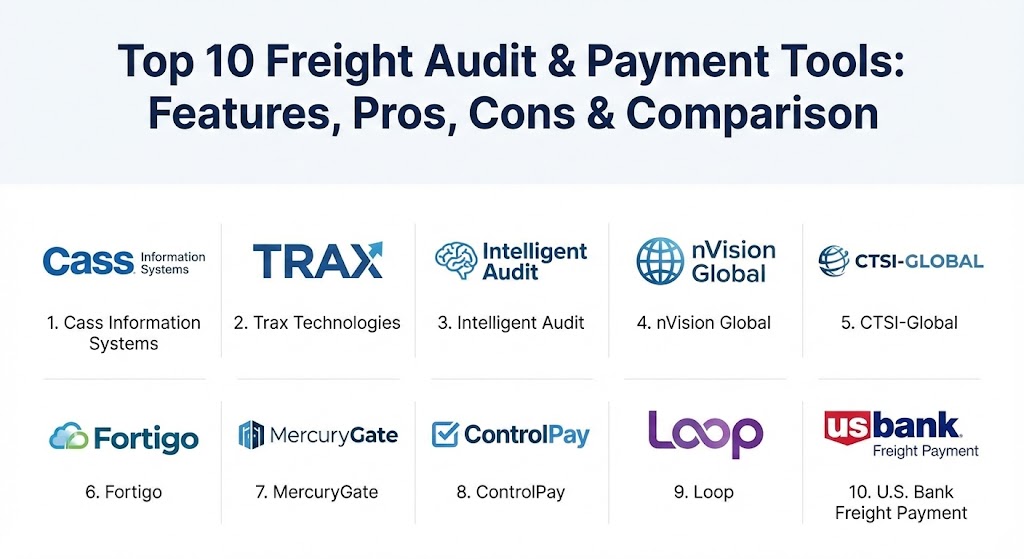
Top 10 Freight Audit & Payment Tools
1 — Cass Information Systems
Cass is the “blue chip” of the freight payment industry. As a publicly traded financial services company, they offer a level of fiscal security and regulatory compliance that few competitors can match. They are best suited for global enterprises that require integrated payment processing alongside deep auditing.
- Key features:
- Integrated payment settlement through a regulated bank.
- Global invoice auditing across 190+ countries.
- Support for all transportation modes including rail and air.
- Advanced iVisibility modules for predictive spend analytics.
- Claims management module for loss and damage recovery.
- High-security financial controls (SOX compliant).
- Pros:
- Unmatched financial stability and security of funds.
- Exceptionally deep data history for long-term trend analysis.
- Cons:
- The interface can feel more “corporate” and less agile than newer SaaS startups.
- Implementation is a significant undertaking requiring several months.
- Security & compliance: SOC 1 & SOC 2, SOX, GDPR, and HIPAA.
- Support & community: High-touch enterprise support with dedicated account managers and extensive user training programs.
2 — Trax Technologies
Trax focuses on “Total Transportation Spend Management.” They are known for their sophisticated AI-driven platform that handles not just the payment, but the normalization of complex data to drive business intelligence.
- Key features:
- AI-powered invoice ingestion and normalization.
- Carbon emissions reporting for ESG goals.
- Global multi-currency and multi-language support.
- Advanced “Pattern Recognition” to identify systemic billing errors.
- Detailed lane-level performance and cost benchmarking.
- Comprehensive variance analysis for budget vs. actual spend.
- Pros:
- Leading-edge analytics that help in strategic network design.
- Strongest focus on sustainability and carbon footprinting in the FAP space.
- Cons:
- Premium pricing reflects its advanced feature set.
- Requires high-quality data input to get the most out of the AI.
- Security & compliance: ISO 27001, SOC 2, and GDPR compliant.
- Support & community: Excellent global support footprint with regional offices in Europe, Asia, and the Americas.
3 — Intelligent Audit
Intelligent Audit is a technology-first SaaS provider that specializes in high-volume parcel and freight auditing. They pride themselves on the depth of their audit points—checking over 200 variables per invoice.
- Key features:
- Real-time billing error notifications and proactive alerts.
- AI-powered anomaly detection to catch unusual spend spikes.
- Seamless API integration with major carriers and internal TMS.
- Dedicated five-person client success team for every account.
- High-uptime cloud architecture with 24/7/365 reporting access.
- Advanced “What-If” scenario modeling for rate changes.
- Pros:
- Extremely fast audit processing and discrepancy flagging.
- User interface is modern, intuitive, and highly customizable.
- Cons:
- Primarily a software solution; payment settlement is often handled via partners.
- Less focus on heavy industrial modes like rail compared to Cass.
- Security & compliance: SOC 2 Type II and GDPR compliant.
- Support & community: Known for highly responsive customer service and frequent software updates based on user feedback.
4 — nVision Global
nVision Global is a massive player in the international market, processing invoices in over 190 countries. They are the go-to for companies with complex global supply chains that need local expertise in different regions.
- Key features:
- Multi-lingual support for processing invoices in local languages.
- Integrated claims management and contract management.
- Global tax compliance (VAT/GST) verification.
- Global logistics consulting services included with the platform.
- Robust business intelligence suite with 1,000+ standard reports.
- Mobile-friendly dashboard for executive visibility.
- Pros:
- Incredible global footprint with localized regional processing centers.
- Flexible service models ranging from software-only to fully managed services.
- Cons:
- The sheer breadth of features can make the initial configuration daunting.
- Reporting can be “data-heavy,” requiring some training to navigate effectively.
- Security & compliance: ISO 9001, GDPR, and HIPAA.
- Support & community: 24/7 global support with localized teams in major trade hubs.
5 — CTSI-Global
CTSI-Global offers a unique combination of Freight Audit & Payment and a homegrown Transportation Management System (TMS). This allows for a “closed-loop” system where the audit happens against the actual execution data in real-time.
- Key features:
- 45-point automated audit for all transportation modes.
- Centralized contract repository with SOX compliance.
- Carrier self-service portal for dispute resolution.
- CT Optima for supply chain network modeling.
- Multi-modal GL (General Ledger) cost allocation tools.
- Integrated TMS for unified shipping and auditing.
- Pros:
- Seamless integration between the audit phase and the shipping phase.
- Strong historical focus on carrier relationship management and dispute speed.
- Cons:
- To get the full value, you ideally need to use their TMS as well.
- Customization of reports can sometimes require professional service hours.
- Security & compliance: SOC 2 and SOX.
- Support & community: Strong North American presence with an established user base in manufacturing.
6 — Fortigo
Fortigo focuses on the “plug-and-play” aspect of FAP, offering a cloud-native platform that integrates deeply with ERP systems like SAP and Oracle. They are particularly strong in parcel-heavy environments.
- Key features:
- Guaranteed service refund identification for late shipments.
- Automated refund request generation sent directly to carriers.
- Match-pay logic (3-way match) against original PO numbers.
- Platform-neutral cloud architecture with mobile access.
- Advanced carrier performance scorecards.
- Integrated vendor portal for invoice submission.
- Pros:
- Very high ROI for companies with high-volume parcel (UPS/FedEx) spends.
- Minimal IT footprint required for implementation.
- Cons:
- May lack some of the deep “managed service” consulting of nVision.
- Dashboard visualization is functional but less “flashy” than competitors.
- Security & compliance: SOC 1 & 2, HIPAA.
- Support & community: Direct access to technical engineers and a simplified onboarding process.
7 — MercuryGate (Settlement Module)
While MercuryGate is primarily a TMS giant, their Freight Settlement and Audit module is a powerhouse for users who want to manage their entire freight lifecycle within a single ecosystem.
- Key features:
- Automated freight invoice matching and auto-pay thresholds.
- Self-billing capabilities for carriers (eliminating the invoice altogether).
- Integrated dispute management workflow within the TMS interface.
- Real-time visibility into every shipment’s reference numbers (BOL, PRO, PO).
- Global multi-mode support (Ocean, Air, Rail, Road).
- Automated GL coding for finance system synchronization.
- Pros:
- One of the best at “Auto-Settlement,” reducing manual labor by up to 90%.
- High level of configuration for complex business rules.
- Cons:
- Primarily available to existing MercuryGate TMS users.
- Can be expensive if you only need the audit function.
- Security & compliance: SOC 2 and GDPR.
- Support & community: Massive user community and a robust certification program for logistics professionals.
8 — ControlPay (Part of Transporeon)
ControlPay is the European leader in freight audit, now part of the larger Transporeon network. They are highly specialized in complex, multi-modal European and global logistics.
- Key features:
- Cloud-native platform with high scalability for global fleets.
- Carrier self-service portal for digital invoice submission.
- Automated rate management and contract version control.
- Business intelligence for carbon footprint tracking.
- Multi-currency payment processing through Transporeon’s network.
- Deep focus on data quality and “clean” invoice ingestion.
- Pros:
- Best-in-class for European logistics and complex VAT regulations.
- Integration with the Transporeon carrier network simplifies data flow.
- Cons:
- Less focused on the specific nuances of the North American LTL market.
- Heavily tied into the Transporeon ecosystem for maximum efficiency.
- Security & compliance: ISO 27001, SOC 2, and GDPR.
- Support & community: Strong European support base with multi-lingual capabilities.
9 — Loop
Loop is a newer, “Logistics-AI” platform that is disrupting the traditional FAP space with its focus on data extraction and explainable AI. They aim to automate up to 99.9% of the audit process.
- Key features:
- Logistics-specific AI that extracts data from any document format (PDF, JPG, EDI).
- Real-time spend visibility and automated cost allocation.
- Explainable AI that shows why an invoice was flagged for an error.
- Direct ERP integration for real-time financial synchronization.
- Scenario planning for carrier network optimization.
- Quick-pay options for carriers to improve relationship health.
- Pros:
- The most modern, user-friendly interface in the industry.
- Dramatically reduces the need for manual exception management.
- Cons:
- Still a younger company; may lack the decades-long “institutional knowledge” of Cass.
- Currently more focused on North American markets.
- Security & compliance: SOC 2 Type II and modern data encryption standards.
- Support & community: High-growth startup energy with very fast support response times.
10 — U.S. Bank Freight Payment
U.S. Bank offers a uniquely “bank-backed” solution, processing over $43 billion in freight payments annually. It is a massive powerhouse for organizations that view freight payment primarily as a financial compliance and cash flow exercise.
- Key features:
- Bank-guaranteed payment settlement and high-security funds transfer.
- Online dispute resolution tools for carriers and shippers.
- Comprehensive reporting suite for multi-modal spend.
- Integration with leading TMS providers.
- Detailed carrier scorecards and performance metrics.
- Collaborative cash flow tools for both shippers and carriers.
- Pros:
- Provides absolute certainty of payment to carriers, which can lead to better rates.
- Extremely high levels of financial audit and regulatory compliance.
- Cons:
- Can be less flexible in terms of “logistics consulting” compared to FAP boutiques.
- Reporting interface can feel like a banking portal.
- Security & compliance: Bank-grade security, OCC regulated, SOC 1 & 2.
- Support & community: Professional banking-style support with a focus on reliability and security.
Comparison Table
| Tool Name | Best For | Platform Supported | Standout Feature | Rating (Gartner/TrueReview) |
| Cass Info Systems | Large Global Shippers | Cloud / Hybrid | Integrated Bank Payments | 4.7 / 5 |
| Trax Tech | ESG & AI Insights | Cloud Native | Carbon Emissions Tracking | 4.6 / 5 |
| Intelligent Audit | High-Volume SaaS | Cloud | 200+ Audit Point Depth | 4.8 / 5 |
| nVision Global | Global Multi-Region | Cloud / Managed | Local Language Processing | 4.5 / 5 |
| CTSI-Global | Integrated TMS/FAP | Cloud / Modular | Closed-Loop TMS Sync | 4.4 / 5 |
| Fortigo | SAP/Oracle Users | Cloud | 3-Way Match Logic | 4.3 / 5 |
| MercuryGate | TMS-Centric Firms | SaaS | Auto-Settlement Engine | 4.5 / 5 |
| ControlPay | European Logistics | Cloud | Transporeon Network Sync | 4.4 / 5 |
| Loop | AI-First Automation | Cloud Native | Explainable Logistics AI | 4.7 / 5 |
| U.S. Bank | Financial Compliance | Web-Based | Bank-Backed Security | 4.5 / 5 |
Evaluation & Scoring of Freight Audit & Payment Tools
When selecting a tool, most organizations use a weighted scoring rubric to ensure that the software meets both technical and financial requirements.
| Category | Weight | Evaluation Criteria |
| Core Features | 25% | Multi-modal support, multi-currency, VAT compliance, and audit depth. |
| Ease of Use | 15% | Dashboard intuitiveness, mobile accessibility, and reporting speed. |
| Integrations | 15% | Pre-built connectors for SAP, Oracle, NetSuite, and major TMS platforms. |
| Security & Compliance | 10% | SOC 1/2, SOX readiness, and security of funds during the payment cycle. |
| Performance | 10% | Invoice processing speed and accuracy of the automated audit engine. |
| Support & Community | 10% | Availability of dedicated account teams and carrier onboarding services. |
| Price / Value | 15% | ROI (Total savings recovered vs. system cost and implementation). |
Which Freight Audit & Payment Tool Is Right for You?
Selecting the right FAP partner depends on your specific “pain points.” Use this guide to narrow your focus:
- Solo Users & SMBs: Generally, a dedicated FAP tool is overkill. Look for a TMS with a built-in audit module (like FreightPOP) or use the basic reporting provided by your primary carrier.
- Budget-Conscious Mid-Market: Fortigo or Intelligent Audit offer high ROI with relatively low implementation costs. They focus on finding the “low hanging fruit” (late shipment refunds and duplicate invoices) to pay for themselves quickly.
- Feature Depth & Complexity: If you move heavy machinery by rail, ocean, and road, Cass or nVision Global are the only players with the deep institutional knowledge to handle those complex tariffs.
- Integration & Scalability: If you are a “Microsoft/Oracle/SAP Shop,” prioritize Fortigo or Trax, which have spent years refining their connectors for these ERP environments.
- Security & Compliance: If your internal audit team is highly risk-averse, U.S. Bank or Cass provide the peace of mind that comes with a regulated financial institution.
Frequently Asked Questions (FAQs)
1. What is the average ROI for a freight audit tool? Most companies see a 2% to 6% reduction in total freight spend within the first year. The ROI is usually achieved through recovered overcharges and the elimination of manual invoice processing labor.
2. Can these tools handle international VAT and taxes? Yes, global players like nVision Global and ControlPay are specifically designed to handle the complexities of VAT, GST, and diverse tax regulations across nearly 200 countries.
3. Is it better to use a managed service or software-only? Software-only is great for companies with a strong internal logistics team. Managed services (where the provider handles carrier disputes for you) are better for organizations that want a “hands-off” approach to cost recovery.
4. How long does implementation take? A standard implementation ranges from 90 to 180 days. This includes connecting carrier data feeds (EDI/API), loading contracts into the rate engine, and integrating with your finance system.
5. Does the tool pay the carriers directly? Some providers (like Cass and U.S. Bank) act as the payor, while others (like Intelligent Audit) flag the errors and allow your internal AP team to make the actual payments.
6. Can FAP tools help with carrier negotiations? Absolutely. By centralizing all shipment data, you gain a “Negotiation Dashboard” that shows exactly which carriers are performing well and where your highest-volume lanes are.
7. Do these tools support parcel shipments (UPS/FedEx)? Yes, most modern FAP tools have specialized modules for parcel audit, which often focus on “service failure” refunds (late deliveries) which are common in the parcel industry.
8. What is “Self-Billing”? Self-billing is a trend where the shipper’s system calculates the cost of the freight based on the contract and issues a payment to the carrier automatically, bypassing the need for an invoice entirely.
9. How do these tools handle “Accessorial” charges? They match the billed accessorials against your contract rules. If a “fuel surcharge” is higher than the agreed index for that week, the system automatically flags it for a dispute.
10. What is the biggest mistake companies make when choosing a tool? The biggest mistake is choosing a tool based on “cost per invoice” rather than “data visibility.” Saving a few cents on processing but losing thousands in missed network insights is a poor trade-off.
Conclusion
The “best” Freight Audit & Payment tool isn’t necessarily the one with the most features; it’s the one that aligns with your operational reality. As we move through 2026, the market is splitting into two clear camps: the Financial Giants (like Cass and U.S. Bank) who prioritize security and stability, and the AI Innovators (like Loop and Trax) who prioritize data-driven insights and automation.
Before making a selection, map your “data maturity.” If your goal is simply to stop paying double for shipments, a mid-market SaaS tool will suffice. But if your goal is to transform your supply chain into a competitive advantage, look for a partner that provides the deep analytics necessary to optimize your network for the next decade.