Introduction
Predictive Maintenance Platforms are advanced software ecosystems that leverage the Internet of Things (IoT), Machine Learning (ML), and big data analytics to anticipate equipment failures before they occur. By continuously monitoring variables such as vibration, temperature, pressure, and acoustic emissions, these platforms identify subtle “anomalies” that precede a breakdown. Instead of performing maintenance based on the calendar, teams intervene only when the data indicates a genuine need.
The importance of these tools lies in their ability to transform maintenance from a “cost center” into a “value driver.” Key real-world use cases include monitoring turbine health in wind farms, predicting pump failures in water treatment plants, and optimizing the lifespan of robotic arms in automotive assembly lines. When evaluating these platforms, users should look for ease of sensor integration, the accuracy of their AI models (False Positive rates), scalability across global sites, and the ability to integrate with existing Enterprise Asset Management (EAM) or CMMS systems.
Best for: Asset-intensive industries like oil and gas, aerospace, utilities, and large-scale manufacturing. It is ideal for Reliability Engineers and Maintenance Managers who need to reduce O&M (Operations & Maintenance) costs and extend the Remaining Useful Life (RUL) of expensive machinery.
Not ideal for: Small workshops with low-cost, easily replaceable machinery or businesses where equipment failure has minimal impact on production or safety. In these cases, simple preventive maintenance or “run-to-fail” strategies are often more cost-effective.
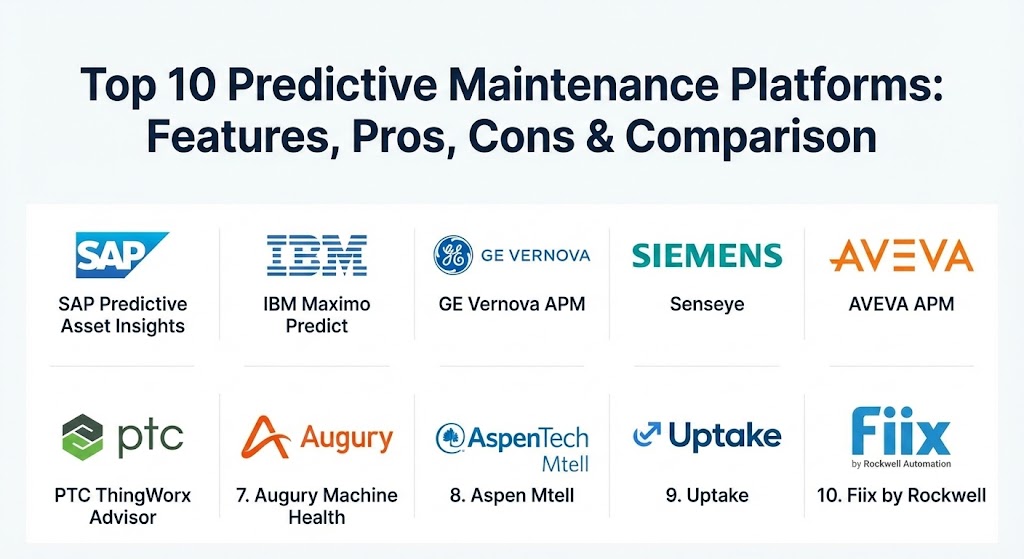
Top 10 Predictive Maintenance Platforms
1 — SAP Predictive Asset Insights (PAI)
SAP PAI is a cloud-native solution that integrates IoT sensor data with SAP’s vast ERP ecosystem. It is designed to provide a “Digital Twin” of every asset, allowing for deep health monitoring and risk-based maintenance planning.
- Key features:
- Native integration with SAP S/4HANA and SAP EAM.
- Real-time condition monitoring with automated alert triggers.
- Predictive analytics engine for calculating Remaining Useful Life (RUL).
- Digital Twin visualization for 2D/3D equipment modeling.
- Risk estimation and evaluation using reliability methodologies.
- Automated work order generation based on asset health scores.
- Pros:
- Unmatched data continuity for organizations already using the SAP ecosystem.
- Highly scalable for global enterprises with thousands of distributed assets.
- Cons:
- Prohibitively high cost and complexity for Small and Medium Enterprises (SMEs).
- The user interface can feel unintuitive compared to modern SaaS-only rivals.
- Security & compliance: ISO 27001, SOC 2, GDPR, and HIPAA compliant. Multi-tenant cloud security with SSO.
- Support & community: Backed by a global network of SAP partners and a massive community of enterprise users.
2 — IBM Maximo Predict
Part of the broader IBM Maximo Application Suite (MAS), Maximo Predict uses Watson AI to analyze historical and real-time data to forecast imminent failures and optimize maintenance schedules.
- Key features:
- AI-powered anomaly detection and failure probability scoring.
- Integration with Watson IoT for high-fidelity sensor data ingestion.
- Pre-built “notebooks” for data scientists to customize predictive models.
- Unified view of asset health, history, and environmental data.
- Seamless transition from “Predict” to “Manage” (Work Orders).
- Asset health scoring based on multiple weighted variables.
- Pros:
- The “gold standard” for enterprise asset management with powerful AI.
- Clean, modern web interface that is significantly more usable than legacy versions.
- Cons:
- Licensing can be complex as it is tied to the larger Maximo App Suite.
- Requires a high level of “data maturity” to be truly effective.
- Security & compliance: FedRAMP, SOC 2, ISO 27001, and advanced cyber-asset protection.
- Support & community: World-class enterprise support; extensive technical documentation and formal certification programs.
3 — GE Vernova Asset Performance Management (APM)
GE Vernova (formerly GE Digital) offers a massive, highly configurable suite designed for heavy industries. It is particularly strong in “Risk-Based Inspection” and deep mechanical diagnostics.
- Key features:
- SmartSignal technology for early warning of equipment failure.
- Deep industry-specific “blueprints” for Power, Mining, and Oil & Gas.
- Risk-Based Inspection (RBI) and Reliability Centered Maintenance (RCM) modules.
- High-speed data ingestion from various historians (like GE iFIX).
- Mobile-ready dashboards for field technicians.
- Sustainability metrics tracking for energy-intensive assets.
- Pros:
- Unrivaled domain expertise in heavy rotating equipment and turbines.
- Exceptional for multi-site “fleet” health monitoring.
- Cons:
- Extremely long implementation times (often several months).
- The sheer number of modules can be overwhelming for smaller teams.
- Security & compliance: ISO 27001, SOC 2 Type II, SSO integration, and deep audit logging.
- Support & community: Global technical support and a large annual user conference (Accelerate).
4 — Siemens Senseye Predictive Maintenance
Siemens Senseye is a leading “plug-and-play” PdM platform that focuses on ROI and ease of use. It is designed to be configured by existing engineering teams rather than data scientists.
- Key features:
- Automated “Attention Index” to prioritize assets needing urgent care.
- Cloud-based application that scales easily from ten to ten thousand assets.
- Hardware-agnostic; connects to existing PLC, SCADA, and IoT sensors.
- Machine-learning models that “learn” the normal behavior of each machine.
- Estimated ROI calculator integrated into the platform.
- Support for EaaS (Equipment-as-a-Service) business models.
- Pros:
- Proven to reduce unplanned downtime by up to 50% with rapid time-to-value.
- Intuitive interface that doesn’t require advanced coding or AI knowledge.
- Cons:
- Focused primarily on prediction; lacks the broader “Asset Strategy” depth of GE or IBM.
- Dependency on cloud connectivity for real-time model updates.
- Security & compliance: ISO 27001, GDPR, and rigorous third-party security audits.
- Support & community: High-quality technical support and a massive global partner ecosystem.
5 — AVEVA APM (incorporating OSIsoft PI System)
AVEVA APM provides a comprehensive view of asset health by leveraging the industry-leading OSIsoft PI System for real-time data management and visualization.
- Key features:
- Integration with the PI System for high-fidelity, time-series data.
- Predictive analytics utilizing “Digital Twin” simulations.
- Advanced pattern recognition for detecting subtle deviations.
- Integrated decision support for maintenance and operations.
- Mobile work management for “disconnected” environments.
- Extensive library of asset-specific failure models.
- Pros:
- Exceptional data visualization and historical data trending capabilities.
- The modular design allows companies to start small and scale vertically.
- Cons:
- High resource requirement for IT teams during the initial data mapping phase.
- Advanced predictive features often require moving to higher pricing tiers.
- Security & compliance: SOC 2 Type II, data-at-rest encryption, and full audit logs.
- Support & community: Dedicated online learning portal and a strong presence in the process industries.
6 — PTC ThingWorx Asset Advisor
ThingWorx Asset Advisor is part of PTC’s Industrial IoT platform. It focuses on providing real-time visibility and anomaly detection for “connected” equipment in the field.
- Key features:
- Automated anomaly detection based on pre-defined thresholds and ML.
- Remote monitoring and diagnostics to reduce onsite service calls.
- Native integration with Kepware for connecting to industrial protocols (OPC).
- Unified list of all assets under management with status indicators.
- Alerts generated directly to mobile devices or SMS.
- Augmented Reality (AR) integration via Vuforia for guided repairs.
- Pros:
- Rapid implementation and fast time-to-value for IoT-ready equipment.
- Excellent for OEMs who want to offer predictive maintenance to their customers.
- Cons:
- Heavily reliant on the broader ThingWorx platform for advanced features.
- Less focus on deep “reliability engineering” (like Weibull analysis) than specialized APMs.
- Security & compliance: FIPS 140-2, SOC 2, and rigorous data encryption protocols.
- Support & community: Strong community and extensive developer resources through the PTC portal.
7 — Augury Machine Health
Augury takes a unique “full-stack” approach by providing the proprietary sensors, connectivity, and AI software as a single bundled service. It is famous for its 30-day “quick wins.”
- Key features:
- Continuous monitoring of vibration, temperature, and magnetic data.
- AI-driven diagnostics that prescribe specific fixes, not just alerts.
- Hardware-as-a-Service (HaaS) model; sensors are included.
- “Hybrid Intelligence” that pairs AI models with human experts.
- Mobile app that gives technicians real-time “Green/Yellow/Red” status.
- 3-10x ROI guaranteed within the first year of operation.
- Pros:
- Zero internal hardware maintenance; Augury owns and maintains the sensors.
- High accuracy in machine status insights, reducing “alarm fatigue.”
- Cons:
- Limited flexibility if you already have extensive sensor infrastructure.
- Restricted to rotating equipment (motors, pumps, fans, compressors).
- Security & compliance: SOC 2 Type II, encrypted data transmission, and GDPR compliance.
- Support & community: Exceptional customer success team and proactive human monitoring.
8 — Aspen Mtell
Aspen Mtell is a specialized AI solution that uses “Autonomous Agents” to monitor machine behavior and recognize precise failure patterns across large fleets.
- Key features:
- Pattern recognition that identifies the specific “signature” of impending failure.
- Automated AI training; models can be built in hours, not weeks.
- Highly accurate “Remaining Useful Life” (RUL) forecasting.
- Ability to handle “dirty” or noisy industrial data effectively.
- Low-code interface designed for reliability engineers.
- Integration with major EAMs for automated work requests.
- Pros:
- Provides a very wide “window of warning,” often weeks or months ahead.
- Unique scalability; models can be deployed across hundreds of similar assets quickly.
- Cons:
- Primarily focused on prediction; lacks broader maintenance workflow management.
- The learning curve can be steep for those unfamiliar with pattern-based AI.
- Security & compliance: SOC 2, ISO 27001, and secure cloud/on-prem deployment options.
- Support & community: Deep expertise in the chemical and process industries with dedicated global support.
9 — Uptake
Uptake is a cloud-based industrial AI platform that focuses on data-driven insights to improve the productivity and reliability of industrial assets.
- Key features:
- Pre-trained models for common industrial components (engines, gearboxes).
- Multi-source data ingestion including sensor, maintenance, and fluid data.
- Predictive analytics for fuel efficiency and emissions monitoring.
- Collaborative workflows for maintenance and operations teams.
- Insights into “Bad Actor” assets causing the most downtime.
- Advanced natural language processing (NLP) for maintenance logs.
- Pros:
- Strong emphasis on the “Financial” impact of maintenance decisions.
- Exceptional data science foundations; models are highly robust.
- Cons:
- Can be expensive for smaller operations; targets mid-to-large enterprises.
- Integration with older, legacy “non-smart” equipment can be challenging.
- Security & compliance: SOC 2 Type II, ISO 27001, and rigorous data anonymization.
- Support & community: Robust documentation and a growing user base in transportation and energy.
10 — Fiix by Rockwell Automation (PdM Module)
Fiix is primarily a CMMS (Computerized Maintenance Management System), but through its integration with Rockwell Automation, it offers an accessible path to predictive maintenance for the mid-market.
- Key features:
- IoT-triggered work orders based on live meter readings.
- AI-driven “Asset Risk” forecasting to identify vulnerable machines.
- Mobile-first approach for work order automation and data entry.
- Native integration with Rockwell’s FactoryTalk ecosystem.
- Multi-site benchmarking and performance reporting.
- QR code scans for instant asset health and history access.
- Pros:
- The most user-friendly entry point for companies moving from preventive to predictive.
- Excellent value; combines CMMS and PdM in a single, affordable platform.
- Cons:
- Lacks the deep “Physics-based” modeling of GE or Siemens.
- Predictive features are secondary to the core CMMS functionality.
- Security & compliance: SOC 2 Type II, 256-bit TLS encryption, and 99.5% uptime SLA.
- Support & community: Highly active user community and a very responsive customer success team.
Comparison Table
| Tool Name | Best For | Platform(s) Supported | Standout Feature | Rating (Gartner Peer Insights) |
| SAP PAI | SAP-Centric Enterprises | Cloud / Hybrid | Digital Twin Visualization | 4.5 / 5 |
| IBM Maximo Predict | Enterprise AI Depth | On-Prem / Cloud / SaaS | Watson AI Integration | 4.7 / 5 |
| GE Vernova APM | Heavy Industry Fleet | Cloud / On-Prem | Risk-Based Inspection (RBI) | 4.6 / 5 |
| Siemens Senseye | Rapid ROI / Scalability | Cloud-Native | Automated Attention Index | 4.5 / 5 |
| AVEVA APM | Real-time Ops Data | Cloud / On-Prem | OSIsoft PI Integration | 4.4 / 5 |
| ThingWorx Advisor | Connected OEMs / IoT | Edge / Cloud | Remote Diagnostics | 4.3 / 5 |
| Augury Machine Health | Rotating Equipment | HaaS / Cloud | “AI + Human” Service | 4.8 / 5 |
| Aspen Mtell | Precise Failure Patterns | Cloud / On-Prem | Autonomous AI Agents | 4.5 / 5 |
| Uptake | Data-Mature Orgs | Cloud-Native | Financial Impact Analytics | 4.4 / 5 |
| Fiix (Rockwell) | SMBs / Mid-Market | SaaS / Mobile | IoT-Triggered Workflows | 4.6 / 5 |
Evaluation & Scoring of Predictive Maintenance Platforms
| Category | Weight | Evaluation Criteria |
| Core Features | 25% | Anomaly detection, RUL forecasting, and root cause analysis depth. |
| Ease of Use | 15% | Intuitiveness for engineers (vs. data scientists) and mobile access. |
| Integrations | 15% | Compatibility with CMMS/EAM, historians, and IoT protocols. |
| Security & Compliance | 10% | SOC 2, ISO 27001, and edge-to-cloud data protection. |
| Performance | 10% | Real-time processing speed and “False Positive” suppression. |
| Support & Community | 10% | Implementation services, training, and documentation quality. |
| Price / Value | 15% | TCO (sensors + software) relative to downtime savings. |
Which Predictive Maintenance Platform Is Right for You?
Selecting a platform depends largely on your current “IT/OT” infrastructure and the criticality of your assets.
- The “Locked-In” Strategy: If your entire company runs on SAP or IBM Maximo, sticking with their native predictive modules is usually the best choice for data continuity and ease of procurement.
- The “Quick Win” Strategy: For companies that need immediate results on rotating equipment (pumps, motors), Augury is the most effective choice because they handle the hardware and software for you.
- The “Heavy Industry” Giant: For oil, gas, and power, GE Vernova and AVEVA provide the deep, physics-based diagnostics that simple AI models cannot match.
- The “SMB / Mid-Market” Path: If you are just starting your digital journey, Fiix or Siemens Senseye offer a much lower barrier to entry both in terms of cost and technical complexity.
- The “OEM” Choice: If you build machines and want to sell “Predictive Maintenance as a Service” to your customers, PTC ThingWorx is built specifically for this use case.
Frequently Asked Questions (FAQs)
1. What is the difference between Condition Monitoring and Predictive Maintenance? Condition monitoring tells you what is happening now (e.g., “this bearing is hot”). Predictive maintenance tells you when it will fail based on that data (e.g., “this bearing will fail in 14 days”).
2. Do I need to buy new sensors for these platforms? It depends. Many platforms (like Siemens or SAP) can connect to your existing PLC and SCADA data. Others (like Augury) provide their own high-fidelity sensors as part of the service.
3. How long does the AI take to “learn” my machines? Most AI models require a “training period” of 2–4 weeks to establish a baseline of normal operation. Specialized tools like Aspen Mtell can sometimes work faster using pre-built failure patterns.
4. Is my data safe in the cloud? Modern industrial platforms use military-grade encryption (AES-256) and strict compliance standards like SOC 2 and ISO 27001 to ensure your proprietary operational data remains secure.
5. Can PdM work on old (legacy) equipment? Yes. You can “bolt on” wireless IoT sensors to old machines and connect them to a platform. You do not need “smart” machines to use predictive maintenance.
6. What are “False Positives” in PdM? A false positive is when the system alerts you to a failure that isn’t actually happening. High-quality platforms use “anomaly suppression” and human experts to keep these to a minimum.
7. How much does a PdM platform cost? Pricing varies from a few hundred dollars per machine annually (for SaaS solutions like Fiix) to multi-million dollar enterprise licenses for global deployments.
8. Do I need a team of Data Scientists? Not necessarily. “Low-code” or “No-code” platforms like Siemens Senseye and Augury are designed for reliability engineers and maintenance managers to use without coding.
9. Can PdM help with energy efficiency? Yes. Poorly maintained machines often consume more energy. By keeping equipment in peak condition, PdM platforms frequently lead to a 5–10% reduction in energy costs.
10. What is a “Digital Twin”? A Digital Twin is a virtual replica of a physical asset that uses real-time sensor data to simulate performance and predict failures in a safe, digital environment.
Conclusion
Predictive Maintenance is no longer a luxury for the “factory of the future”—it is a necessity for the survival of the factory of today. While the initial investment in sensors and software can be significant, the return on investment in the form of reduced downtime and extended asset life is undeniable. The “best” platform is not the one with the most features, but the one that your maintenance team will actually use and trust.