Introduction
Oil & Gas Field Service Tools are specialized software platforms designed to manage the unique, often remote, and high-risk operations of the energy sector. These tools provide a unified interface for scheduling crews, tracking high-value assets (like drilling rigs and turbines), and automating field ticketing processes. In a sector where a single day of unplanned downtime can cost hundreds of thousands of dollars, these solutions act as the central nervous system for field operations.
The importance of these tools lies in their ability to bridge the gap between the remote wellsite and the back office. Key real-world use cases include automated dispatching of technicians based on proximity and skill, preventive maintenance triggered by IoT sensors, and rapid revenue capture through digital field tickets that integrate directly with accounting systems. When evaluating these tools, users should look for offline mobile capabilities, robust HSE (Health, Safety, and Environment) compliance modules, and deep integration with industry-standard ERPs.
Best for: Upstream and midstream service companies, drilling contractors, equipment rental firms, and maintenance teams managing mission-critical energy infrastructure.
Not ideal for: Small local general contractors with simple service needs or businesses that do not operate in high-risk, asset-heavy environments where safety and compliance are not primary drivers.
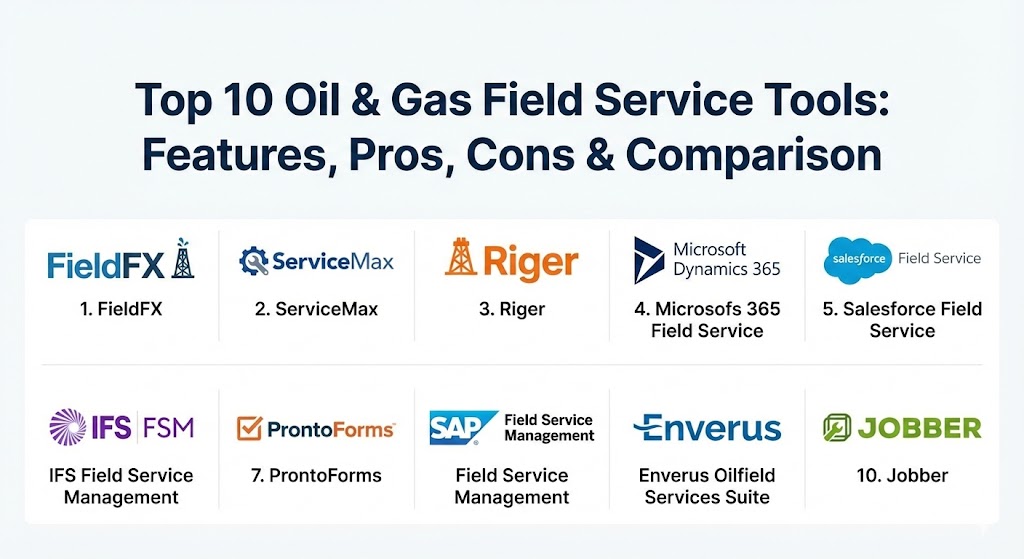
Top 10 Oil & Gas Field Service Tools
1 — FieldFX (by Fortra)
FieldFX is a purpose-built solution designed specifically for the energy industry. It focuses on the complex workflows of oilfield services, from initial quotes and scheduling to field ticketing and final invoicing.
- Key features:
- “Offline-first” mobile sync for remote wellsites with no cell service.
- Complex price book management for multi-tiered client contracts.
- Integrated e-ticketing with direct sync to OpenInvoice and OpenTicket.
- Robust asset tracking and preventive maintenance scheduling.
- Dynamic scheduling and dispatch for crews and equipment.
- Advanced reporting on crew utilization and project profitability.
- Pros:
- It “speaks the language” of the oilfield with industry-specific terminology.
- Drastically reduces DSO (Days Sales Outstanding) by accelerating the field-to-invoice cycle.
- Cons:
- The visual interface can feel slightly dated compared to generic SaaS tools.
- Initial configuration of complex price books requires a significant time investment.
- Security & compliance: SOC 2 Type II, GDPR, and HIPAA compliant.
- Support & community: Strong North American support team; comprehensive training documentation and webinars.
2 — ServiceMax (by PTC)
ServiceMax is an asset-centric field service management platform. It is designed for large enterprises that maintain complex, expensive machinery—like subsea drilling assemblies—where the cost of failure is astronomical.
- Key features:
- 360-degree view of asset history, including warranty and service contracts.
- Advanced AI-driven scheduling for high-value technician dispatch.
- Remote Assist utilizing Augmented Reality (AR) for field support.
- Predictive maintenance fueled by IoT and machine learning.
- Parts and inventory management with real-time visibility.
- Comprehensive mobile app with digital signature capture.
- Pros:
- Best-in-class for managing high-value, mission-critical machinery.
- Exceptional remote support features that reduce the need for senior engineers on-site.
- Cons:
- Highly complex and often requires a dedicated administrator to manage.
- Cost-prohibitive for smaller service providers.
- Security & compliance: ISO 27001, SOC 2, and FedRAMP authorized.
- Support & community: Global enterprise support; “ServiceMax Academy” for formal certifications.
3 — Riger
Riger is a digital oilfield platform specifically tailored for oilfield rental and service operations. It manages the entire lifecycle of rental equipment and service jobs in one unified system.
- Key features:
- Specialized rental management for pipes, valves, and rig mats.
- Fleet maintenance and inspection tracking.
- Mobile oilfield tickets with offline data capture.
- Real-time dispatching and fleet utilization dashboards.
- Integration with accounting software like QuickBooks and Sage.
- Customizable HSE checklists for field workers.
- Pros:
- Unmatched depth in equipment rental management.
- Quick implementation compared to larger enterprise platforms.
- Cons:
- Less effective for general field service that doesn’t involve rentals.
- Mobile app performance can vary on older hardware.
- Security & compliance: Secure SSL encryption and role-based access controls; GDPR compliant.
- Support & community: Responsive personalized support; active development of new features based on user feedback.
4 — MS Dynamics 365 Field Service
Microsoft’s flagship FSM tool offers a powerful ecosystem of AI, automation, and predictive maintenance, making it a top choice for companies already embedded in the Microsoft stack.
- Key features:
- AI-driven “Smart Scheduling” to optimize travel time and fuel costs.
- IoT integration (Connected Field Service) for real-time asset monitoring.
- Native integration with Microsoft Teams and Power BI.
- Mixed reality support through HoloLens for remote technician assistance.
- Offline-capable mobile app for field work.
- Comprehensive inventory and warehouse management.
- Pros:
- Unbeatable integration with the wider Microsoft 365 and Azure ecosystem.
- Highly scalable; can handle thousands of technicians across multiple regions.
- Cons:
- Requires a Microsoft specialist for custom workflow development.
- Can feel “over-engineered” for companies with straightforward workflows.
- Security & compliance: ISO 27001, SOC 1/2/3, GDPR, and HIPAA.
- Support & community: Massive global partner ecosystem and extensive online documentation.
5 — Salesforce Field Service
Salesforce combines its world-leading CRM with advanced field scheduling, focusing on the customer experience and long-term asset health.
- Key features:
- AI-based dispatcher console for real-time workforce visibility.
- Automated appointment booking with customer-facing portals.
- Deep connection between sales opportunities and service work orders.
- Intelligent parts forecasting and inventory management.
- Customizable mobile app with built-in knowledge base.
- Integration with Salesforce’s Einstein AI for predictive insights.
- Pros:
- Best for organizations that prioritize a 360-degree view of the customer.
- Extremely flexible; can be customized to fit almost any business model.
- Cons:
- Very expensive when scaling with multiple modules.
- Implementation often requires expensive third-party consultants.
- Security & compliance: FedRAMP, SOC 2, ISO 27001, and HIPAA.
- Support & community: Industry-leading support (Trailhead) and a massive global community.
6 — IFS Field Service Management
IFS is a global leader in EAM (Enterprise Asset Management) and FSM, providing a single platform that connects industry-specific products through a unified data model.
- Key features:
- End-to-end service lifecycle management from contract to invoice.
- Advanced “IFS PSO” for scheduling optimization in complex environments.
- Depot repair and warranty management.
- Mobile work execution with full offline capability.
- Integrated project and asset management.
- Embedded AI (IFS.ai) for continuous schedule optimization.
- Pros:
- Exceptional at balancing asset maintenance with field service delivery.
- Highly resilient and designed for heavy industrial use.
- Cons:
- The learning curve is steep due to the breadth of the platform.
- Sales and contract renegotiation processes can be complex for users.
- Security & compliance: ISO 27001, SOC 2, and GDPR.
- Support & community: Global professional services; proactive delivery partner approach.
7 — ProntoForms (TrueContext)
ProntoForms specializes in mobile data capture and compliance. It is often used alongside other FSM tools to handle the dense inspection and HSE requirements of the oilfield.
- Key features:
- Drag-and-drop form builder for complex inspections and safety reports.
- Full offline functionality with automated sync upon reconnection.
- Rich data capture (photos, GPS, QR codes, digital signatures).
- Integration with major platforms like Salesforce, ServiceMax, and SharePoint.
- Automated PDF generation and email distribution.
- Conditional logic within forms to guide field workers through procedures.
- Pros:
- The gold standard for mobile inspections and safety compliance.
- Incredibly easy for field workers to adopt; high “user-friendliness.”
- Cons:
- Lacks native scheduling and advanced dispatching features.
- Pricing per-user can add up if used only for simple tasks.
- Security & compliance: SOC 2 Type II, HIPAA, and GDPR compliant.
- Support & community: Excellent documentation and responsive customer success teams.
8 — SAP Field Service Management
SAP FSM is the preferred choice for large-scale energy enterprises already utilizing SAP S/4HANA, offering a deeply integrated service experience.
- Key features:
- AI-based technician planning and resource forecasting.
- Real-time status updates and job tracking for dispatchers.
- Mobile self-service portals for customers and partners.
- Knowledge management for field technicians (manuals, videos).
- Integration with SAP’s Asset Manager and ERP core.
- Multi-language and multi-site support for global operations.
- Pros:
- Seamless data flow for organizations already running on SAP.
- Perfect for global operations with high regulatory complexity.
- Cons:
- High implementation cost and lengthy setup times.
- UI can be complex for frontline technicians compared to mobile-first apps.
- Security & compliance: ISO 27001, SOC 1/2, GDPR, and HIPAA.
- Support & community: Global enterprise support and a vast user network.
9 — Enverus Oilfield Services Suite (OSS)
Enverus OSS is built specifically for the “upstream” market, focusing heavily on getting paid faster by digitizing the field ticket to invoice process.
- Key features:
- Native integration with OpenInvoice and OpenTicket.
- Digital field ticket submission directly from the wellsite.
- Real-time visibility into ticket approval status.
- Automated AR processing to reduce ticket errors.
- Bid tracking and direct communication with operators.
- Dashboards for monitoring revenue and DSO metrics.
- Pros:
- Drastically improves cash flow—users report getting paid up to 2x faster.
- 0% ticket error rates due to automated validation.
- Cons:
- Narrow focus on ticketing and invoicing; lacks deep asset maintenance features.
- Primarily effective for users already within the Enverus ecosystem.
- Security & compliance: Rigorous internal safety audits and SOC 2 compliance.
- Support & community: Access to industry experts and a dedicated product tour for onboarding.
10 — Jobber
Jobber is a more accessible, “all-in-one” solution that has gained traction with smaller oilfield service providers who need efficiency without the enterprise price tag.
- Key features:
- Simple job scheduling and “drag-and-drop” calendar.
- Professional quoting and automated follow-ups.
- Mobile app for crew management and time tracking.
- Integrated payment processing for faster collections.
- Basic CRM to manage customer history and notes.
- Automated SMS and email notifications for clients.
- Pros:
- Very high ease of use; can be set up in days rather than months.
- Cost-effective for small to mid-sized teams.
- Cons:
- Lacks the complex “oilfield-specific” logic (like rig numbers or well IDs).
- Limited HSE and compliance documentation features.
- Security & compliance: GDPR compliant; secure payment processing (Stripe).
- Support & community: Friendly customer support and a helpful online “Jobber Academy.”
Comparison Table
| Tool Name | Best For | Platform(s) Supported | Standout Feature | Rating (Gartner / TrueReview) |
| FieldFX | E-Ticketing & Pricing | Web, iOS, Android | Offline Ticket Sync | 4.6 / 5 |
| ServiceMax | Asset Maintenance | Web, iOS, Android | Asset-Centric Service | 4.8 / 5 |
| Riger | Equipment Rentals | Web, iOS, Android | Rental Fleet Lifecycle | 4.7 / 5 |
| Dynamics 365 | Microsoft Ecosystem | Windows, Web, Mobile | Power BI Integration | 4.7 / 5 |
| Salesforce FS | Customer Experience | Web, iOS, Android | 360 Customer View | 4.6 / 5 |
| IFS FSM | Heavy Industrial Use | Web, Windows, Mobile | AI-Driven Scheduling | 4.6 / 5 |
| ProntoForms | HSE & Inspections | iOS, Android, Web | Drag-and-Drop Forms | 4.7 / 5 |
| SAP FSM | Global Enterprises | Web, iOS, Android | SAP S/4HANA Sync | 4.5 / 5 |
| Enverus OSS | Cash Flow / DSO | Web, iOS, Android | OpenInvoice Integration | 4.4 / 5 |
| Jobber | SMB Service Teams | iOS, Android, Web | Ease of Use | 4.8 / 5 |
Evaluation & Scoring of Oil & Gas Field Service Tools
The following scoring reflects how these tools are measured against the harsh requirements of the energy sector.
| Category | Weight | Evaluation Criteria |
| Core Features | 25% | Offline mobile sync, e-ticketing, asset tracking, and HSE modules. |
| Ease of Use | 15% | Adoption speed for field crews; intuitiveness of the mobile app. |
| Integrations | 15% | Syncing with OpenInvoice, ERPs (SAP/MS), and accounting software. |
| Security & Compliance | 10% | SOC 2/ISO status and the ability to handle audit-ready logs. |
| Performance | 10% | Stability in low-bandwidth areas and high-volume data handling. |
| Support | 10% | Availability of “field-ready” 24/7 support and training resources. |
| Price / Value | 15% | Return on investment based on DSO reduction and uptime gains. |
Which Oil & Gas Field Service Tool Is Right for You?
Selecting the right tool depends on your primary “pain point” and the scale of your operations.
- Solo Users vs SMB: If you are a small team (under 10 people), Jobber or ProntoForms are great entry points. They solve the immediate problem of paper forms and basic scheduling without massive upfront costs.
- Mid-Market Companies: For firms managing rental fleets or complex price books, Riger or FieldFX offer the best vertical-specific depth. They allow you to scale without needing a team of developers.
- Enterprise Operations: If your data lives in a central ERP like SAP or Microsoft, then SAP FSM or Dynamics 365 are the logical choices. They offer the security and global scale required for multi-national operations.
- Budget-Conscious vs Premium: If your main goal is to get paid faster, Enverus OSS is a high-value choice. If you need a “future-proof” system with AR and AI, ServiceMax or Salesforce represent the premium, higher-cost end of the market.
- Security Requirements: In the oilfield, safety is non-negotiable. If your primary focus is HSE compliance and rig inspections, ProntoForms should be your top evaluation.
Frequently Asked Questions (FAQs)
1. Why do I need an oil-specific tool instead of a generic one? Oil-specific tools understand industry concepts like rig numbers, wellsite IDs, and complex multi-client price books that generic tools (like those for plumbing or HVAC) often miss.
2. Does the mobile app work if there is no cell service on a rig? Yes, tools like FieldFX and ServiceMax use “offline-first” architecture, allowing technicians to save data locally and sync automatically when they reach a connection.
3. Can these tools help me get paid faster? Absolutely. By digitizing field tickets and integrating them with platforms like OpenInvoice, companies can reduce “Days Sales Outstanding” from months to days.
4. Can I track my equipment rental fleet? Yes, specialized tools like Riger are built specifically to manage the lifecycle of rental equipment, including matting, valves, and heavy machinery.
5. How hard is it to switch from paper to a digital tool? It requires a “culture shift.” Success usually depends on choosing a user-friendly app (like Jobber or ProntoForms) and providing hands-on training for the field crews.
6. Do these tools replace SCADA systems? No. SCADA handles the operational technology (valves/pumps), while Field Service tools handle the business/technician workflows. They often integrate, however.
7. Are these tools secure enough for the energy sector? Most leading tools are SOC 2 and ISO 27001 certified, providing the high level of encryption and audit trails required by major energy operators.
8. Can I manage preventive maintenance for my trucks and rigs? Yes, most enterprise tools include EAM (Enterprise Asset Management) modules to schedule maintenance based on time, usage, or IoT triggers.
9. Do they offer remote assistance for field workers? Premium tools like ServiceMax and Dynamics 365 offer AR-based remote assistance, allowing a senior engineer in the office to “see” what the technician sees in the field.
10. What is the biggest mistake when buying these tools? Buying a tool that is too complex for the field crews. If the technicians find the app too hard to use, they will go back to using paper, and the investment will fail.
Conclusion
The transition from manual field tickets to digital operations is no longer optional in the energy sector. The “best” tool for your company is the one that your field workers will actually use and that your office can trust for accurate billing and HSE compliance. Whether you prioritize the specialized rental depth of Riger, the cash-flow acceleration of Enverus, or the enterprise power of Microsoft, the goal remains the same: safer, faster, and more profitable operations.