Introduction
Solar Asset Monitoring Software is a specialized category of digital platforms designed to track, analyze, and optimize the performance of solar photovoltaic (PV) systems. These tools aggregate data from inverters, sensors, weather stations, and meters to provide real-time visibility into energy production. Beyond simple monitoring, they offer advanced analytics for “loss attribution”—identifying exactly why a plant is underperforming, whether due to soiling, component degradation, or grid curtailment.+1
The importance of these tools lies in their ability to transform raw technical data into actionable business intelligence. For an asset manager, a 1% improvement in performance across a multi-gigawatt portfolio can translate into millions of dollars in additional annual revenue. Key real-world use cases include predictive maintenance (identifying a failing inverter before it trips), automated financial reporting for investors, and ensuring compliance with grid-operator mandates. When evaluating these tools, users should look for hardware-agnostic capabilities, the precision of weather-normalized benchmarking, and the robustness of their ticketing and O&M (Operations & Maintenance) integration.+2
Best for: Utility-scale IPPs (Independent Power Producers), EPC (Engineering, Procurement, and Construction) firms, O&M service providers, and large commercial & industrial (C&I) portfolio owners who need a unified view of disparate hardware.
Not ideal for: Small residential homeowners with a single, simple system where the inverter’s native (and free) app is sufficient, or for companies that do not have the internal capacity to act on the deep data insights provided.
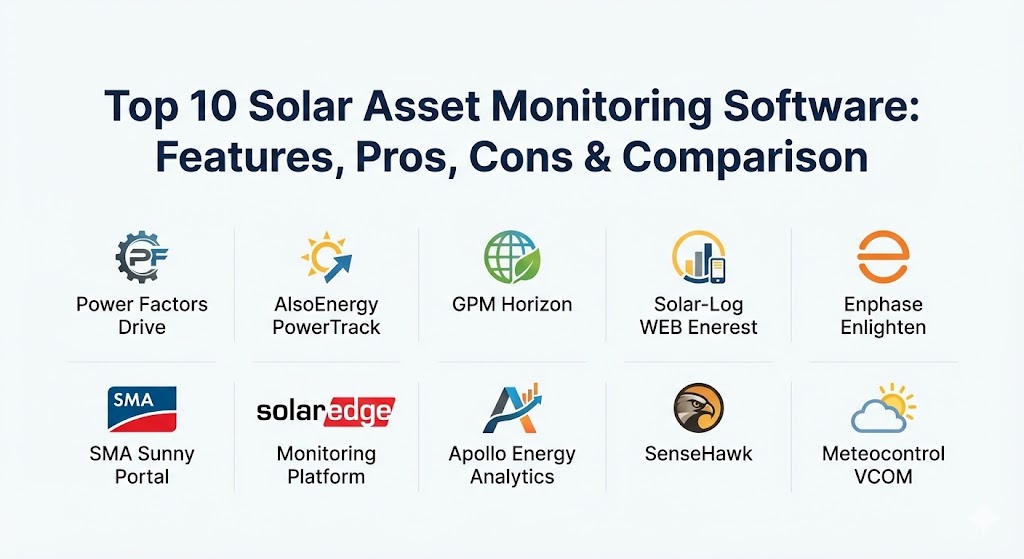
Top 10 Solar Asset Monitoring Software
1 — Power Factors Drive
Power Factors Drive is a flagship platform in the renewable energy industry, specifically designed for high-stakes utility-scale solar, wind, and battery storage portfolios. It focuses on turning “big data” into “smart data” through advanced loss attribution.+1
- Key features:
- Unified data model for solar, wind, and BESS (Battery Energy Storage Systems).
- Advanced loss attribution engine to categorize energy gaps (soiling, downtime, etc.).
- Integrated event management and automated O&M ticketing workflows.
- High-fidelity digital twin modeling for performance benchmarking.
- Regulatory-grade financial and contractual KPI tracking.
- Comprehensive API for integration with ERP and BI tools.
- Pros:
- Unmatched depth in technical analytics; it is the industry standard for large IPPs.
- Excellent at handling multi-technology portfolios (solar + wind + storage).
- Cons:
- The interface and feature set can be overwhelming for smaller C&I portfolios.
- High implementation cost and longer onboarding period compared to SaaS-only tools.
- Security & compliance: SOC 2 Type II, GDPR compliant, NIST-aligned cybersecurity, and role-based access control (RBAC).
- Support & community: White-glove enterprise support, dedicated account managers, and an extensive technical documentation portal.
2 — AlsoEnergy PowerTrack
AlsoEnergy (now part of Stem) offers PowerTrack, one of the most widely used platforms in the C&I and utility segments. It is known for its versatility and its ability to integrate both hardware (dataloggers) and software.
- Key features:
- Hardware-agnostic platform supporting over 100 different inverter brands.
- “Single pane of glass” view for distributed portfolios across various geographies.
- Detailed irradiance and weather data integration for performance ratio (PR) calculations.
- Customizable dashboards for different stakeholders (executives vs. technicians).
- Automated reporting for PPA (Power Purchase Agreement) compliance.
- Integrated site-level diagnostic tools.
- Pros:
- Highly flexible; it works as well for a 50kW rooftop as it does for a 50MW farm.
- Strong “all-in-one” offering if using AlsoEnergy’s own edge hardware.
- Cons:
- The legacy user interface can feel clunky compared to newer cloud-native competitors.
- Reporting customization can sometimes require professional services.
- Security & compliance: ISO 27001, SOC 2, and encrypted data transmission from edge to cloud.
- Support & community: Robust 24/7 technical support and a large global network of certified installers.
3 — GreenPowerMonitor (GPM) Horizon
GPM Horizon, a DNV company, is a high-end analytical platform favored by technical auditors and large asset owners who require “bankable” data and high-precision monitoring.
- Key features:
- Multi-technology support (PV, Wind, Storage, and Hybrid).
- Powerful data visualization for real-time SCADA integration.
- Advanced technical asset management (TAM) modules.
- In-depth predictive analytics to forecast component failure.
- High-resolution data acquisition (up to 1-second intervals).
- Pros:
- Extremely high data reliability; often used as the “system of record” for audits.
- Backed by DNV’s global engineering expertise and scientific rigor.
- Cons:
- Premium pricing reflects its position as a high-end enterprise tool.
- Requires a certain level of technical expertise to fully utilize the analytics.
- Security & compliance: SOC 2, GDPR, and rigorous internal data privacy standards.
- Support & community: Specialized consulting services and deep enterprise training programs.
4 — Solar-Log WEB Enerest
Solar-Log is a veteran in the monitoring space, particularly strong in the European market. Their WEB Enerest platform is designed to provide high-quality monitoring for residential and commercial fleets.
- Key features:
- Exceptional hardware compatibility with nearly every inverter and meter.
- Smart Energy management to optimize self-consumption.
- Automated “Inverter Comparison” to detect subtle string-level issues.
- Mobile-optimized for field service teams.
- White-labeling options for installers and O&M providers.
- Pros:
- One of the best tools for mixed-hardware portfolios in the C&I space.
- Easy setup process with automated device detection.
- Cons:
- Not designed for the extreme technical complexity of 100MW+ utility sites.
- Data storage limits on lower-tier plans can be restrictive.
- Security & compliance: GDPR compliant, secure encrypted cloud storage, and SSO support.
- Support & community: Strong community forum and reliable regional support centers.
5 — Enphase Enlighten
While Enphase is a hardware manufacturer (microinverters), their Enlighten software is so sophisticated that it has become a benchmark for what residential and small C&I monitoring should look like.
- Key features:
- Panel-level monitoring (not just system or inverter level).
- Real-time energy production vs. consumption tracking.
- Integrated battery storage and EV charger monitoring.
- “MyEnlighten” for homeowners and “Enlighten Manager” for professionals.
- Remote diagnostic and firmware update capabilities.
- Pros:
- The most granular visibility in the industry (down to each individual panel).
- User interface is widely considered the gold standard for ease of use.
- Cons:
- Strictly proprietary; only works with Enphase hardware.
- No support for large central inverters common in utility-scale projects.
- Security & compliance: High-level cloud security, encrypted data streams, and automated security patches.
- Support & community: Massive user community and excellent self-service documentation.
6 — SMA Sunny Portal
Sunny Portal (powered by ennexOS) is the software arm of SMA, one of the world’s largest inverter companies. It provides a comprehensive ecosystem for energy management beyond just monitoring.+1
- Key features:
- ennexOS cross-sector energy management (heating, cooling, EV, PV).
- Virtual “plant” creation to group multiple sites into logic units.
- Detailed fault history and event logs for long-term troubleshooting.
- Grid-management feature integration for utility compliance.
- Automated email alerts for critical system failures.
- Pros:
- Best-in-class for SMA-centric fleets; offers deep hardware-level insights.
- Excellent integration with broader building automation and HVAC systems.
- Cons:
- Limited third-party hardware support compared to AlsoEnergy or Power Factors.
- The transition between legacy Sunny Portal and ennexOS can be confusing for users.
- Security & compliance: ISO 27001, GDPR, and German-standard data privacy protocols.
- Support & community: Reliable global support and comprehensive technical training (SMA Academy).
7 — SolarEdge Monitoring Platform
SolarEdge’s platform leverages their DC-optimized inverter technology to provide a unique “Physical Layout” view of a solar plant.
- Key features:
- Logical and physical layout maps showing real-time optimizer performance.
- “Playback” feature to visualize shadow movement and impact over time.
- Remote troubleshooting down to the power optimizer level.
- Built-in safety alerts for “Rapid Shutdown” and arc-fault detection.
- Financial reporting for ROI and payback period tracking.
- Pros:
- Incredible for detecting local issues like shading or specific module soilage.
- Drastically reduces “truck rolls” by allowing for detailed remote diagnostics.
- Cons:
- Proprietary to the SolarEdge ecosystem.
- Large fleets can sometimes experience dashboard latency during heavy data loads.
- Security & compliance: SOC 2, GDPR, and encrypted communication.
- Support & community: Comprehensive online help center and high-touch professional support.
8 — Apollo Energy Analytics
Apollo is an AI-driven platform specifically targeted at asset managers and owners who want to move from simple monitoring to high-level financial optimization.
- Key features:
- AI-powered performance diagnostics that learn from historical data.
- Automated revenue-loss analysis (quantifying issues in dollars, not just kWh).
- Portfolio-wide benchmarking against “P50/P90” energy projections.
- Intelligent O&M dispatching based on economic priority.
- Clean, executive-focused financial dashboards.
- Pros:
- Best for financial stakeholders who care about “dollars and cents.”
- The AI helps filter through the noise of too many alerts.
- Cons:
- Relatively newer player; smaller community compared to legacy vendors.
- Requires high-quality historical data to “train” the AI effectively.
- Security & compliance: Cloud-native security, SOC 2, and data sovereignty options.
- Support & community: High-touch implementation and specialized consulting.
9 — SenseHawk
SenseHawk is a digital twin and GIS-based asset management platform that integrates drone data and visual inspections with traditional sensor monitoring.
- Key features:
- GIS-integrated dashboards showing physical locations of every module and fault.
- Drone thermography integration to detect “hotspots” automatically.
- Lifecycle management from construction through O&M.
- Visual workflow for field teams (using digital maps).
- Inventory and spare parts management integration.
- Pros:
- Superior for large-scale utility maintenance; technicians know exactly where to walk.
- Drone-software integration is the best in the market.
- Cons:
- Its value is mostly tied to having drone data; less useful for small commercial roofs.
- Can be more expensive than purely digital-sensor platforms.
- Security & compliance: Secure cloud storage with encrypted image processing.
- Support & community: Expert GIS and drone specialists available for onboarding.
10 — Meteocontrol VCOM (Virtual Control Room)
VCOM is a highly technical, industrial-grade monitoring platform designed for professional O&M providers and technical asset managers.
- Key features:
- High-frequency data acquisition from industrial-grade dataloggers.
- Professional-grade PR (Performance Ratio) calculations.
- Fully customizable cockpit for managing thousands of mixed assets.
- Integrated ticketing system and mobile service app.
- High-precision weather data and irradiance modeling.
- Pros:
- A “true” industrial tool; provides the raw data depth needed for power engineers.
- Hardware-agnostic and highly scalable.
- Cons:
- The UI is built for engineers, not necessarily for non-technical managers.
- Setup requires a professional configuration of dataloggers and sensors.
- Security & compliance: ISO 27001, GDPR, and enterprise-grade audit logs.
- Support & community: Technical training and expert-level engineering support.
Comparison Table
| Tool Name | Best For | Platform(s) Supported | Standout Feature | Rating (TrueReviewnow.com) |
| Power Factors Drive | Multi-GW IPPs | Cloud-based | Loss Attribution Engine | 4.8 / 5 |
| AlsoEnergy PowerTrack | C&I / Mid-Market | Cloud + Hardware | Hardware/Software Synergy | 4.6 / 5 |
| GPM Horizon | Technical Auditors | SCADA / Cloud | Bankable Precision Data | 4.7 / 5 |
| Solar-Log Enerest | Installers / C&I | Cloud + Dataloggers | Smart Energy Optimizing | 4.5 / 5 |
| Enphase Enlighten | Residential / SMB | Enphase Cloud | Module-Level Granularity | 4.9 / 5 |
| SMA Sunny Portal | SMA Fleets | Cloud / ennexOS | Cross-Sector Energy Mgmt | 4.4 / 5 |
| SolarEdge Monitoring | Optimized Systems | SolarEdge Cloud | Physical Layout Playback | 4.7 / 5 |
| Apollo Analytics | Financial Managers | AI / Cloud | AI Revenue Forecasting | 4.5 / 5 |
| SenseHawk | Large-scale O&M | GIS / Drone / Cloud | GIS-Digital Twin Mapping | 4.6 / 5 |
| Meteocontrol VCOM | Professional O&M | Industrial Cloud | High-Frequency SCADA | 4.7 / 5 |
Evaluation & Scoring of Solar Asset Monitoring Software
| Category | Weight | Evaluation Criteria |
| Core Features | 25% | Monitoring depth, Loss Attribution, loss analysis, and PR calculation accuracy. |
| Ease of Use | 15% | Dashboard clarity, mobile app functionality, and report automation. |
| Integrations | 15% | Hardware-agnosticism, API depth, and SCADA/ERP compatibility. |
| Security & Compliance | 10% | Encryption, SOC 2 / ISO 27001, and role-based access control. |
| Performance | 10% | Data acquisition frequency, dashboard latency, and uptime. |
| Support & Community | 10% | Expert engineering support, documentation, and user forums. |
| Price / Value | 15% | TCO vs. performance gains and reduction in manual labor. |
Which Solar Asset Monitoring Software Tool Is Right for You?
Selecting the right tool depends on where you sit in the solar value chain.
- For Residential Installers: If you specialize in one brand, stick with Enphase Enlighten or SolarEdge. Their software is free (or low cost) and provides the specific hardware-level data your customers want.
- For Small to Medium Commercial (C&I): You likely have a mix of hardware across various rooftops. Solar-Log or AlsoEnergy are excellent because they can consolidate different brands into one portal.
- For Utility-Scale IPPs: You need the highest level of bankability and financial reporting. Power Factors and GreenPowerMonitor are the heavyweights here, providing the scientific loss attribution that investors demand.
- For O&M Service Providers: Speed of dispatch and technician efficiency are your priorities. SenseHawk (for its GIS maps) or Meteocontrol VCOM (for its industrial ticketing and raw data) are the best choices to reduce operating costs.
- Budget vs. Premium: If budget is the primary concern, native OEM apps are your best bet. If maximizing ROI and minimizing risk is the goal, the 10–15 cents per kWp per year for a premium platform like Apollo or Power Factors pays for itself in detected energy losses.
Frequently Asked Questions (FAQs)
1. What is “Loss Attribution” and why does it matter? Loss attribution is the process of breaking down underperformance into specific buckets like soiling, shading, inverter downtime, or grid curtailment. Without it, you know you’re losing energy, but you don’t know if a “truck roll” (sending a technician) will actually fix it.
2. Can these tools predict hardware failure before it happens? Advanced platforms like Power Factors and GPM Horizon use AI to detect anomalies in data—such as a slightly overheating inverter component—that often precede a total system trip.
3. Do I need additional hardware like dataloggers? It depends. Many modern inverters send data directly to the cloud via Wi-Fi or Cellular. However, for industrial sites, dedicated dataloggers (like those from Solar-Log or Meteocontrol) ensure high-frequency, reliable data even when the internet is spotty.
4. How does weather data integrate into these tools? Software typically pulls data from satellite weather services or on-site irradiance sensors (pyranometers). This allows the software to calculate the “Expected Energy”—how much power the plant should have made given the actual sun conditions.
5. Are these tools hardware-agnostic? Most third-party tools (AlsoEnergy, Power Factors, etc.) are hardware-agnostic, meaning they can manage a fleet with 10 different inverter brands. OEM tools (Enphase, SolarEdge) are usually proprietary.
6. What is the difference between Monitoring and Asset Management? Monitoring is the technical tracking of data. Asset Management includes financial tracking, contract management (PPAs), insurance claims, and investor reporting.
7. How much does solar monitoring software cost? Pricing is typically based on the capacity of the system (e.g., dollars per Megawatt-peak per year) or a flat monthly fee per site. It can range from $100/year for small C&I sites to thousands for utility-scale.
8. Can these tools manage Battery Energy Storage (BESS)? Yes, top-tier tools like Power Factors and GPM are now “Energy Management Systems” (EMS) that can manage the complex charging/discharging cycles of batteries alongside solar.
9. Is my data secure in the cloud? Most enterprise providers use bank-grade encryption and follow SOC 2 or ISO standards. This is critical because solar plants are increasingly viewed as “critical infrastructure” by governments.
10. Can I white-label these tools for my own customers? Many platforms (like Solar-Log and AlsoEnergy) offer white-labeling, allowing installers to put their own logo and branding on the dashboard their customers see.
Conclusion
The transition from “installing solar” to “operating solar” represents a major maturation of the renewable energy industry. Choosing the right monitoring software is no longer a luxury—it is a financial necessity to protect the 25-year lifespan of an asset. Whether you prioritize module-level granularity or high-level financial KPIs, the right tool should act as an extension of your team, identifying problems before they become losses.