Introduction
Grid Operations software—commonly referred to as the “brain of the grid”—forms the digital backbone of modern power systems. Energy Management Systems (EMS) are traditionally used by transmission system operators to monitor and control high-voltage networks, ensuring that power generation matches demand in real-time. On the other hand, Distribution Management Systems (DMS) handle the “last mile” of electricity delivery, managing the medium and low-voltage lines that connect to homes and businesses.
Today, these two worlds are converging into Advanced Distribution Management Systems (ADMS). These tools are critical for real-time situational awareness, allowing operators to detect faults, simulate “what-if” scenarios, and automate the restoration of power. When evaluating these platforms, decision-makers must prioritize interoperability (the ability to “talk” to different hardware), cybersecurity (compliance with NERC CIP), and scalability to handle the influx of Distributed Energy Resources (DERs) like residential batteries and solar.
Best for: Large-scale electric utilities, Transmission System Operators (TSOs), and Distribution System Operators (DSOs) who need to manage complex, multi-site networks with high reliability and regulatory requirements.
Not ideal for: Small commercial facilities or individual building managers who only need basic energy monitoring or billing analytics; these users are better served by simpler Building Management Systems (BMS).
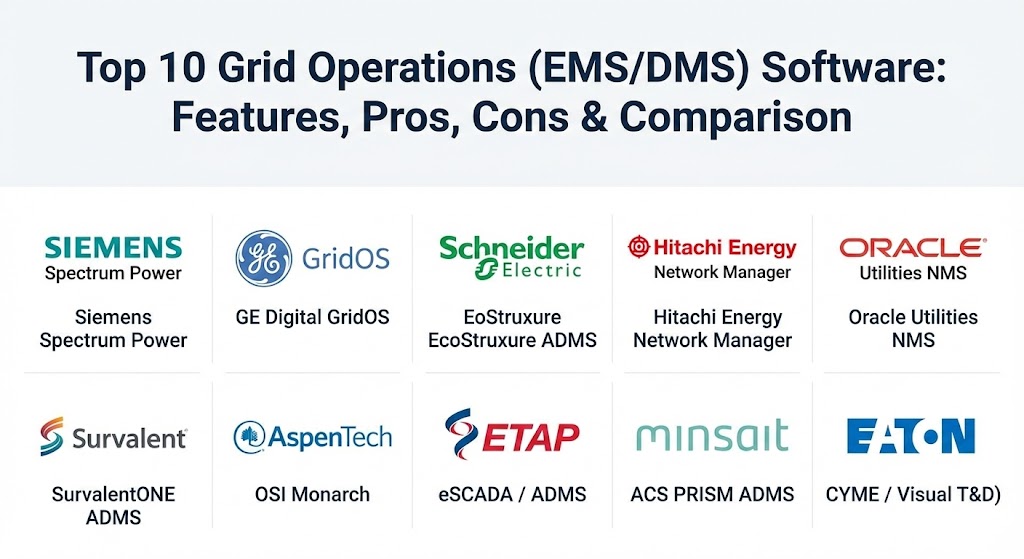
Top 10 Grid Operations (EMS/DMS) Software
1 — Siemens Spectrum Power
Siemens Spectrum Power is a highly modular and scalable platform used by some of the largest grid operators in the world. It is known for its ability to handle both transmission (EMS) and distribution (DMS) within a single, unified architectural framework.
- Key features:
- Unified environment for EMS, DMS, and Outage Management (OMS).
- Advanced Wide Area Monitoring Systems (WAMS) for early warning.
- Integrated Energy Market Management for trading and settlement.
- AI-driven load and generation forecasting.
- High-fidelity digital twin modeling for grid simulations.
- Seamless integration with Siemens and third-party SCADA hardware.
- Pros:
- Exceptionally robust for massive, multi-national grid interconnections.
- Modular design allows utilities to add features as their grid matures.
- Cons:
- Extremely complex deployment requiring highly specialized engineers.
- High total cost of ownership compared to more lightweight solutions.
- Security & compliance: Full NERC CIP compliance, ISO 27001, and advanced multi-factor authentication for control room access.
- Support & community: Extensive global network of Siemens Energy experts, comprehensive training academies, and 24/7 mission-critical support.
2 — GE Digital GridOS
GE Digital’s GridOS is a modern, software-defined platform designed to orchestrate the “grid of the future.” It focuses heavily on data orchestration and the integration of renewables through its Advanced Distribution Management System (ADMS).
- Key features:
- Data fabric architecture that breaks down silos between IT and OT.
- Advanced Fault Location, Isolation, and Service Restoration (FLISR).
- Native Distributed Energy Resource Management System (DERMS) integration.
- Real-time “orchestration” of behind-the-meter assets.
- Mobile-first interface for field crews and control room operators.
- Predictive analytics for weather-related outage prevention.
- Pros:
- Best-in-class for managing high penetrations of solar, wind, and EVs.
- Highly modern, user-friendly interface that reduces operator fatigue.
- Cons:
- The transition to the new GridOS platform can be a hurdle for legacy GE users.
- Requires a significant investment in data cleanup and integration.
- Security & compliance: Built on a “Zero Trust” security model; NERC CIP and SOC 2 compliant.
- Support & community: Strong user group community and deep integration partnerships with major cloud providers like AWS.
3 — Schneider Electric EcoStruxure ADMS
Schneider Electric is a perennial leader in the ADMS space, consistently ranked #1 for its completeness of vision. Its EcoStruxure platform provides a deeply integrated suite for monitoring, analysis, and optimization of the distribution network.
- Key features:
- World-leading Volt-VAR Optimization (VVO) for energy efficiency.
- Unified SCADA, DMS, and OMS on a single network model.
- Advanced “What-If” study modes for planning and real-time operations.
- Native integration with Schneider’s vast portfolio of smart sensors.
- Comprehensive DERMS capabilities for grid-edge management.
- Automated switching plan generation and validation.
- Pros:
- Proven track record in hundreds of utilities worldwide; very stable.
- Excellent visibility into the “low voltage” side of the distribution grid.
- Cons:
- Can feel a bit “closed” if you aren’t using other Schneider products.
- Complexity in managing the underlying GIS (Geographic Information System) data.
- Security & compliance: Adheres to IEC 62443 and NERC CIP; includes robust encryption for all field communications.
- Support & community: Massive global footprint with localized support in nearly every country; very active developer ecosystem.
4 — Hitachi Energy Network Manager
Following the acquisition of ABB’s Power Grids business, Hitachi Energy’s Network Manager has become a powerhouse for managing massive transmission and distribution infrastructures.
- Key features:
- High-performance SCADA with sub-second data processing.
- State Estimation and Contingency Analysis for transmission stability.
- Integrated Outage Management System with mobile workforce tools.
- Support for “islanding” and microgrid control.
- Advanced Market Management System for large-scale energy hubs.
- Cyber-security monitoring built directly into the grid controllers.
- Pros:
- Unmatched reliability for mission-critical transmission operations.
- Deep expertise in high-voltage DC (HVDC) and offshore wind integration.
- Cons:
- Administrative tools can be less intuitive than modern cloud-native rivals.
- Licensing and maintenance costs are among the highest in the industry.
- Security & compliance: Rigorous NERC CIP compliance and FIPS 140-2 encryption.
- Support & community: Backed by the massive Hitachi global research and development engine; premium enterprise support.
5 — Oracle Utilities Network Management System (NMS)
Oracle’s NMS is a specialized, data-heavy platform that excels in outage management and the orchestration of complex network activities for large-scale utilities.
- Key features:
- Industry-leading Outage Management System (OMS) capabilities.
- Advanced Switching Management for high-risk operations.
- Deep integration with Oracle’s Customer Information System (CIS).
- Distributed Energy Resource (DER) awareness and control.
- Real-time storm management and crew tracking dashboards.
- Analytics-driven “Self-Healing” grid functionality.
- Pros:
- Best-in-class integration between grid operations and customer billing/care.
- Highly scalable for utilities with millions of customer end-points.
- Cons:
- Primarily a “DMS/OMS” focused tool; less emphasis on high-end EMS transmission.
- Requires a significant amount of Oracle database and infrastructure expertise.
- Security & compliance: Leverage’s Oracle’s “Hardened” cloud and database security; NERC CIP and GDPR ready.
- Support & community: Extensive Oracle Utilities user group; robust documentation and global support.
6 — SurvalentONE ADMS
Survalent is the “agile” choice in the market, providing a highly integrated ADMS that is significantly easier to deploy and manage than the legacy “Big Four” platforms.
- Key features:
- Native SCADA, OMS, and DMS on a single database.
- Easy-to-use graphical map interface with “Google Maps” feel.
- Automated Fault Location and Isolation (FLISR).
- Integrated customer communication tools for outage updates via SMS/Web.
- Lightweight architecture that runs on standard Windows servers.
- Quick deployment cycles (months instead of years).
- Pros:
- Outstanding value; provides 80% of the features of the giants at a fraction of the cost.
- Highly praised for its customer support and ease of configuration.
- Cons:
- Not designed for managing massive, multi-region transmission networks.
- Advanced “What-If” analysis is not as deep as Siemens or Schneider.
- Security & compliance: NERC CIP compliant; simplified security auditing for smaller utilities.
- Support & community: Dedicated “Survalent University” for training; very high customer satisfaction ratings.
7 — AspenTech OSI Monarch
OSI (Open Systems International), now part of AspenTech, is famous for its “Monarch” architecture, which offers a high-performance, open-standard platform for all aspects of grid management.
- Key features:
- High-performance real-time data processing (one of the fastest in the world).
- Advanced Transmission Management (EMS) with deep stability analysis.
- Modular “plug-and-play” ADMS components.
- Support for “Next-Generation” SCADA protocols.
- Integrated Digital Twin for predictive maintenance of grid assets.
- Multi-platform support including Linux and Windows.
- Pros:
- Extremely fast and responsive system; low latency in the control room.
- “Open” philosophy makes it easier to integrate with third-party software.
- Cons:
- The transition under AspenTech ownership has some users watching for roadmap changes.
- User interface is highly functional but lacks the modern “visual flair” of GridOS.
- Security & compliance: ISO 27001, NERC CIP, and rigorous “Defense-in-Depth” security layers.
- Support & community: Strong reputation for technical excellence and “engineer-to-engineer” support.
8 — ETAP eSCADA / ADMS
ETAP is the industry standard for power system design and analysis. Its expansion into real-time ADMS allows engineers to take their “design models” and use them to manage the actual grid in real-time.
- Key features:
- Intelligent Load Shedding and restoration logic.
- Real-time State Estimation and Power Flow.
- Advanced Microgrid and DER controller integration.
- Automated “Islanding” detection and management.
- High-fidelity simulation of renewable energy assets.
- Integrated Sequence-of-Events (SOE) recording.
- Pros:
- The most accurate “modeling” engine in the industry.
- Ideal for industrial microgrids and large campus environments.
- Cons:
- Historically an engineering tool, so the control-room UI can be data-dense.
- Lacks the deep Outage Management (OMS) history of Oracle or Schneider.
- Security & compliance: SOC 2, ISO 9001, and NERC CIP compliant architecture.
- Support & community: World-class technical training and an massive global community of power engineers.
9 — Minsait ACS PRISM ADMS
Minsait (an Indra company) offers the PRISM platform, which is designed for utilities looking for a modular, high-performance way to manage increasingly complex distribution networks.
- Key features:
- Advanced Distribution Network modeling and analysis.
- Integrated Fault Detection, Isolation, and Restoration (FDIR).
- Volt-VAR management for loss reduction.
- DER integration and hosting capacity analysis.
- Unified SCADA/DMS/OMS visualization.
- Comprehensive historical archiving and reporting.
- Pros:
- Very strong for mid-sized utilities in the EMEA and LATAM markets.
- Modular approach allows for a “pay-as-you-grow” implementation.
- Cons:
- Brand recognition is lower in the North American market.
- Ecosystem of third-party “ready-made” connectors is smaller than GE or Siemens.
- Security & compliance: Adheres to international cybersecurity standards (IEC) and NERC CIP.
- Support & community: Strong localized support in Europe and South America.
10 — Eaton (CYME / Visual T&D)
Eaton’s presence in the grid management space is anchored by its world-class analysis software (CYME) and its real-time grid monitoring tools, creating a bridge between electrical hardware and digital control.
- Key features:
- World-class distribution network analysis and protection coordination.
- Hosting capacity analysis for new solar and EV installations.
- Real-time network visualization and contingency assessment.
- Integrated GIS mapping for asset location.
- Load flow and short-circuit study automation.
- Advanced analytics for predicting equipment health.
- Pros:
- Unrivaled for distribution planning and “what-if” impact studies.
- Deeply integrated with Eaton’s ubiquitous electrical hardware.
- Cons:
- Not a traditional “full-suite” EMS for high-voltage transmission.
- Real-time operations capabilities are newer than the core “analysis” engine.
- Security & compliance: Robust cybersecurity features built into the hardware/software layer; NERC CIP ready.
- Support & community: Massive global service network; very strong reputation for hardware-software synergy.
Comparison Table
| Tool Name | Best For | Platform(s) Supported | Standout Feature | Rating (Gartner/TrueReview) |
| Siemens Spectrum | Large TSOs/Global Grids | Linux, Windows | Energy Market Management | 4.7 / 5 |
| GE Digital GridOS | Renewable Integration | Cloud-Native, Hybrid | Data Fabric Architecture | 4.6 / 5 |
| Schneider EcoStrux | Distribution Efficiency | Windows, SaaS | Volt-VAR Optimization | 4.8 / 5 |
| Hitachi Energy | High-Voltage / HVDC | Windows, Linux | Sub-second SCADA Speed | 4.5 / 5 |
| Oracle Utilities | Customer-Centric Ops | Linux, Oracle Cloud | Outage/Crew Management | 4.5 / 5 |
| SurvalentONE | SMB Utilities / Co-ops | Windows | Single-Database Integration | 4.6 / 5 |
| AspenTech OSI | Performance / Openness | Multi-Platform | Monarch Speed/Latency | 4.4 / 5 |
| ETAP ADMS | Microgrids / Engineering | Windows | Design-to-Ops Twin | 4.7 / 5 |
| Minsait ACS | Modular EMEA/LATAM | Linux, Windows | Modular ADMS Growth | 4.3 / 5 |
| Eaton / CYME | Dist. Network Analysis | Windows | Protection Coordination | 4.5 / 5 |
Evaluation & Scoring of Grid Operations Software
| Category | Weight | Evaluation Criteria |
| Core Features | 25% | Real-time SCADA, FLISR, VVO, and State Estimation accuracy. |
| Ease of Use | 15% | Control room ergonomics, mobile support, and dashboard clarity. |
| Integrations | 15% | Interoperability with GIS, CIS, and third-party smart meters (AMI). |
| Security & Compliance | 10% | NERC CIP compliance, multi-factor authentication, and encryption. |
| Reliability | 10% | High-availability (HA) performance and sub-second failover. |
| Support & Community | 10% | Training availability, global footprint, and user group activity. |
| Price / Value | 15% | Total cost of ownership vs. grid stability improvements. |
Which Grid Operations Tool Is Right for You?
- Transmission System Operators (TSOs): You need high-end EMS stability and market management. Siemens Spectrum Power or Hitachi Energy Network Manager are the primary contenders for high-voltage reliability.
- Large Distribution Utilities (DSOs): If your focus is on outages and customer satisfaction, Oracle NMS or Schneider Electric EcoStruxure provide the best tools for managing millions of endpoints.
- Municipalities & Electric Co-ops: If you have a small IT team and need a tool that “just works,” SurvalentONE is frequently cited as the easiest to maintain and most cost-effective.
- Microgrids & Industrial Sites: For campus-level grids with high reliability needs, ETAP offers the most precise modeling for balancing local generation with grid constraints.
- The “Future-Proof” Utility: If your goal is to manage a complex mix of solar, batteries, and EVs, GE Digital GridOS offers the most modern, software-defined approach to grid orchestration.
Frequently Asked Questions (FAQs)
1. What is the difference between EMS and DMS? EMS (Energy Management System) is for high-voltage transmission grids and power plants. DMS (Distribution Management System) is for medium/low voltage distribution networks that deliver power to homes.
2. What does ADMS stand for? Advanced Distribution Management System. it is a single platform that combines DMS, Outage Management (OMS), and SCADA into one unified system.
3. What is NERC CIP compliance? It is a set of cybersecurity requirements designed to secure the North American bulk power system. Any grid software used in North America must comply with these strict standards.
4. How does these tools help with renewable energy? They use AI and DERMS (Distributed Energy Resource Management Systems) to predict when solar and wind will fluctuate and automatically adjust the grid to prevent instability.
5. Can I run these in the cloud? Most modern systems (like GE GridOS or Oracle NMS) offer cloud or hybrid options. However, many utilities still prefer on-premise for “Critical Infrastructure” security.
6. What is FLISR? Fault Location, Isolation, and Service Restoration. It is an automated feature that detects a power outage, isolates the broken segment, and restores power to everyone else in seconds.
7. How much does ADMS software cost? For a mid-sized utility, implementation can range from $1M to $10M+, depending on the number of endpoints, integrations (GIS/AMI), and high-availability requirements.
8. Do these systems replace SCADA? No. SCADA provides the communication layer (the nerves). The EMS/DMS/ADMS acts as the brain that analyzes that data and makes decisions.
9. What is a “Digital Twin” in grid operations? It is a virtual, real-time copy of the physical grid. Operators can run simulations on the twin to see what happens before they make a change to the real system.
10. How long does it take to implement an ADMS? Large enterprise rollouts typically take 18 to 36 months due to the complexity of data migration from GIS and integration with thousands of field devices.
Conclusion
Grid Operations software has moved from a “nice-to-have” monitoring tool to a mission-critical orchestration platform. As the world electrifies everything from heating to transport, the ability to “see” and “control” the grid in real-time is the only way to ensure reliability. The best choice depends on your grid’s specific complexity—whether you need the massive scale of Siemens, the distribution finesse of Schneider, or the agile efficiency of Survalent.