Introduction
Energy Trading & Risk Management (ETRM) refers to an integrated suite of software solutions designed to support the commercial decision-making and market execution involved in buying, selling, and moving energy commodities. Unlike generic financial trading systems, ETRM platforms are uniquely built to handle the physical realities of energy, such as pipeline capacity, power grid constraints, and storage tank levels.
The importance of these tools has skyrocketed in 2026 as the energy transition accelerates. Real-world use cases include managing complex Power Purchase Agreements (PPAs), hedging against price spikes in the LNG market, and automating regulatory reporting for carbon credits. When evaluating an ETRM system, users must look for “front-to-back” transparency, the ability to calculate Value-at-Risk (VaR) in real-time, and seamless integration with market data feeds and ERP systems.
Best for: Large-scale utilities, independent power producers (IPPs), multi-commodity trading houses, and large industrial energy consumers who need to hedge their exposure to volatile energy prices.
Not ideal for: Small businesses with static energy contracts or organizations that only deal with a single commodity in low volumes, where the high cost and complexity of an ETRM might outweigh the benefits.
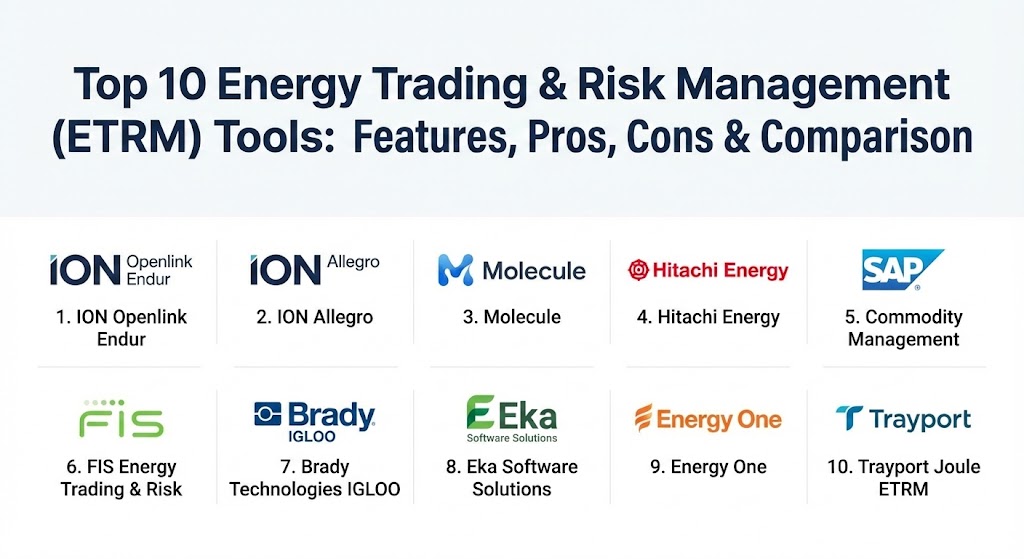
Top 10 Energy Trading & Risk Management (ETRM) Tools
1 — ION Openlink Endur
Openlink Endur is widely considered the “gold standard” for enterprise-level energy trading. It is an extremely deep, multi-commodity platform used by the world’s largest banks, utilities, and energy majors.
- Key features:
- Comprehensive coverage for power, gas, oil, coal, and environmental products.
- Advanced risk analytics including Monte Carlo simulations for VaR.
- Highly configurable “front-to-back” trade lifecycle management.
- Real-time P&L (Profit and Loss) and exposure tracking.
- Sophisticated physical logistics and scheduling for pipelines and grids.
- Integration with major financial accounting and ERP systems.
- Pros:
- Unmatched depth of functionality; there is virtually no trade structure it cannot handle.
- Strong global presence with a massive ecosystem of consultants and certified experts.
- Cons:
- Extremely high cost of ownership and complex implementation cycles.
- The user interface can feel overwhelming for smaller, more focused trading teams.
- Security & compliance: SOC 1/2, FIPS 140-2, GDPR, HIPAA, and robust audit trails for Dodd-Frank and EMIR.
- Support & community: Extensive enterprise support, global training centers, and a mature peer community through ION’s user groups.
2 — ION Allegro
Allegro (now under the ION umbrella) is known for its modular architecture and flexibility. It is particularly strong in the North American power and gas markets and has made significant strides in renewable energy management.+1
- Key features:
- Modular design allowing companies to purchase only the components they need.
- Horizon platform offers a modern, cloud-native web interface.
- Strong emphasis on “what-if” scenario analysis and stress testing.
- Automated regulatory reporting for FERC, CFTC, and other bodies.
- Excellent credit risk management and collateral tracking.
- Native support for complex renewable certificates (RECs) and carbon offsets.
- Pros:
- Faster implementation times compared to other high-end enterprise solutions.
- Highly extensible; users can build custom “Class Events” to tailor the system.
- Cons:
- As the tool expands, keeping custom modules updated can be a technical challenge.
- Some legacy components still exist within the newer web-based framework.
- Security & compliance: ISO 27001, SOC 2 Type II, SSO, and granular role-based access controls (RBAC).
- Support & community: Robust documentation and a dedicated support portal with 24/7 global availability.
3 — Molecule
Molecule is the leader of the “modern ETRM” movement. It is a cloud-native, SaaS-only platform designed to be implemented in weeks rather than months, focusing on a clean user experience and automated data feeds.
- Key features:
- “Big Data” backend that calculates risk and P&L instantly on every trade.
- Automated market data integration with ICE, CME, and various ISOs.
- Sleek, intuitive UI that requires minimal training for new users.
- Out-of-the-box support for power, gas, and environmental commodities.
- Integrated “Electra” module for power-specific nuances like hourly pricing.
- Pros:
- The easiest ETRM to set up and use; ideal for companies moving off spreadsheets.
- Transparent, subscription-based pricing with no hidden implementation fees.
- Cons:
- Less flexible than Allegro or Endur for extremely exotic physical deal structures.
- Focused primarily on the North American and European markets.
- Security & compliance: SOC 2 Type II, AES-256 encryption, and 100% cloud-based security posture.
- Support & community: High-touch customer success teams and a modern help center with video tutorials.
4 — Hitachi Energy (RiskTracker)
Hitachi Energy provides a suite of TRM (Trading and Risk Management) solutions that are deeply integrated with the physical operations of power grids and utilities.
- Key features:
- Deep focus on power generation and utility-scale portfolio optimization.
- Integrated weather data and load forecasting modules.
- Strong physical asset management (hydro, thermal, wind, solar).
- Comprehensive credit risk and market risk analytics.
- Designed to handle the transition to high-penetration renewable grids.
- Pros:
- Excellent for companies that own physical assets and need to optimize their dispatch.
- Backed by Hitachi’s deep expertise in electrical engineering and grid technology.
- Cons:
- Can feel “too industrial” for pure financial energy traders.
- Integration with non-Hitachi hardware/software can require custom middleware.
- Security & compliance: NERC CIP compliant, ISO 27001, and enterprise-grade encryption.
- Support & community: Global service network with specialized engineers for different energy sectors.
5 — SAP Commodity Management
For organizations already running on SAP S/4HANA, SAP’s ETRM and Commodity Management solution offers the tightest possible integration with financial accounting and supply chain logistics.
- Key features:
- Native integration with SAP S/4HANA Finance and Logistics.
- Single source of truth for both financial and physical data.
- Automated settlement and invoicing directly within the ERP.
- Global compliance coverage for tax and regulatory requirements.
- Robust Treasury and Risk Management (TRM) integration for hedging.
- Pros:
- Eliminates the need for complex interfaces between the trading desk and the back office.
- Scalable for global conglomerates operating across dozens of countries.
- Cons:
- Can be rigid; making changes outside the standard SAP framework is difficult.
- Requires a significant investment in SAP-specific IT talent.
- Security & compliance: World-class SAP security framework, SOC 1/2/3, GDPR, and HIPAA.
- Support & community: One of the world’s largest software support networks and a massive global community.
6 — FIS Energy Trading & Risk (Aligne)
The FIS Aligne platform is an integrated suite that covers the full range of front-to-back office activities for power, gas, and oil markets.
- Key features:
- Comprehensive physical scheduling for power and gas.
- Advanced “position management” for complex portfolios.
- Integrated credit risk and financial reporting.
- Support for multi-currency and multi-language operations.
- Strong focus on European market specificities like REMIT compliance.
- Pros:
- Very stable and reliable; a “safe pair of hands” for mid-to-large utilities.
- Good balance between physical logistics and financial risk management.
- Cons:
- The user interface is functional but lacks the modern aesthetic of SaaS rivals.
- Implementation can be slower due to the depth of the legacy codebase.
- Security & compliance: FIPS 140-2, SOC 1/2, and global regulatory reporting modules.
- Support & community: High-quality enterprise support with dedicated account managers.
7 — Brady Technologies (IGLOO)
Brady Technologies is a UK-based provider that has recently pivoted toward cloud-native solutions with their IGLOO platform, targeting the fast-paced European power markets.
- Key features:
- Specialized in short-term and intraday power trading.
- Cloud-native SaaS architecture for rapid scaling.
- Native connectivity to European exchanges like Nord Pool and EPEX SPOT.
- Automated nomination and scheduling for European power grids.
- High-performance calculation engine for real-time exposure.
- Pros:
- One of the best options for intraday power traders in the UK and Europe.
- Very clean, modern interface designed for fast-paced trading environments.
- Cons:
- Limited focus on North American power markets compared to ION or Molecule.
- Primarily a power and gas tool; less emphasis on crude oil or soft commodities.
- Security & compliance: ISO 27001, GDPR, and secure API-based architecture.
- Support & community: Strong European presence with a focused, expert support team.
8 — Eka Software Solutions
Eka is a cloud-based commodity management platform that leverages AI and machine learning to provide deeper insights into the energy supply chain.
- Key features:
- AI-driven predictive analytics for price and demand forecasting.
- Unified platform for ETRM, CTRM, and supply chain management.
- Mobile-first design for monitoring portfolios on the go.
- Real-time dashboards with customizable “app” widgets.
- Strong ESG (Environmental, Social, and Governance) tracking features.
- Pros:
- The most “advanced” use of AI in the current ETRM market.
- Very flexible; users can pick and choose specific “apps” for their workflow.
- Cons:
- The vast amount of data and options can be overwhelming if not configured correctly.
- Some users report a steep learning curve for the advanced AI modules.
- Security & compliance: SOC 2 Type II, GDPR, and end-to-end data encryption.
- Support & community: Fast-growing community with a strong focus on digital transformation.
9 — Energy One (enTrader)
Energy One is a leading provider for the UK, European, and Asia-Pacific markets, offering a highly reliable and focused ETRM suite.
- Key features:
- Multi-commodity support with a focus on regional energy markets.
- Integrated “enVoy” tool for communications with grid operators.
- Robust settlement and invoicing for retail and wholesale energy.
- Support for 5-minute and 30-minute power settlement periods.
- Comprehensive environmental certificate management.
- Pros:
- Excellent regional expertise, especially for the Australian (AEMO) and UK (Elexon) markets.
- Very high reliability; widely used by major retailers and generators.
- Cons:
- Not as widely used in the United States; lacks native integrations for some US ISOs.
- The core platform is very traditional and less “dynamic” than Molecule or Eka.
- Security & compliance: ISO 27001, GDPR, and regional market-specific security audits.
- Support & community: High customer retention and expert regional support teams.
10 — Trayport (Joule ETRM)
Trayport’s Joule is ubiquitous on European trading floors. While primarily a trading screen, its ETRM extensions provide a seamless flow from execution to risk management.
- Key features:
- Industry-standard execution platform for European energy markets.
- Real-time price discovery and liquidity access.
- Integrated position management and simple risk tracking.
- Seamless STP (Straight Through Processing) from the trade screen to the back office.
- Support for power, gas, and coal trading.
- Pros:
- If you are a European trader, you are likely already using the UI; minimal training needed.
- Unbeatable connectivity to European energy brokers and exchanges.
- Cons:
- Not a full-scale enterprise ETRM like Endur; it lacks deep physical logistics.
- Focus is almost exclusively on the trading “moment” rather than long-term asset optimization.
- Security & compliance: MiFID II compliant, secure API integration, and enterprise RBAC.
- Support & community: Massive user base in Europe with extensive peer-to-peer support.
Comparison Table
| Tool Name | Best For | Platform(s) Supported | Standout Feature | Rating (Gartner Peer Insights) |
| Openlink Endur | Global Enterprise | Windows, Web, Cloud | Depth of Risk Analytics | 4.5 / 5 |
| ION Allegro | Modular / Oil & Gas | Web, Cloud-Native | Customizable “Class Events” | 4.6 / 5 |
| Molecule | Modern SaaS / Power | Web-Based (SaaS) | Rapid Implementation | 4.8 / 5 |
| Hitachi Energy | Physical Assets / Grid | Web, On-Prem | Grid Optimization Focus | 4.4 / 5 |
| SAP Commodity | SAP Ecosystem | S/4HANA ERP | ERP Integration | 4.3 / 5 |
| FIS Aligne | Mid-to-Large Utilities | Windows, Web | Physical Scheduling | 4.2 / 5 |
| Brady IGLOO | Intraday Power | Web-Based (SaaS) | European Market Speed | 4.4 / 5 |
| Eka Software | AI / Data Insights | Web, Mobile | Machine Learning Analytics | 4.5 / 5 |
| Energy One | UK / APAC Markets | Windows, Web | Regional Market Expertise | 4.6 / 5 |
| Trayport Joule | Execution / Trading | Desktop, Web | Liquidity Connectivity | 4.4 / 5 |
Evaluation & Scoring of Energy Trading & Risk Management (ETRM)
| Category | Weight | Evaluation Criteria |
| Core Features | 25% | Multi-commodity support, physical logistics, and real-time risk (VaR) calculations. |
| Ease of Use | 15% | Modernity of UI, speed of navigation, and requirements for specialized training. |
| Integrations | 15% | Connectivity to exchanges (CME, ICE), ISOs, ERPs, and market data feeds. |
| Security | 10% | Encryption, SSO, SOC compliance, and audit trails for regulatory bodies. |
| Performance | 10% | Speed of the calculation engine and stability during high-volume periods. |
| Support | 10% | Documentation quality, global 24/7 support availability, and vendor reputation. |
| Price / Value | 15% | Implementation costs, subscription fees, and long-term ROI. |
Which ETRM Tool Is Right for You?
- Solo Users & Boutique Traders: If you are a small team trading financial energy, Molecule or Trayport Joule are the most logical starting points. They offer high power without the million-dollar price tag.
- Small to Medium Businesses (SMBs): Growing utilities should look toward Brady Technologies or Eka. These platforms allow you to scale your features as your portfolio grows without needing a 20-person IT department.
- Mid-Market Utilities: If physical logistics and grid nominations are your priority, Energy One or FIS Aligne provide the necessary regional expertise and stability.
- Large Multi-National Enterprises: If you are managing billions in assets across multiple continents, Openlink Endur or SAP Commodity Management are the only systems with the sheer depth required to consolidate that data.
- Renewables & ESG Focused: For those purely in the green space, ION Allegro and Eka have the most robust tracking for environmental certificates and carbon credits.
Frequently Asked Questions (FAQs)
1. What is the difference between ETRM and CTRM? ETRM (Energy Trading and Risk Management) focuses specifically on energy commodities like power, gas, and oil. CTRM (Commodity Trading and Risk Management) is a broader term that includes metals, agriculture, and other commodities.+1
2. Can an ETRM handle renewable energy intermittency? Modern ETRMs use high-resolution data (hourly or 5-minute intervals) and weather integration to help forecast and manage the risks associated with wind and solar variability.
3. Why is “Value-at-Risk” (VaR) so important in energy? VaR is a statistical measure that tells a trader the maximum potential loss over a specific timeframe with a given confidence level. In the volatile energy market, knowing your “worst-case scenario” is vital for survival.
4. How long does a typical implementation take? SaaS tools like Molecule can be up in 6–10 weeks. Enterprise systems like Endur or SAP can take 12–24 months for a full global rollout.
5. Do these tools integrate with Excel? Most ETRMs allow for data export to Excel, and some offer “live” Excel plugins, allowing traders to keep their favorite spreadsheet models while using the ETRM as the secure database.
6. Is cloud-based ETRM safe? Yes. In 2026, cloud-based ETRMs often have higher security standards (SOC 2, ISO 27001) than aging on-premise servers. However, some large utilities still prefer on-premise for strict grid security reasons.
7. Can an ETRM help with carbon credit trading? Yes, leading tools have added specific modules to track the “lifecycle” of a carbon credit, from its generation (e.g., a wind farm) to its retirement or sale.
8. What are “Physical Logistics” in an ETRM? This includes tracking the actual movement of energy—nominating gas on a pipeline, scheduling power on a grid, or managing the “bill of lading” for an oil tanker.
9. Why are these tools so expensive? You aren’t just paying for code; you are paying for a massive library of mathematical models, regulatory report templates, and pre-built connections to global markets that cost millions to maintain.
10. Can I build my own ETRM in-house? While possible, it is extremely risky. Most companies that try eventually switch to a commercial vendor because keeping up with changing market rules and exchange protocols is a full-time software job.
Conclusion
The energy landscape of 2026 is unrecognizable from that of a decade ago. As we shift toward a decentralized, decarbonized grid, the “best” ETRM is no longer just the one with the most buttons—it is the one that can turn massive amounts of data into actionable insights in seconds. Whether you choose the enterprise power of Endur, the modern speed of Molecule, or the AI-driven depth of Eka, ensure that your choice aligns with your long-term digital transformation strategy.