Introduction
Carbon accounting platforms are specialized software solutions designed to help organizations measure, report, and reduce their greenhouse gas (GHG) emissions. Much like financial accounting software tracks the flow of dollars, these platforms track “carbon equivalents” (CO2e) across an organization’s entire value chain. They automate the complex process of mapping activity data (like electricity bills or shipping logs) to scientifically validated emission factors, providing a “single source of truth” for a company’s carbon footprint.
The importance of these tools lies in their ability to provide “audit-ready” data. Without a centralized platform, companies often struggle with fragmented data silos, leading to “greenwashing” risks and regulatory non-compliance. Key real-world use cases include calculating “Scope 3” supply chain emissions, setting Science Based Targets (SBTi), and preparing investor-grade ESG reports. When evaluating these tools, users should look for deep integration capabilities, a robust library of emission factors, and advanced scenario modeling to help plot a path toward Net Zero.
Best for: Sustainability officers, CFOs, and operations leads at medium to large-scale enterprises that face complex regulatory reporting requirements or pressure from investors to disclose precise climate risks.
Not ideal for: Very small businesses with simple operations (e.g., a single-office service firm) where a basic manual calculator or free online tool would suffice without the overhead of an enterprise SaaS subscription.
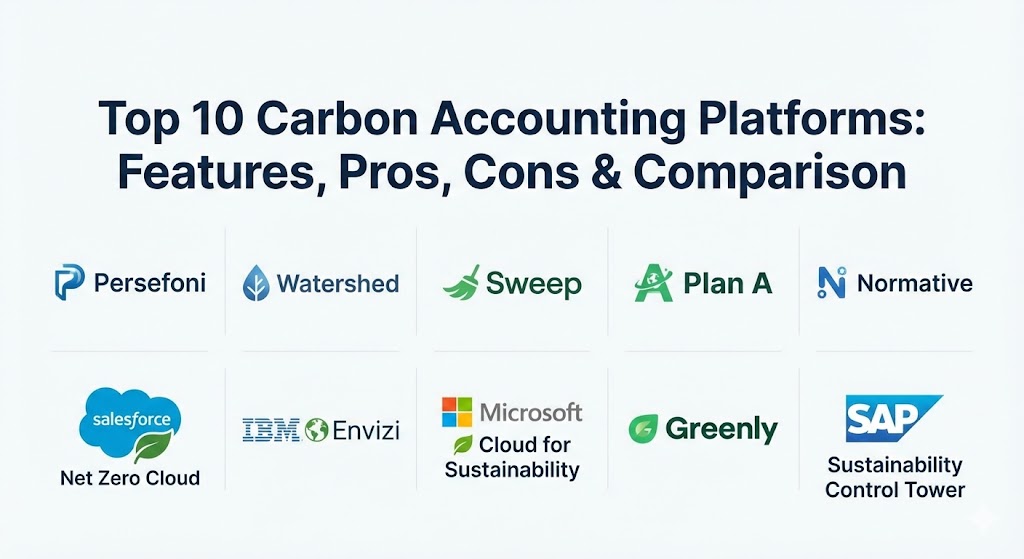
Top 10 Carbon Accounting Platforms
1 — Persefoni
Persefoni is often cited as the “gold standard” for carbon accounting within the financial sector. It is designed to mirror the rigor of financial accounting, making it a favorite for CFOs who require “investor-grade” data.
- Key features:
- Financial-grade carbon accounting based on the GHG Protocol.
- Specialized modules for “financed emissions” (PCAF standard).
- Automated data validation to catch anomalies in bulk uploads.
- Climate risk management and disclosure reporting templates.
- Benchmarking tools to compare footprints against industry peers.
- Pros:
- Unmatched precision for banks, private equity, and insurance firms.
- Extremely high levels of auditability for regulatory compliance.
- Cons:
- High price point compared to entry-level competitors.
- May be overly complex for non-financial service organizations.
- Security & compliance: SOC 1 Type II, SOC 2 Type II, GDPR, and ISO 27001.
- Support & community: Enterprise-tier support with dedicated account managers and access to climate policy experts.
2 — Watershed
Watershed is a high-powered climate platform built for modern, fast-moving enterprises. It focuses on driving real-world decarbonization rather than just static reporting.
- Key features:
- Automated data ingestion from ERP, utility, and travel systems.
- Massive database of granular, science-based emission factors.
- Integrated supply chain engagement tools for primary Scope 3 data.
- Marketplace for high-quality carbon removals and clean energy.
- Real-time dashboards for tracking progress toward science-based targets.
- Pros:
- Exceptionally polished user interface and executive-ready reporting.
- Strong emphasis on action and reduction, not just measurement.
- Cons:
- Primarily focused on large, global enterprises; can be “too much tool” for smaller firms.
- Rapid feature rollout means the documentation sometimes lags behind the software.
- Security & compliance: SOC 2, HIPAA, and GDPR compliant.
- Support & community: Active user community and world-class onboarding services.
3 — Sweep
Sweep positions carbon management as a collaborative activity, using a “Sweep Tree” structure to assign emissions ownership across large, distributed teams.
- Key features:
- Collaborative “Sweep Trees” for mapping emissions to specific teams or entities.
- Robust Scope 3 tracking across complex global supply chains.
- Integrated ESG data management beyond just carbon.
- Public-facing sustainability portals for stakeholder transparency.
- No-code automation for data collection workflows.
- Pros:
- Best-in-class for internal engagement and delegating responsibility.
- Highly flexible and scalable for multi-national conglomerates.
- Cons:
- The tree-based architecture requires careful initial planning and setup.
- Reporting modules can feel less “financial-grade” than Persefoni.
- Security & compliance: SOC 2 Type II, GDPR, and ISO 27001.
- Support & community: Strong European presence with extensive multi-lingual support and documentation.
4 — Plan A
Plan A is a Berlin-based platform that blends AI-driven carbon accounting with personalized decarbonization services, making it a leader in the European market.
- Key features:
- AI-powered data mapping and anomaly detection.
- Automated CSRD and sustainability reporting modules.
- Decarbonization “Pathways” that simulate ROI for reduction initiatives.
- Employee engagement tools to foster a “green culture.”
- Deep focus on EU regulatory frameworks.
- Pros:
- Exceptional for companies needing to comply with strict European mandates.
- The AI-driven data cleansing significantly reduces manual labor.
- Cons:
- Less focus on “financed emissions” compared to US-based rivals.
- Some advanced features are heavily geared toward the EMEA region.
- Security & compliance: TÜV-certified, SOC 2, and GDPR compliant.
- Support & community: Excellent advisory-led support with subject matter specialists.
5 — Normative
Normative is built on a foundation of scientific accuracy, using a massive database of 30 million+ data points to provide highly granular calculations.
- Key features:
- Scientific carbon accounting engine with rigorous data validation.
- Deep Scope 3 coverage focused on high-polluting hotspots.
- Automated gap-filling using industry averages where data is missing.
- Visual reduction roadmaps and benchmarking.
- Direct alignment with the Science Based Targets initiative (SBTi).
- Pros:
- Extremely reliable for identifying specific areas of the supply chain to optimize.
- Very transparent about the scientific methodologies used.
- Cons:
- The interface is more technical and “data-heavy” than Watershed.
- Can take longer to see actionable insights due to the depth of analysis.
- Security & compliance: GDPR, encryption at rest, and regular third-party audits.
- Support & community: Strong academic and scientific community backing.
6 — Salesforce Net Zero Cloud
Built directly on the Salesforce platform, Net Zero Cloud is the ideal choice for organizations already using Salesforce for their CRM or operations.
- Key features:
- Seamless integration with Salesforce CRM and Slack.
- Supplier Sustainability Portals for collecting direct Scope 3 data.
- “What-if” analysis for carbon reduction scenario modeling.
- Integrated dashboards for water and waste management.
- Pre-built Einstein AI for sustainability insights.
- Pros:
- Quick implementation for existing Salesforce customers.
- Leverages the world-class security and scalability of the Salesforce ecosystem.
- Cons:
- Requires a Salesforce environment to function optimally.
- Can be expensive if you aren’t already an “all-in” Salesforce user.
- Security & compliance: SOC 2, HIPAA, ISO 27001, and FedRAMP.
- Support & community: Massive global partner network and “Trailhead” learning paths.
7 — IBM Envizi ESG Suite
IBM Envizi is a robust, enterprise-grade solution that focuses on managing the vast amounts of data generated by global organizations.
- Key features:
- Centralized data management across 500+ different data types.
- Energy management tools for real-time facility monitoring.
- Audit-ready reporting for frameworks like TCFD, SASB, and GRI.
- Advanced analytics powered by IBM Watson.
- Support for multi-currency and multi-language global reporting.
- Pros:
- Highly scalable for the world’s largest, most complex corporations.
- Strongest platform for companies that also need deep energy management.
- Cons:
- The UI can feel “traditional” and less agile than modern SaaS startups.
- Complex configuration process often requires external consulting.
- Security & compliance: SOC 2, ISO 27001, and enterprise-grade encryption.
- Support & community: Global 24/7 support and deep technical documentation.
8 — Microsoft Cloud for Sustainability
This platform leverages Microsoft’s massive cloud infrastructure to provide a unified data lake for sustainability metrics.
- Key features:
- Integration with Microsoft 365, Azure, and Dynamics 365.
- Sustainability Manager for automated emissions data collection.
- Microsoft Fabric integration for advanced data analytics.
- “Environmental Credit Service” for managing carbon offsets.
- Copilot (AI) integration for querying sustainability data.
- Pros:
- Native integration with the tools your IT team already manages.
- Strongest option for data-heavy companies using Azure.
- Cons:
- Still a relatively new and evolving product compared to specialists.
- Best features are locked behind the premium licensing tiers.
- Security & compliance: Meets all major global cloud standards (ISO, SOC, FedRAMP).
- Support & community: Backed by the global Microsoft support and partner network.
9 — Greenly
Greenly focuses on making carbon accounting accessible and fast for SMEs and technology companies through a “spend-based” approach.
- Key features:
- Rapid spend-based footprinting via bank and accounting software sync.
- Integrated library of 100,000+ emission factors.
- Supplier engagement surveys and scorecards.
- Industry-specific templates for tech, retail, and manufacturing.
- Mobile app for on-the-go tracking.
- Pros:
- One of the fastest implementation times in the market.
- Lower cost of entry makes it ideal for startups and mid-market firms.
- Cons:
- Spend-based calculations are generally less accurate than activity-based.
- Lacks some of the deep “heavy industrial” features of IBM or SAP.
- Security & compliance: GDPR, SOC 2, and secure API data handling.
- Support & community: Helpful onboarding and a growing library of “green” resources.
10 — SAP Sustainability Control Tower
For large industrial and manufacturing companies running on SAP, the Sustainability Control Tower provides the deepest level of operational integration.
- Key features:
- Native integration with SAP S/4HANA and SAP ERP data.
- Real-time tracking of carbon, waste, and social metrics.
- Integrated financial and non-financial reporting.
- Regulatory reporting support for over 20 global frameworks.
- Process-level emissions tracking for manufacturing.
- Pros:
- Unrivaled “traceability” from the raw material to the final report.
- Best choice for the “Global 2000” that already rely on SAP.
- Cons:
- Extremely high implementation cost and complexity.
- Effectively a “closed” ecosystem; not ideal if you don’t use SAP ERP.
- Security & compliance: Top-tier enterprise security and global compliance.
- Support & community: Extensive SAP support ecosystem and certified partner network.
Comparison Table
| Tool Name | Best For | Platform(s) Supported | Standout Feature | Rating (Gartner Peer Insights) |
| Persefoni | Financial Institutions | Web / Cloud | PCAF “Financed Emissions” | 4.7 / 5 |
| Watershed | Large Modern Enterprise | Web / SaaS | Decarbonization Marketplace | 4.8 / 5 |
| Sweep | Collaborative Teams | Web / Cloud | “Sweep Trees” Hierarchy | 4.6 / 5 |
| Plan A | EU Compliance | Web / SaaS | AI Data Anomaly Detection | 4.5 / 5 |
| Normative | Scientific Accuracy | Web / Cloud | 30M+ Emission Points | 4.4 / 5 |
| Salesforce | Current Salesforce Users | Salesforce / Cloud | Native CRM Integration | 4.5 / 5 |
| IBM Envizi | Global Operations | Web / SaaS | Energy & Asset Monitoring | 4.3 / 5 |
| Microsoft | Azure / MS Ecosystem | Azure / Cloud | Microsoft Fabric Analytics | 4.4 / 5 |
| Greenly | SMBs / Tech Startups | Web / Mobile | Spend-Based Quick Sync | 4.6 / 5 |
| SAP | Large Industrials | SAP Ecosystem | S/4HANA ERP Integration | 4.2 / 5 |
Evaluation & Scoring of Carbon Accounting Platforms
To choose the right platform, organizations must weigh technical depth against operational ease. The following rubric provides a framework for internal scoring.
| Category | Weight | Evaluation Criteria |
| Core Features | 25% | Scope 1-3 coverage, library depth, and target-setting tools. |
| Ease of Use | 15% | UI clarity, onboarding speed, and dashboard customization. |
| Integrations | 15% | Connections to ERP, travel, utility, and financial software. |
| Security | 10% | SOC 2 / ISO certifications, audit trails, and data privacy. |
| Performance | 10% | Calculation speed, data validation accuracy, and scalability. |
| Support | 10% | Access to climate experts, help desk, and community forums. |
| Price / Value | 15% | Licensing cost vs. time saved and compliance risk mitigated. |
Which Carbon Accounting Platform Tool Is Right for You?
The “right” platform is often determined by your data maturity and your primary reporting goal.
- Solo Users vs SMBs: If you are a small company just starting out, Greenly is excellent because it syncs with your bank data to give you a baseline in hours.
- Mid-Market Companies: If you have multiple departments but don’t need a full ERP integration, Sweep or Normative offer the right balance of collaboration and data depth.
- Enterprise Giants: For those with massive global footprints, the choice often falls on your existing ecosystem. If you are an “IBM shop,” Envizi is the natural fit. If you are a “Microsoft shop,” Microsoft Cloud for Sustainability is the logical path.
- The “CFO First” Approach: If your primary concern is the SEC or investor audits, Persefoni is the safest choice due to its financial-grade architecture.
- The “Planet First” Approach: If you want to aggressively reduce emissions and buy carbon removals, Watershed offers the best marketplace and action-oriented tools.
Frequently Asked Questions (FAQs)
1. What is the difference between spend-based and activity-based carbon accounting? Spend-based accounting estimates emissions based on the dollars spent (e.g., $100 on fuel), while activity-based accounting uses the physical unit (e.g., 50 liters of fuel). Activity-based is far more accurate but harder to collect.
2. Can these platforms track Scope 3 emissions? Yes, all the top platforms now prioritize Scope 3 (value chain) emissions. They use a combination of supplier surveys and “gap-filling” models to estimate impact where direct data is missing.
3. Do I need a sustainability expert to run these tools? While the tools automate much of the work, you will likely still need a dedicated “owner” (like a Sustainability Manager or an ESG-focused accountant) to ensure the data inputs are correct and to act on the insights.
4. How long does implementation typically take? For a mid-sized company using a spend-based tool, you can be up and running in 2–4 weeks. For a global enterprise requiring deep ERP integration, it can take 6 months or more.
5. Are these tools audit-ready? The top-tier tools (Persefoni, Watershed, IBM) provide full audit trails, meaning an external auditor can click on any number in a report and see exactly where the source data came from and what emission factor was used.
6. Will these tools help me comply with the EU’s CSRD? Yes. Platforms like Plan A and Sweep have built-in templates specifically designed for the European Corporate Sustainability Reporting Directive.
7. Can these platforms help with Science Based Targets (SBTi)? Most of these platforms allow you to set your base year and target year, then model various reduction scenarios to ensure your goals align with the 1.5∘C pathway required by the SBTi.
8. Is my data secure on these platforms? Since this data is highly sensitive (revealing your energy use, travel, and supply chain), these platforms use enterprise-grade security including SOC 2 compliance and AES-256 encryption.
9. Do I need to buy new hardware to use these tools? No. Almost all modern carbon accounting platforms are 100% cloud-based (SaaS) and accessible via a standard web browser.
10. How much does a carbon accounting platform cost? Pricing is highly variable but generally starts around $5,000/year for smaller firms and can exceed $100,000/year for global enterprises with complex supply chains.
Conclusion
Selecting a carbon accounting platform is a strategic decision that affects your compliance posture, your investor relations, and your long-term operational efficiency. There is no “one size fits all” winner; rather, there is a “best fit” for your specific industry and data ecosystem. The most important thing is to move from manual estimation to digital certainty—because in the coming years, carbon will be counted just as closely as cash.