Introduction
An Emergency Services Records Management System (RMS) is a secure, centralized software platform used by public safety agencies to store, retrieve, and analyze information related to incidents, arrests, investigations, and administrative operations. Unlike standard data entry tools, an RMS is built to withstand the rigors of field operations, offering mobile integration and rugged reliability. These systems act as a “single source of truth,” ensuring that dispatchers, officers in the field, and administrative staff are all working from the same real-time data.
The importance of a modern RMS cannot be overstated. It is essential for maintaining chain of custody, ensuring CJIS (Criminal Justice Information Services) compliance, and automating the complex reporting required by state and federal mandates (such as NIBRS or NFIRS). Key evaluation criteria include mobile functionality, ease of search, cross-agency data sharing, and robust audit trails. A top-tier RMS doesn’t just store data; it provides the analytical tools needed for predictive policing and resource allocation.
Best for: Municipal police departments, county sheriff’s offices, fire departments, and multi-agency regional dispatch centers. It is ideal for agencies looking to move away from paper-based reporting and toward data-driven decision-making.
Not ideal for: Small private security firms with no reporting mandates or community volunteer groups that do not handle sensitive legal or medical records. For these users, a basic incident logging app or simple project management software may suffice.
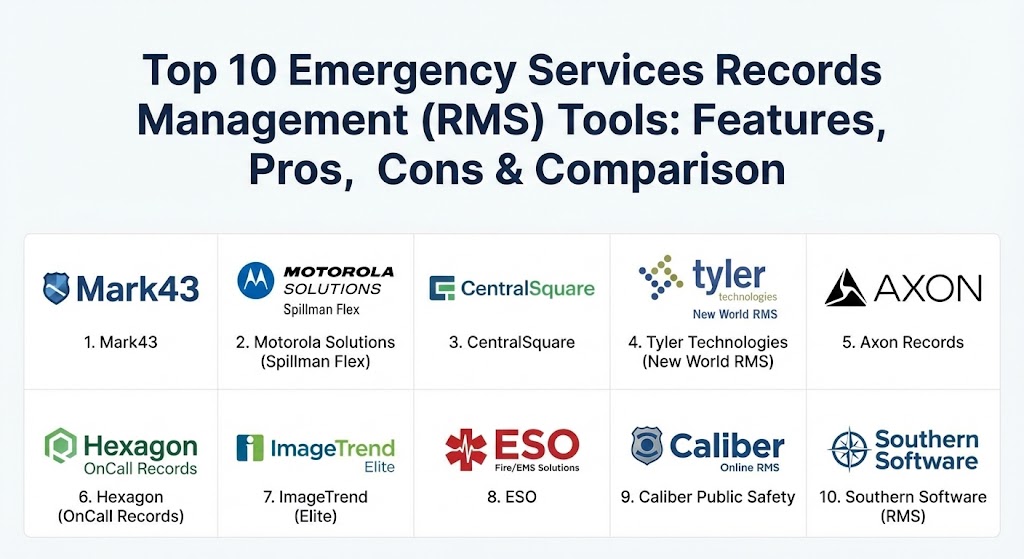
Top 10 Emergency Services Records Management (RMS) Tools
1 — Mark43
Mark43 is a cloud-native public safety platform designed to modernize the way agencies manage data. Built on AWS, it focuses on a “cloud-first” approach that ensures high availability and seamless updates without the need for on-site server maintenance.
- Key features:
- Cloud-native architecture with 99.99% uptime.
- Integrated CAD (Computer-Aided Dispatch) and RMS on a single platform.
- Automated NIBRS reporting to ensure state/federal compliance.
- Fast, Google-like search functionality across all records.
- Mobile-optimized for tablets and smartphones in the field.
- Robust data visualization tools for crime mapping.
- Pros:
- Eliminates the need for expensive on-premise hardware and local IT maintenance.
- The user interface is exceptionally modern and intuitive compared to legacy systems.
- Cons:
- Requires a stable and high-speed internet connection for full functionality.
- The transition from a legacy on-premise system to a cloud model can be a significant cultural shift for some agencies.
- Security & compliance: CJIS compliant, AWS GovCloud hosting, SOC 2 Type II, and FIPS 140-2 encryption.
- Support & community: 24/7/365 mission-critical support; extensive online academy for training and onboarding.
2 — Motorola Solutions (Spillman Flex)
Spillman Flex is a cornerstone of the public safety industry. Known for its deep integration and “single-source” data entry, it ensures that once information is entered, it is instantly available across all modules, from dispatch to jail management.
- Key features:
- Comprehensive suite covering CAD, RMS, Jail, and Mobile.
- Multi-jurisdictional data sharing across regional agencies.
- Advanced investigative tools, including link analysis and master indexes.
- Built-in evidence management and tracking.
- Support for fire and EMS reporting modules.
- Highly customizable dashboards for different user roles.
- Pros:
- The depth of the “Master Index” prevents duplicate entries and ensures data integrity.
- Extremely stable and time-tested in thousands of agencies across the U.S.
- Cons:
- The software can feel “heavy” and traditional compared to newer web-based platforms.
- Customizations and upgrades can be costly and time-consuming.
- Security & compliance: CJIS, HIPAA (for EMS), and NIBRS/NFIRS compliant.
- Support & community: Extensive user groups and regional training conferences; dedicated enterprise support teams.
3 — CentralSquare (Enterprise RMS)
CentralSquare provides a highly scalable RMS solution that caters to some of the largest metropolitan agencies in North America. It focuses on breaking down data silos to provide a 360-degree view of public safety.
- Key features:
- Enterprise-level scalability for cities with thousands of users.
- Deep GIS (Geographic Information System) integration for spatial analysis.
- Field reporting with offline capabilities for remote areas.
- Integrated document management for digital case files.
- Citizen engagement portal for online reporting.
- Automated validation for state and federal reporting mandates.
- Pros:
- Powerful analytical tools that help in resource planning and crime prevention.
- Excellent integration with third-party hardware like body-worn cameras.
- Cons:
- Implementation for large agencies can take 12-24 months.
- The complexity of the system requires a dedicated internal admin team.
- Security & compliance: CJIS, SOC 1/2, and FIPS 140-2 encryption.
- Support & community: Massive customer base with a dedicated “CentralSquare University” for training.
4 — Tyler Technologies (New World RMS)
Tyler Technologies’ New World RMS is designed to streamline the reporting process so officers can spend less time on paperwork and more time in the community. It emphasizes workflow efficiency and mobile accessibility.
- Key features:
- Decision-support tools that provide real-time alerts to field units.
- Integrated ESRI mapping for high-accuracy location data.
- Mobile messaging and status updates for better situational awareness.
- Comprehensive investigation management from crime scene to courtroom.
- Direct integration with Tyler’s court and corrections software.
- Automated NIBRS error-checking before submission.
- Pros:
- The “Tyler Drive” ecosystem allows for seamless data flow from the street to the judge.
- Very strong reporting engine for administrative and legislative audits.
- Cons:
- Can be expensive when purchasing the full suite of Tyler products.
- Some users find the interface to be data-dense and requiring significant training.
- Security & compliance: CJIS, HIPAA, and NIBRS compliant; secure cloud or on-premise deployment.
- Support & community: Strong presence at industry trade shows; 24/7 technical assistance.
5 — Axon Records
Axon, the company famous for TASERs and body cameras, has moved into the RMS space with a focus on “automating the report.” Axon Records leverages video data to reduce the manual burden of police report writing.
- Key features:
- Direct integration with Axon Body and Evidence.com.
- AI-assisted reporting (transcription and data extraction from video).
- Streamlined digital evidence management for prosecutors.
- Modern, web-based interface optimized for speed.
- Collaborative case management for multi-detective investigations.
- Cloud-based updates and scalability.
- Pros:
- Significantly reduces report writing time by pulling data directly from body-cam footage.
- Creates a “seamless thread” from the physical event to the digital record.
- Cons:
- Best suited for agencies already heavily invested in the Axon ecosystem.
- AI features are innovative but may require oversight for accuracy.
- Security & compliance: CJIS, ISO 27001, FedRAMP, and SOC 2 Type II.
- Support & community: Excellent customer success program; robust online support documentation.
6 — Hexagon (OnCall Records)
Hexagon’s OnCall Records is a flexible, browser-based solution that allows agencies to configure the system to their specific workflows without the need for custom coding.
- Key features:
- Browser-based client works on any device (PC, tablet, mobile).
- Highly configurable forms and fields to match local needs.
- Integrated search across multiple data sources (CAD, RMS, External).
- Task-driven workflows to guide officers through complex reports.
- Advanced administrative reporting and crime analysis.
- Multi-agency support with granular data-sharing controls.
- Pros:
- Very low administrative overhead due to the browser-based delivery model.
- Flexes easily to accommodate both small departments and large regional hubs.
- Cons:
- The initial configuration phase requires careful planning to get the workflows right.
- May lack some of the “legacy” deep-feature sets of more established competitors.
- Security & compliance: CJIS compliant; support for FIPS 140-2 and SSO.
- Support & community: Global presence with local support teams in many countries.
7 — ImageTrend (Elite)
While many RMS tools focus on police, ImageTrend Elite is a leader in the Fire and EMS space, specializing in electronic Patient Care Reporting (ePCR) and fire incident management.
- Key features:
- Specialized NEMSIS and NFIRS reporting for Fire/EMS.
- Real-time situational awareness for fire chiefs and medical directors.
- Integrated inventory and fleet management for emergency vehicles.
- Community health and paramedicine modules.
- Robust offline data entry for rural responses.
- Automated billing integration for EMS services.
- Pros:
- The gold standard for medical data accuracy and EMS compliance.
- Exceptional data visualization for tracking response times and health trends.
- Cons:
- Not designed for law enforcement; purely a Fire/EMS/Health solution.
- Can be overly complex for a small, volunteer-only fire department.
- Security & compliance: HIPAA, NEMSIS V3, NFIRS, and SOC 2 compliant.
- Support & community: Known for its annual “Connect” conference and high-touch customer support.
8 — ESO (Fire/EMS Solutions)
ESO is a data-driven company that provides a suite of software for Fire and EMS agencies, focusing heavily on analytics and improving patient outcomes through better records management.
- Key features:
- ESO EHR (Electronic Health Record) for advanced patient charting.
- Fire RMS for incident, inspections, and hydrants management.
- “Handoff” feature to share data directly with receiving hospitals.
- Personnel management and scheduling modules.
- Asset management to track medical supplies and equipment.
- Benchmarking tools to compare agency performance against national averages.
- Pros:
- Unrivaled focus on clinical data and patient outcomes.
- Very sleek, modern interface that first responders find easy to use on the move.
- Cons:
- Similar to ImageTrend, it lacks the law enforcement capabilities required for a “unified” city RMS.
- Pricing is modular, which can add up if you need the entire suite.
- Security & compliance: HIPAA, NEMSIS, and NFIRS compliant; secure cloud hosting.
- Support & community: Highly proactive support team and extensive webinars for training.
9 — Caliber Public Safety (Online RMS)
Caliber offers a cloud-based RMS designed for small to medium-sized agencies that need enterprise-level features without the enterprise-level price tag.
- Key features:
- Easy-to-deploy cloud infrastructure.
- Multi-jurisdictional data sharing (InterAct) built-in.
- Mobile field reporting with voice-to-text capabilities.
- Integrated evidence and property management.
- Automated state and federal reporting validations.
- Clean, simplified navigation for high-stress environments.
- Pros:
- Great “bang for the buck” for smaller agencies with limited budgets.
- Very fast implementation timeline compared to larger legacy rivals.
- Cons:
- May lack the deep custom analytics required by massive metro agencies.
- Limited third-party integration options compared to Axon or Motorola.
- Security & compliance: CJIS compliant and hosted in secure, redundant data centers.
- Support & community: High customer retention; personal, responsive support staff.
10 — Southern Software (RMS)
Southern Software is a regional powerhouse known for its “Southern Hospitality” approach to customer service and its straightforward, reliable RMS software.
- Key features:
- Master Name/Vehicle/Location indexing to reduce data entry.
- Integrated civil process and warrant tracking.
- Property and evidence management with barcode support.
- NIBRS/UCR reporting with built-in validation checks.
- Mobile field reporting for officers.
- Simple, flat-rate pricing models in many cases.
- Pros:
- Renowned for having the best customer support in the industry.
- The software is very stable and doesn’t require high-end hardware to run.
- Cons:
- Primarily focused on the Southeastern United States; limited presence elsewhere.
- UI looks a bit dated (Windows-classic style) compared to modern web apps.
- Security & compliance: CJIS compliant and supports all state-mandated reporting.
- Support & community: Famous for “real people” answering the phones within minutes.
Comparison Table
| Tool Name | Best For | Platform(s) Supported | Standout Feature | Rating (Gartner/TrueReview) |
| Mark43 | Modern/Cloud-First | Web, iOS, Android | Cloud-Native Agility | 4.7 / 5 |
| Spillman Flex | Multi-Agency Hubs | Windows (On-Prem) | Master Index Integrity | 4.5 / 5 |
| CentralSquare | Large Metro Cities | Web, Windows, Mobile | Scalability & GIS | 4.4 / 5 |
| Tyler New World | End-to-End Justice | Web, Windows, Mobile | Court System Integration | 4.3 / 5 |
| Axon Records | Video-Centric Policing | Web, Mobile | AI Report Automation | 4.6 / 5 |
| Hexagon OnCall | Configurable Workflows | Browser-Based | No-Code Configuration | 4.4 / 5 |
| ImageTrend Elite | Fire & EMS | Web, iOS, Android | Patient Care Focus | 4.7 / 5 |
| ESO | Data-Driven Fire/EMS | Web, Mobile | Hospital Data Handoff | 4.6 / 5 |
| Caliber RMS | SMB Agencies | Cloud / Web | Inter-Agency Sharing | 4.2 / 5 |
| Southern Software | Smaller Departments | Windows (On-Prem) | Exceptional Support | 4.5 / 5 |
Evaluation & Scoring of Emergency Services RMS
| Category | Weight | Evaluation Criteria |
| Core Features | 25% | NIBRS/NFIRS compliance, master indexing, mobile reporting, and case management. |
| Ease of Use | 15% | UI modernness, search speed, and the number of clicks to complete a report. |
| Integrations | 15% | Compatibility with CAD, Body-Worn Cameras, GIS, and Court systems. |
| Security & Compliance | 10% | CJIS, HIPAA, FIPS 140-2, and robust audit logging for legal integrity. |
| Performance | 10% | System uptime, mobile sync reliability, and search performance. |
| Support & Community | 10% | 24/7 availability, speed of response, and quality of training materials. |
| Price / Value | 15% | Implementation cost vs. time saved and hardware reduction (cloud vs. on-prem). |
Which Emergency Services RMS Tool Is Right for You?
Selecting an RMS is a 10-year decision for most agencies. It requires a deep look at both current needs and future technology trends.
- Solo Users (e.g., Private Investigators): You likely do not need a full Emergency Services RMS. Look for lightweight case management software designed for legal professionals.
- Small Municipalities (1-20 Officers): Priority should be on ease of use and low IT overhead. Caliber or Southern Software are excellent choices that provide essential features without overwhelming the staff.
- Mid-Market & Regional Centers: If you are sharing data across multiple towns, Spillman Flex or Mark43 provide the robust multi-jurisdictional “Master Index” needed to track suspects across city lines.
- Large Enterprises (Metros): For cities like Chicago or Dallas, CentralSquare and Tyler New World offer the massive scalability and deep GIS integrations required to manage thousands of calls per day.
- Specialized Fire/EMS: If your agency is not law-enforcement focused, do not buy a police RMS. Go with ImageTrend or ESO, which are built specifically for the clinical and tactical needs of fire and medical responders.
Frequently Asked Questions (FAQs)
1. What is CJIS compliance, and why does it matter? The Criminal Justice Information Services (CJIS) security policy ensures that sensitive fingerprint, criminal history, and incident data is handled securely. Any RMS must meet these standards to be legally used by law enforcement.
2. Is a cloud-based RMS secure? Yes, provided it uses GovCloud (like AWS or Azure Government). Cloud systems often offer better security than local servers because they are monitored 24/7 by cybersecurity experts.
3. What is NIBRS reporting? The National Incident-Based Reporting System (NIBRS) is the FBI’s standard for collecting crime data. Modern RMS tools automate this reporting to ensure the agency remains eligible for federal grants.
4. Can an RMS integrate with body-worn cameras? Yes, tools like Axon Records are built specifically to link video evidence directly to the written incident report, saving hours of manual data entry.
5. How long does it take to implement a new RMS? For a small agency, it may take 3-6 months. For large metropolitan areas, the process of data migration, training, and testing can take 12-24 months.
6. Can we share data with neighboring agencies? Most modern systems offer “data sharing” modules that allow agencies to see if a suspect in their town has a history in the next town over, provided both use compatible systems.
7. Does RMS software work offline? High-quality RMS tools offer “offline mobile reporting,” allowing officers in rural areas to write reports that automatically sync once they return to a cellular or Wi-Fi coverage area.
8. What is the difference between CAD and RMS? CAD (Computer-Aided Dispatch) is for “live” events—dispatching units to a call. RMS is for the “history”—recording what happened once the event is over.
9. Can Fire and Police use the same RMS? Yes, suites like Spillman or Tyler offer modules for both. However, Fire/EMS often prefer specialized tools like ESO for better clinical data management.
10. How much does an RMS cost? Pricing is typically based on the number of “sworn officers” or “total users.” It includes a large upfront implementation fee followed by annual maintenance or subscription costs.
Conclusion
The evolution of Emergency Services Records Management has moved from “digital filing cabinets” to proactive intelligence platforms. Whether you choose the cloud-native agility of Mark43, the video-integrated automation of Axon, or the time-tested reliability of Spillman, the goal remains the same: getting the right information to the right person at the right time. The “best” tool is the one that your officers will actually use—one that reduces their administrative burden so they can focus on protecting and serving their community.