Introduction
Facilities Space Planning Tools are specialized software solutions designed to help organizations visualize, allocate, and optimize their physical workspace. At their core, these tools act as a “digital twin” of a building, integrating CAD (Computer-Aided Design) floor plans with real-time occupancy data. They allow facility managers to move beyond spreadsheets, providing a centralized system to track square footage, department allocations, and desk availability.
The importance of these tools is rooted in data-driven efficiency. By analyzing how space is actually used versus how it was planned, companies can make informed decisions about renewing leases or consolidating floors. Key real-world use cases include “office restacking” during mergers, managing social distancing compliance, and implementing “hot-desking” strategies. When evaluating tools in this category, users should look for ease of floor plan integration, robust “what-if” scenario modeling, mobile accessibility for employees, and the ability to integrate with IoT occupancy sensors.
Best for: Corporate real estate directors, facility managers, and HR leaders in mid-to-large enterprises who need to manage complex hybrid work schedules, optimize high-cost real estate portfolios, and improve the employee onsite experience.
Not ideal for: Small businesses with a single, small office and static seating, or companies that operate entirely remotely and have no physical footprint to manage.
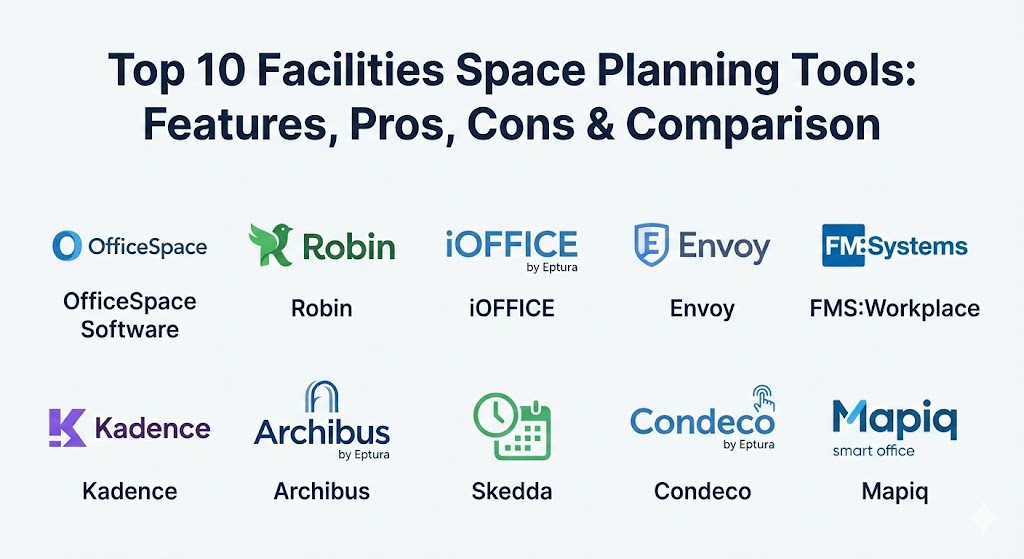
Top 10 Facilities Space Planning Tools
1 — OfficeSpace Software
OfficeSpace is a comprehensive platform built to simplify the complexities of the modern workplace. It is widely recognized for its highly visual interface and powerful “Scenario Planning” engine.
- Key features:
- Visual Directory for instant wayfinding and colleague location.
- Drag-and-drop Scenario Planning for modeling office moves.
- Advanced Move Management to coordinate relocations.
- Integrated desk and room booking modules.
- Robust occupancy and utilization analytics.
- Stacking and blocking tools for multi-floor planning.
- Pros:
- Exceptionally intuitive visual maps that require almost no training for end-users.
- Highly flexible “what-if” modeling that doesn’t affect the live environment.
- Cons:
- Can be more expensive than basic desk-booking apps.
- Advanced customization sometimes requires assistance from their support team.
- Security & compliance: SOC 2 Type II, GDPR compliant, SSO integration, and role-based access control.
- Support & community: Dedicated client success managers, extensive documentation, and an active user community.
2 — Robin
Robin focuses heavily on the “Workplace Experience,” making it a favorite for tech-forward companies that want to make the office a destination for collaboration.
- Key features:
- Interactive floor maps for real-time desk and room availability.
- “Abandoned Meeting Protection” to automatically release ghosted rooms.
- Comprehensive hybrid work scheduling for teams.
- Integration with Slack, Microsoft Teams, and Google Calendar.
- Detailed office usage and “busyness” reporting.
- Pros:
- Strong focus on the employee experience, making it easy for staff to book space.
- Simple, modern UI that is frequently updated with new features.
- Cons:
- Less focus on “heavy” architectural planning compared to Archibus.
- Reporting can be less granular for very complex real estate portfolios.
- Security & compliance: SOC 2 Type II, GDPR, and ISO 27001.
- Support & community: High-rated customer support and a well-maintained knowledge base.
3 — iOFFICE (by Eptura)
iOFFICE, now part of the Eptura family, is an enterprise-grade Integrated Workplace Management System (IWMS) that handles everything from space to mailrooms.
- Key features:
- Modular approach (Space, Move, Asset, Service Request).
- Integration with IoT sensors for live occupancy tracking.
- Advanced move management and automated floor plan updates.
- Employee mobile app for wayfinding and service requests.
- Deep analytics for real estate cost-justification.
- Pros:
- Extremely scalable; suitable for global organizations with millions of square feet.
- Part of the Eptura ecosystem, offering deep asset and maintenance integration.
- Cons:
- The interface can feel “industrial” and less “consumer-grade” than Robin or Envoy.
- Steep learning curve due to the sheer depth of features.
- Security & compliance: ISO 27001, SOC 1/2, HIPAA, and GDPR.
- Support & community: 24/7 global enterprise support and professional service options.
4 — Envoy
Envoy, originally famous for visitor management, has expanded into a unified “Workplace” platform that includes desk booking and space planning.
- Key features:
- Envoy Desks for easy map-based seat reservations.
- Integrated Visitor Management for a seamless front-desk experience.
- Occupancy dashboards that combine visitor and employee data.
- Workplace “health checks” and document verification.
- Room booking with tablet-based meeting status indicators.
- Pros:
- Best-in-class for combining security (visitors/delivery) with space planning.
- “Mobile-first” design that is very popular with employees.
- Cons:
- Lacks the deep architectural and “restacking” tools of dedicated IWMS.
- Analytics are geared toward daily usage rather than long-term real estate strategy.
- Security & compliance: SOC 2 Type II, GDPR, and HIPAA.
- Support & community: Excellent online chat support and a large library of tutorial videos.
5 — FMS:Workplace (FM:Systems)
FMS:Workplace is a modular solution designed to help facility managers gain better visibility into their space, assets, and operations.
- Key features:
- Space management with BOMA and IFMA standard support.
- Strategic planning for forecasting future space needs.
- Project management for renovations and construction.
- Mobile data collection for field facility audits.
- Integration with Revit and AutoCAD for floor plan accuracy.
- Pros:
- Highly configurable; can be tailored to very specific industry regulations (e.g., Higher Ed or Government).
- Strong focus on facility “lifecycle” from construction to decommissioning.
- Cons:
- Implementation can be lengthy and often requires specialized consultants.
- User interface is more traditional/legacy compared to modern SaaS.
- Security & compliance: FedRAMP authorized, ISO 27001, and SOC 2.
- Support & community: Robust training programs and a strong network of implementation partners.
6 — Kadence
Kadence is a rapidly growing tool that positions itself as an “Operating System for Hybrid Work,” focusing on how people coordinate their office time.
- Key features:
- Team coordination tools (“Who’s in when?”).
- Personal and team “neighbor” booking for collaboration.
- Interactive maps and booking rules (fair usage).
- Insights into team performance and space utilization.
- Simplified visitor and room management.
- Pros:
- Very affordable for mid-market companies.
- High emphasis on “team intentionality” rather than just room booking.
- Cons:
- Feature set is narrower than the legacy enterprise platforms.
- Newer to the market, so some integrations are still in development.
- Security & compliance: SOC 2, GDPR, and SSO support.
- Support & community: Personalized onboarding and highly responsive support team.
7 — Archibus (by Eptura)
Archibus is arguably the most powerful real estate and facility management platform in the world, used by organizations with vast, complex portfolios.
- Key features:
- BIM and 3D visualization for facilities.
- Full Lease and Real Estate portfolio management.
- Capital project and environmental sustainability tracking.
- Strategic space planning for multi-year forecasting.
- Operations and maintenance integration.
- Pros:
- The “gold standard” for depth; if a space planning feature exists, Archibus has it.
- Unrivaled for managing universities, hospitals, and government campuses.
- Cons:
- Extremely high complexity; often requires a full-time internal admin.
- High total cost of ownership (TCO).
- Security & compliance: FIPS 140-2, HIPAA, SOC 1/2, and ISO 27001.
- Support & community: Global user group (AUG) and massive partner ecosystem.
8 — Skedda
Skedda is a lightweight, highly automated booking platform that excels in environments where space needs to be reserved quickly and rules enforced strictly.
- Key features:
- Highly customizable “rules engine” for bookings.
- Interactive “bird’s-eye view” maps.
- Mobile-friendly interface with QR code check-ins.
- Automatic “no-show” cleanup to maximize room availability.
- Payment integration for shared/coworking spaces.
- Pros:
- One of the fastest implementation times in the industry.
- User-friendly for both staff and external “guests.”
- Cons:
- Lacks deep facility move management or architectural planning.
- Targeted more at “booking” than “strategic real estate planning.”
- Security & compliance: SOC 2 Type II and GDPR.
- Support & community: Excellent self-service documentation and responsive email support.
9 — Condeco (by Eptura)
Condeco provides a high-end, elegant solution for workspace scheduling, often used by professional services firms like banks and law offices.
- Key features:
- High-quality desk and room touchscreens (hardware).
- Deep Microsoft Outlook and Teams integration.
- Stacking and utilization dashboards.
- “Work from Home” vs “Office” status tracking.
- Visitor and hospitality management integrations.
- Pros:
- Hardware-software integration creates a very professional office look.
- Extremely strong integration with the Microsoft ecosystem.
- Cons:
- To get the best experience, you often need to purchase their proprietary hardware.
- Can feel expensive for companies that don’t need “executive-level” aesthetics.
- Security & compliance: ISO 27001, SOC 2, and GDPR.
- Support & community: Global 24/7 support with specialized enterprise accounts.
10 — Mapiq
Mapiq is a “smart office” platform from Europe that focuses on “activity-based working,” helping employees find the right type of space for their current task.
- Key features:
- Activity-based suggestions (quiet zones vs collaborative zones).
- Sensor-based utilization maps (live heatmaps).
- Clean, minimalist “employee journey” mobile app.
- Team “neighborhood” planning for hybrid teams.
- Global search for colleagues and amenities.
- Pros:
- Beautiful, modern design that employees actually enjoy using.
- Strong focus on data privacy and European compliance standards.
- Cons:
- Smaller footprint in North America compared to OfficeSpace or Robin.
- Requires sensor investment to unlock its full “smart office” potential.
- Security & compliance: ISO 27001 and GDPR (very high standards).
- Support & community: Direct support and tailored implementation for large corporate HQ projects.
Comparison Table
| Tool Name | Best For | Platform(s) Supported | Standout Feature | Rating (Gartner Peer Insights) |
| OfficeSpace | Visual Space Planning | Web, Mobile, SaaS | Drag-and-drop Scenarios | 4.7 / 5 |
| Robin | Employee Experience | Web, Mobile, Slack/Teams | Meeting Room Recovery | 4.6 / 5 |
| iOFFICE | Large Scale IWMS | Web, Mobile, IoT | Modular IWMS Breadth | 4.5 / 5 |
| Envoy | All-in-one Simplicity | Web, Mobile, Tablet | Visitor-Desk Integration | 4.4 / 5 |
| FMS:Workplace | Regulated Industries | Web, Mobile, Revit/CAD | Architectural Compliance | 4.5 / 5 |
| Kadence | Hybrid Coordination | Web, Mobile, Teams | Team Intentionality | 4.7 / 5 |
| Archibus | Complex Portfolios | Web, Mobile, On-Prem | 3D BIM Visualization | 4.1 / 5 |
| Skedda | Fast Implementation | Web, Mobile | Automated Rules Engine | 4.6 / 5 |
| Condeco | Professional Services | Web, Mobile, Hardware | Microsoft Ecosystem Sync | 4.4 / 5 |
| Mapiq | Smart Office / IoT | Web, Mobile, Sensors | Activity-Based Suggests | 4.6 / 5 |
Evaluation & Scoring of Facilities Space Planning Tools
The following rubric shows how enterprise-ready space planning tools are typically evaluated by decision-makers.
| Category | Weight | Evaluation Notes |
| Core Features | 25% | Capacity planning, floor plan editing, scenario modeling, and booking. |
| Ease of Use | 15% | Employee mobile experience and administrative learning curve. |
| Integrations | 15% | Sync with HRIS (Workday/ADP), Calendars, and IoT sensors. |
| Security & Compliance | 10% | SOC 2/ISO certifications, GDPR, and FedRAMP (for gov). |
| Performance | 10% | Reliability of live maps and speed of report generation. |
| Support & Community | 10% | Availability of training, documentation, and user groups. |
| Price / Value | 15% | Per-user vs per-desk vs per-square-foot pricing relative to ROI. |
Which Facilities Space Planning Tool Is Right for You?
Selecting a tool requires a balance between long-term strategic planning and daily operational efficiency.
- Solo Users vs SMBs: If you are a small startup, Skedda or Envoy are great because they are easy to set up and offer “freemium” or low-cost starter plans.
- Mid-market Companies: If your primary goal is coordinating a hybrid workforce, Robin or Kadence are ideal due to their focus on employee collaboration and “busyness” metrics.
- Large Enterprises: For those managing multiple campuses or high-rise buildings, OfficeSpace offers the best balance of visual planning and powerful move-management.
- Global Real Estate Portfolios: If you need to manage leases, construction, and facilities under one roof, Archibus or iOFFICE are the industry heavyweights.
- Government & Higher Ed: Look for FMS:Workplace because it handles the specific BOMA/IFMA standards and federal security requirements (FedRAMP) better than many SaaS-only tools.
Frequently Asked Questions (FAQs)
1. What is the difference between CAFM and IWMS? CAFM (Computer-Aided Facility Management) focuses mainly on space and assets. IWMS (Integrated Workplace Management System) is broader, including lease accounting, project management, and environmental sustainability.
2. Can I use these tools with my existing AutoCAD files? Yes, most enterprise tools like OfficeSpace and FMS:Workplace allow you to upload AutoCAD or Revit files to create accurate, interactive digital floor plans.
3. Do I need to install sensors to use these tools? No. Most tools can estimate usage based on “check-ins” or badge data. However, IoT sensors provide the most accurate, real-time “heat maps” of actual space utilization.
4. How do these tools help reduce real estate costs? They identify “dead space” (underutilized desks or conference rooms). This allows companies to consolidate floors or sublease unused areas, often saving millions in annual rent.
5. Are these tools accessible on mobile devices? Yes, almost all modern tools have “mobile-first” apps designed for employees to find colleagues or book desks while on the train or walking through the lobby.
6. Can these tools help with “Move Management”? Yes. Tools like OfficeSpace have dedicated workflows to plan “who sits where” in a new layout and then automate the communication to those employees about their new seats.
7. Is data privacy a concern with occupancy tracking? Most vendors anonymize occupancy data, meaning they track that a desk is used, not necessarily who is sitting there, ensuring compliance with privacy laws like GDPR.
8. What is “Scenario Planning”? It is the ability to create a copy of your office map and move departments around to see if they fit, without changing the live map that employees see.
9. Do these tools integrate with Slack or Microsoft Teams? Yes. Tools like Robin and Kadence allow employees to book a desk or check into a meeting directly within the chat platforms they already use every day.
10. How is this software typically priced? Pricing is usually based on either the number of desks managed, the total square footage, or the number of active employees. SaaS models typically charge an annual subscription.
Conclusion
The “best” facilities space planning tool is the one that bridges the gap between your real estate data and your employees’ daily needs. Whether you are looking for the architectural depth of Archibus or the employee-centric design of Robin, the key is to choose a platform that can scale with your organization’s hybrid journey. Space is your second largest expense—managing it with data is no longer optional.