Introduction
HOA/Condo management software is a specialized category of property management technology designed to handle the unique administrative, financial, and social needs of common-interest communities. Unlike standard rental software, these tools prioritize “association” workflows—such as assessment billing instead of rent, architectural review committees (ARC), violation tracking, and board-level transparency.
The importance of these tools lies in their ability to automate repetitive tasks like dues collection and notice distribution, which reduces human error and legal risk. Key real-world use cases include managing high-rise visitor access, facilitating digital voting for board elections, and tracking complex maintenance projects across multiple units. When evaluating tools in this category, users should look for robust accounting modules, mobile-first resident portals, transparent audit trails, and seamless integration with third-party banking and legal services.
Best for: Professional community management companies managing large portfolios, self-managed HOA boards looking for efficiency, and mid-to-large scale condominium complexes that require integrated communication and security tools.
Not ideal for: Individual landlords managing a single rental unit (who should look at standard rental software) or very small, informal associations with fewer than five units and no common area maintenance requirements.
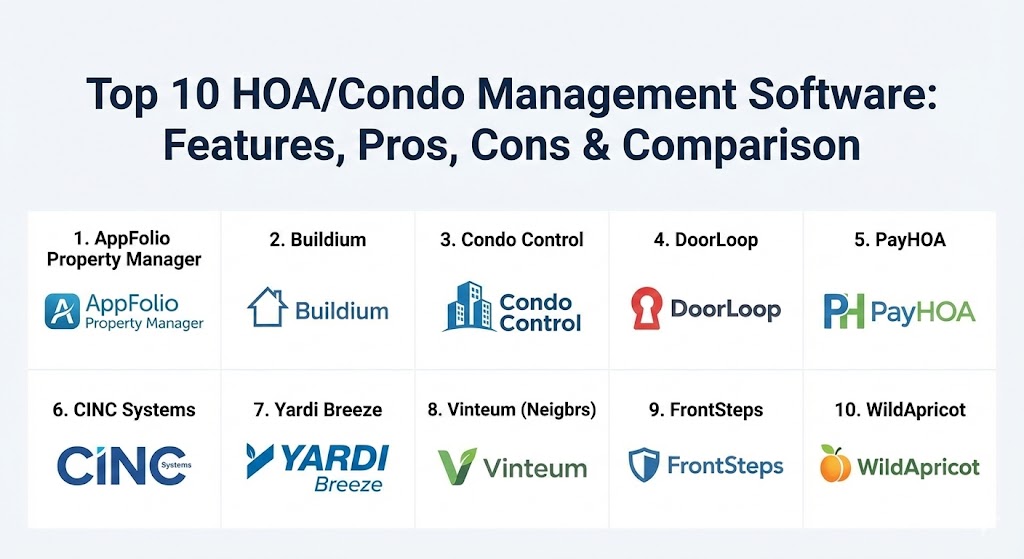
Top 10 HOA/Condo Management Software
1 — AppFolio Property Manager
AppFolio is widely considered the industry heavyweight for growing management companies. In 2026, it has solidified its position by integrating deep AI capabilities (AppFolio Stack™) to handle high-volume administrative tasks.
- Key features:
- AI-powered automated accounting and “smart” bill entry.
- Integrated architectural review and violation tracking workflows.
- Real-time board member dashboards and performance insights.
- Mobile app for on-site inspections and work order management.
- Resident portal for online payments and community announcements.
- Bulk SMS and email communication tools for rapid updates.
- Pros:
- Best-in-class automation that significantly reduces manual data entry.
- Extremely modern and intuitive user interface across all devices.
- Cons:
- High minimum monthly fees make it cost-prohibitive for very small associations.
- Can feel “over-engineered” for communities that only need basic dues collection.
- Security & compliance: SOC 2 Type II compliant, multi-factor authentication (MFA), and encrypted data storage.
- Support & community: Strong onboarding programs, a massive user university, and 24/7 enterprise support for high-tier plans.
2 — Buildium
Buildium, a RealPage company, offers a highly flexible all-in-one solution that strikes a balance between professional-grade features and ease of use. It is particularly popular among mid-market associations and multi-unit complexes.
- Key features:
- Comprehensive association accounting with 1099 e-filing.
- Built-in resident center for payments, documents, and communication.
- Specialized “Violations” module to track and resolve CC&R infractions.
- Public-facing community website builder for association transparency.
- Maintenance request tracking with integrated vendor management.
- Open API (Marketplace) for connecting third-party specialized apps.
- Pros:
- Excellent balance of price and feature depth for mid-sized portfolios.
- One of the most reliable and stable platforms with high uptime.
- Cons:
- Some advanced reporting features require moving to the higher “Growth” or “Premium” tiers.
- The setup process for complex accounting structures can take time.
- Security & compliance: Bank-grade encryption, PCI compliance for payments, and detailed audit logs.
- Support & community: Extensive “Buildium Academy” training and a highly responsive customer success team.
3 — Condo Control
As the name suggests, this platform is the gold standard for condominiums and high-rise living. It focuses heavily on the “concierge” and “resident experience” aspects of community management.
- Key features:
- Advanced visitor and parking management with security desk integration.
- Amenity booking system with automated rules and capacity limits.
- Digital voting and proxy management for board elections.
- Package tracking and automated notification system.
- Multi-language support to accommodate diverse urban populations.
- Incident reporting and security guard patrol tracking.
- Pros:
- The best tool for communities with physical security needs or complex amenities.
- Highly rated mobile experience for residents of all ages.
- Cons:
- Less focus on deep property accounting compared to AppFolio or Buildium.
- Pricing is generally quote-based, which can be confusing for small boards.
- Security & compliance: GDPR and HIPAA compliant options; role-based access control (RBAC).
- Support & community: Offers dedicated implementation managers and a strong library of video tutorials.
4 — DoorLoop
DoorLoop has emerged as the fastest-growing contender in the space due to its incredible speed, modern aesthetics, and aggressive pricing for smaller communities.
- Key features:
- Lightning-fast user interface designed for 2026 performance standards.
- Unlimited document storage and e-signature capabilities.
- Automated rent/dues collection via ACH, Credit Card, and Check.
- Customizable CRM for tracking member data and history.
- Built-in marketing tools for listing vacant units in managed condos.
- Interactive owner/resident portals for maintenance and billing.
- Pros:
- Extremely easy to set up; boards can go live in as little as 24 hours.
- Transparent pricing with no hidden setup fees.
- Cons:
- Lacks some of the “deep” HOA-specific features like architectural review tiers.
- Integration ecosystem is still smaller than legacy competitors.
- Security & compliance: SOC 2 Type II, SSO support, and 256-bit encryption.
- Support & community: Highly rated “personal” support with world-class response times.
5 — PayHOA
PayHOA is the leading solution for self-managed associations that want to professionalize their operations without hiring a full-service management company.
- Key features:
- Simplified “QuickBooks-style” accounting built for non-accountants.
- Automated dues invoicing and late fee application.
- Digital “Lockbox” service to digitize physical check payments.
- Violation tracking with photo evidence and letter templates.
- Resident directory and shared community calendar.
- Online storage for governing documents and meeting minutes.
- Pros:
- The most cost-effective and straightforward tool for volunteer boards.
- Purpose-built specifically for HOA workflows, avoiding “rental” clutter.
- Cons:
- Not suitable for massive professional management companies with thousands of units.
- Reporting is functional but lacks the high-level “portfolio” analytics of enterprise tools.
- Security & compliance: PCI Level 1 compliant payments and encrypted database backups.
- Support & community: Robust online help center and email/chat support tailored for volunteers.
6 — CINC Systems
CINC Systems is an enterprise-grade platform that prioritizes “banking-first” management. It is designed for large-scale management companies that need to manage hundreds of bank accounts simultaneously.
- Key features:
- Deep direct-banking integration with automatic reconciliation.
- Automated accounts payable and vendor invoice processing.
- Board member portal with one-click financial report generation.
- Integrated work order and violation tracking system.
- Scalable architecture for portfolios exceeding 10,000 units.
- Project management tools for large-scale community capital improvements.
- Pros:
- Unrivaled for financial accuracy and high-volume bank processing.
- Built by industry veterans specifically for professional CAMs.
- Cons:
- The user interface feels more like traditional software and has a steeper learning curve.
- Implementation is a significant project requiring dedicated staff time.
- Security & compliance: ISO 27001, SOC 1 & 2, and advanced fraud detection tools.
- Support & community: Offers “CINC University” and formal certification programs for managers.
7 — Yardi Breeze
Yardi Breeze is the “lite” version of the industry-leading Yardi Voyager, bringing enterprise-level reliability to small and mid-sized associations in a simplified cloud package.
- Key features:
- Clean, card-based dashboard for daily task management.
- Automated assessment billing and online payment processing.
- Tracking for unit ownership history and resident transitions.
- Basic violation and maintenance management modules.
- Mobile-optimized for boards to review reports on the go.
- Straightforward unit-based pricing model.
- Pros:
- Backed by the reliability and data security of the Yardi ecosystem.
- Ideal for associations that want “just the essentials” without complexity.
- Cons:
- Lacks the deep customization and AI features of Yardi Voyager or AppFolio.
- Integration with non-Yardi third-party apps is limited.
- Security & compliance: Tier 1 data center security, SOC 2, and regular penetration testing.
- Support & community: Live chat support and an extensive library of self-help articles.
8 — Vinteum (Neigbrs)
Vinteum focuses heavily on community engagement and transparency. It is the best choice for associations that prioritize “social harmony” and communication over just financial tracking.
- Key features:
- Customizable community websites with private resident-only sections.
- Automated voice calls and SMS alerts for emergency notifications.
- Social networking tools for interest groups (e.g., book clubs, gardening).
- Amenity booking and document sharing with version control.
- Detailed communication logs for legal and compliance disputes.
- Simplified “Concierge” module for deliveries and visitors.
- Pros:
- Exceptionally high resident adoption rates due to the “social” focus.
- One of the best support teams in the niche, often acting as a partner.
- Cons:
- Accounting features are basic; most users integrate it with QuickBooks.
- May feel too “informal” for strict, high-liability commercial associations.
- Security & compliance: Varies / Cloud-standard encryption; focus on privacy settings.
- Support & community: High-touch onboarding and proactive monthly check-ins.
9 — FrontSteps
FrontSteps is a specialized platform for gated communities and associations where physical security and access control are the primary concerns.
- Key features:
- Direct integration with gate hardware and license plate readers.
- Visitor management with temporary digital “guest passes.”
- Public safety and guard tour tracking capabilities.
- Integrated community website and mass communication suite.
- Online voting and architectural request management.
- Mobile app that acts as a “digital key” for residents.
- Pros:
- The only choice for communities where the “gate” is the center of operations.
- Strong focus on safety and reducing community liability.
- Cons:
- The hardware integration makes the initial setup more complex and expensive.
- Reporting on financial data is not as deep as accounting-first tools.
- Security & compliance: SOC 2 Type II; high-level physical-to-digital security protocols.
- Support & community: Specialized technical support for both software and gate hardware.
10 — WildApricot (by Personify)
While originally a membership management tool, WildApricot is frequently used by small HOAs and non-profits that operate like associations but lack the budget for traditional property software.
- Key features:
- Robust membership database with automated renewal reminders.
- Drag-and-drop website builder with mobile responsiveness.
- Event registration and ticketing for community gatherings.
- Online payment processing for dues and donations.
- Email marketing system with automated newsletters.
- Mobile app for members to check directories and pay bills.
- Pros:
- Highly affordable for very small associations (under 50 members).
- Excellent for communities that run frequent events or volunteer programs.
- Cons:
- Lacks property-specific features like violation tracking or unit history.
- No native “work order” system for building maintenance.
- Security & compliance: PCI DSS compliant and cloud-standard data protection.
- Support & community: Massive community of non-profit and association users.
Comparison Table
| Tool Name | Best For | Platform(s) Supported | Standout Feature | Rating (2026 Avg) |
| AppFolio | Large Management Co. | Web, iOS, Android | AI Smart Bill Entry | 4.45 / 5 |
| Buildium | Mid-Market / All-in-one | Web, iOS, Android | Violations Workflow | 4.4 / 5 |
| Condo Control | High-Rise / Concierge | Web, iOS, Android | Visitor/Parking Mgmt | 4.55 / 5 |
| DoorLoop | Speed / Modern UI | Web, iOS, Android | Fastest UI Performance | 4.65 / 5 |
| PayHOA | Self-Managed Boards | Web, Mobile Web | Digital Lockbox Service | 4.5 / 5 |
| CINC Systems | Banking-First Co. | Web, Desktop App | Automated Bank Recon | 4.1 / 5 |
| Yardi Breeze | Small HOAs / Essential | Web, iOS, Android | Yardi Trusted Security | 4.1 / 5 |
| Vinteum | Resident Engagement | Web, iOS, Android | Emergency Voice Alerts | 4.6 / 5 |
| FrontSteps | Gated Communities | Web, iOS, Android | Hardware Gate Integrations | 4.2 / 5 |
| WildApricot | Non-Profit / Events | Web, iOS, Android | Event Ticketing | 4.3 / 5 |
Evaluation & Scoring of HOA/Condo Management Software
To help boards and managers objectively evaluate their options, we have weighted the most critical categories based on the 2026 industry requirements.
| Category | Weight | Key Considerations |
| Core Features | 25% | Presence of violation tracking, ARC requests, and board portals. |
| Ease of Use | 15% | Adoption rates among non-technical residents and volunteer board members. |
| Integrations | 15% | Connectivity with banks, legal services, and hardware (e.g., gates). |
| Security & Compliance | 10% | SOC 2 status, encryption levels, and CCPA/GDPR adherence. |
| Performance & Reliability | 10% | Speed of the interface and historical uptime of the platform. |
| Support & Community | 10% | Availability of 24/7 help and depth of the training “University.” |
| Price / Value | 15% | Per-unit cost compared to the labor hours saved by automation. |
Which HOA/Condo Management Tool Is Right for You?
The right software is the one that your board will actually use and your residents will find helpful.
- Solo & Self-Managed Boards: If you are a volunteer treasurer for a 50-unit neighborhood, PayHOA or Yardi Breeze are your best options. They offer enough “guardrails” to keep you compliant without the complexity of an enterprise system.
- Professional Management Companies: If you are managing thousands of doors across different states, AppFolio or CINC Systems are necessary for the portfolio-level reporting and automated banking integration.
- High-Rise & Urban Condos: For buildings where the front desk is the “brain,” Condo Control is the logical choice. Its focus on visitor logs and amenity booking is unmatched.
- Budget-Conscious / Small Associations: For associations with under 25 units, WildApricot or the basic tier of DoorLoop provide the best ROI.
- Security-Focused Communities: Gated neighborhoods should prioritize FrontSteps to ensure that their software and physical security hardware are in sync.
Frequently Asked Questions (FAQs)
1. Does HOA software replace the need for an accountant?
Not necessarily. While tools like AppFolio automate daily bookkeeping, most associations still require a professional CPA for annual audits and tax filings. However, the software makes the CPA’s job significantly faster and cheaper.
2. Can residents pay dues with their smartphones?
Yes. In 2026, all top-tier HOA platforms offer a mobile-responsive portal or dedicated app where residents can pay via ACH, credit card, or digital wallets like Apple Pay.
3. Is our community data safe in the cloud?
Most leading platforms use enterprise-grade security (SOC 2, AWS/Azure servers). It is generally far safer than keeping data on a personal laptop or in a physical file cabinet.
4. How does the software handle rule violations?
Admins can take a photo of a violation (like an unkempt lawn) on their phone, and the software automatically matches it to the resident, generates a notice based on CC&R templates, and tracks the resolution timeline.
5. Can we use this for digital voting during annual meetings?
Yes. Tools like Condo Control and Buildium have built-in secure voting and proxy tracking that meets legal standards in most states, increasing quorum rates significantly.
6. What is the average implementation time?
For small HOAs, it takes 1–2 weeks. For large management companies with thousands of units, full data migration and staff training can take 3–6 months.
7. Do these tools integrate with QuickBooks?
Some do (like PayHOA and Vinteum), while others (like AppFolio and Buildium) are designed to replace QuickBooks with an all-in-one property-specific ledger.
8. Is there a free version of HOA software?
Some tools offer a limited free tier (e.g., Innago or basic WildApricot), but most associations eventually outgrow these once they require professional violation tracking or bulk communication.
9. How do we handle “technologically-challenged” residents?
Most modern software allows you to print physical letters or statements for specific residents while the majority of the community uses the digital portal, ensuring no one is left behind.
10. What is “Architectural Review” in the software?
This allows residents to submit plans for fences, patios, or home changes online. Board members then review the plans, leave notes, and vote on the approval within the platform, creating a legal paper trail.
Conclusion
Selecting an HOA/Condo management tool is a decision that affects the entire community’s quality of life and the association’s long-term financial health. The “best” tool is rarely the one with the most features, but rather the one that solves your board’s specific “stress points”—whether that is a lack of financial transparency, poor resident communication, or a nightmare-inducing gate system. In 2026, the standard for excellence is automation, mobile accessibility, and total transparency.