Introduction
A Pulse Survey Tool is a specialized software solution designed to send short, frequent questionnaires to employees to gauge their sentiment, engagement levels, and satisfaction in real time. Unlike comprehensive annual surveys that can take weeks to analyze, “pulses” typically consist of 1–15 questions delivered on a weekly, bi-weekly, or monthly cadence. By providing a continuous stream of feedback, these tools allow leadership to identify burnout, cultural friction, or management issues before they escalate into turnover.
The importance of these tools lies in their ability to foster transparency and trust. In a world where remote and hybrid work is the standard, pulse surveys bridge the physical gap between employees and management. Key real-world use cases include monitoring sentiment during organizational mergers, measuring the effectiveness of new wellness initiatives, and identifying specific bottlenecks in remote workflows. When evaluating these tools, users should prioritize anonymity protections, AI-driven sentiment analysis, ease of integration with communication platforms (like Slack or Teams), and “action planning” features that suggest concrete steps based on results.
Best for: HR leaders, People Ops managers, and department heads in organizations of 50+ employees who want to transition from static data to a dynamic, feedback-driven culture. It is particularly valuable for fast-growing startups and large enterprises with high-intensity work environments.
Not ideal for: Very small micro-teams (under 10 people) where direct, face-to-face communication is more effective, or highly traditional organizations that lack the resources or willingness to actually act on the feedback they receive.
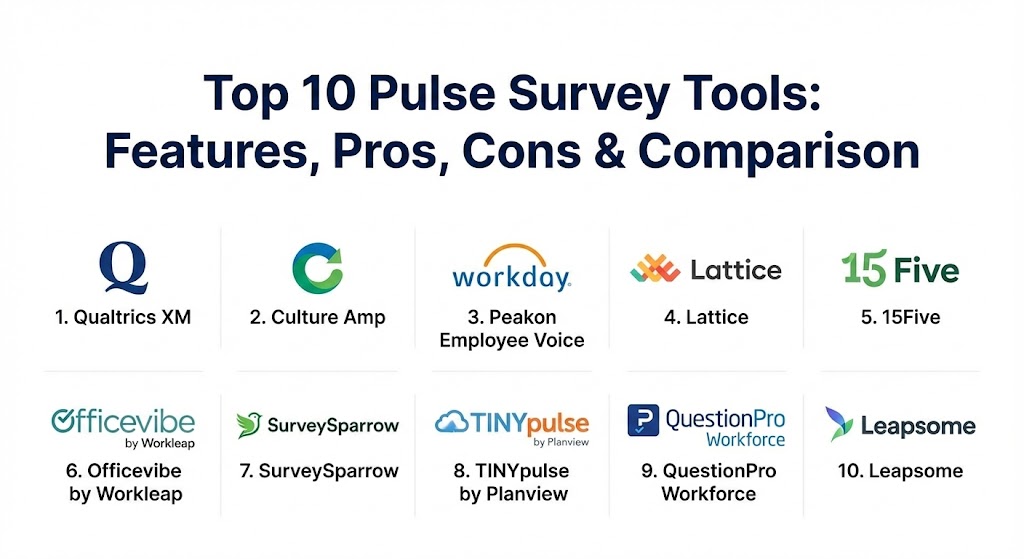
Top 10 Pulse Survey Tools
1 — Qualtrics XM (Employee Pulse)
Qualtrics is widely considered the “titan” of the experience management category. Its Employee Pulse solution is a sophisticated, enterprise-grade platform that uses advanced AI to correlate employee sentiment with actual business outcomes like revenue and productivity.
- Key features:
- AI-driven “iQ” analytics for automated sentiment and text analysis.
- Research-backed question libraries validated by industrial-organizational psychologists.
- Highly customizable dashboards that filter data by department, tenure, or geography.
- Predictive modeling to identify teams at high risk of attrition.
- Integrated action planning that assigns follow-up tasks to managers.
- Multi-channel distribution including email, SMS, and QR codes.
- Pros:
- Unmatched data depth and statistical rigor for large organizations.
- Extremely scalable, handling global workforces with 100,000+ employees.
- Cons:
- The platform is highly complex and usually requires a dedicated administrator.
- Pricing is at the highest end of the market, making it inaccessible for most SMBs.
- Security & compliance: SOC 2 Type II, ISO 27001, HIPAA, GDPR, and FedRAMP authorized. Includes enterprise-grade SSO.
- Support & community: Premier enterprise support, dedicated success managers, and the massive “XM Institute” for professional training.
2 — Culture Amp
Culture Amp focuses on “putting people first” by combining powerful data with a beautiful, user-centric interface. It is highly regarded for its educational resources that help HR teams turn raw scores into cultural transformations.
- Key features:
- Benchmark data from over 6,000 global companies to see how you compare.
- Automated pulse surveys triggered by employee lifecycle events (onboarding, exit).
- “Focus Agent” AI that highlights the one or two areas that will impact engagement most.
- Targeted action plans for managers based on team-specific scores.
- Heatmaps for visualizing sentiment across different demographic slices.
- Integration with performance management and development tools.
- Pros:
- The most intuitive and visually appealing interface for both admins and employees.
- Strong emphasis on education; the tool teaches managers how to be better leaders.
- Cons:
- Advanced features like benchmarking are locked behind higher-tier plans.
- Some users find the sheer amount of data options overwhelming at first.
- Security & compliance: SOC 2 Type II, GDPR compliant, and ISO 27001 certified.
- Support & community: Robust online community (“Culture First”) and world-class customer success teams.
3 — Workday Peakon Employee Voice
Peakon (acquired by Workday) is a leader in “intelligent listening.” It is designed to work autonomously, running pulse surveys in the background and delivering real-time insights directly to managers’ inboxes.
- Key features:
- Continuous, automated survey delivery with rotating questions to prevent fatigue.
- Real-time employee comments with the ability for managers to reply anonymously.
- Deep integration with the Workday HRIS ecosystem.
- AI-driven comment tagging to identify recurring themes instantly.
- Segment-level insights that protect employee anonymity at small team sizes.
- Executive-level dashboards for organizational health tracking.
- Pros:
- Truly automated; once configured, it requires very little manual HR oversight.
- The anonymous “two-way” conversation feature builds significant trust.
- Cons:
- Best value is only realized if you already use Workday as your HRIS.
- Setup can be rigid and difficult to customize for non-standard workflows.
- Security & compliance: Enterprise-grade security including SOC 2, ISO 27001, and full GDPR compliance.
- Support & community: Extensive documentation and enterprise-level customer success teams.
4 — Lattice
Lattice is a comprehensive people management platform that treats pulse surveys as one part of a larger performance ecosystem. It is ideal for companies that want to connect “how people feel” with “how people perform.”
- Key features:
- Pulse surveys that integrate directly into 1-on-1 meeting agendas.
- Research-backed templates for engagement, diversity, and remote work.
- Powerful filtering to drill down into scores by manager or department.
- “Engagement Trends” that track sentiment against performance review cycles.
- Real-time alerts for significant drops in team sentiment.
- Slack and Microsoft Teams integrations for high response rates.
- Pros:
- Perfect for tech-forward companies that want a “unified” people stack.
- The sleek, modern UI encourages high adoption from younger workforces.
- Cons:
- Can be expensive if you only need the survey module and not the full suite.
- Reporting, while good, is not as deep as Qualtrics for specialized research.
- Security & compliance: SOC 2 Type II, GDPR ready, and SSO compatible.
- Support & community: Highly praised support and a robust university for HR certification.
5 — 15Five
15Five is built on the philosophy of “Positive Psychology.” It uses pulse surveys as part of a “Check-in” process designed to maximize employee potential and manager effectiveness.
- Key features:
- Weekly “Check-ins” that combine pulse questions with qualitative updates.
- High-fives and recognition integrated into the pulse experience.
- Impact-driven reporting that shows how engagement affects OKRs.
- “Manager Accelerate” coaching tools based on survey results.
- Science-backed question bank developed by Dr. Seligman’s principles.
- Anonymous “High-Five” walls for public appreciation.
- Pros:
- Exceptional for building a culture of appreciation and high performance.
- Makes managers more proactive in addressing employee concerns.
- Cons:
- The “Weekly” cadence can lead to survey fatigue if not managed carefully.
- Not designed as a standalone “broad” survey tool; it’s very check-in focused.
- Security & compliance: SOC 2 Type II, GDPR compliant, and Privacy Shield certified.
- Support & community: Excellent onboarding and a strong community of “Chief People Officers.”
6 — Officevibe (by Workleap)
Officevibe is the go-to choice for companies looking for a lightweight, “fun” approach to pulse surveys. It prioritizes simplicity and high response rates above all else.
- Key features:
- 10 key metrics of engagement tracked through automated weekly pulses.
- Gamified survey experience to increase participation.
- Anonymous feedback “suggestion box” for employees to speak up.
- “Manager Toolbox” that provides specific activities to fix low scores.
- Automated report delivery to team leads every Friday.
- Slack and Teams integration for frictionless feedback.
- Pros:
- One of the fastest tools to set up—you can go live in under 15 minutes.
- Extremely high participation rates due to the short, non-intimidating format.
- Cons:
- Lacks the deep customization and AI analysis of enterprise competitors.
- Not suitable for organizations that need complex, multi-stage survey logic.
- Security & compliance: SOC 2 Type II and GDPR compliant. Strict anonymity threshold (min 3-5 users).
- Support & community: Good documentation and responsive email support.
7 — SurveySparrow
SurveySparrow brings a “conversational” approach to pulse surveys, making the feedback process feel like a chat rather than a test. It is highly versatile and fits well in both SMB and mid-market companies.
- Key features:
- Chat-like survey interface for higher completion rates.
- Executive dashboards with real-time sentiment tracking.
- Recurring survey schedules with automated reminders.
- Offline survey capabilities for deskless or field workers.
- Robust API for custom integrations with HRIS or CRM tools.
- WhatsApp and SMS survey distribution.
- Pros:
- Highly affordable and provides excellent value for its feature set.
- The WhatsApp integration is a game-changer for non-desk employees.
- Cons:
- The platform can feel a bit “generalist” compared to HR-specific tools like Culture Amp.
- Sentiment analysis is functional but not as “smart” as Peakon or Qualtrics.
- Security & compliance: GDPR, ISO 27001, and SOC 2 ready.
- Support & community: 24/5 support via chat and email; growing template library.
8 — TINYpulse (by Planview)
TINYpulse pioneered the “one-question” pulse model. Now part of Planview, it focuses on transparency and peer-to-peer recognition as the drivers of organizational health.
- Key features:
- “TINYpulse Engage” for regular one-question pulses.
- “Cheers for Peers” system for integrated employee recognition.
- Anonymous “Suggestions” that allow for two-way threaded conversations.
- Happiness score tracking to visualize long-term cultural trends.
- Integrated “Coach” features to help managers improve team morale.
- Pros:
- Proven to increase employee retention through small, consistent wins.
- The recognition feature makes the survey feel like a “gift” rather than a chore.
- Cons:
- The UI feels a bit dated compared to Lattice or Culture Amp.
- Reporting can be rigid; difficult to customize deep-dive analytics.
- Security & compliance: SOC 2 Type II, GDPR compliant, and SSO supported.
- Support & community: Active blog and a helpful customer success team for enterprise clients.
9 — QuestionPro Workforce
QuestionPro is a powerhouse in the research world, and its “Workforce” edition is a comprehensive suite designed for deep culture and pulse analytics.
- Key features:
- 360-degree feedback and pulse surveys in a single platform.
- Predictive analytics for attrition and “culture drift.”
- Advanced heatmap and cluster analysis for large datasets.
- Multilingual support for global workforce surveys.
- Real-time mobile app for managers to track sentiment on the go.
- Flexible pricing tiers starting with a robust free option.
- Pros:
- Deeply powerful research tools for companies with data science teams.
- Excellent value-to-feature ratio, especially for mid-market firms.
- Cons:
- The interface is less “friendly” and more “analytical” than rivals.
- Onboarding can take longer due to the sheer number of configuration options.
- Security & compliance: ISO 27001, SOC 2, HIPAA, and GDPR compliant.
- Support & community: 24/7 global support and an extensive help center.
10 — Leapsome
Leapsome is a European-based leader that focuses on the integration of performance, learning, and engagement. It is highly respected for its clean design and GDPR-first approach.
- Key features:
- Integrated platform for engagement, reviews, and learning paths.
- AI-based comment analysis to identify sentiment drivers.
- Automated pulse cycles that adjust based on team performance data.
- Strong anonymity protections with customizable thresholds.
- Real-time analytics that pinpoint “toxic” culture pockets.
- Seamless integration with Slack, Teams, and Google Workspace.
- Pros:
- The “gold standard” for GDPR compliance and data privacy.
- Exceptionally easy to use for both managers and employees.
- Cons:
- Pricing is per-user and can add up quickly for larger teams.
- Some users want more specialized benchmarking for very niche industries.
- Security & compliance: GDPR “by design,” SOC 2 Type II, and ISO 27001.
- Support & community: Very responsive European-based support and dedicated onboarding.
Comparison Table
| Tool Name | Best For | Platform(s) Supported | Standout Feature | Rating (Gartner) |
| Qualtrics XM | Enterprise Data | Web, Mobile, App | iQ Predictive Analytics | 4.7 / 5 |
| Culture Amp | Culture & Education | Web, Slack, Teams | Benchmarking Data | 4.6 / 5 |
| Workday Peakon | Automation / Workday | Web, Mobile, Slack | Autonomous Listening | 4.5 / 5 |
| Lattice | Integrated People Ops | Web, Slack, Teams | 1-on-1 Pulse Integration | 4.7 / 5 |
| 15Five | Manager Development | Web, Mobile, App | Positive Psychology Logic | 4.6 / 5 |
| Officevibe | Quick & Fun SMBs | Web, Slack, Teams | Simple Anonymity | 4.5 / 5 |
| SurveySparrow | Mobile / Conversational | Web, WhatsApp, SMS | Chat-like Interface | 4.4 / 5 |
| TINYpulse | Peer Recognition | Web, Slack, Teams | Cheers for Peers | 4.3 / 5 |
| QuestionPro | Deep Research | Web, Mobile, App | Attrition Prediction | 4.4 / 5 |
| Leapsome | GDPR / All-in-One | Web, Slack, Teams | Performance-Linked Pulse | 4.8 / 5 |
Evaluation & Scoring of Pulse Survey Tools
To help you decide which tool provides the best ROI for your specific situation, we have evaluated them across the following weighted scoring rubric:
| Category | Weight | Evaluation Criteria |
| Core Features | 25% | Frequency automation, question libraries, and anonymity protection. |
| Ease of Use | 15% | The intuitiveness of the dashboard and the employee response experience. |
| Integrations | 15% | Compatibility with Slack, Teams, and major HRIS systems (Workday, BambooHR). |
| Security | 10% | Encryption standards, GDPR/SOC 2 compliance, and data privacy. |
| Performance | 10% | AI-driven sentiment analysis and data processing speed. |
| Support | 10% | Documentation quality, response times, and customer success options. |
| Price / Value | 15% | Scalability of costs and the depth of features provided for the price. |
Which Pulse Survey Tool Is Right for You?
Solo Users vs SMB vs Mid-Market vs Enterprise
If you are a solo consultant or a micro-team, you likely don’t need a dedicated pulse tool; Google Forms or Microsoft Forms will suffice. SMBs (10-100 employees) should look at Officevibe or SurveySparrow for their low barrier to entry. Mid-Market firms (100-1,000 employees) often find the best balance in Lattice or Culture Amp. Enterprises (1,000+ employees) with complex reporting needs should almost exclusively consider Qualtrics or Workday Peakon.
Budget-Conscious vs Premium Solutions
QuestionPro and SurveySparrow offer the most features for the lowest entry price. If budget is no object and you need the “Ferrari” of data analytics, Qualtrics is the definitive choice.
Feature Depth vs Ease of Use
If your HR team is small and lacks data analysts, prioritize Workday Peakon or Officevibe for their automated, “set it and forget it” nature. If you have a dedicated People Analytics team, QuestionPro or Qualtrics will provide the data depth they crave.
Integration and Scalability Needs
For companies living in Slack or Teams, Lattice and 15Five have the most mature integrations. If you are already a Workday customer, staying in that ecosystem with Peakon is highly efficient.
Frequently Asked Questions (FAQs)
1. How often should we send pulse surveys?
Most experts suggest a weekly or bi-weekly cadence for general happiness, but monthly is better if you are asking deeper questions that require significant time for the organization to act upon.
2. Won’t employees get “survey fatigue”?
Yes, if the surveys are too long. Keep pulse surveys to 1–5 questions. If employees see that their feedback results in real changes, they are much less likely to feel fatigued.
3. Are pulse surveys truly anonymous?
Most professional tools (like those listed here) have a “minimum threshold” (usually 3–5 people) below which data will not be shown to protect individuals in small teams.
4. Can pulse surveys replace the annual engagement survey?
Many modern companies have moved entirely to pulses. However, some still use a “hybrid” model: a deep annual survey for strategy, and pulses for tactical, real-time adjustments.
5. How do I get high participation rates?
Keep them short, distribute them where people already work (Slack/Teams), and—most importantly—communicate the actions you took based on the previous survey’s results.
6. Do these tools help with employee retention?
Absolutely. By identifying “hotspots” of low morale early, managers can intervene and fix issues before an employee decides to look for a new job.
7. Can we customize the questions?
Yes, all tools on this list allow for custom questions, though they also provide research-backed libraries to ensure your data is scientifically sound.
8. Is AI sentiment analysis reliable?
In 2026, AI sentiment analysis is highly accurate. It can categorize thousands of open-ended comments into “Positive,” “Negative,” or “Neutral” in seconds, identifying key themes automatically.
9. What is eNPS?
Employee Net Promoter Score (eNPS) is a standard metric many pulse tools track. It asks: “On a scale of 0-10, how likely are you to recommend this company as a place to work?”
10. How much do pulse survey tools cost?
Pricing typically ranges from $2 to $15 per user, per month. Enterprise tools often have custom pricing based on the complexity of the deployment.
Conclusion
Choosing a pulse survey tool is not about finding the software with the most features; it is about finding the software that your managers will actually use and your employees will actually trust. In the data-driven world of 2026, the real winner is the organization that listens the fastest. Whether you choose the analytical power of Qualtrics, the cultural intelligence of Culture Amp, or the simplicity of Officevibe, the most important step is simply to start listening.