Introduction
A Preference Management Tool is a centralized software solution that enables customers to proactively choose how, when, and why a brand communicates with them. Unlike Consent Management Platforms (CMPs) that focus primarily on legal “yes/no” permissions for data tracking, Preference Management focuses on engagement. It captures “zero-party data”—data intentionally shared by the consumer—regarding their preferred channels (email, SMS, push), frequency of contact, and specific topics of interest.
The importance of these tools lies in building digital trust. By giving users granular control, companies reduce “opt-out” rates, improve data accuracy, and ensure compliance with global regulations like GDPR and CCPA. Real-world use cases include allowing newsletter subscribers to “snooze” emails for 30 days or letting e-commerce customers opt-out of “Holiday Sale” alerts while keeping “Order Status” notifications. When evaluating tools, look for seamless CRM integration, multi-language support, and a user-friendly “Self-Service” interface.
Best for: Mid-to-large enterprises, multi-channel retailers, and subscription-based services that manage high-volume customer communications across multiple regions and brands. It is ideal for marketing, privacy, and customer experience (CX) teams seeking to increase retention and personalization.
Not ideal for: Small personal blogs or very early-stage startups with a single communication channel (e.g., just one email list), where the native preference settings of an ESP (Email Service Provider) like Mailchimp are sufficient.
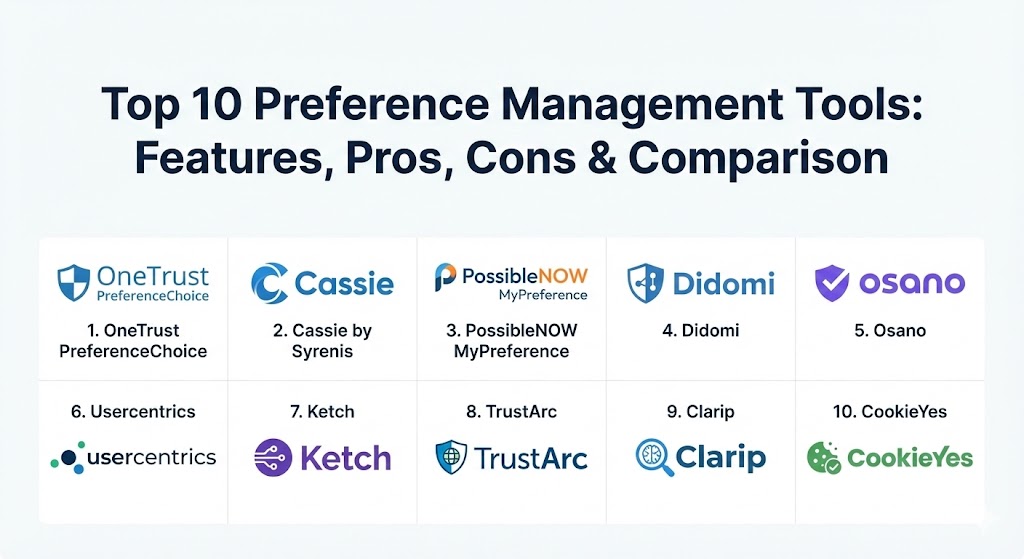
Top 10 Preference Management Tools
1 — OneTrust PreferenceChoice
OneTrust is the industry giant in the privacy space. Its PreferenceChoice module is part of a massive ecosystem that links consent, preferences, and regulatory compliance into a single source of truth.
- Key features:
- Unified dashboard for consent and preference management.
- Mobile-optimized preference centers with “drag-and-drop” design.
- Dynamic localization (over 100 languages supported).
- Real-time synchronization with Salesforce, Adobe, and Marketo.
- Advanced analytics to track “opt-down” vs. “opt-out” trends.
- Integrated Data Subject Access Request (DSAR) automation.
- Pros:
- Unrivaled regulatory intelligence; the tool updates automatically as laws change.
- Highly scalable for global companies with dozens of different brands.
- Cons:
- High complexity and steep learning curve for smaller teams.
- Pricing is often higher than specialized, boutique competitors.
- Security & compliance: SOC 2 Type II, ISO 27001, FedRAMP, GDPR, HIPAA, and CCPA compliant.
- Support & community: Extensive documentation, OneTrust University training, and 24/7 global enterprise support.
2 — Cassie (by Syrenis)
Cassie is a data-first preference management platform that prioritizes a “single record of truth” for every customer, ensuring that preferences are reflected across all silos instantly.
- Key features:
- Direct data-layer integration (doesn’t rely purely on cookies).
- Granular “Preference Personas” for different customer types.
- History auditing to prove compliance at any point in time.
- High-volume processing (handles millions of updates per minute).
- Flexible API-first architecture for custom builds.
- Pros:
- Exceptional at resolving “conflicting” data from different systems.
- Very fast implementation for a tool of its technical depth.
- Cons:
- UI can feel more “technical” and less “marketing-friendly” than some rivals.
- Requires a solid internal data strategy to get the most out of it.
- Security & compliance: ISO 27001, Cyber Essentials Plus, and fully GDPR/CCPA ready.
- Support & community: Known for high-touch onboarding and dedicated project managers.
3 — PossibleNOW (MyPreference)
PossibleNOW is one of the longest-standing players in the market, with a heavy focus on complex regulatory environments like telecommunications and financial services.
- Key features:
- Advanced “Do Not Call” (DNC) and TCPA compliance scrubbing.
- Multi-channel preference orchestration (Email, SMS, Phone, Mail).
- Zero-party data collection through surveys and interactive centers.
- Proprietary integration adapters for legacy enterprise CRMs.
- Detailed audit logs for every preference change.
- Pros:
- Deep expertise in North American privacy laws (TCPA/CCPA).
- Highly customizable “Opt-Down” logic to prevent total unsubscribes.
- Cons:
- Visual customization of templates can be more restrictive than newer SaaS tools.
- Enterprise-heavy pricing may be out of reach for SMBs.
- Security & compliance: SOC 2 Type II, HIPAA, and industry-specific certifications for finance/telecom.
- Support & community: Expert consulting services available for regulatory strategy.
4 — Didomi
Didomi is a European-based leader that excels in balancing sleek user experience (UX) with strict GDPR compliance. It is widely used by major publishers and digital media brands.
- Key features:
- Visually stunning preference centers that match brand aesthetics.
- Cross-device preference syncing (Web, Mobile App, Connected TV).
- “Preference Orchestrator” to push data to 300+ third-party tools.
- A/B testing for preference center layouts to optimize engagement.
- Native SDKs for developers.
- Pros:
- Top-tier UI/UX; the preference centers feel like a natural part of the brand.
- Excellent performance and low latency on global websites.
- Cons:
- Stronger focus on European regulations than some US-centric niche laws.
- Advanced features like cross-device syncing require premium tiers.
- Security & compliance: ISO 27001, GDPR, CCPA, and TCF v2.2 (IAB) certified.
- Support & community: High-quality documentation and responsive technical support in multiple languages.
5 — Osano
Osano is the “easy-to-use” compliance platform. It is famous for its “Compliance Guarantee,” where they provide legal backing for their tool’s output.
- Key features:
- Automated vendor discovery and risk assessment.
- Visual editor for preference and consent banners.
- Unified dashboard for managing multi-region traffic.
- “Consent Search” to look up specific user records instantly.
- Seamless integration with popular tag managers.
- Pros:
- Incredibly fast setup; you can be live in a few hours.
- The “No-Fines” guarantee provides significant peace of mind for small teams.
- Cons:
- Lacks the deep multi-channel “logic” of enterprise tools like PossibleNOW.
- Customization of the “Preference Center” experience is more rigid.
- Security & compliance: SOC 2, GDPR, CCPA, and LGPD.
- Support & community: Massive library of free legal templates and a very helpful blog.
6 — Usercentrics
Usercentrics focuses on “Privacy-Led Marketing.” They provide highly flexible tools that allow marketers to turn compliance into a competitive advantage.
- Key features:
- Highly customizable preference banners and centers.
- Deep integration with Google Consent Mode v2.
- Cross-platform consent and preference management (Mobile, Web, CTV).
- Detailed analytics on “Acceptance Rates.”
- Support for the latest privacy standards like IAB TCF and GPP.
- Pros:
- One of the best tools for optimizing “Consent and Preference” ROI.
- Strong presence and support in both Europe and the US.
- Cons:
- Documentation can sometimes be overly technical for non-developers.
- The modular pricing can add up if you need multiple platform supports.
- Security & compliance: ISO 27001, SOC 2, and TCF v2.2 certified.
- Support & community: Professional onboarding and a dedicated partner ecosystem.
7 — Ketch
Ketch is a “Data Control Plane” that treats preferences as a programmatic layer across your entire tech stack. It is built for the modern, data-heavy era.
- Key features:
- “Smart Tagging” of data assets for automated preference enforcement.
- Policy-based automation (set a rule once, it applies everywhere).
- Lightweight, API-first architecture.
- Built-in identity resolution to link preferences to the right user.
- Dynamic permissioning for developers.
- Pros:
- Excellent for tech-forward companies with complex internal data pipelines.
- Automates the “enforcement” of preferences, not just the collection.
- Cons:
- May be “too much tool” for companies with simple marketing stacks.
- Higher learning curve for setting up the initial “Data Map.”
- Security & compliance: SOC 2 Type II and modern privacy regulation ready.
- Support & community: Good developer documentation and proactive account management.
8 — TrustArc
TrustArc is a veteran in the privacy consulting space that has transitioned into a powerful SaaS platform. They offer a deep “Privacy Maturity” approach.
- Key features:
- Preference centers integrated with full Privacy Impact Assessments (PIAs).
- “Intelligence Engine” that maps global regulatory changes in real-time.
- Comprehensive vendor risk management.
- Cross-border data transfer tracking.
- Detailed reporting for board-level compliance reviews.
- Pros:
- Ideal for companies that need both a tool and a compliance strategy.
- Very strong in highly regulated industries like Healthcare and Fintech.
- Cons:
- UI can feel a bit “legacy” compared to newer SaaS competitors like Didomi.
- Setup can be lengthy due to the deep discovery process.
- Security & compliance: ISO 27001, SOC 2, HIPAA, and APEC Cross-Border Privacy Rules.
- Support & community: World-class privacy experts available for consulting.
9 — Clarip
Clarip uses AI to enhance preference management, focusing on “Data Privacy Governance” for large-scale consumer data.
- Key features:
- AI-powered data mapping to find where preference data is stored.
- “Hybrid” preference centers (combines cookie consent with channel preferences).
- Automated preference synchronization across legacy databases.
- Real-time monitoring of data flows.
- Identity verification for preference changes.
- Pros:
- Excellent at finding “dark data” that isn’t respecting preferences.
- Strong automation reduces the manual labor of data syncing.
- Cons:
- The interface is functional but lacks the “gloss” of marketing-centric tools.
- AI features can require significant initial training on your data.
- Security & compliance: SOC 2, HIPAA, and GDPR.
- Support & community: Dedicated support engineers for enterprise clients.
10 — CookieYes
While primarily known as a cookie consent tool, CookieYes has expanded into lightweight preference management, making it perfect for SMBs.
- Key features:
- Simple, intuitive preference toggle setup.
- One-click integration with WordPress, Shopify, and Wix.
- Basic multi-language support.
- Log of all user consent and preference choices.
- Highly affordable pricing for small sites.
- Pros:
- The easiest entry point for a business to start managing preferences.
- Free tier available for very small websites.
- Cons:
- Lacks the advanced “Preference Orchestration” and CRM syncing of rivals.
- Not suitable for complex, multi-channel enterprise needs.
- Security & compliance: GDPR, CCPA, and LGPD.
- Support & community: Large community of users and basic email/chat support.
Comparison Table
| Tool Name | Best For | Platform(s) Supported | Standout Feature | Rating (Gartner/TrueReview) |
| OneTrust | Global Enterprise | Web, Mobile, Cloud | Regulatory Intelligence | 4.6 / 5 |
| Cassie | Data Integrity | Web, API, Cloud | Single Record of Truth | 4.8 / 5 |
| PossibleNOW | Telecom / Finance | Web, Phone, SMS | TCPA / DNC Scrubbing | 4.4 / 5 |
| Didomi | UX & Publishing | Web, Mobile, CTV | Visual Brand Matching | 4.7 / 5 |
| Osano | Rapid SMB Setup | Web | No-Fines Guarantee | 4.5 / 5 |
| Usercentrics | Marketing ROI | Web, App, CTV | Google Consent Mode v2 | 4.6 / 5 |
| Ketch | Data Engineering | Web, API, Cloud | Programmatic Enforcement | 4.4 / 5 |
| TrustArc | Risk Management | Web, Cloud | Board-Level Reporting | 4.3 / 5 |
| Clarip | Data Governance | Web, Database | AI Data Mapping | 4.5 / 5 |
| CookieYes | Small Business | Web | Simplest Deployment | 4.7 / 5 |
Evaluation & Scoring of Preference Management Tools
The following rubric is used to weigh the effectiveness of a tool based on the needs of a modern digital organization.
| Criteria | Weight | Evaluation Notes |
| Core Features | $25\%$ | Ability to handle multi-channel preferences, “opt-down” logic, and zero-party data. |
| Ease of Use | $15\%$ | How simple it is for a marketer to build a center and for a user to use it. |
| Integrations | $15\%$ | Depth of “hooks” into CRMs (Salesforce), ESPs (Klaviyo), and Data Warehouses. |
| Security & Compliance | $10\%$ | Certifications (ISO/SOC 2) and the ability to automate audit logs. |
| Performance | $10\%$ | Impact on website load times and API responsiveness. |
| Support & Community | $10\%$ | Access to privacy experts and high-quality documentation. |
| Price / Value | $15\%$ | Scaling cost relative to features and ROI (e.g., reduction in opt-outs). |
Which Preference Management Tool Is Right for You?
Solo Users & Small Businesses
If you are running a single-site shop or a simple newsletter, CookieYes or the free tier of Osano is your best bet. You likely don’t need a multi-channel orchestrator yet; you just need to be compliant and professional.
Growing SMBs & Fast-Growth Startups
Focus on tools that help you grow without a massive legal team. Usercentrics or Didomi offer a perfect blend of high-end aesthetics (to build trust) and powerful marketing integrations (to keep your email list healthy).
Mid-Market & B2B
If you have a complex CRM like Salesforce and multiple sales teams, Cassie or Ketch are excellent. They ensure that when a customer tells a salesperson “no more calls,” it actually stops the automated marketing emails instantly.
Global Enterprises & High-Risk Industries
For companies in banking, healthcare, or global retail, OneTrust, TrustArc, or PossibleNOW are the only choices. These tools provide the “defensibility” required during a government audit and can handle the sheer volume of global traffic.
Frequently Asked Questions (FAQs)
1. Is a Preference Center different from an Unsubscribe link?
Yes. An unsubscribe link is a binary “off” switch. A Preference Center is a “dimmer” switch that lets users choose frequency (e.g., weekly instead of daily) or specific topics (e.g., just “Product Updates” but not “Promotions”).
2. What is “Zero-Party Data”?
Zero-party data is information a customer intentionally and proactively shares with you. This includes their interests, communication preferences, and intent. Preference management tools are the primary way to collect this valuable data.
3. Do these tools help with GDPR compliance?
Absolutely. GDPR requires that users can easily change their preferences and withdraw consent. These tools automate the logging and enforcement of those requests, which is critical for an audit.
4. Will a preference center slow down my website?
Most modern tools (like Didomi or Osano) use “asynchronous loading,” meaning they don’t block other elements of your page from appearing. The impact is usually negligible (less than 50ms).
5. Can I host the preference center on my own domain?
Most enterprise tools (OneTrust, Cassie) allow for “CNAME” or white-labeling, so the user sees preferences.yourbrand.com rather than a third-party link.
6. What is “Opt-Down”?
Opt-down is the strategy of offering a user fewer communications rather than none at all. For example, moving from a daily newsletter to a “Weekly Roundup.” This can reduce total churn by $30-40\%$.
7. Do I need a developer to set these up?
For basic tools like CookieYes, no. For enterprise tools that require deep CRM syncing, you will likely need a technical resource for the initial “plumbing” between systems.
8. Can these tools manage SMS and Phone preferences too?
Enterprise platforms like PossibleNOW and Cassie are designed specifically to handle “Omnichannel” preferences, including voice, SMS, and even physical mail.
9. How do these tools handle “Identity Resolution”?
Advanced tools use a “Privacy ID” to link a user across their email, their browser cookies, and their mobile app. This ensures that if they change a preference on their phone, it is reflected when they visit on a desktop.
10. What happens if my tool goes down?
Most top-tier providers (OneTrust, Didomi) have $99.9\%$ uptime SLAs. They also cache preferences locally so the user experience isn’t interrupted even if the central server has a brief blip.
Conclusion
The shift toward consumer privacy is not a temporary trend; it is the new baseline for digital business. Choosing a Preference Management Tool is about more than just checking a compliance box—it’s about creating a better, more respectful customer experience. By giving your users the power to control the conversation, you build the kind of long-term trust that drives loyalty and revenue.