Introduction
Competitive Intelligence Platforms are specialized software solutions designed to collect, analyze, and distribute actionable data about a company’s competitors and its broader market environment. These tools automate the tedious process of tracking competitor website changes, pricing shifts, new product launches, job postings, and customer sentiment. By centralizing these disparate signals, CI platforms allow organizations to move from reactive “firefighting” to proactive strategic planning.
The importance of CI tools today is driven by the sheer volume of data produced every second. Without automation, a dedicated team of analysts could spend 40 hours a week just monitoring a handful of competitors and still miss a critical update. Key real-world use cases include sales enablement (creating “battlecards” to help sales reps handle objections), product positioning (identifying feature gaps), and executive strategy (spotting emerging threats before they disrupt the industry). When evaluating these tools, users should focus on data freshness, the quality of AI-driven noise filtering, and how well the tool integrates with existing workflows like Slack or Salesforce.
Best for: Mid-to-large enterprises with aggressive growth goals, sales teams in crowded B2B markets, and product managers who need to stay ahead of feature parity. It is also ideal for marketing teams looking to benchmark their digital performance and SEO visibility against industry leaders.
Not ideal for: Small businesses in very local or niche markets where competitor moves are rare and easily tracked manually, or companies that lack the internal resources to act on the intelligence provided by the platform.
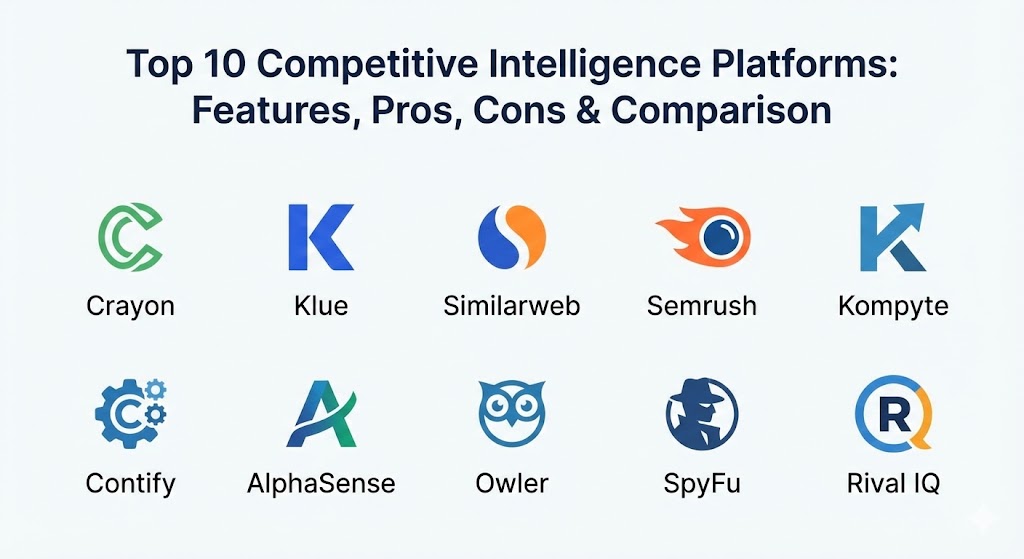
Top 10 Competitive Intelligence Platforms
1 — Crayon
Crayon is an enterprise-grade platform known for its extensive data collection capabilities and AI-driven “Sparks” that distill thousands of market signals into actionable insights. It is designed to help teams capture and activate intelligence across the entire organization.
- Key features:
- Automated tracking of 100+ data types including pricing, messaging, and reviews.
- AI-powered noise filtering to highlight high-impact competitor updates.
- Dynamic, real-time battlecards for sales enablement.
- Customizable dashboards for different departments (Sales, Marketing, Product).
- Integration with major CRM and communication tools like Salesforce and Slack.
- Competitive landscape mapping to visualize market shifts.
- Pros:
- Unmatched depth of data collection; it catches subtle website changes others miss.
- Highly scalable for large teams tracking dozens of competitors simultaneously.
- Cons:
- The sheer volume of data can be overwhelming if not properly filtered initially.
- Higher price point makes it less accessible for startups.
- Security & compliance: SOC 2 Type II compliant, SSO integration, and GDPR-aligned data handling.
- Support & community: Offers dedicated customer success managers for enterprise tiers; robust documentation and regular strategy webinars.
2 — Klue
Klue focuses heavily on “Competitive Enablement,” bridging the gap between raw data collection and the sales reps who need it to win deals. It is particularly strong at turning intelligence into persuasive sales assets.
- Key features:
- Centralized hub for collecting both external and internal “field” intelligence.
- Interactive battlecards that update automatically as data changes.
- Win/loss analysis tracking to identify why deals are being won or lost.
- Browser extension for easy data collection while browsing the web.
- In-depth usage analytics to see which assets the sales team uses most.
- Pros:
- The best interface for sales teams; battlecards are clean and highly readable.
- Encourages a culture of intelligence sharing within the organization.
- Cons:
- Less focus on automated web scraping compared to tools like Crayon.
- Requires a consistent internal effort to keep “internal” intelligence fresh.
- Security & compliance: ISO 27001 certified, SOC 2 compliant, and support for SAML-based SSO.
- Support & community: High customer satisfaction scores; very active community of “Product Marketing” professionals.
3 — Similarweb
Similarweb provides a “digital X-ray” of the internet, offering unparalleled insights into competitor website traffic, audience behavior, and digital marketing strategies. It uses real-user behavioral data rather than just scraping.
- Key features:
- Global traffic and engagement metrics for any website or app.
- Identification of traffic sources (Search, Social, Referral, Direct).
- Keyword gap analysis to see where competitors are outranking you.
- Audience demographic and interest data.
- Benchmarking tools for market share and industry trends.
- Pros:
- The most accurate traffic data in the industry thanks to their proprietary data panel.
- Exceptional for marketing teams looking to optimize their SEO and PPC spend.
- Cons:
- Accuracy can dip for websites with very low traffic volumes.
- Pricing scales quickly as you add more countries or categories.
- Security & compliance: GDPR and CCPA compliant; uses anonymized, aggregated data for its insights.
- Support & community: Extensive library of case studies and a massive knowledge base; 24/5 global support.
4 — Semrush
While primarily known as an SEO tool, Semrush has expanded into a powerful competitive intelligence suite, focusing on search visibility, paid advertising, and social media benchmarking.
- Key features:
- Domain Overview for a snapshot of any competitor’s digital health.
- Advertising research to uncover competitor PPC budgets and ad copy.
- Social Media Tracker to compare engagement rates across platforms.
- Market Explorer to identify key players and industry benchmarks.
- Backlink analytics to understand competitor authority-building strategies.
- Pros:
- A “Swiss Army Knife” for digital marketers; covers SEO, ads, and content.
- Very transparent pricing and easy self-serve setup.
- Cons:
- Many CI features (like Traffic Analytics) require a paid “Trends” add-on.
- Not designed for tracking non-digital signals like job postings or PR.
- Security & compliance: Standard SaaS security; GDPR compliant; secure payment processing.
- Support & community: One of the largest marketing communities globally; excellent webinars and academy.
5 — Kompyte (by Semrush)
Kompyte, now integrated into the Semrush ecosystem, is a direct competitor to Crayon and Klue, focusing on real-time website change detection and automated sales enablement.
- Key features:
- Real-time alerts for competitor pricing and feature updates.
- Side-by-side website comparison to visualize exactly what changed.
- Automated battlecard generation and CRM integration.
- Repository for competitor newsletters and social media activity.
- Performance tracking for competitive sales opportunities.
- Pros:
- The integration with Semrush’s SEO data provides a unique “full-stack” view.
- Excellent at spotting tactical changes like header copy or pricing tier shifts.
- Cons:
- Some users find the UI a bit cluttered compared to Klue.
- Configuration of automation rules requires a bit of an initial time investment.
- Security & compliance: Enterprise SSO support and standard data encryption.
- Support & community: Backed by the robust Semrush support infrastructure; dedicated account managers for large teams.
6 — Contify
Contify is a strategic market intelligence platform that uses AI to monitor and summarize news, regulatory updates, and competitor activity across global sources. It is highly valued for its “noise reduction.”
- Key features:
- AI-curated news feeds from over 200,000 global sources.
- Automated newsletter generator to distribute intelligence to executives.
- Support for multi-language intelligence with auto-translation.
- Custom taxonomy to categorize data specifically for your industry.
- Integrated dashboards for tracking trends and market developments.
- Pros:
- The most effective tool for “cutting through the noise” in news-heavy industries.
- Highly customizable to fit complex organizational structures.
- Cons:
- Less focus on “digital marketing” metrics like SEO or PPC.
- The initial setup of the custom taxonomy can be time-consuming.
- Security & compliance: SOC 2 compliant, GDPR aligned, and enterprise-grade data security.
- Support & community: Known for its “Analyst-as-a-Service” model where human analysts help refine your data.
7 — AlphaSense
AlphaSense is the premier platform for strategic and financial research, providing AI-powered search across millions of premium sources like broker research, SEC filings, and expert calls.
- Key features:
- Generative AI summarization of earnings calls and financial reports.
- Access to an exclusive library of expert interview transcripts.
- Smart Synonyms that identify relevant concepts, not just keywords.
- Real-time alerts on corporate filings and press releases.
- Sentiment analysis to gauge the market’s reaction to a competitor.
- Pros:
- Provides deep, qualitative insights that web-scrapers simply cannot find.
- The “Generative Search” significantly reduces the time needed for deep research.
- Cons:
- Primarily focused on high-level strategy; less useful for daily “marketing” tasks.
- Premium pricing reflects its status as a top-tier institutional research tool.
- Security & compliance: Bank-grade security, SOC 2, and rigorous compliance for financial services.
- Support & community: Dedicated account teams and high-touch professional onboarding.
8 — Owler
Owler provides a community-driven approach to competitive intelligence, specializing in “hard-to-find” data on private companies, including revenue estimates and funding history.
- Key features:
- Competitive Relationship Graph to see who is truly competing for your business.
- Real-time “Daily Snapshot” emails with relevant competitor news.
- Crowdsourced insights on private company revenue and employee counts.
- Advanced search for identifying new lead prospects in your niche.
- Integration with popular CRMs for sales prospecting.
- Pros:
- Best for getting a high-level pulse on private company performance.
- The “Free” tier provides significant value for individuals and small teams.
- Cons:
- Data is crowdsourced, meaning accuracy is not always 100% guaranteed.
- Lacks the deep automation and workflow tools of enterprise CI platforms.
- Security & compliance: Standard SaaS security protocols and GDPR compliance.
- Support & community: Large community of contributors; responsive email support.
9 — SpyFu
SpyFu is the specialist’s choice for deep historical competitor keyword data. It allows you to see every place a competitor has shown up on Google for the last 15+ years.
- Key features:
- Competitor keyword history for both organic and paid search.
- Ad copy history to see which headlines have stood the test of time.
- Domain comparison tools for “Kombat” (identifying keyword overlap).
- Custom reporting with white-label options for agencies.
- Unlimited backlink tracking and ranking history.
- Pros:
- Incredible value for money; offers unlimited data on most plans.
- The “Ad History” feature is arguably the best in the industry.
- Cons:
- The interface can feel a bit dated compared to modern AI tools.
- Coverage is primarily focused on English-speaking markets.
- Security & compliance: Secure payment handling and standard data privacy.
- Support & community: Highly rated live chat and an extensive library of tutorial videos.
10 — Rival IQ
Rival IQ focuses on visual social media analytics and benchmarking, helping brands understand how their content engagement stacks up against their closest rivals.
- Key features:
- Automated “Social Audit” that benchmarks you against competitors in seconds.
- Breakout post alerts when a competitor has a viral hit.
- In-depth analysis of Instagram, Facebook, TikTok, and Twitter/X.
- Social listening for brand mentions and sentiment.
- Automated report delivery for stakeholders.
- Pros:
- Extremely visual and easy to present to executives.
- The “Breakout Alerts” are essential for agile social media teams.
- Cons:
- Narrow focus on social media; not a “full” competitive intelligence suite.
- Can be expensive if you need to track a large number of social handles.
- Security & compliance: Secure API connections and respect for social platform privacy rules.
- Support & community: Excellent webinars and a blog famous for its industry benchmarks.
Comparison Table
| Tool Name | Best For | Platform(s) Supported | Standout Feature | Rating (Gartner) |
| Crayon | Enterprise Automation | Cloud / SaaS | AI “Sparks” Insights | 4.6 / 5 |
| Klue | Sales Enablement | Cloud / SaaS | Dynamic Battlecards | 4.5 / 5 |
| Similarweb | Digital Benchmarking | Cloud / Browser Ext | Real-User Behavioral Data | 4.7 / 5 |
| Semrush | Search Intelligence | Cloud / SaaS | PPC & SEO Suite | 4.7 / 5 |
| Kompyte | Real-Time Monitoring | Cloud / SaaS | Side-by-Side Site Comparison | 4.4 / 5 |
| Contify | Market Strategy | Cloud / API | Multi-language AI Curation | 4.5 / 5 |
| AlphaSense | Financial Research | Cloud / Mobile | Expert Call Library | 4.8 / 5 |
| Owler | Private Co. Intel | Cloud / SaaS | Crowdsourced Financials | 4.2 / 5 |
| SpyFu | PPC & Ad History | Cloud / SaaS | 15+ Year Keyword History | 4.6 / 5 |
| Rival IQ | Social Media Benchmarking | Cloud / SaaS | Breakout Post Alerts | 4.5 / 5 |
Evaluation & Scoring of Competitive Intelligence Platforms
To determine which platform provides the most balanced value, we use a weighted scoring rubric that prioritizes the activation of data over mere collection.
| Category | Weight | Evaluation Criteria |
| Core Features | 25% | Automated tracking, noise filtering, and data breadth (pricing, news, reviews). |
| Ease of Use | 15% | Intuitiveness of the UI, speed of onboarding, and clarity of reports. |
| Integrations | 15% | Native connections to Salesforce, Slack, HubSpot, and BI tools. |
| Security & Compliance | 10% | SOC 2 status, GDPR compliance, and SSO availability. |
| Performance & Reliability | 10% | Data freshness, accuracy of web scraping, and platform uptime. |
| Support & Community | 10% | Availability of dedicated managers, training, and a user community. |
| Price / Value | 15% | Flexibility of tiers and the return on investment for the organization. |
Which Competitive Intelligence Platform Is Right for You?
The right choice depends on where your business feels the most “competitive pressure.”
- Solo Users & Freelancers: If you’re a one-person shop, SpyFu or the basic plan of Semrush provides more than enough data to stay relevant without breaking the bank. Owler’s free tier is also excellent for basic news tracking.
- Small to Medium Businesses (SMBs): For growing teams, Similarweb is vital for understanding your traffic share. If you have a small but active sales team, Kompyte offers a great balance of automation and price.
- Mid-Market & Rapid Growth: Organizations in this tier should look at Crayon or Klue. These tools move you away from “looking at data” and toward “using data” to win deals.
- Large Enterprises & Global Brands: High-end strategic intelligence requires AlphaSense or Contify. These platforms handle the scale and multi-language requirements of a global operation and provide the “boardroom-level” insights that standard scrapers cannot.
- Agency Needs: If you manage clients, SpyFu and Rival IQ are favorites because of their white-label reporting and unlimited data options in many cases.
Frequently Asked Questions (FAQs)
1. Is it legal to use competitive intelligence platforms?
Yes. These platforms only collect “Publicly Available Information” (PAI) such as website changes, press releases, and social media. They do not hack into private servers or access non-public corporate data.
2. How often do these tools update their data?
Most enterprise tools like Crayon and Kompyte update daily or in near-real-time. Marketing-focused tools like Similarweb usually update their historical panels on a monthly basis.
3. Do I need an analyst to run these platforms?
While AI helps filter the noise, having a dedicated “Intelligence Lead” ensures the data is actually used. However, modern tools are designed to be intuitive enough for any marketing or sales manager to use.
4. Can I track private companies?
Yes. Tools like Owler, Crunchbase, and Contify specialize in finding data on private companies through news, funding filings, and employee sentiment reports.
5. What is a “battlecard”?
A battlecard is a one-page cheat sheet for sales reps that compares your product to a competitor. It highlights your strengths, their weaknesses, and provides “kill shots” to handle objections.
6. Can these tools predict a competitor’s next move?
While not psychic, features like “Job Posting Tracking” (indicating new territories or tech stacks) and “Patent Filing Monitoring” give strong early warnings of future strategy shifts.
7. How do these tools help with pricing?
Tools like Crayon and Kompyte alert you the moment a competitor changes their pricing page, allowing you to react with a counter-promotion before the market shifts.
8. What is “Social Listening” in CI?
It involves monitoring what customers say about your competitors on social media to identify their product flaws, which you can then exploit in your own marketing.
9. Why is noise filtering so important?
Tracking 10 competitors might generate 500 alerts a week. Noise filtering uses AI to hide the junk (like a copyright year change) and only show you the “signals” (like a new product launch).
10. How much do these platforms cost?
Basic digital tools start at around $100–$200/month. Enterprise-grade CI enablement platforms typically range from $15,000 to $50,000+ per year depending on seats and competitors.
Conclusion
Competitive intelligence is the bridge between data and strategy. In 2026, the winner isn’t the company with the most information—it’s the company that acts on the right information the fastest. Whether you choose the deep financial research of AlphaSense, the sales enablement power of Klue, or the digital benchmarking of Similarweb, remember that a tool is only as good as the action it inspires. Start by identifying your most critical “knowledge gap” and choose the platform that fills it with the least amount of friction.