Introduction
Product Feed Management (PFM) tools are specialized software platforms that allow retailers and brands to ingest their product data from an e-commerce store (like Shopify or Magento) and transform it into optimized, compliant feeds for hundreds of different marketing channels.2 These tools act as a “translator” and “optimizer,” ensuring that a product’s title, price, and availability are accurate and formatted to maximize click-through rates and return on ad spend (ROAS).3
The importance of these tools has skyrocketed in 2026 as AI-driven ad platforms like Google’s Performance Max rely heavily on high-quality data to function. Key real-world use cases include dynamic price updates, excluding out-of-stock items in real-time to save ad spend, and A/B testing product titles to see which drives more conversions. When evaluating these tools, users should look for ease of mapping, automation depth, the frequency of sync, and the quality of built-in templates.
Best for: E-commerce managers, PPC agencies, and digital marketing teams at mid-sized to enterprise-level retailers who need to scale their presence across multiple global channels simultaneously without manual overhead.
Not ideal for: Very small, single-channel sellers with less than 50 products. If you only sell on one platform (like Etsy), the built-in native tools are usually sufficient and more cost-effective.
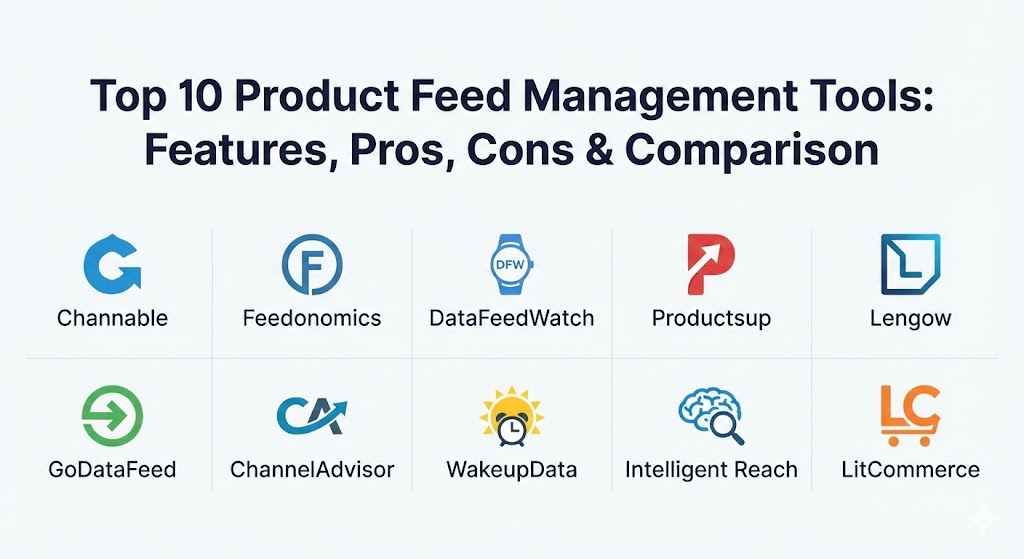
Top 10 Product Feed Management Tools
1 — Channable
Channable is a versatile and user-friendly platform that combines powerful feed management with sophisticated PPC automation.4 It is widely considered the industry standard for mid-market businesses seeking a balance between technical depth and an intuitive interface.
- Key features:
- “If-Then” rule-based logic for bulk data transformations.5
- Integrated PPC tool for generating Google and Microsoft ads directly from feeds.6
- Marketplace API connections for real-time order and inventory synchronization.7
- Built-in templates for over 2,500 global price comparison sites and marketplaces.8
- Dynamic Image Editor to automate branded product visuals.
- Pros:
- Exceptional user interface that is easy to master without a developer background.9
- Combines feed optimization with ad creation, reducing the tool-stack complexity.
- Cons:
- Some advanced features (like order sync) are gated behind higher-tier plans.
- Can be slightly slower when processing massive catalogs exceeding 1 million SKUs.
- Security & compliance: GDPR compliant, ISO 27001 certified data centers, and data encryption in transit and at rest.
- Support & community: High-quality documentation; responsive live chat and email support in multiple languages (EN, NL, DE, FR, ES).
2 — Feedonomics (by BigCommerce)
Feedonomics is an enterprise-level, “full-service” platform that prioritizes managed services.10 It is the go-to solution for brands that want to outsource the technical heavy lifting of feed optimization to a team of experts.
- Key features:
- Fully managed service model with dedicated “Feed Ninjas.”
- AI-powered attribute mapping and automated data enrichment.11
- Robust 24/7 monitoring and error detection for global feeds.12
- Specialized integrations for social commerce (TikTok, Instagram Shop).13
- Scalable architecture capable of handling millions of SKUs with sub-hourly updates.
- Pros:
- Drastically reduces the internal workload for IT and marketing teams.
- Unrivaled accuracy and feed health due to constant expert human oversight.
- Cons:
- Premium pricing model with significant setup fees.
- Less “DIY” control; users often have to go through a support ticket for major changes.
- Security & compliance: SOC 2 Type II, HIPAA ready, GDPR compliant, and SSO integration.
- Support & community: Industry-leading support with dedicated account managers and 24/7 technical assistance.14
3 — DataFeedWatch
DataFeedWatch is a popular choice for agencies and SMBs due to its straightforward pricing and powerful, self-serve mapping engine. It offers a “no-nonsense” approach to feed marketing.
- Key features:
- Drag-and-drop mapping interface for all major shopping engines.15
- “Pricewatch” feature to monitor competitor pricing directly within the tool.16
- Automated category mapping to match channel-specific taxonomies.17
- Deep integration with Shopify, BigCommerce, and WooCommerce.18
- Multi-store management from a single dashboard.19
- Pros:
- One of the best price-to-performance ratios in the market.
- Very transparent pricing with no hidden revenue-sharing percentages.20
- Cons:
- Interface can feel slightly utilitarian compared to Channable.
- Limited advanced PPC automation features.21
- Security & compliance: GDPR compliant, regular vulnerability scans, and secure API connections.
- Support & community: 24/7 live chat and a very helpful “Feed Academy” for training.
4 — Productsup
Productsup is a high-performance, software-defined platform built for global enterprises.22 It focuses on the concept of “Product-to-Consumer” (P2C) and is designed for extreme data complexity.
- Key features:
- Visual flow editor for complex data transformations (no coding required).23
- AI-assisted “Content Experimentation” for A/B testing feed attributes.
- Automated image and video generation for social channels.
- Support for localized feeds across dozens of countries in one project.24
- Real-time performance tracking integrated into the feed dashboard.25
- Pros:
- Immense flexibility; if you can imagine a rule, Productsup can execute it.
- Built for scale, easily handling tens of millions of products without lag.26
- Cons:
- High learning curve; requires significant training to use effectively.27
- Entry-level price points are significantly higher than SMB-focused tools.
- Security & compliance: ISO 27001, SOC 2 Type II, GDPR, and robust audit logs.
- Support & community: Dedicated technical account managers and a professional training certification program.
5 — Lengow
Based in Europe, Lengow is a sophisticated platform favored by large retail chains and fashion brands. It excels in navigating the complex regulatory and marketplace landscape of the EMEA region.
- Key features:
- Centralized order management for hundreds of global marketplaces.28
- Intelligent recommendations for which channels to join based on product category.29
- Localized compliance checks for different European regions.
- Advanced analytics to track ROI at the individual SKU level.
- “Success Managers” provided for enterprise-tier clients.
- Pros:
- Excellent for managing physical inventory sync across multiple marketplaces.30
- Strong emphasis on fashion and lifestyle retail verticals.
- Cons:
- Some users find the interface less intuitive than modern SaaS rivals.31
- Support response times can vary depending on the geographic region.
- Security & compliance: GDPR compliant, ISO 27001, and secure data hosting in Europe.
- Support & community: Strong community in Europe; provides extensive whitepapers and strategy webinars.
6 — GoDataFeed
GoDataFeed focuses on the “Essential” market—SMBs that need reliable, automated feed delivery without the high-enterprise price tag.32 It is especially strong in the North American market.
- Key features:
- Pre-built templates for Amazon, Google, Walmart, and Meta.
- Automatic SKU scaling based on performance metrics.
- Bulk editing tools for rapid price or title adjustments.33
- Inventory alerts to prevent over-selling on marketplaces.34
- Import from any source including FTP, HTTP, and direct API.35
- Pros:
- Very affordable starting plans for smaller catalogs.36
- Reliable, US-based support team.
- Cons:
- Fewer advanced AI features than Productsup or Feedonomics.
- Dashboard can feel a bit dated compared to newer competitors.
- Security & compliance: PCI compliant, GDPR support, and standard SSL encryption.
- Support & community: Responsive phone and email support; extensive library of video tutorials.37
7 — ChannelAdvisor (by Rithum)
ChannelAdvisor is a veteran in the e-commerce space, now part of Rithum. It is an all-in-one “commerce hub” that manages not just feeds, but inventory, orders, and shipping.38
- Key features:
- Unified commerce platform for marketplace, social, and search.39
- Advanced algorithmic repricing for Amazon and eBay.
- Global fulfillment and logistics management integrations.
- Deep performance insights and retail media management.40
- Predictive modeling for inventory and demand forecasting.
- Pros:
- The most comprehensive feature set for managing a total e-commerce business.
- Strong relationships with major retailers (Walmart, Target) for exclusive integrations.
- Cons:
- Complex pricing often involves a percentage of revenue, which can be very high.
- Requires a significant time commitment for implementation and training.
- Security & compliance: SOC 2, ISO 27001, HIPAA ready, and GDPR compliant.
- Support & community: Full enterprise support model with dedicated strategy consultants.41
8 — WakeupData
WakeupData is a Danish-born tool that prides itself on support and “actionable data.” It is popular in Northern Europe among performance marketers who want granular control.
- Key features:
- Custom feed creation without being restricted to pre-made templates.
- Weather-based bidding integration (adjusting ads based on local weather).42
- Image optimization tool to create high-converting product photos.
- Competitor monitoring and price intelligence.
- Advanced filtering to remove unprofitable “zombie” products from feeds.43
- Pros:
- Highly responsive and helpful technical support team.44
- Very flexible for creating niche or custom exports.45
- Cons:
- Smaller community compared to global giants like Channable.
- UI can be complex for users who just want a “set it and forget it” tool.
- Security & compliance: GDPR compliant and secure data handling practices.
- Support & community: Known for “human-to-human” support; very strong presence in Nordic and Benelux regions.
9 — Intelligent Reach
Intelligent Reach differentiates itself through “Content Experimentation.” It is designed for data-driven teams that view the product feed as a testing ground for growth.
- Key features:
- Native A/B testing for product titles, descriptions, and images.
- AI-driven recommendations for improving feed quality scores.46
- Dynamic “Marketplace Sync” for inventory and order management.47
- Real-time performance dashboards at the product level.48
- Integrated “Store Locator” for local inventory ads (LIA).
- Pros:
- The best tool for marketers who want to scientifically improve ad performance.
- Excellent visibility into “hidden” errors that lower ad rankings.49
- Cons:
- Premium positioning; not the best choice for budget-conscious SMBs.
- Interface focuses heavily on data, which might overwhelm less technical users.
- Security & compliance: SOC 2 Type II, GDPR, and ISO 27001.
- Support & community: Strong strategy-led support; provides quarterly performance reviews for top-tier clients.
10 — LitCommerce
LitCommerce is a modern, lightweight solution designed for multi-channel selling. It is a fantastic entry point for Shopify or WooCommerce users looking to expand into Amazon and eBay.
- Key features:
- Simple “Listing” interface to push products to multiple marketplaces.
- Real-time inventory sync to prevent stockouts.50
- Centralized order management (fulfilled within your main e-comm platform).
- Bulk listing editor for rapid multi-channel deployment.51
- Free plan available for very small stores.
- Pros:
- Extremely fast and easy to set up for standard marketplace selling.
- Very affordable pricing for startups and growing brands.
- Cons:
- Lacks the deep “feed transformation” and PPC optimization of Channable or Productsup.
- Not designed for complex enterprise data workflows.
- Security & compliance: Standard data encryption and GDPR compliant.
- Support & community: 24/7 dedicated support team; helpful community forum.52
Comparison Table
| Tool Name | Best For | Platform(s) Supported | Standout Feature | Rating (Gartner/G2) |
| Channable | PPC Automation & SMB | Shopify, Magento, BigComm | Integrated PPC Ad Gen | 4.8 / 5 |
| Feedonomics | Enterprise Managed Svc | All Major Platforms | “Full-Service” Ninjas | 4.4 / 5 |
| DataFeedWatch | Agency & Mid-Market | 20+ Cart Integrations | PriceWatch Monitoring | 4.7 / 5 |
| Productsup | Global Complexity | Multi-Cloud, Any Data | Visual Workflow Editor | 4.6 / 5 |
| Lengow | EU Retail & Fashion | Shopify, Magento, Presta | European Compliance | 4.3 / 5 |
| GoDataFeed | Budget-Conscious SMB | Shopify, BigComm | Affordable SKU Scaling | 4.2 / 5 |
| ChannelAdvisor | All-in-One Commerce | Custom / Legacy / SaaS | Repricing & Logistics | 4.2 / 5 |
| WakeupData | Performance Experts | Shopify, WooCommerce | Weather-Based Rules | 4.5 / 5 |
| Intelligent Reach | Data Scientists | All Major Platforms | Feed A/B Testing | 4.6 / 5 |
| LitCommerce | Multichannel Selling | Shopify, WooCommerce | Simple Order Syncing | 4.8 / 5 |
Evaluation & Scoring of Product Feed Management Tools
The following rubric shows how top tools are weighted when evaluated by industry consultants.
| Category | Weight | Evaluation Criteria |
| Core Features | 25% | Rule depth, template variety, and automation capability. |
| Ease of Use | 15% | Intuitiveness of UI and speed of rule creation. |
| Integrations | 15% | Breadth of marketplace APIs and shopping cart plugins. |
| Security | 10% | Compliance certifications (SOC 2, ISO) and data encryption. |
| Reliability | 10% | Sync frequency and error detection accuracy. |
| Support | 10% | Response time, documentation, and account management. |
| Price / Value | 15% | Cost relative to features and SKU limits. |
Which Product Feed Management Tool Is Right for You?
Selecting the right tool depends on your current scale and the specific business problem you are trying to solve.
- Solo Users vs SMB: If you are a small team just starting out, LitCommerce or GoDataFeed provide the necessary marketplace connections without overwhelming you with enterprise features.
- Mid-market Businesses: If your focus is on scaling ad performance (PPC), Channable or DataFeedWatch offer the best balance of power and usability.
- Global Enterprises: Organizations dealing with high complexity, multi-language feeds, and millions of SKUs should look toward Productsup or Feedonomics.53
- Agency Needs: Agencies typically prefer DataFeedWatch or Channable because they allow for managing multiple clients under one master account with clear sub-billing.
- Security and Compliance: For businesses in regulated sectors or those that prioritize data security, Feedonomics, Productsup, and ChannelAdvisor offer the most robust enterprise-grade certifications.
Frequently Asked Questions (FAQs)
1. What is a product feed?
A product feed is a digital file (usually XML, CSV, or via API) containing a list of products and their attributes (titles, prices, images).54 It is used to share your inventory with external marketing channels.55
2. Why do I need a management tool instead of just using a direct plugin?
Direct plugins often just “export” data. Management tools allow you to optimize that data (e.g., changing titles for better SEO) and centralize multiple feeds in one place.56
3. Will these tools increase my sales?
Directly, no. But by improving your feed quality, your ads become more relevant, which typically leads to higher click-through rates and lower cost-per-acquisition.57
4. How often do these tools sync with my store?
Most mid-market tools sync once or twice a day on standard plans. Enterprise tools like Feedonomics or Productsup can sync every few minutes.
5. Can I use these tools for Amazon?
Yes. Most tools on this list have dedicated Amazon API connectors that manage everything from listing creation to order synchronization.
6. Do I need to be a developer to use these?
No. Modern PFM tools use “low-code” or visual rule engines designed for marketers, though a basic understanding of spreadsheets and data logic helps.
7. What is “Category Mapping”?
This is the process of matching your store’s categories (e.g., “Men’s Sneakers”) to a channel’s required category (e.g., Google’s “Apparel > Shoes > Sneakers”).58 These tools automate this.59
8. Is there a free version available?
LitCommerce and DataFeedWatch offer free or entry-level plans for very small catalogs, but most industrial-grade tools require a monthly subscription.
9. Can these tools handle international selling?
Yes. High-end tools like Lengow and Productsup are specifically designed to translate and localize feeds for global markets.60
10. What happens if a tool goes down?
Your ads might display outdated information or lead to “out of stock” clicks. This is why “Performance & Reliability” is a critical scoring factor.
Conclusion
The “best” product feed management tool is not the one with the most features, but the one that aligns with your team’s technical ability and your business goals. If you want a hands-off experience, Feedonomics is unbeatable. If you want a powerful DIY engine to drive your PPC strategy, Channable is likely your winner. In 2026, the data behind your product is just as important as the product itself—choose the tool that makes that data shine.