Introduction
Print-on-demand platforms are specialized fulfillment services that allow businesses to sell customized products without holding any physical inventory.1 When a customer places an order on your online store, the POD provider automatically receives the details, prints the design on the chosen item (whether it’s a t-shirt, a piece of wall art, or a high-end tech accessory), and ships it directly to the customer.2 This “white-label” fulfillment model means the customer receives a package that appears to come directly from your brand.
The importance of these tools lies in their ability to facilitate “lean” business growth. They allow creators to test product ideas in real-time with zero financial risk.3 Key real-world use cases include influencers launching merchandise lines, corporate entities creating branded “swag” for remote teams, and independent artists monetizing their portfolios globally. When evaluating POD platforms, users should look for print quality consistency, fulfillment speed, the breadth of their product catalog, and the robustness of their integration with storefronts like Shopify, Etsy, or TikTok Shop.4
Best for: Creators, influencers, and e-commerce entrepreneurs who want to scale a brand without the overhead of inventory management. It is ideal for those who prioritize design and marketing over logistics and manufacturing.
Not ideal for: Large-scale retailers with massive, predictable volumes who could achieve significantly higher margins through bulk traditional manufacturing. It is also not ideal for businesses requiring extremely proprietary or highly complex custom-engineered physical products.
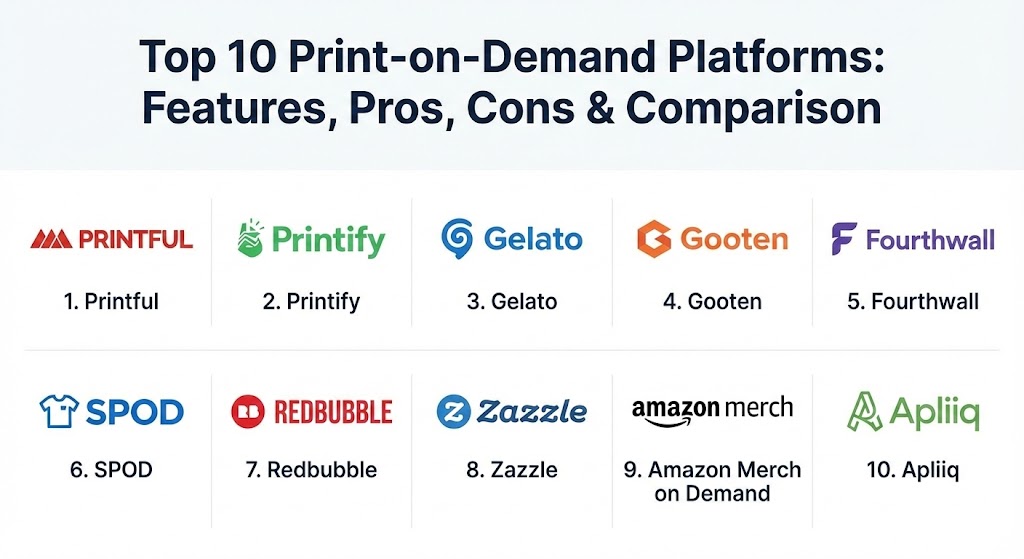
Top 10 Print-on-Demand Platforms
1 — Printful
Printful is widely considered the gold standard for premium print-on-demand services.5 Unlike many competitors that outsource to third parties, Printful owns and operates its own fulfillment centers across North America, Europe, and Asia, ensuring consistent quality control.6
- Key features:
- In-house printing and quality control for most product categories.7
- Wide-ranging catalog including apparel, home goods, and tech accessories.8
- Advanced branding options such as custom neck labels, pack-ins, and branded tracking pages.9
- Warehouse and fulfillment services for non-POD items you may already own.
- Built-in mockup generator and basic graphic design tools.10
- Native integrations with nearly every major e-commerce platform and marketplace.
- Sustainable product options and eco-friendly packaging initiatives.11
- Pros:
- Unmatched reliability and consistency in print quality.
- Deep branding capabilities that make your business look like a major retailer.12
- Cons:
- Higher base costs compared to marketplace-style competitors, which can squeeze profit margins.
- The product catalog, while high quality, is not as massive as some supplier-network models.
- Security & compliance: PCI DSS for payment processing, GDPR and CCPA compliant data handling, and SOC 2 audits for internal processes.
- Support & community: 24/7 customer support via chat/email, a massive library of video tutorials, and a highly active Facebook community for sellers.13
2 — Printify
Printify operates as a massive marketplace of print providers.14 Instead of doing the printing themselves, they connect you with a global network of hundreds of printing partners, giving you the power to choose based on price, location, and rating.15
- Key features:
- The largest product catalog in the industry (850+ items in 2026).
- Network-based model allowing you to switch print providers easily.16
- Printify Premium plan that offers up to 20% discount on all products.17
- Smart Order Routing to automatically send orders to the nearest printer.
- User-friendly mockup generator with high-resolution 3D previews.18
- Integration with niche marketplaces like Walmart and TikTok Shop.
- Pros:
- Generally offers the lowest base prices in the POD market, allowing for better margins.19
- Incredible variety of niche products (from pet beds to custom watches).
- Cons:
- Quality can vary between different print providers in the network.20
- Branding options are more limited and inconsistent compared to in-house models.21
- Security & compliance: Multi-factor authentication (MFA), GDPR compliance, and standard secure payment encryption.
- Support & community: Extensive self-service Help Center and 24/7 merchant support; strong focus on educational content via “Printify University.”22
3 — Gelato
Gelato is a global POD platform that focuses on “local production.”23 By partnering with local printers in over 30 countries, they reduce shipping distances, costs, and carbon emissions, making them a favorite for eco-conscious brands.24
- Key features:
- Local production in 32 countries to ensure fast, domestic delivery.25
- Heavy focus on paper products, wall art, and apparel.
- Gelato+ and Gelato+ Gold subscriptions for shipping discounts and premium mockups.26
- Automated tax and customs handling for international sales.
- Personalization tools that allow your customers to add their names to designs.27
- Seamless integration with Etsy, Shopify, and Wix.28
- Pros:
- Significantly faster international shipping compared to US-centric providers.
- Reduced carbon footprint due to localized printing.
- Cons:
- The product catalog is more curated and smaller than Printify’s.
- Branding options (like custom inserts) are not as robust as Printful’s.29
- Security & compliance: ISO 27001 certified, GDPR compliant, and secure data encryption at rest.30
- Support & community: Excellent 24/7 multi-language support and a strong focus on enterprise-level sustainability reporting.
4 — Gooten
Gooten is a sophisticated fulfillment partner designed for high-volume stores and enterprise-level operations. It uses an intelligent logic-based engine to route orders to the most efficient manufacturer in its curated network.
- Key features:
- Sophisticated order management system (OMS) for complex scaling.
- Curated network of high-quality manufacturers.31
- Extensive home and lifestyle catalog (bedding, curtains, kitchenware).32
- White-label fulfillment with no Gooten branding on packages.
- Custom API for organizations with proprietary storefronts.
- Automated tracking updates for customers.33
- Pros:
- Highly reliable for large-scale operations and seasonal spikes.
- Offers unique products that are hard to find on other general POD platforms.34
- Cons:
- Not as beginner-friendly as Printful or Printify; the interface is more technical.
- The setup process for some integrations can be more labor-intensive.
- Security & compliance: SOC 2 Type II, GDPR, and rigorous vendor security assessments.
- Support & community: Dedicated account managers for high-volume sellers and robust technical documentation.
5 — Fourthwall
Fourthwall is an all-in-one platform built specifically for creators and influencers.35 It doesn’t just provide POD; it provides the entire storefront, membership platform, and digital product hosting in one place.
- Key features:
- Fully integrated, high-converting storefront builder.
- Built-in membership and subscription tools (similar to Patreon).
- Support for selling physical POD products, digital files, and memberships.
- “Thank you” video feature to send personalized clips to buyers.
- High-quality curated product catalog with a focus on “creator-grade” apparel.36
- Direct integrations with YouTube, Twitch, and TikTok.37
- Pros:
- Simplifies the entire tech stack for creators; no need for a separate Shopify subscription.38
- Extremely high-quality product blanks (AS Colour, Comfort Colors).39
- Cons:
- Transaction fees are generally higher than a self-hosted store.
- Less flexibility in terms of deep e-commerce SEO compared to Shopify.
- Security & compliance: PCI DSS Level 1, GDPR, and built-in fraud protection.
- Support & community: Highly personalized support for established creators and a Discord community for users.
6 — SPOD (by Spreadshirt)
SPOD (Spreadshirt Print-on-Demand) is famous for its speed.40 They claim that over 95% of their orders are shipped within 48 hours, making them one of the fastest providers in the industry.
- Key features:
- Industry-leading fulfillment speed (often within 24–48 hours).41
- High-quality printing using sustainable Oeko-Tex certified inks.
- Competitive pricing for European and North American markets.
- Simple, easy-to-use design tool and mockup generator.42
- Large library of 50,000+ free designs to use on your products.
- Pros:
- The speed of production leads to significantly higher customer satisfaction.43
- Lower return rates due to consistent, high-standard printing.44
- Cons:
- The integration list is shorter than competitors (mostly Shopify and WooCommerce).
- The product selection is very focused on apparel and lacks some lifestyle variety.
- Security & compliance: GDPR compliant and secure SSL encryption for all data transfers.
- Support & community: Responsive email support and a detailed “Success Center” for new merchants.45
7 — Redbubble
Redbubble is not a fulfillment service for your own store; it is a massive global marketplace. Artists upload designs, and Redbubble handles everything from the storefront to the customer service and shipping.46
- Key features:
- Built-in marketplace with millions of monthly visitors.47
- Completely hands-off; no need to build a website or handle marketing.
- “Fan Art” program allowing artists to legally design for major brands.
- Automated fulfillment through a global network of third-party printers.48
- Artist analytics dashboard to track trends and earnings.
- Pros:
- Zero cost to start and no need to worry about traffic or SEO.
- Excellent for artists who want to focus 100% on design rather than business.
- Cons:
- You have no control over the customer data or the branding.
- Profit margins are generally lower because Redbubble takes a larger cut for the marketplace traffic.
- Security & compliance: Standard marketplace security, PCI compliance, and GDPR data protection.
- Support & community: Strong artist community and extensive documentation on how to protect intellectual property.
8 — Zazzle
Zazzle is a unique marketplace that prioritizes “customization.”49 It allows customers to take an artist’s design and modify the text, colors, or images themselves before purchasing.
- Key features:
- Advanced “Design Tool” that allows end-user personalization.50
- Huge variety of products including invitations, office supplies, and gifts.
- Large established customer base seeking personalized items.51
- Referral program that allows you to earn by promoting other people’s designs.
- Licensing deals with major brands (Disney, DC Comics, etc.).52
- Pros:
- The go-to platform for the lucrative personalized gift and wedding niche.53
- Highly sophisticated customization engine that competitors can’t match.
- Cons:
- The interface for designers is notoriously complex and has a high learning curve.
- The marketplace is very crowded, making it hard to stand out without a specific niche.
- Security & compliance: Norton Secured, PCI DSS, and standard privacy protections.
- Support & community: Extensive forums and a “Zazzle University” tutorial series.
9 — Amazon Merch on Demand
Amazon Merch on Demand allows you to tap into the world’s largest e-commerce audience.54 You upload your artwork, and Amazon creates a product page for you on their main site.
- Key features:
- Access to hundreds of millions of Amazon Prime customers.55
- Products are eligible for Prime shipping, increasing conversion rates.
- No marketing required if your SEO and keywords are strong.
- Simple “Royalty” model—you get a set amount for every shirt sold.
- Integration with the Amazon Advertising console.
- Pros:
- The highest potential for volume sales due to Amazon’s massive traffic.56
- Prime delivery makes customers much more likely to buy.
- Cons:
- High barrier to entry (it is an invite-only platform with a long waitlist).
- Strict content policies; accounts can be banned easily for minor IP violations.
- Security & compliance: Amazon’s world-class enterprise security and global compliance standards.
- Support & community: Limited direct support; most help comes from the Merch community and third-party tools.
10 — Apliiq
Apliiq is a boutique POD provider focusing specifically on high-end, “retail-ready” apparel.57 They specialize in branding techniques that make products look like they were bought in a premium fashion boutique.
- Key features:
- Specialized branding: woven labels, private labeling, and custom patches.
- Embroidery and appliqué services alongside standard printing.58
- “Cut and sew” options for truly unique garment construction.59
- Warehousing for custom-branded apparel.60
- Designer-centric UI for placing complex branding elements.
- Pros:
- The best choice for someone wanting to build a “real” clothing brand, not just a merch store.
- High-quality fabrics and finishes that justify premium pricing.
- Cons:
- Longer production times due to the complexity of the custom branding.
- Higher costs per unit compared to basic t-shirt printers.
- Security & compliance: GDPR compliant and secure payment processing.
- Support & community: Highly personalized customer service and expert design consultation available.
Comparison Table
| Tool Name | Best For | Platform(s) Supported | Standout Feature | Rating (Gartner / TrueReview) |
| Printful | Scaling DTC Brands | Shopify, Etsy, Amazon | In-house Quality Control | 4.8 / 5 |
| Printify | Cost-Conscious Sellers | Shopify, Etsy, TikTok | 850+ Product Catalog | 4.7 / 5 |
| Gelato | Global Speed / Eco | Shopify, Wix, Etsy | Local Production in 32 Countries | 4.6 / 5 |
| Gooten | Enterprise Scaling | Shopify, BigCommerce | Intelligent Order Routing | 4.5 / 5 |
| Fourthwall | Creators / Influencers | All-in-One Platform | Integrated Memberships | 4.9 / 5 |
| SPOD | Fastest Fulfillment | Shopify, WooCommerce | 48-Hour Shipping | 4.4 / 5 |
| Redbubble | Passive Artists | Marketplace Only | Built-in Global Traffic | 4.3 / 5 |
| Zazzle | Personalized Gifts | Marketplace Only | Advanced User Personalization | 4.2 / 5 |
| Amazon Merch | High Volume Reach | Amazon Marketplace | Prime Shipping Eligibility | 4.5 / 5 |
| Apliiq | Premium Fashion | Shopify, WooCommerce | Woven Labels & Private Labeling | 4.6 / 5 |
Evaluation & Scoring of Print-on-Demand Platforms
| Category | Weight | Evaluation Criteria |
| Core Features | 25% | Product variety, printing methods, branding options, and design tools. |
| Ease of Use | 15% | Mockup generator quality, UI intuitiveness, and onboarding flow. |
| Integrations | 15% | Number of supported e-commerce platforms and marketplace sync speed. |
| Security & Compliance | 10% | Data privacy, payment security, and fulfillment transparency. |
| Performance | 10% | Average fulfillment speed and consistency of print quality. |
| Support & Community | 10% | Documentation, 24/7 support availability, and educational resources. |
| Price / Value | 15% | Base product cost vs. the quality and features provided. |
Which Print-on-Demand Platform Tool Is Right for You?
The “perfect” platform depends heavily on your business stage and goals.
- Solo Artists vs. SMBs: If you are an artist who hates tech, start with Redbubble. If you are an entrepreneur building a store, Printify offers the best margins for beginners.
- Budget-Conscious vs. Premium: If you are competing on price, Printify is your best bet. If you are building a premium brand where quality is the only thing that matters, Printful or Apliiq are the clear winners.61
- Feature Depth vs. Ease of Use: Gooten has the most technical depth for scaling, while Fourthwall is the easiest for creators who want everything (store, merch, memberships) in one package.
- Integration and Scalability Needs: Printful and Gelato have the most robust infrastructures for international scaling. If you plan to sell on social media specifically, Printify and Fourthwall have the best TikTok and YouTube hooks.
- Security and Compliance: For businesses concerned with data residency and GDPR, Gelato is exceptional due to its European roots and localized printing nodes.62
Frequently Asked Questions (FAQs)
1. Is print-on-demand still profitable in 2026?
Yes, but the strategy has changed. Success now requires niche targeting and high-quality branding rather than generic designs. Platforms like Printify allow for margins of 30–50% if handled correctly.
2. Do I need to buy inventory upfront?
No. That is the core benefit of POD. You only pay the platform for the product after your customer has already paid you.
3. Which platform has the fastest shipping?
SPOD is generally the fastest for production, but Gelato is often faster for international delivery because they print the product in the country where the customer lives.
4. Can I use multiple POD platforms at once?
Yes. Many successful sellers use Printful for apparel and Printify for niche items like home decor to maximize quality and variety across their store.
5. How do I handle returns in a POD business?
Most POD companies only accept returns for damaged items or print errors. For “change of mind” returns, you usually have to handle them yourself or state in your policy that they aren’t accepted.
6. Is the print quality consistent?
In-house providers like Printful are very consistent.63 Network providers like Printify can vary, so it is essential to order samples before launching a product.
7. Can I put my own logo on the products?
Yes, most platforms offer “white labeling.” Printful and Apliiq offer the most advanced options, including custom neck labels and branded packaging.64
8. Do I have to pay a monthly fee?
Most platforms have a free “Pay-as-you-go” plan. Optional subscriptions like Printify Premium or Gelato+ offer discounts in exchange for a monthly fee.65
9. Can I sell POD products on Etsy?
Yes, platforms like Printful, Printify, and Gelato have direct integrations that automatically sync your products and orders with Etsy.66
10. What is the most common mistake for POD beginners?
Ignoring shipping costs and times. Many beginners forget to calculate shipping into their profit margins or choose providers that take too long to ship, leading to bad reviews.
Conclusion
The “best” print-on-demand platform isn’t a universal truth; it’s a strategic fit. In 2026, the industry has branched into specialized paths: Printify for the margin-focused, Printful for the brand-obsessed, Gelato for the global-minded, and Fourthwall for the community-driven creator. When choosing, don’t just look at the lowest price—look at the unboxing experience, the reliability of the fulfillment, and the scalability of the tech stack. Your platform is your invisible partner; choose the one that represents your brand as well as you would yourself.