Introduction
Patronage platforms are specialized digital ecosystems that facilitate a direct financial relationship between creators and their audience. Unlike traditional social media platforms that profit from data and ads, these tools focus on value-based transactions—allowing fans to “subscribe” to a creator’s work in exchange for perks, early access, or simply the satisfaction of supporting the arts. These platforms handle the “un-creative” side of the business: payment processing, tier management, tax compliance, and secure content delivery.
The importance of these tools cannot be overstated for modern creative sustainability. They transform “passive followers” into “active patrons,” providing a predictable monthly recurring revenue (MRR) that allows creators to plan for the long term. Key real-world use cases include podcasters offering ad-free episodes, YouTubers providing behind-the-scenes vlogs, and developers offering early access to software builds. When evaluating these tools, users should look for low transaction fees, ease of use for the supporter, robust integration with community tools (like Discord), and reliable data portability to ensure they aren’t locked into a single ecosystem.
Best for: Professional creators, independent journalists, niche community leaders, and non-profits seeking stable, recurring income from a dedicated fanbase. It is ideal for those who already have an established audience on social media and want to deepen their financial relationship.
Not ideal for: One-time sellers of physical goods (where traditional e-commerce like Shopify is better), creators with no existing audience looking for “discovery” (as most patronage tools require you to bring your own traffic), or high-volume B2B software sales.
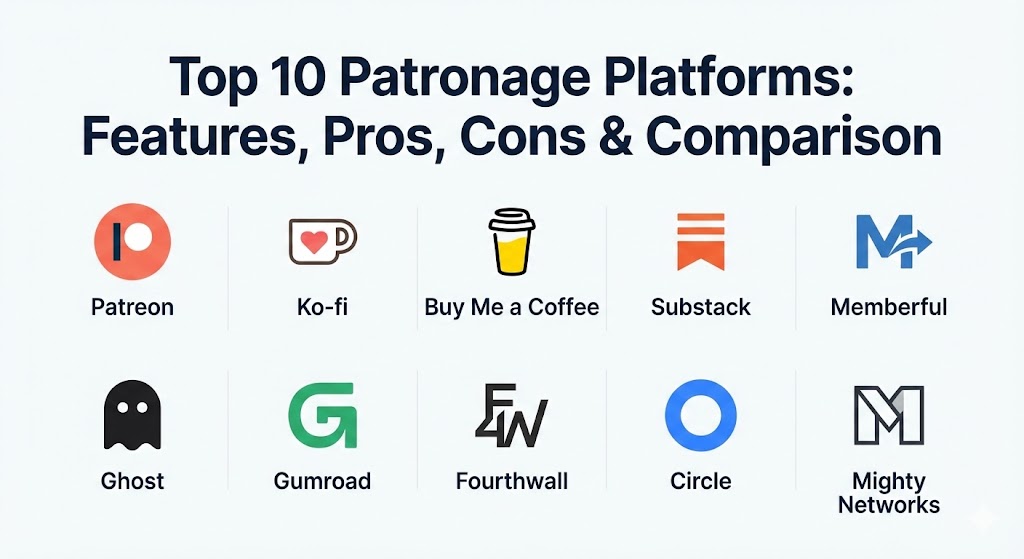
Top 10 Patronage Platforms
1 — Patreon
Patreon is the industry pioneer that popularized the concept of tiered memberships. It is designed for creators across all mediums who want to offer structured rewards to a loyal community.
- Key features:
- Customizable membership tiers with specific pricing and perks.
- Integrated “Community” tab for patron-only discussions and polls.
- Native integration with Discord for exclusive role-based access.
- “Merch for Membership” service for automated physical reward fulfillment.
- Private RSS feeds for exclusive audio/podcast content.
- Detailed analytics on patron growth, churn, and lifetime value.
- Support for multiple currencies and localized payment methods.
- Pros:
- The most recognized name in the industry, fostering high fan trust.
- Extensive ecosystem of third-party integrations (WordPress, Discord, etc.).
- Cons:
- Platform fees can be high (8% to 12% plus payment processing).
- Limited discovery; creators must drive 100% of their own traffic.
- Security & compliance: SOC 2 Type II, GDPR, HIPAA, PCI DSS compliant. Includes Two-Factor Authentication (2FA) for creators.
- Support & community: Extensive Help Center, dedicated creator success managers for top-tier accounts, and a large “Patreon Community” forum.
2 — Ko-fi
Ko-fi began as a simple “tip jar” for artists but has evolved into a comprehensive platform that combines donations, memberships, commissions, and a digital storefront.
- Key features:
- 0% platform fee on one-time donations (tips).
- Integrated commission system for custom art or service requests.
- Simple digital storefront for selling PDFs, images, or software.
- Monthly membership tiers with “post-locking” capabilities.
- Stream alerts for live-engagement tracking.
- Pay-what-you-want pricing options for digital products.
- Pros:
- Extremely artist-friendly with no fees on basic tips.
- Instant payouts directly to the creator’s PayPal or Stripe account.
- Cons:
- Page customization is fairly limited compared to other tools.
- Analytics are basic and lack deep marketing insights.
- Security & compliance: PCI DSS compliant via Stripe/PayPal. GDPR compliant.
- Support & community: High-quality documentation and a supportive community of indie artists on social media.
3 — Buy Me a Coffee
Buy Me a Coffee offers a polished, professional alternative to Ko-fi, focusing on a delightful user experience and one-click support for fans.
- Key features:
- One-click checkout for supporters (no account required for fans).
- “Extras” feature to sell one-off services or digital downloads.
- Native email marketing tools to send newsletters to supporters.
- Membership tiers for recurring monthly or yearly support.
- Sleek, mobile-optimized profile pages that look modern out-of-the-box.
- Discord and Zapier integrations for workflow automation.
- Pros:
- Higher conversion rates due to the frictionless “no login” support option.
- Very fast setup; most creators are live in under 5 minutes.
- Cons:
- Flat 5% platform fee on everything (no 0% tip option like Ko-fi).
- Customer support response times can be slow for free accounts.
- Security & compliance: SOC 2, GDPR compliant. Secure payment processing via Stripe.
- Support & community: Good knowledge base and active Twitter/X presence for updates.
4 — Substack
Substack is the go-to platform for writers and journalists, combining a powerful newsletter engine with a paid subscription model.
- Key features:
- Integrated blogging and newsletter platform with high deliverability.
- Paywall system that allows for a mix of free and premium posts.
- Native podcast hosting with private subscriber-only feeds.
- “Notes” social feed for audience discovery within the Substack network.
- Group subscriptions for professional teams or educational groups.
- Advanced SEO optimization for all published content.
- Pros:
- Built-in discovery engine (“Recommendations”) helps creators find new fans.
- Zero upfront cost; you only pay when you start making money.
- Cons:
- Significant 10% platform fee on all paid subscriptions.
- Very limited design control; every Substack looks similar.
- Security & compliance: GDPR and CCPA compliant. SSL encryption for all pages.
- Support & community: Robust documentation and “Substack Grow” resources for creator education.
5 — Memberful
Memberful is a “behind-the-scenes” membership tool that integrates directly into your existing website (especially WordPress), allowing for a fully branded experience.
- Key features:
- Best-in-class WordPress plugin for seamless membership management.
- Fully white-label checkout and member portal.
- Support for physical and digital downloads with automated delivery.
- Advanced “group” or corporate membership management.
- Deep integrations with Mailchimp, Discord, and Discourse.
- Private podcast feed generation for audio creators.
- Pros:
- Total control over the user experience and branding.
- Owned by Patreon, providing stability and excellent payment infrastructure.
- Cons:
- Requires an existing website or platform to be truly effective.
- Transaction fees on the “Pro” plan are still 4.9% plus Stripe fees.
- Security & compliance: PCI DSS, GDPR, and 2FA support. SSO available for Enterprise.
- Support & community: Premium email support and detailed technical guides for developers.
6 — Ghost
Ghost is a professional, open-source alternative to Substack, designed for creators who want full ownership of their audience and data with no platform fees.
- Key features:
- Clean, minimalist editor optimized for long-form writing.
- Built-in membership management with tiers and custom perks.
- Native SEO tools and social media metadata management.
- Advanced theme engine for 100% design control (using Handlebars).
- API-first architecture allowing for custom developer integrations.
- Automated email newsletters triggered by new posts.
- Pros:
- 0% platform fees—you keep 100% of your revenue (minus Stripe fees).
- Absolute data portability; you own your database and content.
- Cons:
- Requires a monthly subscription fee for the “Ghost(Pro)” hosting.
- Steeper learning curve for users who aren’t tech-savvy.
- Security & compliance: ISO 27001 (for Pro hosting), GDPR, and built-in SSL.
- Support & community: Active developer forum and comprehensive technical documentation.
7 — Gumroad
Gumroad is a flexible e-commerce platform that has expanded into memberships, making it ideal for creators who sell a mix of products and subscriptions.
- Key features:
- Superior digital product delivery (large files, videos, software keys).
- Subscription tiers that include regular content updates.
- Built-in affiliate marketing system to let fans sell for you.
- “Pay what you want” pricing to allow for variable support.
- Mobile app for customers to consume content on the go.
- Automated VAT handling for international sales.
- Pros:
- Unmatched ease of use for selling one-off digital downloads.
- Very strong anti-piracy features for video and software content.
- Cons:
- Flat 10% fee is higher than many other competitors.
- Community features are minimal compared to Patreon or Circle.
- Security & compliance: GDPR compliant, PCI DSS Level 1 payment processing.
- Support & community: Extensive University section with guides on how to sell.
8 — Fourthwall
Fourthwall is an all-in-one platform that combines memberships, branded e-commerce, and high-end website building for professional creators.
- Key features:
- High-quality “merch” designer with on-demand fulfillment.
- Native membership tiers that integrate with shop discounts.
- Fully custom-branded websites with your own domain name.
- “Thank you” video feature to send personalized clips to supporters.
- Integrated “supporter” feed for social interaction.
- Support for “gifting” memberships within the community.
- Pros:
- The best tool for creators who want their “shop” and “patronage” in one place.
- Exceptionally high-quality physical products and fulfillment.
- Cons:
- Focused heavily on physical products; less ideal for “pure” writers or podcasters.
- Can be complex to set up due to the sheer number of features.
- Security & compliance: SOC 2, GDPR, and robust data privacy controls.
- Support & community: Dedicated success managers and a vibrant Discord community.
9 — Circle
Circle is a premium community platform that allows creators to build their own “private social network” with integrated memberships and courses.
- Key features:
- Organized discussion spaces and threads (similar to Slack/Discord).
- Live streaming and group video call capabilities.
- Integrated course hosting with curriculum and progress tracking.
- Member directory and private 1-on-1 messaging.
- Flexible paywalls for different community “spaces” or “levels.”
- Weekly “automated digest” emails to keep members engaged.
- Pros:
- The gold standard for “community-led” patronage models.
- Extremely clean and professional UI that enhances the creator’s brand.
- Cons:
- One of the most expensive options (monthly subscription fee).
- Not a “content first” platform; requires active community management.
- Security & compliance: SOC 2 Type II, GDPR, and 2FA.
- Support & community: High-end customer support and a “Circle for Creators” community.
10 — Mighty Networks
Mighty Networks is an enterprise-grade platform for creators who want to build a massive, independent ecosystem that includes community, courses, and commerce.
- Key features:
- “Mighty Co-Host” AI to help with community moderation and post-generation.
- Native iOS and Android apps for your community (on higher tiers).
- Sophisticated course builder with tiered access.
- Virtual events and integrated calendar management.
- Advanced analytics on member engagement and “hot” topics.
- Ability to host “ambassador” programs to grow your network.
- Pros:
- Powerful enough to support 100k+ member communities.
- Excellent for “cohort-based” learning and professional associations.
- Cons:
- The interface can be overwhelming for simple membership needs.
- Lower-tier plans include transaction fees on top of the subscription.
- Security & compliance: GDPR, PCI DSS, and enterprise-grade data security.
- Support & community: Comprehensive “Community Design” masterclass for all users.
Comparison Table
| Tool Name | Best For | Platform(s) Supported | Standout Feature | Rating (Gartner/TrueReview) |
| Patreon | General Creators | Web, iOS, Android | Tiered Memberships | 4.6 / 5 |
| Ko-fi | Artists & Tipping | Web | 0% Tip Fees | 4.5 / 5 |
| Buy Me a Coffee | Quick Support | Web | Frictionless Checkout | 4.7 / 5 |
| Substack | Writers & Podcasters | Web, iOS, Android | Internal Recommendations | 4.4 / 5 |
| Memberful | Site Owners | WordPress, Web | White-label Control | 4.8 / 5 |
| Ghost | Independent Pubs | Self-hosted, SaaS | 0% Platform Fees | 4.7 / 5 |
| Gumroad | Digital Sellers | Web, iOS, Android | Affiliate Sales System | 4.3 / 5 |
| Fourthwall | Merch + Members | Web | Integrated Fulfillment | 4.9 / 5 |
| Circle | Community Building | Web, iOS, Android | Discussion Spaces | 4.8 / 5 |
| Mighty Networks | Large Networks | Web, iOS, Android | Native Mobile Apps | 4.6 / 5 |
Evaluation & Scoring of Patronage Platforms
To choose the right tool, we have evaluated these platforms against a weighted rubric that balances financial efficiency with the creator’s growth potential.
| Category | Weight | Evaluation Criteria |
| Core Features | 25% | Tier management, content locking, and donation/tip handling. |
| Ease of Use | 15% | Frictionless experience for both the creator and the patron. |
| Integrations | 15% | Compatibility with Discord, WordPress, and marketing stacks. |
| Security & Compliance | 10% | Data privacy, payment security, and GDPR compliance. |
| Performance | 10% | Payout speed, uptime, and mobile responsiveness. |
| Support & Community | 10% | Speed of help and availability of educational resources. |
| Price / Value | 15% | The balance between platform fees and the tools provided. |
Which Patronage Platform Is Right for You?
Selecting a platform depends on your primary “medium” and your technical comfort level.
- Solo Artists & Hobbyists: If you want a “digital tip jar” without a monthly bill, Ko-fi is the most affordable entry point. It allows you to experiment with memberships and commissions without financial pressure.
- Independent Writers: Substack is the clear winner if you want to grow an audience from scratch. If you already have a large following and want to save on fees, Ghost is the professional choice.
- Professional YouTubers & Podcasters: Patreon remains the standard for tiered rewards. However, if your brand relies heavily on physical merchandise, Fourthwall offers a much smoother workflow.
- Community & Course Creators: If your “product” is access to a group of people, Circle offers the most modern experience. For large-scale organizations or those who need their own branded mobile app, Mighty Networks is the enterprise standard.
- Tech-Savvy Owners: If you already run a successful website and simply want to add a paywall, Memberful provides the most robust “unseen” infrastructure.
Frequently Asked Questions (FAQs)
1. What is the average platform fee for patronage tools?
Fees range from 0% (Ghost, Ko-fi tips) to 12% (Patreon Premium). Most mid-market platforms settle around 5% plus standard payment processing (roughly 2.9% + $0.30).
2. Can I move my patrons from one platform to another?
It depends on the platform. Tools like Ghost and Memberful allow you to export your member list and credit card tokens (via Stripe). Patreon and Substack allow list exports, but moving recurring payments is technically difficult.
3. Do patronage platforms handle sales tax and VAT?
Yes, most major platforms like Patreon, Gumroad, and Substack act as the “merchant of record,” meaning they automatically calculate, collect, and remit VAT/sales tax globally.
4. Is there a “discovery” element to these platforms?
Most patronage platforms are “destination” tools—you must bring your own audience. Substack is a notable exception, with a recommendation engine that can drive significant organic growth.
5. How do payouts work?
Payouts usually occur via Stripe or PayPal. Some platforms offer “instant” payouts (Ko-fi), while others hold funds for a short period or pay out on a monthly schedule (Patreon).
6. Can I offer physical rewards through these tools?
Yes. Fourthwall and Patreon have built-in systems for physical merch. For others, you would likely need to integrate with a service like Printful via Zapier.
7. Do fans need an account to support me?
On Buy Me a Coffee, fans can support you with one click without creating an account. On Patreon or Circle, an account is usually required to manage their ongoing access and perks.
8. Can I host video directly on these platforms?
Patreon and Circle offer native video hosting. For others, creators typically host “unlisted” videos on YouTube or Vimeo and embed them behind the platform’s paywall.
9. Are there any free patronage platforms?
Ko-fi is free to use for tips, and Substack is free until you turn on paid subscriptions. Ghost is free if you self-host the open-source software on your own server.
10. What is the “1,000 True Fans” theory?
It’s the core philosophy behind these tools: a creator doesn’t need millions of followers to make a living; they only need 1,000 “true fans” who pay $100 per year for their work.
Conclusion
Choosing a patronage platform is a decision about where your “digital home” will be. While Patreon remains the safest bet for most, the rise of niche-specific tools like Substack for writers and Circle for community leaders shows that “one size fits all” is a thing of the past. Focus on your primary medium, calculate your long-term fees, and choose the platform that makes it easiest for your fans to say “yes” to supporting you.