Introduction
Royalty accounting software is a specialized class of financial technology designed to automate the calculation and distribution of payments to intellectual property (IP) holders. Unlike general accounting software that tracks standard debits and credits, royalty tools must navigate complex contracts involving advances, recoupments, tiered royalty rates, and cross-collateralization. They act as the “truth engine” that sits between raw sales data and the final statement an author, musician, or inventor receives.
The importance of these tools lies in their ability to handle “big data” with precision. A single song on Spotify can generate millions of micro-transactions that need to be parsed and attributed to multiple songwriters and producers. Key real-world use cases include automating author payouts in book publishing, managing “master” and “publishing” rights in music, and tracking franchise fees in global retail. When evaluating these tools, users should look for robust data ingestion capabilities, “no-code” contract modeling, and a transparent portal that allows payees to see their earnings in real-time.
Best for: Book publishers, independent and major record labels, film distributors, life sciences firms (patent royalties), and franchise-based businesses. It is essential for any organization managing more than 20-30 active contracts or those processing high-volume digital sales data.
Not ideal for: Solo creators with a single product or very small businesses with only a handful of static contracts. For these users, a well-constructed Excel sheet or a simple project-based accounting tool like FreshBooks may suffice without the high overhead of a dedicated royalty engine.
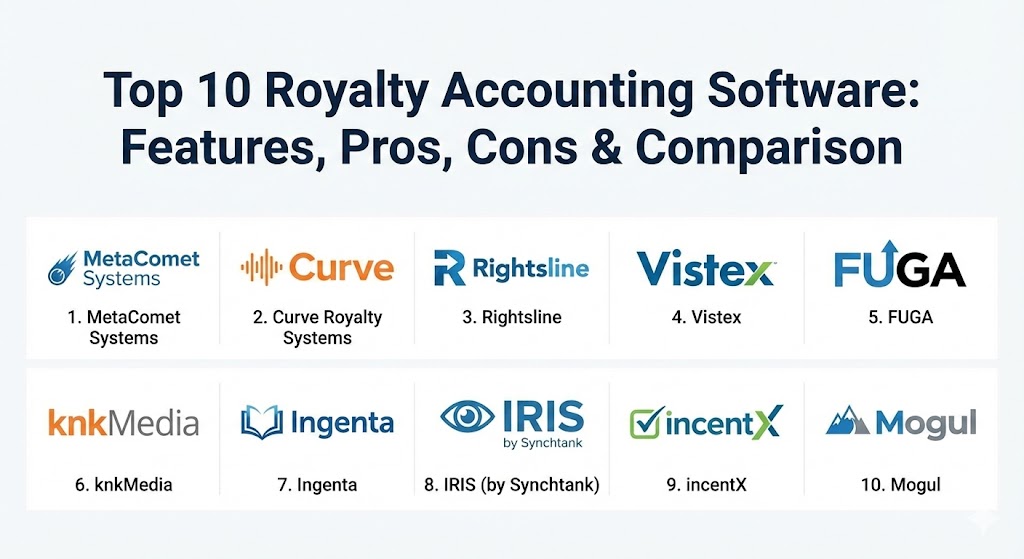
Top 10 Royalty Accounting Software Tools
1 — MetaComet Systems (Royalty Tracker)
MetaComet is widely regarded as an industry standard, particularly within the book publishing and life sciences sectors. Its flagship product, Royalty Tracker, is designed to eliminate the “anxiety” of royalty periods by automating the entire lifecycle from contract entry to payment.
- Key features:
- Automated data ingestion from global retailers (Amazon, Ingram, etc.).1
- “Recoupment tracking” for advances and production costs.2
- Highly customizable royalty statement templates.3
- Integrated author portal for self-service earnings tracking.4
- Multi-currency and multi-territory support.5
- One-click paym6ent file generation (ACH, Wire, PayPal).
- Sophisticated audit trail and version control for contracts.
- Pros:
- Reduces royalty processing time by up to 90% for most users.
- Exceptional customer support that understands the nuances of publishing.
- Cons:
- The initial setup and data migration can be time-consuming.
- The user interface, while functional, feels slightly more “industrial” than some modern music-focused rivals.
- Security & compliance: SOC 2 Type II compliant, featuring end-to-end encryption and robust audit logs.
- Support & community: Offers dedicated implementation specialists, extensive documentation, and a highly responsive email/phone support team.
2 — Curve Royalty Systems
Curve has disrupted the music industry with its sleek, modern interface and “creator-first” approach. It is built specifically to handle the “tsunami” of data generated by modern streaming services.7
- Key features:8
- High-speed ingestion engine capable of processing billions of9 rows of data.
- Advanced analytics and visualizations for both labels and artists.
- Support for complex music-specific deals like US Mechanicals and “Black Box” distributions.
- Native integration with digital distributors like FUGA, Orchard, and Believe.
- Automated currency conversion at the transaction level.
- Artist-facing dashboard with real-time analytics.
- Pros:
- Incredibly fast; what takes other systems hours, Curve often does in minutes.
- The most modern and intuitive UI in the royalty software market.
- Cons:
- Very specific to the music industry; not easily adapted for other IP types like patents.
- Pricing can be a bit steep for very small indie labels.
- Security & compliance: GDPR compliant, ISO 27001 certified data centers, and multi-factor authentication (MFA).
- Support & community: Excellent knowledge base, video tutorials, and a growing community of independent label owners.
3 — Rightsline
Rightsline is a powerhouse in the film, TV, and gaming sectors. It focuses heavily on the “Rights” side of the equation—helping companies see exactly what they own and where they can still sell it.
- Key features:
- 360-degree mapping of rights, from acquisition to distribution.
- Automated participation and royalty calculations for complex film deals.
- Real-time “availability” tracking to spot unsold territories.
- Integration with major ERPs like SAP and Oracle.
- Sophisticated contract lifecycle management (CLM).
- Financial forecasting and revenue modeling.
- Pros:
- Unmatched at tracking the intersection of “what is owned” and “what is owed.”
- High degree of scalability for global media conglomerates.
- Cons:
- Highly complex; requires a dedicated team or power user to manage effectively.
- Implementation costs are high, making it a “premium-only” solution.
- Security & compliance: Enterprise-grade security, SOC 2, and deep role-based access controls (RBAC).
- Support & community: Offers white-glove enterprise support and regular user group workshops in major media hubs.
4 — Vistex
Vistex is the “heavyweight” solution often chosen by Fortune 500 companies. It integrates deeply with ERP systems like SAP, making it the go-to for organizations that need royalty accounting to sit at the center of their enterprise financial planning.
- Key features:
- Deep ERP Integration: Seamlessly connects sales, finance, and royalty data.1011
- Support for a massive variety of incentive and royalty models.1213
- Rights and metadata management for large-scale catalogs.1415
- Advanced analytics for profitability and “margin leak” detection.1617
- Globa18l tax compliance and multi-entity management.19
- Pros:20
- The most robust solution for massive, complex21 enterprises.
- Highly configurable—if you can dream up a royalty deal, Vistex can calculate it.
- Cons:
- Extremely high learning curve and implementation time.
- Not suitable for SMBs or organizations without a significant IT budget.
- Security & compliance: Standard-setting security, ISO 27001, SOC 1 & 2, and HIPAA compliance where applicable.
- Support & community: Global enterprise support network with specialized consultants for every major industry.
5 — FUGA (Royalty Module)
Part of the Downtown Music Holdings ecosystem, FUGA is primarily a digital distributor, but its built-in royalty module is a favorite for labels that want a “unified” stack for distribution and accounting.
- Key features:
- Direct data synchronization between distribution sales and royalty accounting.
- Simplified “one-click” statement generation.
- Support for “cost recoupment” and joint venture splits.
- Flexible white-label artist portals.
- Global tax handling and automated withholding calculations.
- Pros:
- Eliminates the need to export/import data if you already use FUGA for distribution.
- Clean, modern interface that is easy for label managers to navigate.
- Cons:
- You generally need to be a FUGA distribution client to get the most value.
- Less flexible for physical product sales compared to specialized tools like MetaComet.
- Security & compliance: SOC 2 compliant and adheres to all major global data privacy laws.
- Support & community: Strong support for distribution clients; extensive documentation for the royalty module.
6 — knkMedia
Built on the Microsoft Dynamics 365 framework, knkMedia is a specialized solution for book publishers that brings the power of an ERP to the world of content management and royalties.
- Key features:
- Works natively with Excel, Outlook, and Power BI.
- Handles royalties down to individual chapters, hymns, or articles.
- Modern dashboard for authors to track manuscripts and money.
- Automated contract generation based on pre-approved templates.
- Leverages Microsoft’s ongoing AI and cloud investments.
- Pros:
- If your company runs on Microsoft, the integration is unbeatable.
- Extremely granular—perfect for academic or scientific publishers.
- Cons:
- Requires a significant investment in the Microsoft ecosystem.
- Can feel “over-engineered” for small, independent publishers.
- Security & compliance: Inherits Microsoft’s world-class Azure security, GDPR, and ISO compliance.
- Support & community: Access to a global network of Microsoft partners and specialized knk consultants.
7 — Ingenta (Royalties)
Ingenta is a legacy player in the publishing technology space, offering a “battle-tested” royalty engine that has handled some of the world’s largest author catalogs for decades.
- Key features:
- Highly accurate calculation engine for print, digital, and subsidiary rights.
- Support for complex “sliding scale” royalty tiers.
- Robust reporting for internal stakeholders and external auditors.
- Scalable for high volumes of products and payees.
- Professional services for custom data migration and cleanup.
- Pros:
- Exceptional reliability and accuracy; highly trusted by large-scale legacy publishers.
- Good at handling the “weird” edge cases of print publishing.
- Cons:
- The user interface is dated compared to cloud-native platforms like Curve or CData.
- Slower development cycle for new, modern features.
- Security & compliance: ISO 27001 and standard cloud encryption; rigorous audit logging.
- Support & community: Structured onboarding and dedicated account management for long-term clients.
8 — IRIS (by Synchtank)
IRIS is a high-speed royalty engine designed by Synchtank, a company originally known for its music sync and asset management tools. IRIS focuses on solving the “fragmented data” problem.
- Key features:
- Centralized “hub” for rights, metadata, and royalty sales.
- Automated matching of sales data to assets using AI.
- High-performance calculation for massive streaming datasets.
- Comprehensive API for integrating with other financial tools.
- Modern, responsive interface.
- Pros:
- Excellent at handling the intersection of asset management and royalty payables.
- Very fast processing times for modern digital datasets.
- Cons:
- Best used as part of the wider Synchtank ecosystem.
- Newer than some of the established giants; community is still growing.
- Security & compliance: SOC 2 Type II and GDPR compliant.
- Support & community: High-touch customer success and proactive technical support.
9 — incentX
incentX is a modern, cross-industry royalty and rebate management solution that focuses on “transaction-level clarity.” It is excellent for businesses that deal with complex trade royalties or franchise agreements.
- Key features:
- Real-time dashboards for both payors and payees.
- No-code rule builder for complex royalty and rebate logic.
- Native integration with Salesforce and major ERPs.
- Advanced AI for detecting anomalies or “revenue leakage.”
- Fully automated payout workflows.
- Pros:
- Very flexible across industries (not just music or books).
- Focus on “fiscal clarity” helps prevent disputes before they happen.
- Cons:
- Lacks some of the “industry-standard” reporting templates for music or publishing.
- Setup can be complex if your data isn’t already well-structured.
- Security & compliance: SOC 2, GDPR, and enterprise-grade encryption.
- Support & community: Rapidly growing community and an accessible online knowledge base.
10 — Mogul (formerly RoyaltyShare)
Mogul has emerged as a leader for high-volume digital media companies, particularly those that need to aggregate sales from hundreds of digital service providers (DSPs) worldwide.
- Key features:
- Automated aggregation of sales reports from global digital retailers.
- Sophisticated data mapping to handle inconsistent DSP reporting formats.
- High-volume processing for streaming-heavy catalogs.
- Transparent reporting for artists and managers.
- Integrated payment processing.
- Pros:
- Takes the “nightmare” out of collecting and cleaning global digital sales data.
- Highly specialized for the digital-first music and video era.
- Cons:
- Less focused on “physical” sales or complex print publishing logic.
- Can be expensive for labels with low streaming volume but high catalog count.
- Security & compliance: Adheres to industry-standard security protocols; GDPR compliant.
- Support & community: Established support infrastructure with years of industry experience.
Comparison Table
| Tool Name | Best For | Platform(s) Supported | Standout Feature | Rating (Gartner/TrueReview) |
| MetaComet22 | Book Publishers / Life Sciences23 | Cloud24 | 90% Processing Time Reduction25 | 4.8 / 526 |
| Curve Royalty27 | Independent Music Labels28 | Cloud29 | Modern, Creator-Centric UI30 | 4.9 / 531 |
| Rightslin32e | Film, TV & Video Games | Cloud / Hybrid | 360 Rights-to-Royalty Mapping | 4.6 / 5 |
| Vistex | Large Enterprise / Global | On-Prem / Cloud | Deep SAP / ERP Integration | 4.5 / 5 |
| FUGA Royalty | Music Distributors | Cloud | Unified Distribution & Royalties | 4.4 / 5 |
| knkMedia | Microsoft-Centric Publishers | Cloud (Azure) | Chapter-Level Granularity | 4.3 / 5 |
| Ingenta | Legacy Print Publishers | Cloud | Battle-Tested Legacy Support | 4.1 / 5 |
| IRIS (Synchtank) | High-Volume Digital Media | Cloud | AI-Driven Sales Data Matching | 4.7 / 5 |
| incentX | Cross-Industry / Franchises | Cloud | No-Code Rule Builder | 4.5 / 5 |
| Mogul | Digital Aggregation | Cloud | Global DSP Data Cleaning | 4.6 / 5 |
Evaluation & Scoring of Royalty Accounting Software
To provide an objective ranking, we have evaluated these tools against a weighted rubric designed for 2026 standards, where data volume and AI integration are the new benchmarks.
| Category | Weight | Evaluation Criteria |
| Core Features | 25% | Accuracy of calculations, recoupment tracking, and tiered-rate support. |
| Ease of Use | 15% | Intuitive UI for admins and transparency of the payee portal. |
| Integrations | 15% | API availability and native connections to ERPs (SAP/Oracle) and sales sources. |
| Security & Compliance | 10% | SOC 2 status, GDPR adherence, and depth of audit logs. |
| Performance | 10% | Speed of processing large datasets (billions of streaming rows). |
| Support & Community | 10% | Implementation guidance and availability of specialized industry experts. |
| Price / Value | 15% | ROI based on time saved and error reduction vs. the annual license cost. |
Which Royalty Accounting Software Tool Is Right for You?
Selecting a royalty tool is a high-stakes decision. The wrong choice can lead to years of technical debt and potential lawsuits from disgruntled creators.
- Solo Creators & Small Teams: If you have fewer than 10 contracts, stick to a high-quality spreadsheet. If you’re outgrowing that, look at a lightweight tool like SimpleRoyalties (for basic needs) or Curve (if you’re in music).
- SMBs (Independent Labels & Presses): MetaComet and Curve are the clear winners here. They offer enterprise-grade accuracy without the million-dollar price tag of a custom ERP.
- Mid-Market Companies: If you need more than just accounting—like managing the rights lifecycle—Rightsline or IRIS are better choices. They help you monetize what you own while ensuring you pay what you owe.
- Large Enterprises & Fortune 500: Vistex is the gold standard for organizations where royalties are just one part of a massive global financial puzzle. It is expensive and complex, but it is the only tool that can sit natively inside an SAP environment.
- Feature Depth vs. Ease of Use: If your team is non-technical, prioritize Curve or incentX. If you have a dedicated finance and IT team, you can handle the more powerful, albeit complex, interfaces of Rightsline or Ingenta.
Frequently Asked Questions (FAQs)
1. What is the main benefit of moving from Excel to royalty software?
Excel is prone to human error—a single broken cell can result in thousands of dollars in over- or under-payments. Specialty software automates calculations, handles “recoupable” advances, and provides an audit trail that stands up in court.
2. Can these tools handle multiple currencies?
Yes. Modern tools like MetaComet and Curve allow you to import sales in Euros, Yen, or Dollars and automatically convert them to the payee’s local currency based on the exchange rate at the time of the transaction.
3. Do I need an accountant to set this up?
While you don’t need to be a CPA, you do need a deep understanding of your contracts. Most vendors provide “onboarding specialists” who help you translate your paper contracts into the digital “rules” of the software.
4. How do these tools handle “advances”?
Royalty software tracks every dollar paid to a creator as an advance. It then monitors incoming sales and “recoups” that advance before any new royalty payments are triggered, keeping your cash flow accurate.
5. Is my data safe in the cloud?
Most reputable providers (like those on this list) use enterprise-grade encryption and are SOC 2 compliant. Your data is often more secure in their hardened environments than on a local office server or personal laptop.
6. What is a “Royalty Portal”?
It is a secure website where your authors or artists can log in to see their latest statements, historical earnings, and often real-time analytics on where their products are selling best.
7. Can these tools manage physical and digital sales at once?
Yes. Tools like MetaComet are particularly good at “Physical” (print books/CDs) where inventory and returns matter, while others like Curve focus on the “Digital” (streaming) aspect.
8. How does the software handle tax withholdings?
Most enterprise tools can be configured with global tax rules. They will automatically calculate and withhold the necessary taxes based on the payee’s residency and the territory of the sale.
9. Why is “Rights Management” separate from “Royalty Accounting”?
Rights Management tracks what you can do (e.g., “I own the Spanish audio rights until 2030”). Royalty Accounting tracks what you did (e.g., “We sold 500 units in Spain, so we owe the author $200”).
10. What is “Cross-Collateralization”?
This is a complex deal where the earnings from one product (e.g., Book A) are used to pay off the unearned advance of another (e.g., Book B). Good royalty software handles this logic automatically.
Conclusion
In the modern IP landscape, transparency is the new currency. Creators are no longer willing to accept “black box” statements that they can’t verify. By implementing a robust Royalty Accounting Software solution, you are doing more than just crunching numbers; you are building trust with your most valuable assets: your creators. The “best” tool isn’t the one with the most features, but the one that aligns most closely with your industry’s specific data challenges and your team’s technical capacity.