Introduction
A freelance marketplace platform is a digital intermediary that allows independent professionals to offer their services to businesses and individuals. These platforms have become vital because they solve the three biggest hurdles in remote work: discovery, trust, and transaction. For businesses, they offer instant access to a global talent pool that would be impossible to source locally. For freelancers, they provide a consistent pipeline of work and a layer of financial protection through escrow services.
Key real-world use cases include scaling a software development team for a specific sprint, sourcing high-end brand identity from award-winning designers, or managing a distributed content team across multiple time zones. When evaluating a platform, users should look beyond the surface-level interface. Evaluation criteria must include the quality of the vetting process, fee transparency, dispute resolution effectiveness, and integration with existing project management stacks.
Best for: Hiring managers needing specialized skills on short notice, project-based organizations (like marketing agencies), and solo entrepreneurs looking to delegate technical or creative tasks without the overhead of an employee. It is also ideal for professionals seeking a flexible, “digital nomad” lifestyle.
Not ideal for: Roles requiring deep institutional knowledge and long-term, non-project-based continuity. Companies with strictly sensitive on-premise security requirements or those who prefer traditional, in-person team dynamics may find the remote-first nature of these platforms challenging.
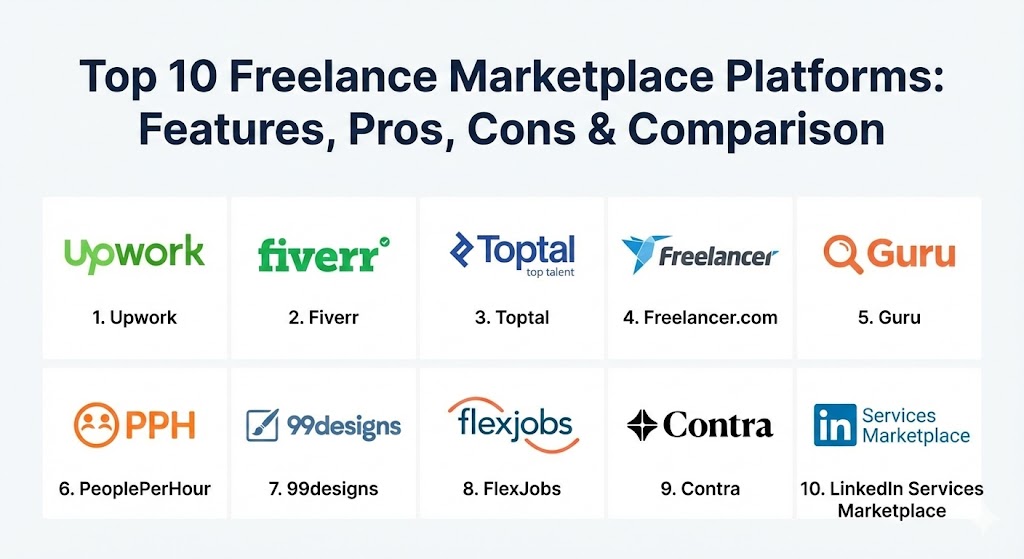
Top 10 Freelance Marketplace Platforms
1 — Upwork
Upwork is arguably the most recognizable name in the industry. Formed by the merger of Elance and oDesk, it has transformed into a comprehensive “all-in-one” workplace. In 2026, it leads the market with its Uma AI integration, which assists in drafting job posts and matching talent with precision.
- Key features:
- Uma AI: Mindful AI that assists in proposal writing and talent matching.
- Upwork Payroll: A built-in service for hiring freelancers as employees in 160+ countries.
- Talent Marketplace & Project Catalog: Choose between traditional bidding or pre-packaged services.
- Enterprise Suite: Advanced compliance and management tools for large-scale deployments.
- Direct Contracts: Allows freelancers to use Upwork’s escrow for clients found outside the platform at lower fees.
- Pros:
- Massive diversity of talent; you can find everything from AI prompt engineers to legal researchers.
- Robust payment protection for both fixed-price and hourly contracts.
- Cons:
- High service fees for new relationships (though they decrease with longevity).
- The “Connects” system (paid bidding credits) can be expensive for new freelancers.
- Security & compliance: SOC 2 Type II, GDPR, and HIPAA compliant (enterprise tier). Features include SSO, multi-factor authentication, and automated classification audits.
- Support & community: Extensive self-service documentation, 24/7 chat support for premium tiers, and a massive community forum with millions of active users.
2 — Fiverr
Fiverr revolutionized the industry with its “productized” service model. Instead of a client posting a job, freelancers (sellers) list specific “Gigs” starting at $5. It has since expanded into the high-end market with Fiverr Pro, targeting serious business buyers.
- Key features:
- Gig-Based Discovery: Services are listed like products on an e-commerce site.
- Fiverr Pro: A hand-vetted tier of top-tier talent for enterprise projects.
- Fiverr Neo: An AI matching assistant that helps buyers find the right gig through a conversational interface.
- Seller Levels: A gamified system that rewards high-performing sellers with better visibility.
- Milestone Payments: Support for breaking large projects into manageable payment phases.
- Pros:
- Unbeatable speed; you can “buy” a service in three clicks without a lengthy bidding process.
- Transparent, upfront pricing with no hidden “negotiation” phases.
- Cons:
- The 20% commission taken from freelancers is among the highest in the industry.
- Quality can be inconsistent in the lower-priced tiers.
- Security & compliance: PCI DSS for payments, GDPR compliant, and identity verification for Pro sellers.
- Support & community: 24/7 customer success teams, specialized “Seller Plus” support for high-volume sellers, and a robust educational platform (Fiverr Learn).
3 — Toptal
Toptal (Top Talent) positions itself as the “VIP lounge” of the gig economy. It famously accepts only the top 3% of applicants through a rigorous 5-step screening process that includes technical tests and live problem-solving.
- Key features:
- Rigorous Vetting: Includes language skills, personality tests, and deep technical reviews.
- Personalized Matching: Toptal directors manually match talent to your project requirements.
- Trial Period: Every engagement starts with a no-risk trial period.
- Focus on Elite Segments: Developers, designers, finance experts, and project managers.
- Enterprise Account Management: Dedicated support for Fortune 500 clients.
- Pros:
- Drastically reduces hiring risk; the talent is almost guaranteed to be world-class.
- Ideal for complex, high-stakes technical projects that cannot afford failure.
- Cons:
- Significant price premium compared to other platforms.
- Not suitable for simple, low-budget tasks.
- Security & compliance: ISO 27001, GDPR, and SOC 2. High focus on Intellectual Property (IP) protection and rigorous NDA protocols.
- Support & community: High-touch, white-glove support with dedicated account managers.
4 — Freelancer.com
Freelancer.com is the high-volume engine of the industry. With over 60 million users, it is the platform where you go when you need the most competitive bids on a global scale.
- Key features:
- Contest System: Post a brief and have dozens of freelancers submit actual work (e.g., logo designs) before you pay.
- Local Jobs: A feature for hiring professionals for physical tasks like furniture assembly or local photography.
- Desktop Time Tracker: Includes automated screenshots and activity levels for hourly work.
- Recruiter Service: Professional assistance in selecting the best bidder.
- Preferred Freelancer Program: Access to an elite group of high-performing, vetted talent.
- Pros:
- Generally the most affordable option due to the sheer volume of global competition.
- The contest model is excellent for creative brainstorming.
- Cons:
- High volume of “spam” applications; requires heavy filtering.
- The interface can feel cluttered and overwhelming for new users.
- Security & compliance: Milestone Payment system ensures funds are only released upon satisfaction. GDPR compliant.
- Support & community: 24/7 live chat and a comprehensive “Freelancer Community” blog.
5 — Guru
Guru focuses on the “experienced professional.” It emphasizes long-term relationships and provides unique “WorkRooms” to manage multiple collaborators efficiently.
- Key features:
- WorkRooms: Dedicated dashboards for managing teams, tasks, and files in one place.
- Flexible Payment Terms: Choose between Fixed-Price, Hourly, Task-Based, or Recurring (retainer) models.
- SafePay: A proprietary escrow system that ensures payment security for both parties.
- Lower Fees: Freelancer fees range from 5% to 9%, which is lower than the industry average.
- Daily Job Matches: AI-driven alerts based on specific skill sets.
- Pros:
- Excellent for managing ongoing, complex projects with multiple freelancers.
- The recurring payment model is perfect for long-term retainers.
- Cons:
- Smaller talent pool compared to the giants like Upwork.
- The user interface is functional but lacks the modern “polish” of competitors.
- Security & compliance: Standard SSL encryption, SafePay escrow, and GDPR compliance.
- Support & community: Knowledge base and email-based support with specialized help for business owners.
6 — PeoplePerHour
Based in the UK, PeoplePerHour is a favorite for SMBs in Europe. It combines the traditional bidding model with “Hourlies”—fixed-price offers that can be started almost instantly.
- Key features:
- Hourlies: Pre-packaged, low-cost services for quick turnarounds.
- AI Matching: Automated pairing of freelancers with projects based on past performance.
- WorkStream: A centralized communication and file-sharing hub for every project.
- Curated Approval: Unlike Freelancer.com, PPH reviews every freelancer application to maintain a quality baseline.
- Escrow Protection: Funds are held securely until the buyer approves the work.
- Pros:
- High quality-to-price ratio, especially for creative and technical tasks in the UK/EU markets.
- The “Hourlies” model provides great transparency for simple tasks.
- Cons:
- Limited number of free proposals per month for freelancers.
- Higher focus on creative/tech; less effective for admin or general business roles.
- Security & compliance: GDPR compliant, anti-fraud monitoring, and secure payment gateways.
- Support & community: 24/7 customer support and a dedicated forum for European freelancers.
7 — 99designs
Owned by Vistaprint, 99designs is a specialized marketplace. It is the gold standard for anything related to graphic design, branding, and visual identity.
- Key features:
- Design Contests: Receive multiple design concepts from different designers and pick the winner.
- 1-to-1 Projects: Hire a specific designer directly for a traditional engagement.
- Expert Vetting: Designers are categorized into tiers (Entry, Mid, Top) based on a manual portfolio review.
- Standardized Copyright Transfer: Automated tools to ensure the buyer owns the final design.
- Brand Style Guides: Tools to help clients define their visual language before hiring.
- Pros:
- The best way to get a wide variety of creative perspectives on a single brief.
- High-quality results guaranteed by the tier-based vetting system.
- Cons:
- Expensive for simple, one-off design needs.
- Contests can be time-consuming to manage.
- Security & compliance: Specialized IP transfer agreements and secure escrow.
- Support & community: Exceptional support for resolving design-based disputes and creative blocks.
8 — FlexJobs
FlexJobs is unique because it isn’t a traditional marketplace; it is a premium, vetted job board. It charges freelancers a subscription fee to ensure every listing is 100% scam-free and professional.
- Key features:
- 100% Hand-Screened Listings: Every job is verified for legitimacy.
- Focus on Flexibility: Specializes in remote, part-time, and freelance professional roles.
- Career Coaching: Includes access to professional resume reviews and skills tests.
- Partner Discounts: Subscriptions include discounts for tools like Audible or coworking spaces.
- Company Guides: Deep research into the remote-work policies of thousands of companies.
- Pros:
- The safest platform for freelancers; virtually zero chance of encountering a scam.
- High-quality listings from reputable companies that often aren’t on Upwork.
- Cons:
- Requires a paid subscription just to apply for jobs.
- Not a transactional platform; it doesn’t handle payments or escrow.
- Security & compliance: Verifies employer legitimacy to protect workers. Standard web privacy policies.
- Support & community: Responsive customer service and a wealth of career-focused webinars.
9 — Contra
Contra is the “new generation” freelance platform. It is a commission-free marketplace that focuses on modern creatives and technical professionals who want to own their client relationships.
- Key features:
- 0% Commission: Freelancers keep 100% of their earnings; the platform charges the client a flat fee.
- Visual Portfolios: High-end, modern portfolio tools that replace traditional resumes.
- Integrated Invoicing: Professional billing tools that look great and work globally.
- Stripe-Powered Payments: Fast, reliable payouts without the long “holding” periods of Fiverr.
- Community Marketplace: Discover other freelancers to collaborate with on large projects.
- Pros:
- Highly attractive to top-tier talent who are tired of high platform fees.
- Modern, clean interface that feels more like a social network than a job board.
- Cons:
- Much smaller volume of active jobs compared to the legacy giants.
- Focus is skewed toward “Gen Z” tech and creative niches.
- Security & compliance: Standard encryption and secure payments via Stripe.
- Support & community: Highly active Slack community and modern, responsive support teams.
10 — LinkedIn Services Marketplace
Leveraging its 900+ million users, the LinkedIn Services Marketplace allows professionals to list their services directly on their profiles. It is the most “organic” way to find B2B freelance help.
- Key features:
- Profile Integration: Services are listed directly alongside your work history and recommendations.
- Recommendation Engine: Built-in credibility from established professional connections.
- Search Integration: Your services appear in LinkedIn’s main search bar.
- Direct Messaging: Uses the familiar LinkedIn InMail system for negotiations.
- Zero Transaction Fees: LinkedIn does not currently charge a cut of the project fee.
- Pros:
- No need to build a new profile; your existing professional reputation carries over.
- Excellent for B2B services like executive coaching, marketing strategy, or legal consulting.
- Cons:
- No escrow or payment protection; you must handle billing off-platform.
- Minimal project management tools.
- Security & compliance: Follows LinkedIn’s enterprise-grade security and privacy policies.
- Support & community: Standard LinkedIn Help Center and access to the world’s largest professional network.
Comparison Table
| Tool Name | Best For | Platform(s) Supported | Standout Feature | Rating (Gartner / TrueReview) |
| Upwork | Scalable Teams | Web, iOS, Android | Uma AI Matching | 4.6 / 5 |
| Fiverr | Quick, Scoped Gigs | Web, iOS, Android | Productized “Gig” Model | 4.3 / 5 |
| Toptal | High-Stakes Tech | Web | Top 3% Manual Vetting | 4.8 / 5 |
| Freelancer.com | Affordability | Web, iOS, Android | Design Contests | 4.1 / 5 |
| Guru | Long-term Retainers | Web | Team WorkRooms | 4.2 / 5 |
| PeoplePerHour | European SMBs | Web, iOS, Android | “Hourlie” Offers | 4.2 / 5 |
| 99designs | Branding & Design | Web | Contest-based Ideation | 4.7 / 5 |
| FlexJobs | Scam-Free Roles | Web | Hand-Screened Listings | 4.5 / 5 |
| Contra | Modern Tech/Creative | Web | 0% Freelancer Fees | 4.6 / 5 |
| LinkedIn Services | B2B Networking | Web, iOS, Android | Built-in Recommendations | 4.4 / 5 |
Evaluation & Scoring of Freelance Marketplace Platforms
To help buyers and sellers choose effectively, we evaluated these tools across seven weighted categories.
| Criteria | Weight | Evaluation Highlights |
| Core Features | 25% | Presence of escrow, time tracking, and robust search filters. |
| Ease of Use | 15% | Intuitiveness of the UI and the speed of the onboarding process. |
| Integrations | 15% | Ability to connect with Slack, Jira, or cloud storage ecosystems. |
| Security & Compliance | 10% | Encryption standards, IP protection, and tax compliance (1099/W2). |
| Performance | 10% | Search speed, mobile app stability, and payment processing time. |
| Support & Community | 10% | Availability of live help and active peer-to-peer forums. |
| Price / Value | 15% | Balance between service fees and the quality of the talent pool. |
Which Freelance Marketplace Platform Is Right for You?
The decision-making process should be dictated by your specific project scope and budget tolerance.
Solo Users vs SMB vs Mid-Market vs Enterprise
- Solo Users: If you need a quick logo or a voice-over for a video, Fiverr is the clear winner for speed and price.
- SMBs: PeoplePerHour or Guru offer the best balance of features and reasonable fees for small business owners.
- Enterprise: Upwork Enterprise or Toptal are the only choices for large companies needing compliance, managed payroll, and elite, pre-vetted talent.
Budget-Conscious vs Premium Solutions
- Budget-Conscious: Freelancer.com consistently attracts the lowest bids due to its massive global user base, though you must be prepared to vet candidates heavily yourself.
- Premium: Toptal and Fiverr Pro are premium services where you pay for the reduction of risk. You will pay more, but you will spend significantly less time on project management.
Feature Depth vs Ease of Use
If you want a simple “Buy Now” button, Fiverr is your tool. If you need a full suite of management features—including hourly screenshots, milestone approvals, and built-in video calls—Upwork is the gold standard for feature depth.
Integration and Scalability Needs
For companies that already live in LinkedIn, using the LinkedIn Services Marketplace is a friction-free way to start. However, if you need to scale a team of 50 developers across multiple time zones, the project management features of Guru or Upwork are necessary for scalability.
Security and Compliance Requirements
If you are in a highly regulated industry like healthcare or finance, avoid the “open” marketplaces like Freelancer.com. Instead, choose Upwork Enterprise or Toptal, which provide the necessary SOC 2 compliance and rigorous NDA handling to protect your data.
Frequently Asked Questions (FAQs)
1. How do these platforms protect my money?
Most platforms (except LinkedIn and FlexJobs) use Escrow Services. This means the buyer deposits the funds before the work starts, but the money is not released to the freelancer until the buyer approves the deliverables.
2. Are the reviews on these sites real?
On most major platforms like Upwork and Fiverr, reviews are “verified,” meaning they can only be left after a financial transaction has been completed. This makes them significantly more reliable than generic review sites.
3. What happens if a freelancer disappears mid-project?
Platforms with escrow (Upwork, Fiverr, Guru) have dispute resolution teams. If a freelancer fails to deliver, you can file a dispute to have your funds returned from escrow.
4. Why is the commission fee so high?
The 10–20% fee covers the cost of finding talent, payment processing, fraud protection, and the escrow infrastructure. Platforms like Contra avoid this by charging the buyer a flat fee instead.
5. Can I hire a freelancer for a full-time role?
Yes. Upwork Payroll and Toptal specifically cater to long-term engagements. However, you must be careful with “worker classification” laws (1099 vs. W2) to avoid legal issues.
6. Is it safe to share my company data with freelancers?
It is as safe as you make it. You should always have a signed NDA. Enterprise tiers on platforms like Toptal and Upwork provide automated NDA management and secure file-sharing environments.
7. Which platform is best for beginners?
Fiverr and Freelancer.com are generally easier for beginners to get their first few “gigs” due to the lower entry barrier.
8. Can I pay freelancers in cryptocurrency?
Directly, no (on most major platforms). However, some newer platforms like Contra or specialized Web3 marketplaces support crypto payments. Most legacy platforms stick to USD/EUR via Bank or PayPal.
9. How do I avoid “scam” listings?
Never communicate or pay outside the platform. Scammers will often try to lure you to Telegram or WhatsApp. Using a vetted site like FlexJobs also eliminates this risk entirely.
10. What is a “Managed Marketplace”?
Platforms like Toptal or Gigster are “managed,” meaning a human from the platform is involved in matching and managing the success of the project, as opposed to “self-service” sites like Fiverr.
Conclusion
The “best” freelance marketplace platform does not exist in a vacuum—it only exists in relation to your needs. If your priority is quality and reliability, Toptal is the winner. If you value speed and simplicity, Fiverr is your best bet. If you need a long-term partner and deep project management features, Upwork remains the undisputed leader.
As the industry moves toward 2027, expect to see even deeper AI integration and a shift toward commission-free models as freelancers gain more leverage. Whatever your choice, ensure that you prioritize payment security and IP protection above all else to make your freelance engagement a success.