Introduction
Language learning apps are digital platforms designed to teach users new languages through structured curricula, interactive exercises, and multimedia content. Unlike traditional classroom settings, these apps offer the flexibility of self-paced study, allowing users to practice anywhere from a morning commute to a short break at the office. They are vital tools for breaking down cultural barriers, enhancing cognitive function, and opening up international career opportunities.
In 2026, the primary use cases for these tools extend beyond casual travel. We see heavy adoption in corporate training for multinational teams, academic support for students, and integration into government programs for migrant relocation. When evaluating these tools, users should look for pedagogical depth (does it teach why, or just what?), speech recognition accuracy, offline functionality, and the quality of AI-driven personalization that adapts to the learner’s specific pace and mistakes.
Best for: Travelers, students, and professionals working in multinational corporations. It is also ideal for cognitive health enthusiasts and digital nomads who need to acquire local language basics quickly and affordably.
Not ideal for: Individuals requiring high-level literary or technical fluency in extremely niche dialects without a structured digital curriculum, or those who learn exclusively through physical, tactile interaction and human-only immersion without digital aids.
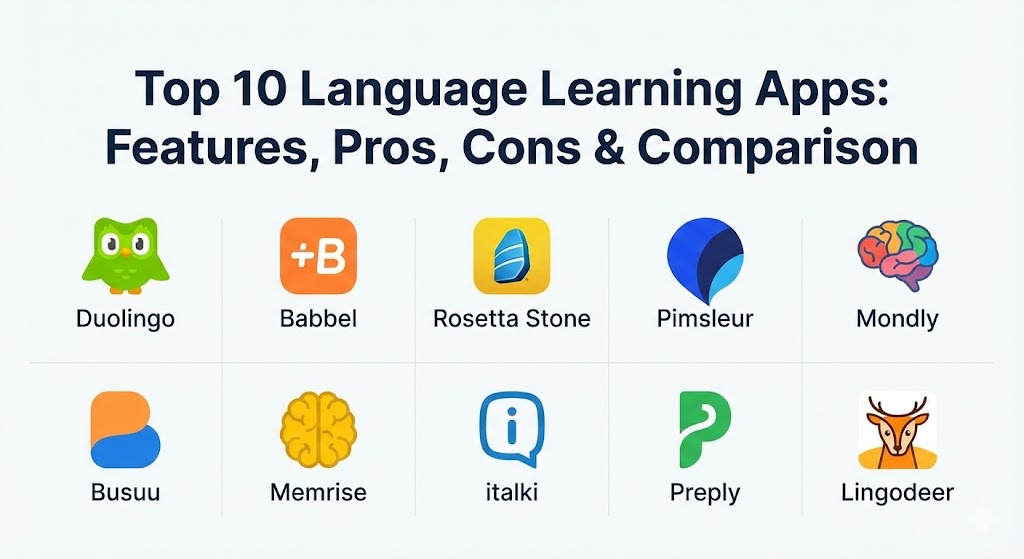
Top 10 Language Learning Apps
1 — Duolingo
Duolingo remains the world’s most downloaded language app, famous for its gamified approach and its persistent mascot, Duo the Owl. In 2026, it has expanded its “Duolingo Max” tier, which utilizes generative AI to provide real-time explanations for mistakes and interactive role-play scenarios.
- Key features:
- Highly gamified “streak” and leaderboard system to drive daily engagement.
- Duolingo Max: AI-powered “Explain My Answer” and “Roleplay” features.
- Bite-sized lessons (3–5 minutes) focusing on vocabulary and basic grammar.
- Podcast and “Stories” integration for listening comprehension in major languages.
- Specialized courses for non-standard languages like High Valyrian or Klingon.
- Cross-platform syncing between web, iOS, and Android.
- Integrated Math and Music courses for a holistic learning environment.
- Pros:
- Completely free tier offers access to the entire core curriculum.
- Exceptionally high retention rates due to addictive gamification mechanics.
- Cons:
- Grammar explanations can feel superficial compared to academic apps.
- Limited focus on deep, spontaneous conversational fluency.
- Security & compliance: GDPR and CCPA compliant; offers SSO for school and enterprise accounts; data is encrypted in transit and at rest.
- Support & community: Massive global community; active Reddit and forum presence; extensive help center but limited direct human support for free users.
2 — Babbel
Babbel is widely considered the “professional’s choice,” offering a more structured, textbook-style experience. It focuses on practical, real-life dialogue and is frequently used by businesses to upskill employees for international relocation.
- Key features:
- Lessons crafted by over 150 linguists rather than just algorithms.
- Focus on “Real-World Dialogue” tailored to specific travel or business needs.
- Babbel Live: Optional small-group classes with professional teachers.
- Speech recognition technology focused on improving natural pronunciation.
- Review sessions that use spaced repetition to move vocabulary into long-term memory.
- Culture snippets that provide context beyond just the literal translation.
- Pros:
- Provides a much stronger grammatical foundation than purely gamified apps.
- Ad-free experience even at the basic subscription level.
- Cons:
- Very limited free content; essentially requires a paid subscription.
- The interface is functional but can feel “dry” to younger learners.
- Security & compliance: ISO 27001 certified; strict GDPR adherence; enterprise-grade security for Babbel for Business users.
- Support & community: High-quality documentation; responsive customer email support; specialized onboarding for corporate clients.
3 — Rosetta Stone
A pioneer in the industry, Rosetta Stone uses a unique immersion method. It avoids translations entirely, instead teaching through a process of “Dynamic Immersion” that mimics how children learn their first language.
- Key features:
- Dynamic Immersion: No English translations; users learn through images and context.
- TruAccent speech engine: Widely cited as one of the best for accent refinement.
- Phrasebook: Practical sets of common expressions for travelers.
- Seek and Speak: Augmented Reality feature that identifies objects and gives their name in the target language.
- Audio Companion: Offline lessons for hands-free learning.
- Live Tutoring sessions available as an add-on for serious students.
- Pros:
- Excellent for visual learners who want to “think” in the new language.
- Long-standing reputation with high trust for corporate and government use.
- Cons:
- The pace can feel slow for users who want quick “cheat sheets” for travel.
- Lack of explicit grammar rules can be frustrating for analytical learners.
- Security & compliance: SOC 2 Type II compliant; GDPR and HIPAA-ready for educational/healthcare institutions.
- Support & community: Professional enterprise support; extensive video tutorials; community-driven webinars for advanced learners.
4 — Pimsleur
Pimsleur is the gold standard for audio-based learning. Based on the research of Dr. Paul Pimsleur, it focuses on the “science of memory” and is designed to be used while driving, exercising, or multitasking.
- Key features:
- 30-minute audio lessons designed for daily consumption.
- Core emphasis on organic learning and the “Principle of Anticipation.”
- Driving Mode: Fully hands-free interface optimized for commuters.
- Voice Coach: AI-driven pronunciation feedback for audio-first learners.
- Digital flashcards and speed-round games for visual reinforcement.
- Uninterrupted focus on the 2,000 most common words in a language.
- Pros:
- The most effective method for developing an authentic-sounding accent quickly.
- Perfect for busy professionals who cannot spend hours staring at a screen.
- Cons:
- Minimal focus on reading and writing skills.
- The subscription price is higher than purely visual/gamified apps.
- Security & compliance: Standard encryption; GDPR compliant; SSO available for premium enterprise tiers.
- Support & community: Solid technical support; comprehensive user guides; less of a “social” community compared to Duolingo.
5 — Mondly
Mondly (by Pearson) is at the forefront of language tech, offering some of the most advanced AR and VR experiences in the category. It is designed for those who want a high-tech, futuristic way to practice conversations.
- Key features:
- Mondly AR: Uses your camera to place a virtual teacher in your room.
- Mondly VR: Immersive scenarios like checking into a hotel or ordering at a restaurant.
- Chatbot with speech recognition for low-stress conversation practice.
- Daily lessons that build into weekly and monthly challenges.
- Support for 41 languages, including many less-common ones.
- Specialized Mondly Kids version with simplified visuals and themes.
- Pros:
- The VR/AR features significantly reduce the “fear” of real-world speaking.
- Excellent value for money, often offering lifetime access deals.
- Cons:
- Content across different languages can feel repetitive.
- Not as deep in advanced grammatical nuances as Babbel.
- Security & compliance: GDPR compliant; data privacy backed by the Pearson corporate framework; ISO 27001.
- Support & community: Extensive online documentation; 24/7 technical support for premium users; growing YouTube tutorial base.
6 — Busuu
Busuu’s standout differentiator is its social community. Every writing or speaking exercise you complete can be sent to a native speaker of that language for real human feedback.
- Key features:
- Study plans aligned with the CEFR (Common European Framework of Reference).
- Peer Review: Get corrections from a native speaker within minutes.
- Smart Review: AI-powered vocabulary trainer based on past performance.
- Official McGraw-Hill Education certificates upon level completion.
- Offline mode for downloading entire courses.
- Detailed grammar units with clear, logical explanations.
- Pros:
- The human correction system adds an element of accountability and culture.
- Lessons are highly structured and feel like a traditional language school.
- Cons:
- The best features (like native corrections) are locked behind the Premium paywall.
- Smaller selection of languages (around 14) compared to competitors.
- Security & compliance: GDPR compliant; secure payment processing; moderate community guidelines to protect users.
- Support & community: One of the most active and helpful peer-to-peer communities in the world; robust help center.
7 — Memrise
Memrise focuses on “Real-World” language. It uses thousands of short video clips of locals speaking their language in their hometowns, ensuring you learn how people actually talk, not just how a textbook tells you to.
- Key features:
- “Learn with Locals”: 30,000+ videos of native speakers in real contexts.
- MemBot: An AI language partner for unlimited chat and roleplay.
- Spaced Repetition System (SRS) specifically optimized for vocabulary.
- Immersive “Scenarios” that teach language for specific contexts like “Nightlife” or “Cooking.”
- User-generated courses (Memrise Community) for niche topics.
- Pros:
- Unbeatable for learning slang, idioms, and natural intonation.
- Highly engaging and visually varied content.
- Cons:
- Can feel a bit “random” and lacks the rigid structure of a CEFR-aligned course.
- The AI bot can sometimes provide repetitive responses.
- Security & compliance: GDPR compliant; clear data usage policies; encrypted user profiles.
- Support & community: Massive library of user-created content; active support forums; quick turnaround on bug reports.
8 — italki
italki is not a traditional “curriculum” app; it is a global marketplace that connects students with 1-on-1 human tutors. It is the preferred tool for those who believe that the only way to learn a language is to speak it with a human.
- Key features:
- Access to over 10,000 professional teachers and community tutors.
- Personalized 1-on-1 lessons over video chat (Zoom, Skype, or italki Classroom).
- Ability to choose tutors based on dialect, price, and professional background.
- Language Challenge events to motivate users to reach specific milestones.
- Free “Notebook” section for getting community corrections on your writing.
- Pros:
- The most flexible and effective way to achieve true conversational fluency.
- Lessons can be tailored 100% to your specific goals (e.g., medical French).
- Cons:
- Costs can add up quickly since you pay per lesson.
- Requires scheduling and showing up at a specific time.
- Security & compliance: Secure internal payment system (italki credits); data privacy protected by international standards; vetting process for professional teachers.
- Support & community: Excellent peer-to-peer support; 24/7 customer service; helpful tutor ratings and reviews.
9 — Preply
Preply is the primary competitor to italki but offers a more “corporate-ready” experience. It provides tutors with a structured curriculum they can follow, ensuring that your 1-on-1 sessions aren’t just aimless chatting.
- Key features:
- Preply Enterprise: Tailored language training for business teams.
- Placement tests to ensure you start at the right difficulty level.
- “Learning Plans” provided by Preply that tutors can use to guide students.
- Integrated video classroom with a built-in whiteboard and notes.
- Vocabulary tracker that saves words discussed during live lessons.
- Pros:
- More structured and “academic” than italki’s freelance approach.
- High-quality enterprise dashboard for tracking employee progress.
- Cons:
- The cancellation policy (24-hour notice) can be strict for busy users.
- Trial lessons are not free (though they are often discounted).
- Security & compliance: ISO 27001; SOC 2 Type II; GDPR; enterprise-level audit logs for corporate accounts.
- Support & community: Comprehensive onboarding; dedicated account managers for business clients; robust technical support.
10 — Lingodeer
Lingodeer was originally designed for Asian languages (Japanese, Korean, Chinese) but has since expanded. It is widely regarded as having the best pedagogical structure for languages that do not use the Roman alphabet.
- Key features:
- Explains the logic of grammar rather than just asking you to memorize.
- Detailed alphabet lessons for non-Roman scripts.
- “Knowledge Cards” that summarize grammar points for quick review.
- High-quality audio recorded by native speakers, not AI voices.
- “Offline Mode” for the entire curriculum.
- “Travel Phrasebook” for quick communication needs.
- Pros:
- Far superior to Duolingo for understanding complex Asian grammar systems.
- Clean, distraction-free interface that focuses on serious learning.
- Cons:
- Smaller selection of languages compared to the major giants.
- The visual style is cute but might feel “juvenile” to some professionals.
- Security & compliance: Standard data encryption; GDPR compliant; clear privacy controls.
- Support & community: Responsive email support; helpful FAQ section; active user community on Discord.
Comparison Table
| Tool Name | Best For | Platform(s) Supported | Standout Feature | Rating (TrueReviewnow.com) |
| Duolingo | Fun Daily Habits | iOS, Android, Web | AI Roleplay & Max | 4.8 / 5 |
| Babbel | Professionals | iOS, Android, Web | Expert-Crafted Logic | 4.6 / 5 |
| Rosetta Stone | Full Immersion | Desktop, Mobile | TruAccent Speech Engine | 4.5 / 5 |
| Pimsleur | On-the-Go Audio | Mobile, Desktop | 100% Hands-Free Mode | 4.7 / 5 |
| Mondly | Tech Enthusiasts | VR, AR, Mobile, Web | AR Virtual Teachers | 4.4 / 5 |
| Busuu | Social Learners | iOS, Android, Web | Native Peer Corrections | 4.5 / 5 |
| Memrise | Real Slang/Idioms | iOS, Android, Web | 30k+ Native Videos | 4.3 / 5 |
| italki | 1-on-1 Speaking | Web, Mobile | Marketplace of 10k+ Tutors | 4.9 / 5 |
| Preply | Corporate Training | Web, Mobile | Enterprise Learning Plans | 4.8 / 5 |
| Lingodeer | Asian Languages | iOS, Android, Web | Grammar-First Pedagogy | 4.7 / 5 |
Evaluation & Scoring of Language Learning Apps
| Criteria | Weight | Evaluation Notes |
| Core Features | 25% | Variety of languages, curriculum depth, and speech recognition quality. |
| Ease of Use | 15% | Intuitiveness of UI, gamification, and lesson accessibility. |
| Integrations | 15% | Ecosystem compatibility (VR/AR), browser extensions, and LMS integrations. |
| Security & Compliance | 10% | Data privacy (GDPR), SSO for business, and secure payments. |
| Performance | 10% | App stability, offline functionality, and sync speed. |
| Support & Community | 10% | Availability of human help, peer forums, and documentation. |
| Price / Value | 15% | Cost-to-fluency ratio and presence of a viable free version. |
Which Language Learning App Tool Is Right for You?
The 2026 landscape offers a tool for every possible psychological profile and professional need.
Solo Users vs. SMB vs. Enterprise
- Solo Users: If your goal is personal growth or hobbyist learning, Duolingo‘s free tier is the best starting point.
- SMBs: Small businesses looking to train a few key employees should look at Babbel for Business, which offers cost-effective, practical language skills.
- Enterprise: Large corporations with diverse, global teams should prioritize Preply Enterprise or Speexx for their high-level management dashboards and ISO-certified security.
Budget-Conscious vs. Premium
- Budget: Duolingo and Memrise offer the best free experiences. Tandem (a language exchange app) is also excellent for free conversation.
- Premium: Rosetta Stone and Pimsleur require an investment but deliver a more cohesive, high-quality result for serious learners.
Feature Depth vs. Ease of Use
- Depth: If you want to understand the “Why” behind the grammar, choose Lingodeer or Babbel.
- Ease of Use: If you struggle with motivation, the gamified loops of Duolingo or the low-stress audio of Pimsleur are better suited for you.
Integration and Scalability
For schools and large organizations, SSO (Single Sign-On) and API integrations are crucial. Rosetta Stone and Babbel lead the way in integrating with existing Learning Management Systems (LMS).
Frequently Asked Questions (FAQs)
1. Can I really become fluent using just an app?
Apps are excellent for building a foundation (A1 to B1 levels), but true fluency usually requires “output” practice. Combining an app like Duolingo with a tutor platform like italki is the most effective path to mastery.
2. Is Duolingo Max worth the extra cost?
If you frequently find yourself asking “Why was that answer wrong?”, the AI-powered explanations in Duolingo Max provide immediate clarity that the free version lacks.
3. Which app is best for children?
Mondly Kids and Duolingo (with supervision) are the most engaging for younger audiences. For serious study, Lingodeer’s clear visuals are also very effective for students.
4. Do these apps work without an internet connection?
Most premium versions (Babbel, Pimsleur, Lingodeer) allow you to download lessons for offline use. Free versions usually require an active data connection to track progress and show ads.
5. How much time should I spend daily on these apps?
Consistency is more important than duration. Research suggests that 15–30 minutes of daily practice is significantly more effective than a single 4-hour “cram” session once a week.
6. Which app has the best speech recognition?
In 2026, Rosetta Stone’s TruAccent and ELSA Speak (specifically for English) are considered the gold standards for precision in pronunciation feedback.
7. Are there apps for sign language?
Yes, apps like Sign It ASL or Lingvano are specialized for American Sign Language and British Sign Language, using video-heavy curricula that standard text apps cannot replicate.
8. Can businesses track employee progress on these apps?
Enterprise versions of Babbel, Busuu, and Preply provide comprehensive dashboards for HR managers to see lesson completion rates and proficiency improvements.
9. What is the most common mistake app users make?
Only focusing on “input” (reading/listening). To truly learn, you must practice “output” (speaking/writing). Don’t skip the speaking exercises just because you’re in a public place.
10. Are there lifetime subscriptions available?
Mondly and Rosetta Stone frequently offer lifetime deals. While expensive upfront, they are often cheaper than paying a monthly subscription for 3+ years.
Conclusion
As we have seen, the “best” language learning app in 2026 is subjective. It depends on whether you learn by seeing (Drops), hearing (Pimsleur), or doing (italki). For the casual learner, the gamification of Duolingo remains a powerful ally. For the career-focused professional, the linguistic rigors of Babbel or the immersion of Rosetta Stone provide a more reliable ROI. Ultimately, the most successful learners are those who use these digital tools not as a replacement for human connection, but as a bridge to it.