Introduction
Reputation Management Tools are specialized platforms designed to track brand mentions, aggregate customer reviews, and analyze public sentiment in real-time. These tools act as a “digital radar,” scouring social media, news sites, blogs, and review directories to provide a centralized view of how a brand is perceived by its audience. By providing a unified dashboard for interaction, these solutions allow businesses to respond to feedback instantly, resolve customer grievances before they escalate, and amplify positive testimonials to build trust and authority.
The importance of these tools is underscored by the shift in consumer behavior: over 90% of modern buyers read reviews before making a purchase, and search engines like Google heavily weigh review signals for local rankings. Key real-world use cases include crisis management (detecting a spike in negative mentions), local SEO optimization (ensuring directory accuracy), and competitive benchmarking (tracking a rival’s sentiment trends). When choosing a tool, users should evaluate the breadth of their monitoring sources, the accuracy of their AI-driven sentiment analysis, the ease of their response automation, and the depth of their integration with existing CRM systems.
Best for: Multi-location retail chains, hospitality brands, healthcare providers, and high-growth e-commerce companies that need to manage a high volume of customer feedback and local listings at scale.
Not ideal for: Small personal blogs with minimal traffic or hyper-local businesses that only receive one or two reviews a month and can manage their reputation manually through free tools like Google Alerts.
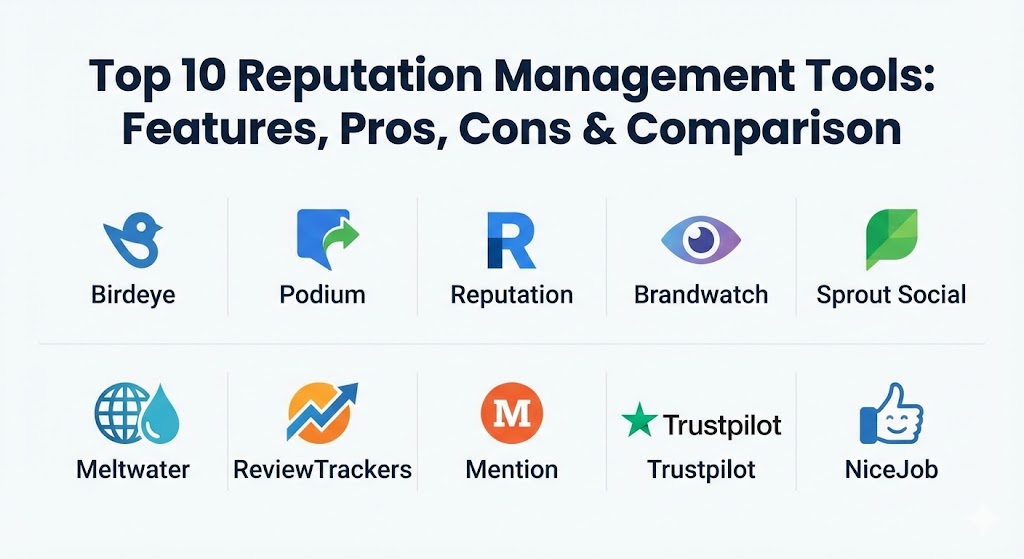
Top 10 Reputation Management Tools
1 — Birdeye
Birdeye is a comprehensive, AI-driven experience and reputation management platform built for multi-location businesses. It consolidates review management, social media monitoring, and customer surveys into a single interface to drive local growth.
- Key features:
- Automated review solicitation via SMS, email, and QR codes.
- AI-powered “Review Response” assistant for personalized, high-speed replies.
- Centralized listing management across 150+ global directories.
- Social listening tools that track keywords and competitor mentions.
- Integrated customer surveys and NPS (Net Promoter Score) tracking.
- Visual reporting dashboards for “sentiment score” trends.
- Pros:
- Unmatched automation capabilities that significantly reduce the manual labor of review management.
- Exceptionally strong local SEO impact through automated review syndication.
- Cons:
- Pricing is on the higher end of the spectrum, which may be prohibitive for single-location SMBs.
- The sheer number of features can lead to a steep learning curve for new users.
- Security & compliance: SOC 2 Type II, HIPAA, GDPR compliant; supports SSO (Single Sign-On) and data encryption at rest.
- Support & community: Extensive documentation, dedicated account managers for enterprise clients, and a high-quality online training university.
2 — Podium
Podium is a communication-first platform that leverages the power of text messaging to collect reviews and engage with customers. It is designed specifically for local service businesses looking to bridge the gap between communication and reputation.
- Key features:
- Text-to-review invitations with high open and response rates.
- Unified “Inbox” for managing SMS, Webchat, and Social Media messages.
- Review reporting with leaderboards to track staff performance.
- Integrated payment processing via text (Text-to-Pay).
- Automated “Review Reminders” to follow up with unresponsive customers.
- Mobile app optimized for front-line employees and technicians.
- Pros:
- The text-centric approach results in significantly higher review conversion rates than email-only tools.
- Extremely easy to use for non-technical staff working in the field.
- Cons:
- Advanced features like marketing automation require higher-tier, expensive plans.
- Integration with legacy CRM systems can sometimes be limited or require manual effort.
- Security & compliance: PCI-DSS compliant, SOC 2, and GDPR ready; uses 256-bit AES encryption.
- Support & community: 24/7 live chat support and a robust help center with video tutorials.
3 — Reputation (formerly Reputation.com)
Reputation is an enterprise-grade “Reputation Experience Management” (RXM) platform that focuses on large-scale data analysis and sentiment mapping for global brands.
- Key features:
- Proprietary “Reputation Score” to benchmark brand health against industry averages.
- Advanced sentiment analysis that categorizes feedback by specific themes (e.g., service, price, cleanliness).
- Competitive intelligence tools to monitor rivals’ performance metrics.
- Managed services for outsourced review responding and listing management.
- Deep-dive customer experience analytics for product and service improvements.
- Global listing synchronization for thousands of locations.
- Pros:
- Best-in-class for global enterprises requiring sophisticated data visualization and cross-departmental reporting.
- Highly effective for identifying systemic operational issues through aggregated sentiment.
- Cons:
- The platform interface can feel overwhelming due to the depth of enterprise-level data.
- Pricing is highly custom and generally starts at a much higher baseline than competitors.
- Security & compliance: ISO 27001, HIPAA, SOC 2, and GDPR compliant; rigorous audit logging and access controls.
- Support & community: Enterprise-level strategic consulting and dedicated customer success teams.
4 — Brandwatch
Brandwatch is a premier social listening and consumer intelligence platform. It is designed for brands and agencies that need to go beyond reviews to understand the broader cultural conversation surrounding their products.
- Key features:
- Historical data access covering over a decade of online conversations.
- AI-powered “Iris” assistant for detecting anomalies and emerging trends.
- Real-time alerts for brand mentions across news, social media, and forums.
- Influencer discovery and management based on topic authority.
- Visual analytics that show the “share of voice” compared to competitors.
- Comprehensive API for exporting data into custom business intelligence tools.
- Pros:
- Unrivaled depth in social listening; it picks up mentions that review-focused tools miss.
- Excellent for proactive crisis management and identifying viral threats early.
- Cons:
- Not a traditional review management tool; it lacks the automated review request features of Birdeye or Podium.
- Requires a dedicated analyst to extract the most value from the complex data sets.
- Security & compliance: GDPR, ISO 27001, and SOC 2 compliant; robust data anonymization features.
- Support & community: World-class webinars, research reports, and a massive community of data professionals.
5 — Sprout Social
Sprout Social is a full-suite social media management tool that includes powerful reputation and review monitoring features. It is ideal for teams that want their social engagement and reputation management in one place.
- Key features:
- Integrated “Smart Inbox” for reviews from Google, Yelp, and Facebook.
- Advanced social listening to monitor industry trends and sentiment.
- Task management features to assign specific mentions to team members.
- Automated chatbots for rapid customer service responses.
- Comprehensive social media scheduling and publishing tools.
- Mobile app for real-time engagement and monitoring.
- Pros:
- The user interface is widely regarded as the most intuitive in the industry.
- Seamlessly combines social media publishing with reputation monitoring.
- Cons:
- Review site coverage is not as broad as specialized tools (focuses primarily on the “big three” platforms).
- Costs can escalate quickly as you add more users and specialized listening modules.
- Security & compliance: SOC 2, GDPR, and SSO support; enterprise-grade permission levels.
- Support & community: Strong educational resources, active user community, and 24/5 live support.
6 — Meltwater
Meltwater is a global media intelligence platform that monitors news, blogs, and social platforms. It is the gold standard for PR teams and large corporations focused on media sentiment.
- Key features:
- Monitoring of 300,000+ online news sources and broadcast media.
- Journalist database for targeted PR outreach and crisis control.
- AI-driven “Sentiment Analysis” across global languages.
- Executive-level newsletters and daily briefing reports.
- Competitive benchmarking for “Media Share of Voice.”
- Integration with social media publishing and engagement tools.
- Pros:
- Superior for tracking high-level news and editorial sentiment that affects corporate reputation.
- The journalist database is a significant value-add for proactive reputation building.
- Cons:
- Like Brandwatch, it is less focused on “local review” collection and management.
- Implementation and setup can be complex for smaller organizations.
- Security & compliance: SOC 2 Type II, ISO 27001, and GDPR compliant.
- Support & community: Dedicated client success managers and 24/7 global support.
7 — ReviewTrackers
ReviewTrackers is a specialized tool focusing on the data-driven side of review management. It is designed for businesses that want to turn feedback into actionable operational insights.
- Key features:
- “Reputation Scorecard” for a quick view of ratings and response times.
- Intelligent “Review Funnel” that guides customers to specific platforms.
- Competitor monitoring with side-by-side performance comparisons.
- SMS and email review requests with A/B testing capabilities.
- Local SEO keyword tracking within customer reviews.
- API access for integrating review data into internal dashboards.
- Pros:
- Highly focused on the “Insights” part of reputation, helping companies solve the root cause of negative feedback.
- Very strong reporting features that are clear and easy to present to stakeholders.
- Cons:
- Lacks broader social listening features found in Sprout Social or Brandwatch.
- The user interface, while functional, is less modern than some cloud-native competitors.
- Security & compliance: SOC 2, HIPAA, and GDPR compliant; uses TLS 1.2 for data transmission.
- Support & community: Excellent onboarding process and a comprehensive library of case studies.
8 — Mention
Mention is a real-time web and social monitoring tool that offers a cost-effective way for SMBs and agencies to stay on top of their digital presence.
- Key features:
- “Boolean Search” queries for extremely precise monitoring.
- Instant alerts for brand, competitor, or industry keywords.
- Influencer discovery based on engagement and reach.
- Automated reports delivered directly to email.
- Simple “Crisis Management” dashboard for tracking mention spikes.
- Integration with Slack for team-wide alerts.
- Pros:
- Very affordable entry-level pricing for startups and small agencies.
- Simple and fast setup; you can be monitoring your brand in less than five minutes.
- Cons:
- Lacks the advanced automated review collection tools of Birdeye or Podium.
- Sentiment analysis can be less accurate than premium AI models on complex queries.
- Security & compliance: GDPR compliant; supports SSO for enterprise tiers.
- Support & community: High-quality documentation and responsive email support.
9 — Trustpilot
Trustpilot is unique as it is both a review platform and a management tool. It focuses on transparency and building a publicly trusted “bridge” between consumers and businesses.
- Key features:
- Publicly accessible profile page that acts as a trust signal on Google.
- Automated “Review Invitations” that sync with e-commerce platforms like Shopify.
- “Visual Reviews” that allow customers to upload photos with their feedback.
- Verified buyer badges to ensure review authenticity.
- Review widgets for websites to showcase “social proof.”
- Advanced analytics to track conversion rates from reviews.
- Pros:
- The Trustpilot brand itself carries immense weight with consumers, increasing click-through rates.
- Excellent for e-commerce brands looking to build trust during the checkout process.
- Cons:
- The platform focuses only on Trustpilot reviews; you still need other tools to manage Google or Yelp.
- There has been historical controversy regarding the “pay-to-play” perception of the platform.
- Security & compliance: GDPR compliant; rigorous anti-fraud algorithms to detect fake reviews.
- Support & community: Strong community guidelines and helpful business resource center.
10 — NiceJob
NiceJob is a reputation marketing tool focused on small businesses. It operates on a “get more reviews” philosophy, emphasizing automation and simplicity.
- Key features:
- “Stories” feature that automatically turns reviews into social media posts.
- Simple review request automation that integrates with your CRM or POS.
- Reputation widgets that display reviews in real-time on your website.
- Referral program tracking to incentivize happy customers.
- Automated follow-up “reminders” for review requests.
- Smart logic that prevents asking the same customer for a review twice.
- Pros:
- One of the most effective tools for actually increasing the number of reviews for local SMBs.
- Very high ROI for small service businesses (plumbers, dentists, realtors).
- Cons:
- Not suitable for larger enterprises needing complex data analytics.
- Limited social listening or broad web monitoring capabilities.
- Security & compliance: GDPR compliant; standard encryption protocols.
- Support & community: Friendly, accessible support and an active “Reputation Marketing” blog.
Comparison Table
| Tool Name | Best For | Platform(s) Supported | Standout Feature | Rating (Gartner/TrueReview) |
| Birdeye | Multi-location SMBs | Web, iOS, Android | AI Review Response | 4.8 / 5 |
| Podium | Local Service Brands | Web, iOS, Android | Text-to-Pay Integration | 4.6 / 5 |
| Reputation | Global Enterprises | Web, Cloud | Reputation Score Metric | 4.5 / 5 |
| Brandwatch | Deep Social Listening | Web, Cloud | “Iris” AI Trend Spotting | 4.4 / 5 |
| Sprout Social | Social + Reputation | Web, iOS, Android | Unified Smart Inbox | 4.7 / 5 |
| Meltwater | PR & Media Monitoring | Web, Cloud | Global News Database | 4.3 / 5 |
| ReviewTrackers | Customer Experience | Web, Cloud | Local SEO Insights | 4.5 / 5 |
| Mention | Budget Monitoring | Web, Cloud | Boolean Search Alerts | 4.2 / 5 |
| Trustpilot | E-commerce Trust | Web, Cloud | Public Trust Symbol | 4.4 / 5 |
| NiceJob | Small Business Growth | Web, Cloud | Review-to-Social Stories | 4.8 / 5 |
Evaluation & Scoring of Reputation Management Tools
When evaluating these tools, we utilize a weighted rubric to ensure that core functionality is prioritized while still accounting for the “soft” factors like ease of use and support.
| Category | Weight | Evaluation Criteria |
| Core Features | 25% | Multi-channel monitoring, review generation, and sentiment accuracy. |
| Ease of Use | 15% | UI/UX design, mobile accessibility, and onboarding speed. |
| Integrations | 15% | Native connections with CRMs (Salesforce), POS systems, and social APIs. |
| Security | 10% | Compliance certifications (SOC 2, HIPAA) and data encryption. |
| Performance | 10% | Real-time alert speed and platform uptime reliability. |
| Support | 10% | Quality of documentation and availability of live human support. |
| Price / Value | 15% | Transparent pricing that scales logically with business growth. |
Which Reputation Management Tool Is Right for You?
Selecting a tool requires a clear understanding of your business’s “reputation profile.”
Solo Users vs SMB vs Enterprise
- Solo Users/Freelancers: Stick to free or low-cost monitoring tools like Google Alerts or the basic tier of Mention. You likely don’t need a massive automation engine.
- SMBs (1-10 locations): Prioritize tools that actually get you more reviews. NiceJob and Podium are highly effective for driving local Google ratings.
- Enterprise: Focus on data governance and sentiment trends. Reputation and Brandwatch provide the “macro” view needed for board-level reporting.
Budget-conscious vs Premium Solutions
If budget is the primary driver, Mention and NiceJob offer the most “bang for your buck.” However, if you are a retail chain where a 0.5-star difference on Google maps translates to millions in lost foot traffic, the premium cost of Birdeye is easily justified by the ROI in local SEO.1
Feature Depth vs Ease of Use2
If you want deep data and don’t mind a learning curve, Brandwatch is the tool. If you want your front-line staff (like hotel receptionists or dental assistants) to use the tool,3 Podium or Sprout Social are much more accessible.
Security and Compliance Requirements
Healthcare providers must choose HIPAA-compliant tools like Birdeye or Reputation. Financial institutions should prioritize SOC 2 and ISO 27001 certifications, making Meltwater or Reputation the safer bets.
Frequently Asked Questions (FAQs)
1. Can these tools delete negative reviews for me?
No. Most major platforms (Google, Yelp) forbid the deletion of reviews unless they violate terms of service (e.g., hate speech or spam). These tools help you suppress negative feedback by gathering more positive reviews and providing a professional platform to resolve grievances.
2. Is there a free reputation management tool?
Google Alerts is the best free tool for keyword monitoring. For review management, platforms like Trustpilot and G2 offer free basic tiers, but automated review generation usually requires a paid subscription.
3. How long does it take to see results with these tools?
For review generation tools, you often see a spike in ratings within 30 days. For SEO suppression of negative press, it can take 6–12 months of consistent content and reputation work to shift the “first page” results.
4. What is the difference between “Social Listening” and “Review Management”?
Review management handles feedback on specific sites like Google or Yelp. Social listening monitors the entire web for conversations about your brand that aren’t necessarily posted as a formal review.
5. Do these tools help with Local SEO?
Yes. Google considers the volume, frequency, and sentiment of reviews as major ranking factors for its “Local Pack.” Tools like Birdeye and ReviewTrackers are specifically built to improve these signals.
6. Can I respond to reviews from within these apps?
Yes. Most of these tools offer a “unified inbox” where you can reply to Google, Facebook, and Yelp reviews without logging into each platform individually.
7. Are these tools mobile-friendly?
Most premium tools (Podium, Sprout Social, Birdeye) have dedicated mobile apps so you can respond to customer feedback while on the go.
8. Is sentiment analysis accurate?
It is generally 80-90% accurate. Sarcasm and regional slang can still trip up some AI models, but the top-tier tools (Brandwatch, Reputation) use advanced NLP (Natural Language Processing) to minimize errors.
9. Can I monitor my competitors with these tools?
Yes. Most platforms allow you to track your competitors’ ratings and sentiment scores so you can identify their weaknesses and capitalize on them.
10. Do I need an agency if I have the software?
Not necessarily. Many tools are designed for “DIY” management. However, for high-stakes crisis management or complex SEO suppression, an agency’s expertise combined with the software is often the best approach.
Conclusion
The digital world never sleeps, and neither does your brand’s reputation. Choosing the right tool is not about finding the most features; it is about finding the solution that aligns with your specific operational challenges. Whether you need the high-speed text communication of Podium, the enterprise-grade data of Reputation, or the social media integration of Sprout Social, the goal remains the same: transforming public perception into a competitive advantage. In 2026, your reputation is your most valuable asset—manage it with precision.