Introduction
Public Relations (PR) Platforms are comprehensive software-as-a-service (SaaS) solutions designed to manage an organization’s relationship with the public, the media, and key stakeholders. These platforms act as a digital “command center” for communications teams, providing access to vast databases of millions of journalists and influencers, real-time media monitoring across billions of online and social sources, and sophisticated reporting tools that measure the commercial impact of earned media.
The importance of these tools lies in their ability to provide transparency and efficiency. Without them, identifying the right journalist for a niche pitch or tracking a brand mention across the global web is an impossible task. Key real-world use cases include managing crisis communications through instant sentiment alerts, launching global product announcements with coordinated distribution, and using “Share of Voice” (SoV) metrics to benchmark against competitors. When choosing a platform in 2026, users should prioritize data accuracy (verified journalist profiles), the depth of AI-powered sentiment analysis, and the ability to attribute PR efforts to tangible business outcomes like website traffic or sales lift.
Best for: In-house corporate communications teams, PR agencies of all sizes, and brand managers who need to maintain high-quality media relationships and demonstrate the ROI of their efforts to executive leadership.
Not ideal for: Individual creators or local small businesses with a purely local customer base who may find the cost and complexity of global databases unnecessary. For these users, simple social media management tools or manual outreach often suffice.
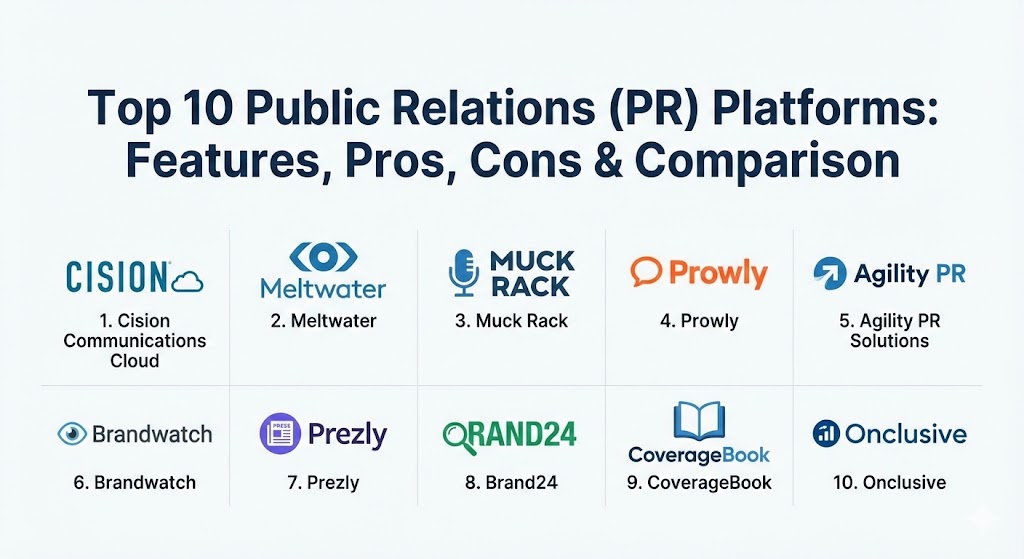
Top 10 Public Relations (PR) Platforms
1 — Cision Communications Cloud
Cision remains the “titan” of the PR industry in 2026, offering the most expansive media database and distribution network (including PR Newswire). It is a heavyweight solution designed for large-scale, global enterprise communication strategies.
- Key features:
- Access to over 1.4 million verified journalists and influencers worldwide.
- Integrated press release distribution via PR Newswire.
- Advanced “Impact” analytics that connect earned media to web conversions.
- Real-time monitoring of online, social, broadcast, and print media.
- AI-powered journalist recommendations based on historical pitching success.
- Multi-user workflow management for global PR teams.
- Pros:
- Unrivaled global reach and the most comprehensive media database in the market.
- Sophisticated reporting that attempts to solve the “PR attribution” problem.
- Cons:
- The interface can be complex and intimidating for new users.
- Highly expensive, typically requiring long-term, high-value contracts.
- Security & compliance: SOC 2 Type II, GDPR, ISO 27001, and SSO integration.
- Support & community: High-tier enterprise support, dedicated account managers, and extensive “Cision University” training resources.
2 — Meltwater
Meltwater has evolved from a pure monitoring tool into a full-scale media intelligence platform. It excels in “Social Listening” and identifying the underlying trends and sentiment that drive public perception.
- Key features:
- Real-time monitoring of over 270,000 news sources and social platforms.
- Advanced sentiment analysis powered by deep-learning AI.
- Integrated social media management and influencer identification.
- Custom dashboards that visualize Share of Voice and brand health.
- Competitive benchmarking to track rival brand performance.
- Newsletter and newsfeed tools for internal stakeholder reporting.
- Pros:
- Best-in-class social listening and real-time alert capabilities.
- Highly visual and intuitive dashboards that are “presentation-ready.”
- Cons:
- Can be very expensive as you add more user seats or specialized modules.
- Some users find the sheer volume of data requires significant initial filtering.
- Security & compliance: GDPR compliant, ISO 27001, and SOC 2.
- Support & community: 24/7 global support and a robust library of webinars and industry trend reports.
3 — Muck Rack
Muck Rack has become the preferred platform for modern PR teams who value relationship-building over mass-blasting. It is famous for its “journalist-first” approach, where media professionals maintain their own profiles.
- Key features:
- Verified journalist profiles that include recent articles and social activity.
- Automated media list maintenance—alerts when a journalist changes beats.
- “Who Shared My Link” tool to track which influencers are talking about your content.
- Simple, email-like pitching interface with open and click tracking.
- Integrated “Public Newsrooms” for hosting brand assets.
- Seamless integration with Slack for real-time coverage alerts.
- Pros:
- The most accurate contact data in the industry because journalists update it themselves.
- Extremely user-friendly UI designed for efficient, day-to-day workflows.
- Cons:
- Reporting features, while clean, are less granular than enterprise tools like Cision.
- Media database focus is primarily digital; less depth in traditional print/broadcast.
- Security & compliance: SOC 2 Type II, GDPR, and SSO.
- Support & community: Highly rated customer success team and a popular PR certification program.
4 — Prowly
Prowly is an all-in-one PR software that provides exceptional value, making it a favorite for small-to-medium businesses (SMBs) and boutique agencies that need a professional presence without an enterprise price tag.
- Key features:
- Visual Press Release Creator for professional, multimedia-rich stories.
- Branded Online Newsrooms to centralize all company news.
- Media database with over 1 million global contacts.
- Pitching tool with automated follow-ups and performance metrics.
- Integrated media monitoring for web and social mentions.
- Collaboration tools for team-based campaign management.
- Pros:
- Excellent value for money; brings enterprise features to smaller budgets.
- Beautifully designed outputs (emails and newsrooms) that enhance brand image.
- Cons:
- Database granularity in hyper-niche B2B sectors may lag behind Cision.
- Analytics are functional but lack advanced revenue-attribution modeling.
- Security & compliance: GDPR compliant, SSO integration available on higher tiers.
- Support & community: Fast-response chat support and a wealth of “How-to” guides for PR beginners.
5 — Agility PR Solutions
Agility PR Solutions offers a balanced approach, providing deep media database access and reliable monitoring with a focus on simplicity and ease of use for mid-market teams.
- Key features:
- Targeted media list builder with AI-suggested contacts.
- Monitoring of online, print, and broadcast media (TV/Radio).
- Automated reporting and executive-ready dashboards.
- “PR Outreach” module for managing personalized media campaigns.
- Integrated Newswire service for broader syndication.
- Competitive analysis tools to track industry-wide coverage trends.
- Pros:
- Strong “human-in-the-loop” support for building custom media lists.
- More flexible pricing and contract terms than the largest enterprise players.
- Cons:
- The user interface can feel slightly more “dated” compared to modern SaaS like Muck Rack.
- Advanced AI features are not as pervasive throughout the platform.
- Security & compliance: SOC 2, GDPR, and data encryption.
- Support & community: Renowned for excellent 1-on-1 customer service and list-building assistance.
6 — Brandwatch
While often categorized as a marketing tool, Brandwatch’s “Consumer Intelligence” capabilities make it an essential PR platform for large brands needing to manage reputation and detect crises early.
- Key features:
- Deep-dive social listening across billions of data points.
- Crisis detection alerts that identify anomalies in brand mentions.
- Influencer discovery and management across global social networks.
- Historical data access (dating back years) for trend benchmarking.
- AI-driven insights that categorize “why” people are talking about a brand.
- Advanced audience segmentation for targeted messaging.
- Pros:
- Unmatched depth in consumer sentiment and historical data analysis.
- Highly flexible for analysts who need granular control over data queries.
- Cons:
- It is a specialized tool; it lacks a native media database for journalist outreach.
- Significant learning curve to master the complex “Boolean” search queries.
- Security & compliance: ISO 27001, SOC 2, HIPAA (available), and GDPR.
- Support & community: Enterprise-grade support with a large community of data analysts.
7 — Prezly
Prezly takes a “CRM-first” approach to PR, focusing on the quality of relationships over the quantity of contacts. It is designed for brands that want to tell stories through beautiful, multimedia newsrooms.
- Key features:
- PR-specific CRM for managing long-term journalist relationships.
- Multimedia Newsroom builder (images, videos, documents).
- Email outreach with tracking and engagement scoring.
- Collaboration tools for internal teams and external stakeholders.
- Support for multiple languages and localized newsrooms.
- Integrated analytics for email campaigns and newsroom traffic.
- Pros:
- Encourages “best practices” in PR—personalization over mass-pitching.
- The newsroom aesthetics are among the best in the industry.
- Cons:
- Does not include a built-in media database; you must import your own contacts.
- Less focused on broad media monitoring than tools like Meltwater.
- Security & compliance: GDPR compliant, SSO support, and data encryption.
- Support & community: Friendly, personalized support and a strong focus on “Storytelling” education.
8 — Brand24
Brand24 is a lightweight but powerful reputation monitoring tool. It is perfect for SMBs that need to stay on top of every mention of their brand, products, or competitors without the complexity of an enterprise suite.
- Key features:
- Real-time mention tracking across web, social, podcasts, and video.
- Sentiment analysis (Positive vs. Negative vs. Neutral).
- “Influence Score” to help prioritize which mentions to respond to first.
- Anomaly Detection to catch potential PR crises before they explode.
- Automated daily/weekly reports sent directly to email.
- Slack and mobile app integrations for on-the-go monitoring.
- Pros:
- Extremely easy to set up—requires zero training for new users.
- Very affordable pricing for startups and small agencies.
- Cons:
- Lacks a media database and outreach tools; it is purely for monitoring.
- Not suitable for high-scale, global enterprise-level reporting.
- Security & compliance: GDPR compliant, SSO for enterprise plans.
- Support & community: Responsive chat support and a very active YouTube channel with PR tips.
9 — CoverageBook
CoverageBook is a specialized PR platform focused entirely on the “after-action” report. it automates the tedious process of collecting clips and measuring the impact of a campaign.
- Key features:
- One-click “Coverage Report” generation from a list of URLs.
- Automated metrics for “Estimated Views,” “Social Shares,” and “Domain Authority.”
- Professional, branded PDF and online reports for clients/executives.
- Integrated “Share of Voice” tracking for ongoing campaigns.
- Vault storage for all historical media clips.
- Simple workflow for team members to upload screenshots and clips.
- Pros:
- Saves PR pros dozens of hours every month on manual reporting.
- Produces the most visually professional and easy-to-read reports in the industry.
- Cons:
- It is a “point solution”—it doesn’t do database management or pitching.
- Pricing is based on the number of “books” or reports, which can add up for busy agencies.
- Security & compliance: GDPR compliant, encryption at rest and in transit.
- Support & community: Excellent documentation and a focus on “Measurement” education.
10 — Onclusive
Onclusive is a data-science-driven PR platform that focuses on “Earned Media Attribution,” helping teams prove exactly how PR moves the needle for a business.
- Key features:
- “PR Attribution” tool that tracks customer journeys from a news article to a purchase.
- Power of Voice™ metric that weights coverage quality beyond simple volume.
- Global media monitoring across 100+ languages.
- Predictive analytics to identify emerging trends in your industry.
- Automated “Insights Reports” that summarize campaign health.
- Integrated media database and outreach tools (via acquisition of PRgloo).
- Pros:
- The most sophisticated tool for proving the commercial ROI of PR efforts.
- Advanced AI that filters out “noise” to show only meaningful coverage.
- Cons:
- The advanced attribution features require integration with web analytics tools.
- Primarily targeted at larger, data-mature enterprise organizations.
- Security & compliance: SOC 2 Type II, ISO 27001, GDPR, and HIPAA.
- Support & community: High-level enterprise consultancy and dedicated data analysts.
Comparison Table
| Tool Name | Best For | Platform(s) Supported | Standout Feature | Rating (Gartner/TrueReview) |
| Cision | Global Enterprises | SaaS / Web | Global Database Depth | 4.2 / 5 |
| Meltwater | Media Intelligence | SaaS / Web | Real-time Social Listening | 4.4 / 5 |
| Muck Rack | Modern Relationship PR | SaaS / Web | Verified Journalist Profiles | 4.7 / 5 |
| Prowly | SMBs & Boutique Agencies | SaaS / Web | Branded Online Newsrooms | 4.6 / 5 |
| Agility PR | Mid-Market Balance | SaaS / Web | List-Building Support | 4.3 / 5 |
| Brandwatch | Consumer Insights | SaaS / Web | Crisis Detection Alerts | 4.5 / 5 |
| Prezly | Relationship Management | SaaS / Web | Story-driven Newsrooms | 4.5 / 5 |
| Brand24 | Startup Monitoring | SaaS / Web / Mobile | Anomaly Crisis Detection | 4.8 / 5 |
| CoverageBook | Campaign Reporting | SaaS / Web | Automated PDF Reports | 4.9 / 5 |
| Onclusive | Data-Driven ROI | SaaS / Web | Revenue Attribution | 4.4 / 5 |
Evaluation & Scoring of Public Relations (PR) Platforms
To choose the right platform, you must weigh its capabilities against your operational needs. The following rubric evaluates the top platforms based on industry-standard criteria.
| Category | Weight | Evaluation Criteria |
| Core Features | 25% | Database accuracy, monitoring depth, outreach efficiency, and distribution. |
| Ease of Use | 15% | Intuitive interface, minimal training required, and mobile accessibility. |
| Integrations | 15% | Compatibility with CRMs, Slack, Google Analytics, and marketing stacks. |
| Security | 10% | GDPR/SOC 2 compliance, SSO, encryption, and data privacy controls. |
| Performance | 10% | Speed of monitoring alerts and platform uptime/reliability. |
| Support | 10% | Documentation quality, speed of customer support, and community engagement. |
| Price / Value | 15% | Transparent pricing relative to the features and scalability provided. |
Which Public Relations (PR) Platform Tool Is Right for You?
The decision-making process for a PR platform should start with your “Outcome Goal.” Are you trying to find new journalists, monitor a crisis, or report results to a client?
- Solo Users & Freelancers: You likely need a “lite” solution. Brand24 for monitoring and CoverageBook for reporting can provide a professional stack without the five-figure price tag of an enterprise database.
- SMBs & Boutique Agencies: Efficiency is key. Prowly or Prezly are ideal because they combine the essential database, newsroom, and outreach tools in a single, user-friendly, and cost-effective interface.
- Mid-Market Companies: At this stage, you need a balance of power and cost. Muck Rack is the top choice here due to its high data accuracy and modern UI, which ensures your team will actually use the tool every day.
- Enterprise & Global Brands: You need the “heavy machinery.” Cision or Meltwater are necessary for the sheer breadth of global monitoring and the depth of their journalist databases. If proving financial ROI is your #1 priority, Onclusive is the standout.
- Budget-Conscious vs. Premium: If budget is no object, the premium services of Cision and Muck Rack are unbeatable. For those watching the bottom line, the monthly subscription models of Prowly offer the most feature-rich alternative.
Frequently Asked Questions (FAQs)
1. What is the difference between a PR platform and a CRM?
A general CRM (like Salesforce) tracks sales leads and customers. A PR platform is a specialized CRM built for media relationships, containing pre-populated journalist data, press release tools, and media monitoring that a standard CRM lacks.
2. Do these tools guarantee media coverage?
No tool can guarantee a journalist will write about you. However, they significantly increase your odds by helping you find the “right” journalist who covers your specific beat and by providing the data needed to craft a relevant pitch.
3. Are these databases GDPR compliant?
Yes, most reputable platforms (like those on this list) are strictly GDPR compliant. They ensure that journalist data is collected and stored according to privacy laws and provide clear “opt-out” mechanisms for media professionals.
4. How often is the journalist data updated?
In 2026, the best tools use AI and human verification to update data daily. Platforms like Muck Rack have an advantage because journalists update their own profiles in real-time.
5. Can PR platforms help with social media influencers?
Most modern PR platforms now include influencers in their databases, allowing you to filter by platform (TikTok, Instagram, YouTube) and audience demographics, merging traditional PR with influencer marketing.
6. Is media monitoring real-time?
Top-tier tools like Meltwater and Brand24 offer “near real-time” monitoring, often sending an alert within minutes of a story or social post going live.
7. Can I buy just a media database without the other tools?
Some vendors offer modular pricing, but most have moved toward integrated suites. It is usually more cost-effective to buy a bundle than to stitch together multiple point solutions.
8. How does PR attribution work?
Advanced tools like Onclusive use “referral tracking” and “commercial correlation” to see if a reader of a news article later visited your website and made a purchase, finally giving PR a seat at the revenue table.
9. Do I need an agency if I have these tools?
A tool is only as good as the person using it. These platforms empower in-house teams to act like an agency, but many organizations still use agencies for their strategic expertise and high-level relationships.
10. What is a “Newsroom,” and do I need one?
An online newsroom is a dedicated page on your website for media assets. It is highly recommended because it gives journalists easy access to high-res images, bios, and past releases, making it easier for them to cover your story.
Conclusion
Selecting a Public Relations platform in 2026 is no longer about finding the largest list of email addresses; it is about finding the tool that enables meaningful connections and measurable impact. For global enterprises, the power and reach of Cision and Meltwater remain indispensable. For modern, growth-focused teams, the relationship-centric design of Muck Rack and the visual storytelling of Prowly offer a competitive edge. Ultimately, the “best” tool is the one that aligns with your team’s maturity and helps you turn your company’s data into a compelling narrative that builds long-term trust.