Introduction
Data enrichment is the process of enhancing existing data with additional, relevant information from third-party sources. An Enrichment API automates this by allowing a system (like a CRM or a custom-built application) to send a small identifier—an email, a domain, or an IP address—and receive a structured JSON response containing hundreds of data points. This is no longer a luxury but a necessity for businesses that want to automate lead scoring, reduce friction in sign-up forms, and ensure their sales teams are only talking to qualified prospects.
When evaluating Data Enrichment APIs, users should look for four critical pillars: Accuracy (is the data up to date?), Match Rate (percentage of queries that return a result), Coverage (geographic and industry diversity), and Latency (how fast the API responds). Real-world use cases range from auto-filling 15 fields in a CRM based on one email to detecting high-risk transactions by enriching IP addresses with geolocation and proxy data.
Best for: Sales Development Representatives (SDRs), Growth Marketers, Data Scientists, and Product Engineers. It is essential for B2B enterprises, fintech startups, and high-volume e-commerce platforms that need to scale personalization without manual research.
Not ideal for: Hyper-local small businesses with a static client base or organizations with strictly “closed” data environments where external API calls are prohibited by policy.
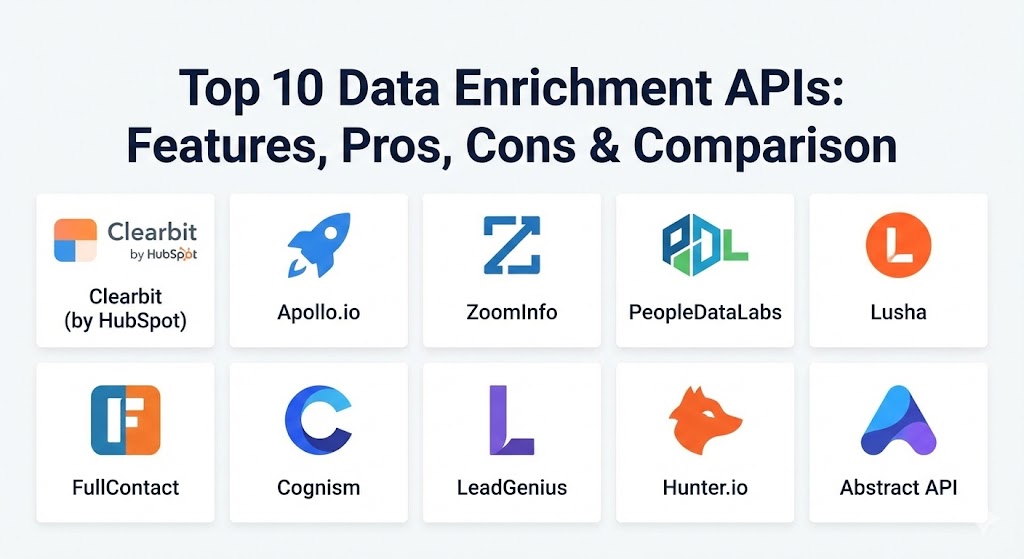
Top 10 Data Enrichment APIs Tools
1 — Clearbit (by HubSpot)
Clearbit, now integrated deeply into the HubSpot ecosystem, remains the gold standard for real-time B2B data enrichment. It is designed for companies that need instantaneous data on leads as they enter the funnel.
- Key features:
- Enrichment of over 100+ B2B data points from an email or domain.
- “Reveal” API to identify which companies are visiting your website via IP.
- Real-time refresh technology to ensure data isn’t stale.
- Form Shortening capability to increase conversion rates.
- Deep integration with Salesforce, Slack, and HubSpot.
- Prospector API for finding new contacts within specific accounts.
- Pros:
- Incredible ease of use; developers can get the API running in minutes.
- High match rates for US-based tech companies and startups.
- Cons:
- Pricing is premium and can be opaque for high-volume users.
- Geographic coverage is weaker in EMEA and APAC compared to competitors.
- Security & compliance: SOC 2 Type II, GDPR, and CCPA compliant. Uses AES-256 encryption for data at rest.
- Support & community: Extensive documentation, a dedicated Slack community for developers, and robust enterprise support for high-tier plans.
2 — Apollo.io
Apollo.io has rapidly become a favorite for mid-market companies due to its massive database and all-in-one platform approach. Its API allows teams to tap into a database of over 275 million contacts.
- Key features:
- Person and Company enrichment APIs.
- Advanced filtering based on “intent” data.
- Direct-dial phone number enrichment.
- Automated lead scoring triggers via API.
- Job change alerts and news event tracking.
- Data health center for monitoring database decay.
- Pros:
- One of the most cost-effective solutions for the volume of data provided.
- Very high match rates for LinkedIn-based data points.
- Cons:
- Data accuracy can occasionally lag behind high-tier “human-verified” competitors.
- API rate limits on lower tiers can be restrictive for large-scale syncing.
- Security & compliance: SOC 2 Type II, GDPR, and ISO 27001 compliant.
- Support & community: Large user base, frequent webinars, and a comprehensive self-service help center.
3 — ZoomInfo (Enrich)
ZoomInfo is the enterprise heavyweight in the data space. Its Enrichment API is powered by a proprietary engine that combines AI with a massive human-verification team to ensure high data fidelity.
- Key features:
- Global company and contact enrichment.
- “Scoops” API for real-time business intelligence and project news.
- Technographics API to see what software a company uses.
- Webhook support for real-time data orchestration.
- Hierarchy and linkage data to understand corporate structures.
- Scheduled “cleanse” APIs to keep existing CRM data updated.
- Pros:
- Industry-leading accuracy for phone numbers and revenue data.
- The most comprehensive database for traditional industries (manufacturing, construction, etc.).
- Cons:
- The most expensive option on the market; usually out of reach for small startups.
- Complex contract structures with multi-year commitments.
- Security & compliance: GDPR, CCPA, and SOC 2 compliant. Strong focus on data privacy “notice and choice” mechanisms.
- Support & community: Dedicated account managers, 24/7 technical support, and the ZoomInfo University training platform.
4 — PeopleDataLabs (PDL)
PeopleDataLabs is a developer-first data company. Unlike platforms that provide a UI, PDL focuses almost exclusively on providing a massive “Person Graph” via API for data scientists and engineers.
- Key features:
- Access to 3 billion+ unique person profiles.
- Skill and education enrichment.
- Work history and professional title normalization.
- Identity resolution (linking multiple emails to one person).
- Social media handle enrichment (GitHub, Twitter, LinkedIn).
- Flexible SQL-like search parameters within the API.
- Pros:
- Unmatched flexibility for data scientists building custom models.
- “Pay-as-you-go” or credit-based pricing that is developer-friendly.
- Cons:
- Requires technical expertise to integrate; no “plug-and-play” CRM app.
- Higher responsibility on the user to ensure data is used compliantly.
- Security & compliance: GDPR and CCPA compliant. SOC 2 Type II certification.
- Support & community: Exceptional technical documentation, active Postman collections, and a responsive engineering support team.
5 — Lusha
Lusha is known for its simplicity and accuracy in finding B2B contact details. Its API is designed for sales-heavy organizations that need direct access to decision-makers.
- Key features:
- Contact enrichment for direct dials and personal emails.
- Company enrichment with industry and employee headcount.
- “Search” API to build lists programmatically.
- Webhook notifications for contact updates.
- Usage and credit tracking via API.
- Integration with major CRMs via native connectors.
- Pros:
- Very high accuracy for mobile phone numbers.
- Transparent, tiered pricing that is easy for SMBs to understand.
- Cons:
- More focused on “contact info” than deep “technographic” or “intent” data.
- Limited bulk-processing features on the basic API tier.
- Security & compliance: ISO 27001, GDPR, and CCPA compliant. Trust Center available for audits.
- Support & community: 24/7 chat support, a rich knowledge base, and easy-to-follow onboarding guides.
6 — FullContact
FullContact focuses on identity resolution. Its API is designed to help brands understand the human behind the data point, linking fragmented identifiers into a persistent “PersonR” ID.
- Key features:
- Real-time identity resolution and enrichment.
- Permissioned data exchange to ensure privacy.
- Linkage between professional and personal identifiers.
- Robust “Customer Recognition” API for marketing personalization.
- Fraud prevention through identity verification.
- Multi-identifier matching (Email, Phone, MAID, Address).
- Pros:
- Excellent for B2C companies trying to bridge the gap between anonymous and known users.
- Privacy-centric approach with “hashed” identifier support.
- Cons:
- Less focused on B2B “firmographic” data (revenue, tech stack).
- Can be complex to implement for simple lead-gen use cases.
- Security & compliance: SOC 2 Type II and GDPR compliant. Strong emphasis on ethical data sourcing.
- Support & community: White-glove enterprise support and detailed API documentation for developers.
7 — Cognism
Cognism is the leader for European data enrichment. While many competitors struggle with GDPR restrictions, Cognism has built its entire infrastructure around being the “compliant” choice for EMEA markets.
- Key features:
- GDPR-compliant “Diamond Data” (human-verified).
- Mobile phone numbers that are “TPS/CTPS” cleaned (UK/EU do-not-call lists).
- Intent data powered by Bombora.
- Global coverage with a specialty in the European market.
- Automated data refreshing for CRM health.
- Event-based triggers (hiring news, funding).
- Pros:
- The best option for companies selling into the UK and EU.
- High level of trust due to human-verification of phone numbers.
- Cons:
- US data coverage, while good, is not as deep as ZoomInfo.
- The interface and API can feel a bit slower due to verification layers.
- Security & compliance: Deep GDPR, CCPA, and ISO 27001 compliance. Registered as a data controller.
- Support & community: Strong localized support in Europe and the US, with a dedicated “Customer Success” model.
8 — LeadGenius
LeadGenius differentiates itself by combining machine learning with a global “human-in-the-loop” workforce to provide custom data enrichment that a bot alone couldn’t find.
- Key features:
- Custom enrichment workflows for “hard-to-find” data points.
- Hyper-specific technographics (e.g., “Is the company using a specific version of a tool?”).
- International data verification across 114 languages.
- Contact-level “Personalized Insights” for outreach.
- API access to custom-curated data sets.
- Strategic account-based mapping.
- Pros:
- Near 100% accuracy due to the human verification layer.
- Ability to find “custom” data points that don’t exist in standard databases.
- Cons:
- Slower turnaround for “on-demand” custom enrichment compared to pure-AI APIs.
- Higher cost-per-lead due to the manual labor involved.
- Security & compliance: SOC 2, HIPAA (if required), and GDPR compliant.
- Support & community: High-touch service with dedicated data strategists.
9 — Hunter.io
Hunter is the specialized tool for email. While it offers less “firmographic” data than Clearbit, it is the most efficient API for finding and verifying professional email addresses.
- Key features:
- Domain Search API to find all emails associated with a company.
- Email Finder API (name + domain to email).
- Email Verifier API with detailed SMTP check responses.
- Author discovery for blog posts and articles.
- Lead storage and management via API.
- Campaigns integration for automated outreach.
- Pros:
- Extremely high reliability and uptime.
- Very affordable and generous “free” tier for developers to test.
- Cons:
- Limited data points (mostly focused on name, email, and social links).
- Does not provide phone numbers or deep financial data.
- Security & compliance: GDPR and CCPA compliant. Data is processed in the EU.
- Support & community: Fast email support, simple documentation, and a massive community of marketers.
10 — Abstract API
Abstract is a versatile “API factory” that offers a suite of enrichment tools, including IP geolocation, email validation, and company data enrichment.
- Key features:
- IP Geolocation API (City, Country, ISP, etc.).
- Company Enrichment API (Domain to company details).
- Email Verification and Validation.
- VAT and Tax rate enrichment based on location.
- Phone number validation and carrier lookup.
- Public holidays and exchange rate APIs for localized commerce.
- Pros:
- A “one-stop-shop” for multiple enrichment needs under one billing account.
- Clean, consistent API design across all their different modules.
- Cons:
- Database depth for B2B contacts is not as deep as specialized tools like ZoomInfo.
- Lacks native CRM “apps”; strictly a developer-facing tool.
- Security & compliance: GDPR and CCPA compliant. Uses 256-bit SSL encryption.
- Support & community: Documentation is clear and concise; support is primarily ticket-based.
Comparison Table
| Tool Name | Best For | Platform(s) Supported | Standout Feature | Rating (Gartner / TrueReview) |
| Clearbit | Real-time B2B Leads | HubSpot, SFDC, Web | Form Shortening Logic | 4.6 / 5 |
| Apollo.io | SMB Outbound | Web, Chrome, API | Massive Contact Database | 4.8 / 5 |
| ZoomInfo | Enterprise Sales | Multi-platform, API | Human-Verified Accuracy | 4.5 / 5 |
| PeopleDataLabs | Data Scientists | API Only | 3B+ Person Graph | N/A |
| Lusha | Finding Phone Numbers | Chrome, API, CRM | Direct-Dial Match Rate | 4.7 / 5 |
| FullContact | Identity Resolution | API, SaaS | PersonR Persistent ID | 4.4 / 5 |
| Cognism | European Compliance | Web, API, CRM | Diamond (Verified) Data | 4.7 / 5 |
| LeadGenius | Custom Data Needs | Managed Service, API | Human-in-the-loop Logic | 4.3 / 5 |
| Hunter.io | Email Verification | Web, Chrome, API | SMTP Verifier Quality | 4.8 / 5 |
| Abstract API | Developer Versatility | API Only | Multi-Utility Suite | N/A |
Evaluation & Scoring of Data Enrichment APIs
Selecting the right API requires weighing different priorities. For a developer, ease of integration is king; for a CFO, price/value is the focus.
| Category | Weight | Evaluation Criteria |
| Core Features | 25% | Data depth, match rates, global coverage, and real-time refresh. |
| Ease of Use | 15% | Documentation quality, SDK availability, and “time to first call.” |
| Integrations | 15% | Native support for Salesforce, HubSpot, and other RevOps tools. |
| Security & Compliance | 10% | GDPR/CCPA status, SOC 2 audits, and data privacy controls. |
| Performance | 10% | API latency, uptime (SLA), and bulk processing speed. |
| Support | 10% | Response times, dedicated success managers, and community resources. |
| Price / Value | 15% | Transparency of pricing and cost-per-successful enrichment. |
Which Data Enrichment API Tool Is Right for You?
The decision-making process for an Enrichment API should be driven by your company’s stage and primary goal.
- Solo Users vs. SMBs: If you are a small team, you need a tool that doesn’t require a developer. Apollo.io and Lusha offer the best “out of the box” experience with intuitive Chrome extensions and self-service APIs. Hunter.io is the most budget-conscious choice for basic email needs.
- Mid-Market Companies: At this stage, you likely have a CRM that needs constant cleaning. Clearbit is ideal for marketing-led growth (inbound), while Cognism is essential if you have a significant presence in Europe.
- Enterprises: Large organizations need high fidelity and high security. ZoomInfo provides the depth and accuracy required for large-scale enterprise sales, while LeadGenius can find the custom data points (like specialized tech stacks) that off-the-shelf databases miss.
- Product Teams & Data Scientists: If you are building a product (e.g., a recruiting app or a marketing platform), PeopleDataLabs is the only logical choice due to its massive person-graph and developer-centric pricing. Abstract API is great if you need supplementary data like IP geolocation or VAT verification.
- B2C Marketing Teams: If you are trying to understand consumers rather than companies, FullContact is the leader. Their identity resolution helps you link an anonymous web visitor to a known customer profile without sacrificing privacy.
Frequently Asked Questions (FAQs)
1. What is the typical “match rate” for an enrichment API?
Match rates vary by industry and region. For US-based B2B tech, you can expect 70–90%. For traditional industries or international data, 40–60% is more common. It is best to run a “sample test” with your own data before buying.
2. How do these APIs affect website performance?
If used on a front-end form (like Clearbit’s form shortening), they add a small script. However, most enrichment happens “asynchronously” on the back-end, meaning it won’t slow down the user’s browser experience.
3. Is data enrichment GDPR compliant?
It can be. Tools like Cognism and PeopleDataLabs are built for compliance, but the user is also responsible for how they use the data (e.g., honoring “do-not-call” requests and providing opt-out links).
4. How often is the data refreshed?
Top-tier APIs like Clearbit and ZoomInfo claim to refresh data every 30–90 days, or even in real-time when a query is made. Cheaper tools may have data that is 6–12 months old.
5. What is “Technographic” data?
Technographics refer to the “tech stack” a company uses. Enrichment APIs can tell you if a lead is currently using Salesforce, AWS, Shopify, or thousands of other software tools.
6. Can I enrich data based only on an IP address?
Yes. “Reverse IP” APIs like Abstract or Clearbit Reveal can identify the company associated with an IP address, which is perfect for identifying anonymous B2B website traffic.
7. Do I pay for failed matches?
Most modern APIs only charge a “credit” for a successful enrichment (where data is actually found). Always check the contract to ensure you aren’t paying for “404 Not Found” responses.
8. What is “Identity Resolution”?
Identity resolution is the process of linking different data points—like a personal email, a work email, and a phone number—to a single “person” profile. FullContact and PeopleDataLabs excel at this.
9. Can these tools find direct-dial mobile numbers?
Yes, but accuracy is the challenge. Lusha and ZoomInfo are currently considered the leaders in accurate mobile phone data for sales outreach.
10. What is the most common mistake when implementing an Enrichment API?
The most common mistake is not “normalizing” the data. If one API returns “CEO” and another returns “Chief Executive Officer,” your CRM filters will break. Always use a tool that offers data normalization features.
Conclusion
Data enrichment is the “secret sauce” of the most successful sales and marketing teams in 2026. By choosing the right API—whether it’s the enterprise power of ZoomInfo, the European compliance of Cognism, or the developer flexibility of PeopleDataLabs—you can ensure your team never wastes a minute on manual research again. The “best” tool is the one that provides the highest accuracy for your specific target market at a latency that doesn’t break your workflows.
I think Nyne.ai is the best person enrichment provider