Introduction
Transaction Monitoring (AML) systems are specialized software platforms used by financial institutions, fintechs, and other “obliged entities” to monitor customer transactions in real-time or on a daily batch basis. These systems analyze historical and current data to identify suspicious patterns that might indicate money laundering, smurfing (breaking large sums into small amounts), or other financial crimes. By automating the screening of millions of data points, these tools allow compliance officers to focus on high-risk alerts rather than manual data entry.
The importance of these systems is rooted in both legal necessity and ethical responsibility. Regulatory bodies like FinCEN in the US and the FCA in the UK impose massive fines—often reaching billions of dollars—on firms that fail to maintain adequate AML controls. Real-world use cases include identifying sudden spikes in cash deposits, monitoring transfers to high-risk jurisdictions, and cross-referencing names against global sanctions and Politically Exposed Persons (PEP) lists. When choosing a tool, evaluators must prioritize the “False Positive” rate, the sophistication of the machine learning models, the ease of integration with existing core banking systems, and the quality of the audit trail provided for regulators.
Best for: Commercial banks, investment firms, cryptocurrency exchanges, payment processors, and gambling platforms. It is essential for Compliance Officers, MLROs (Money Laundering Reporting Officers), and Risk Management teams in organizations ranging from high-growth fintech startups to global Tier-1 banks.
Not ideal for: Small non-financial retail businesses with low-volume, low-risk B2B transactions, or service-based freelancers where client relationships are highly personal and transactions are infrequent enough to be monitored manually through standard accounting software.
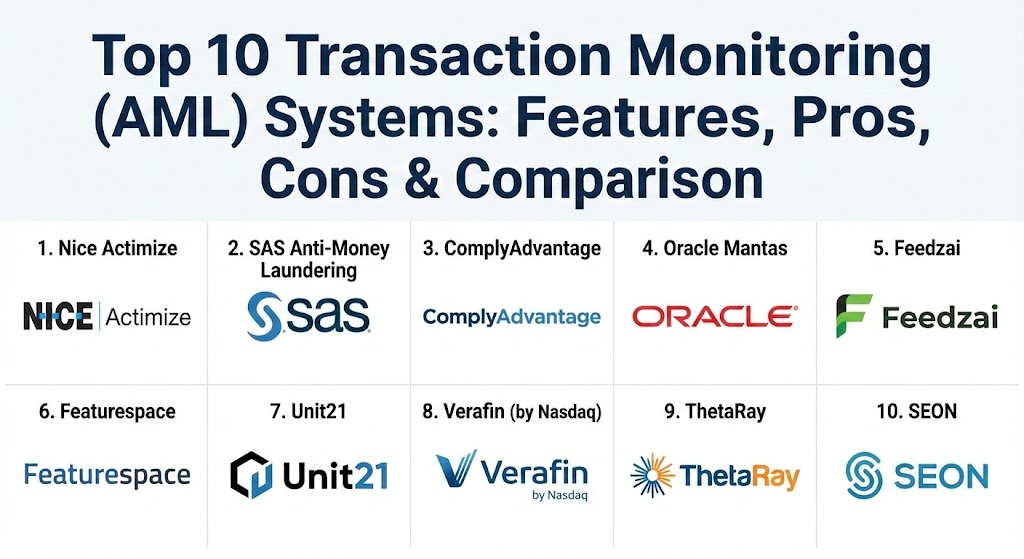
Top 10 Transaction Monitoring (AML) Systems
1 — Nice Actimize (X-Sight)
Nice Actimize is widely regarded as the market leader in the AML space, providing an end-to-end suite that covers the entire financial crime lifecycle. Its X-Sight platform leverages cloud-native technology and advanced AI to provide an “autonomous” compliance experience.
- Key features:
- Integrated “X-Sight Marketplace” for third-party data enrichment.
- Advanced behavioral analytics that learn individual customer “normals.”
- Automated SAR (Suspicious Activity Report) filing and workflow management.
- Real-time and batch monitoring capabilities for global operations.
- Integrated PEP, Sanctions, and Adverse Media screening.
- “Always-on” monitoring that adapts to new regulatory changes automatically.
- Multi-tenant cloud architecture for high-speed processing.
- Pros:
- The most comprehensive feature set in the industry; a “gold standard” for regulators.
- Exceptional scalability, capable of handling the transaction volumes of the world’s largest banks.
- Cons:
- Implementation is a major enterprise undertaking that can take many months.
- High price point makes it inaccessible for many small-to-mid-sized fintechs.
- Security & compliance: SOC 2 Type II, GDPR, ISO 27001, and FIPS 140-2. Features advanced SSO and encrypted audit logs.
- Support & community: Top-tier enterprise support; “Actimize Academy” for user certification; massive global user community and partner network.
2 — SAS Anti-Money Laundering
SAS is a global powerhouse in data analytics, and its AML solution is built on the high-performance SAS Viya platform. It is designed for organizations that want to use deep data science to uncover hidden relationships between entities.
- Key features:
- Next-generation entity resolution to find hidden links between accounts.
- Visual network analysis (Link Analysis) to uncover complex laundering rings.
- Hybrid detection models combining business rules with machine learning.
- Automated alert prioritization to reduce “alert fatigue.”
- Deep integration with the SAS data science ecosystem for custom modeling.
- Support for high-volume, real-time data streaming.
- Regulatory reporting templates for dozens of international jurisdictions.
- Pros:
- Industry-leading analytical depth; perfect for discovering “unknown-unknowns.”
- Highly flexible for firms that have internal data science teams to build custom rules.
- Cons:
- Requires specialized SAS expertise to manage and optimize.
- The interface can be intimidating for non-technical compliance staff.
- Security & compliance: ISO 27001, SOC 2, HIPAA readiness, and GDPR compliance. Advanced role-based access controls.
- Support & community: Extensive documentation; global technical support; very active SAS user forums and professional training courses.
3 — ComplyAdvantage
ComplyAdvantage is a modern, API-first AML platform that has become a favorite among fintechs and digital banks. It uses proprietary data crawling to provide real-time updates on sanctions and risk entities.
- Key features:
- Real-time “Dynamic Risk” engine that updates as data changes.
- Proprietary global database of PEPs, Sanctions, and Adverse Media.
- Easy-to-integrate REST API for rapid product deployment.
- Transaction monitoring that links directly to customer risk profiles.
- Automated “Smart Alerts” that group related suspicious activities.
- Visual case management dashboard for compliance teams.
- High-speed batch screening for historical data cleanup.
- Pros:
- One of the fastest implementation times in the market.
- The proprietary data source reduces reliance on third-party data providers.
- Cons:
- May lack some of the deeply “heavy” enterprise features required by Tier-1 legacy banks.
- Smaller historical data set compared to legacy competitors.
- Security & compliance: SOC 2, GDPR, and ISO 27001. Data is encrypted in transit and at rest.
- Support & community: Excellent developer documentation; responsive email and chat support; growing fintech user community.
4 — Oracle Financial Services Crime and Compliance Management (Mantas)
Often referred to simply as “Mantas,” Oracle’s AML solution is an enterprise veteran used by many of the world’s central banks. It is part of the broader Oracle Financial Services Analytical Applications (OFSAA) suite.
- Key features:
- Massive library of pre-built “scenarios” (patterns of suspicious activity).
- Integrated platform for AML, Fraud, and Trade Compliance.
- Deep integration with Oracle Database for extreme performance.
- Multi-currency and multi-jurisdiction reporting logic.
- Advanced Graph Analytics to visualize transaction paths.
- Automated regulatory filing (E-Filing) for FinCEN and others.
- Robust “What-If” testing for threshold tuning.
- Pros:
- Known for being “unshakeable” during regulatory audits; highly trusted by governments.
- Unmatched ability to handle multi-terabyte data sets.
- Cons:
- Often requires a massive hardware footprint (or Oracle Cloud commitment).
- UI is functional but feels dated compared to modern SaaS rivals.
- Security & compliance: FedRAMP, SOC 1/2/3, GDPR, and FIPS 140-2. State-of-the-art identity management.
- Support & community: Global enterprise support; massive partner ecosystem; “Oracle University” training paths.
5 — Feedzai
Feedzai is an AI-first platform that focuses on the convergence of AML and Fraud. It uses a “Segment-of-One” approach, where the system creates a unique behavioral profile for every single customer.
- Key features:
- Pulse AI: Real-time machine learning for instantaneous transaction scoring.
- Unified Risk Platform covering AML, KYC, and Fraud.
- “Fairness and Explainability” tools to show why an alert was triggered.
- Automated Link Analysis to detect organized crime networks.
- Cloud-first architecture with elastic scaling.
- Customizable “Auto-ML” that allows teams to update models without coding.
- Integration with external data lakes for holistic risk views.
- Pros:
- One of the lowest false-positive rates in the industry thanks to hyper-personalization.
- The “Explainable AI” feature is vital for satisfying inquisitive regulators.
- Cons:
- High complexity in the initial model training phase.
- Premium pricing reflecting its high-tech AI positioning.
- Security & compliance: SOC 2 Type II, ISO 27001, GDPR, and PCI-DSS compliance.
- Support & community: High-touch implementation support; proactive customer success managers; technical knowledge base.
6 — Featurespace (ARIC Risk Hub)
Featurespace is the pioneer of “Adaptive Behavioral Analytics.” Its ARIC Risk Hub is designed to spot anomalies in real-time by focusing on “good” behavior and flagging anything that deviates from it.
- Key features:
- Adaptive Behavioral Analytics that update in real-time without retraining.
- Unified platform for AML and Fraud (Framl).
- Real-time transaction scoring for instant block/allow decisions.
- Advanced reporting and dashboarding for MLROs.
- “Sandbox” environment for testing new rules without impacting live data.
- Entity-centric monitoring across multiple accounts.
- Support for on-premise, cloud, or hybrid deployment.
- Pros:
- Exceptional at identifying “First Party Fraud” and subtle laundering patterns.
- Dramatically reduces manual work for analysts by only flagging true anomalies.
- Cons:
- Can be overkill for organizations with very simple, predictable transaction patterns.
- Implementation requires a high degree of collaboration with Featurespace engineers.
- Security & compliance: ISO 27001, SOC 2, and GDPR. Robust data anonymization capabilities.
- Support & community: Deep domain expertise; dedicated 24/7 support; regular user training workshops.
7 — Unit21
Unit21 is a “no-code” platform that empowers compliance teams to build and modify their own monitoring rules without waiting for the engineering department. It is widely used by high-growth startups and crypto firms.
- Key features:
- No-code rule engine with a visual “if-this-then-that” builder.
- Integrated Case Management and SAR filing.
- Advanced Graph Database for network visualization.
- Native support for cryptocurrency transaction monitoring.
- “Ghost Rules” for testing new logic against historical data.
- Third-party data orchestration for KYC/KYB.
- Highly flexible API for custom data ingestion.
- Pros:
- Provides compliance teams with total autonomy; highly agile.
- The most modern and “consumer-friendly” UI in the AML market.
- Cons:
- Scale for “mega-banks” with billions of transactions per day is still being proven.
- Analytics are powerful but may lack the deep statistical “niche” of SAS.
- Security & compliance: SOC 2 Type II, GDPR, and HIPAA compliance readiness.
- Support & community: Excellent documentation; Slack-based community support; fast-moving product updates.
8 — Verafin (by Nasdaq)
Verafin is a leading provider of cloud-based AML and Fraud detection, specifically optimized for community banks and credit unions in North America. It was acquired by Nasdaq to bolster its financial crime division.
- Key features:
- “FRAML” (Fraud + AML) approach to unified risk management.
- Cross-institutional data sharing (314b) to track crime between banks.
- Automated SAR e-filing directly to FinCEN.
- Integrated High-Risk Customer management and CDD/EDD.
- Visual Link Analysis for identifying money mules.
- Robust reporting for state and federal examinations.
- Easy-to-use case management for small teams.
- Pros:
- The 314b data-sharing feature is a unique and powerful weapon against crime.
- Tailor-made for the regulatory landscape of North American banking.
- Cons:
- Not as well-suited for international banks operating in dozens of different regions.
- Pricing is optimized for the banking sector, not the high-volume fintech sector.
- Security & compliance: FFIEC compliant, SOC 2, and GDPR. Built on a secure cloud infrastructure.
- Support & community: Industry-specific webinars; 24/7 technical support; very active user community in the banking sector.
9 — ThetaRay (SONAR)
ThetaRay specializes in “Unsupervised Machine Learning.” Unlike traditional systems that need to be told what to look for, ThetaRay’s SONAR platform discovers new, unknown types of financial crime automatically.
- Key features:
- Unsupervised ML that identifies anomalies without pre-defined rules.
- Global “Transaction Path” analysis for correspondent banking.
- Low False Positive rate through intelligent anomaly clustering.
- Rapid deployment (often live in weeks).
- Transparent “Black Box” explanations for all alerts.
- Support for cross-border and cross-currency monitoring.
- Intuitive risk-score dashboard for analysts.
- Pros:
- Essential for correspondent banking where you don’t always “know” the end customer.
- Finds sophisticated laundering schemes that rule-based systems miss entirely.
- Cons:
- Requires a significant volume of data for the unsupervised ML to be effective.
- Analysts must be trained on how to interpret “unsupervised” alerts.
- Security & compliance: ISO 27001, SOC 2, and GDPR. Multi-layered data encryption.
- Support & community: Specialized implementation teams; global support; deep focus on the fintech and banking ecosystem.
10 — SEON
SEON is a “Data-Enrichment” focused platform that has expanded into transaction monitoring. It is particularly strong for digital businesses that need to prevent fraud and laundering at the point of entry.
- Key features:
- Real-time data enrichment based on email, phone, and IP address.
- Social media footprinting to verify customer identity.
- Transparent, “White-box” machine learning rules.
- Flexible transaction monitoring based on custom velocity rules.
- Chrome Extension for manual analyst reviews.
- Pay-as-you-go pricing (unique in this sector).
- Low-latency API for instantaneous decisions.
- Pros:
- Most cost-effective tool for startups and mid-market digital firms.
- The social media lookup is a game-changer for verifying “thin-file” customers.
- Cons:
- Lacks the deep regulatory “SAR filing” automation of enterprise giants like Nice Actimize.
- More focused on “Fraud-AML” than pure, legacy-style AML.
- Security & compliance: GDPR, ISO 27001, and SOC 2. Advanced data hashing for privacy.
- Support & community: 24/7 chat support; excellent API documentation; active blog and technical tutorials.
Comparison Table
| Tool Name | Best For | Platform(s) Supported | Standout Feature | Rating (Gartner) |
| Nice Actimize | Tier-1 Global Banks | Cloud, On-Prem | Autonomous AML | 4.6 / 5 |
| SAS AML | Advanced Analytics | Cloud, On-Prem | Entity Resolution | 4.5 / 5 |
| ComplyAdvantage | High-Growth Fintechs | SaaS / API | Proprietary Data Graph | 4.4 / 5 |
| Oracle Mantas | Multi-Jurisdiction | Cloud, On-Prem | Scenario Library | 4.3 / 5 |
| Feedzai | AI/ML Precision | Cloud, SaaS | Segment-of-One AI | 4.7 / 5 |
| Featurespace | Behavioral Anomalies | Cloud, On-Prem | Adaptive Analytics | 4.7 / 5 |
| Unit21 | Agile Compliance Teams | SaaS | No-Code Rule Builder | 4.5 / 5 |
| Verafin | North American Banks | Cloud | 314b Data Sharing | 4.6 / 5 |
| ThetaRay | Correspondent Banking | Cloud / SaaS | Unsupervised ML | 4.4 / 5 |
| SEON | Digital Businesses | SaaS / API | Social Media Lookup | 4.8 / 5 |
Evaluation & Scoring of Transaction Monitoring (AML) Systems
To choose the right system, organizations must weigh technical prowess against operational reality. The following rubric represents how a professional procurement team evaluates these tools.
| Category | Weight | Evaluation Criteria |
| Core Features | 25% | Real-time monitoring, rule-building depth, PEP/Sanctions screening. |
| Ease of Use | 15% | Intuitive case management, dashboard clarity, “no-code” options. |
| Integrations | 15% | API quality, connectivity to core banking, and third-party data feeds. |
| Security & Compliance | 10% | SOC 2 status, GDPR compliance, and encryption standards. |
| Performance | 10% | Latency of decisions and ability to handle high transaction volumes. |
| Support & Community | 10% | Documentation, 24/7 support availability, and professional training. |
| Price / Value | 15% | Total cost of ownership (TCO) relative to efficiency gains. |
Which Transaction Monitoring (AML) Systems Tool Is Right for You?
Selecting an AML system is a decision that will stay with your organization for years. You must balance the “regulator’s peace of mind” with “operational efficiency.”
- Solo Users vs. SMBs: Small fintechs should look at Unit21 or SEON. These tools offer low barriers to entry, flexible pricing, and modern APIs that don’t require a massive IT team to maintain.
- Mid-Market Banks & Credit Unions: If you are in North America, Verafin is the industry standard for community-scale banking. If you are a global mid-market player, ComplyAdvantage provides a highly scalable SaaS model.
- Tier-1 Global Enterprises: For banks with millions of customers and multi-national footprints, Nice Actimize, Oracle Mantas, or SAS are the only tools with the proven depth to satisfy global regulators.
- Budget-Conscious vs. Premium: SEON offers a transparent, entry-level cost structure, while Feedzai and Nice Actimize are premium solutions that command higher prices in exchange for industry-leading AI and comprehensive compliance coverage.
- High-Tech/Crypto Needs: If you are dealing with blockchain transactions, Unit21 or ThetaRay provide the specific anomaly detection required for the non-linear path of digital assets.
Frequently Asked Questions (FAQs)
1. What is the difference between KYC and Transaction Monitoring?
KYC (Know Your Customer) happens at onboarding to verify who the customer is. Transaction Monitoring is an ongoing process that analyzes what the customer is doing with their money after they have joined.
2. What are “False Positives” and why do they matter?
A false positive is when a system flags a legitimate transaction as suspicious. High false-positive rates waste compliance officers’ time and can lead to “alert fatigue,” where real threats are missed because of too much noise.
3. Do these systems file SARs automatically?
While many systems (like Nice Actimize and Verafin) can auto-populate the forms for a Suspicious Activity Report (SAR), human review is almost always required before the report is officially filed with the government.
4. How does AI improve AML monitoring?
Traditional systems use “rules” (e.g., flag any transfer over $10k). AI looks for “behavioral anomalies” (e.g., this user usually transfers $50, but suddenly sent $8,000 to a new country), which catches much more sophisticated crime.
5. Can I use these tools for cryptocurrency?
Yes. Modern platforms like Unit21 and ThetaRay have native support for blockchain data, allowing you to monitor digital asset flows just as easily as traditional bank transfers.
6. What is “Entity Resolution”?
This is the process of figuring out that “John Doe,” “J. Doe,” and “Jonathan Doe” across three different accounts are actually the same person. It is vital for spotting “smurfing” and complex laundering rings.
7. Is cloud-based AML secure enough?
Yes. In fact, most regulators now prefer cloud-based systems because they receive security patches and regulatory rule updates instantly, whereas on-premise systems can become outdated quickly.
8. How long does it take to implement an AML system?
A modern API-based tool can be live in 4 to 8 weeks. A massive enterprise legacy system migration can take 12 to 18 months, depending on the complexity of the data integration.
9. What is “Correspondent Banking” monitoring?
This is when a bank monitors transactions on behalf of another bank. Tools like ThetaRay are specifically designed for this because they can spot risk even when they don’t have the full KYC data of the secondary bank’s customer.
10. What is “Explainable AI”?
Regulators don’t like “black boxes.” Explainable AI (found in tools like Feedzai) provides a clear reason why an alert was triggered, such as “Transaction frequency increased by 500% compared to the user’s 90-day average.”
Conclusion
The battle against financial crime is an ongoing arms race. As criminals become more sophisticated, the tools we use to catch them must evolve even faster. Choosing a Transaction Monitoring system is about more than just checking a box for a regulator; it is about protecting the integrity of your brand and the safety of the global financial system. Whether you prioritize the “unsupervised” brilliance of ThetaRay, the “no-code” agility of Unit21, or the enterprise weight of Nice Actimize, the most important step is moving toward a proactive, data-driven compliance culture. The best system is the one that allows your team to stop chasing ghosts and start stopping actual crime.