Introduction
A PEP screening tool is a specialized software solution designed to identify individuals who hold prominent public positions—or are closely related to them—and may therefore pose a higher risk for involvement in financial crime. Because PEPs have significant influence over public funds and policy, they are susceptible to bribery and embezzlement. These tools cross-reference customer data against vast databases of government officials, their family members, and close associates (RCAs) to ensure businesses are not inadvertently facilitating illicit transactions.
The importance of these tools cannot be overstated. Beyond avoiding multi-million dollar fines from regulators like FinCEN or the FCA, effective screening protects an organization’s reputation and ensures ethical business operations. Key real-world use cases include onboarding new banking clients, performing enhanced due diligence (EDD) on high-net-worth individuals, and maintaining continuous monitoring for existing customers whose status might change due to an election or appointment. When evaluating these tools, users should prioritize data depth (global reach), the quality of name-matching algorithms (to reduce false positives), real-time update frequency, and the ease of integration into existing Know Your Customer (KYC) workflows.
Best for: Compliance officers, AML (Anti-Money Laundering) specialists, and risk managers in banks, insurance companies, crypto exchanges, and real estate firms. It is essential for any business operating in a highly regulated jurisdiction or handling significant cross-border transactions.
Not ideal for: Small, local retail businesses or service providers with no regulatory obligation to perform AML/KYC checks. These organizations may find the cost and technical complexity of specialized screening tools unnecessary for their low-risk operational profiles.
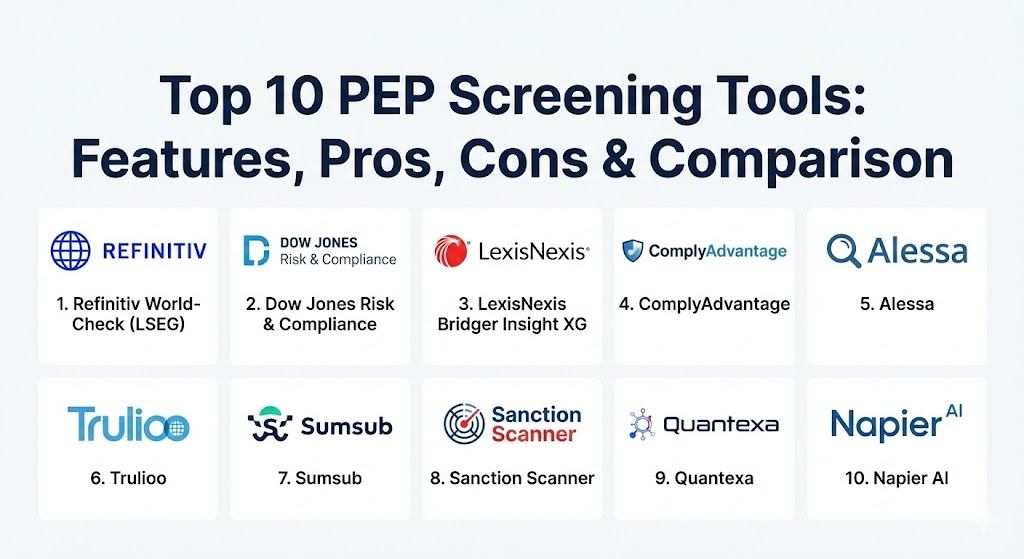
Top 10 PEP Screening Tools
1 — Refinitiv World-Check (LSEG)
Refinitiv World-Check, now part of the London Stock Exchange Group (LSEG), is the industry benchmark for risk intelligence. It provides one of the most comprehensive and meticulously researched databases of PEPs and heightened-risk individuals globally.
- Key features:
- Access to millions of records across 240+ countries and territories.
- Detailed sub-classification of PEPs (Levels 1–4) for nuanced risk assessment.
- Integration with World-Check One for a unified screening and case management workflow.
- Native character screening (non-Latin scripts) for improved global accuracy.
- Adverse media screening integrated directly into PEP profiles.
- Highly structured data that includes family members and close associates (RCAs).
- Secondary identifier matching (DOB, Place of Birth) to minimize false positives.
- Pros:
- Unrivaled data depth and historical record accuracy.
- Trusted by the world’s largest Tier-1 banks and government agencies.
- Cons:
- Premium pricing can be prohibitive for startups and smaller firms.
- The sheer volume of data can sometimes result in high numbers of alerts that require manual review.
- Security & compliance: SOC 2, ISO 27001, GDPR, and ISAE 3000 standard accreditation.
- Support & community: Enterprise-grade support with global 24/7 availability; extensive technical documentation and formal certification programs.
2 — Dow Jones Risk & Compliance
Dow Jones leverages its world-class news-gathering infrastructure to provide a highly accurate and up-to-date PEP database. It is favored by compliance teams who prioritize data precision and “explainability” in their risk models.
- Key features:
- Structured PEP profiles that include official roles, dates of birth, and clear relationship maps.
- Adverse media risk classification categorized by specific crime types.
- State-owned company (SOC) data to identify entities with political influence.
- Sanctions and watchlist screening updated in near real-time.
- Flexible delivery via web interface, API, or data feed for custom environments.
- Human-curated data to ensure high relevance and low noise.
- Pros:
- Exceptional data quality with a focus on reducing “low-quality” aliases and false positives.
- The integration of Factiva news data provides the most robust adverse media context in the market.
- Cons:
- Implementation for custom data feeds can be technically demanding.
- Not an “all-in-one” KYC platform; usually requires integration with other tools for full onboarding.
- Security & compliance: ISO 27001, GDPR, and rigorous internal data privacy protocols.
- Support & community: Dedicated account managers; high-quality onboarding and regular training webinars for compliance teams.
3 — LexisNexis Bridger Insight XG
Bridger Insight XG is an enterprise-grade compliance platform that combines the massive data reach of LexisNexis with advanced filtering technology. It is designed for large-scale operations requiring high-speed batch and real-time screening.
- Key features:
- Powered by WorldCompliance data, featuring over 7 million high-risk individual profiles.
- Advanced “fuzzy matching” logic that accounts for spelling variations and transliterations.
- Integrated case management for streamlining investigations and audit trails.
- Automated ongoing monitoring that alerts users to changes in PEP status.
- Comprehensive reporting capabilities designed for regulatory auditors.
- Support for batch screening of entire customer databases.
- Pros:
- Significant reduction in manual reviews due to highly configurable matching rules.
- Seamless integration with other LexisNexis identity and fraud tools.
- Cons:
- The interface can feel complex and “dense” for smaller, less experienced teams.
- Pricing is generally structured for high-volume enterprise users.
- Security & compliance: SOC 2, HIPAA, and alignment with USA PATRIOT Act and EU AML directives.
- Support & community: Global professional services team for implementation; extensive knowledge base and community forums.
4 — ComplyAdvantage
ComplyAdvantage is the leader of the “new wave” of RegTech providers. It utilizes proprietary AI and machine learning to build a real-time, dynamic database of PEPs, sanctions, and adverse media.
- Key features:
- AI-driven “Smart Matching” that continuously learns from user decisions to reduce false positives.
- Real-time API that allows for instant screening during customer onboarding.
- Automated ongoing monitoring with daily scans for risk status changes.
- Fully configurable risk scoring based on role, geography, and transaction type.
- Case management dashboard with collaborative tools for compliance teams.
- “Adverse Media” monitoring that uses natural language processing (NLP) to categorize news.
- Pros:
- Highly modern, cloud-native UI that is intuitive for younger compliance teams.
- Extremely fast implementation; one of the best developer-friendly APIs in the market.
- Cons:
- Because it relies heavily on AI, some traditional auditors may require more “explainability” on specific matches.
- Data historical depth is growing but may not yet match legacy giants like World-Check.
- Security & compliance: SOC 2 Type II, ISO 27001, and GDPR aligned.
- Support & community: Live chat and email support; robust API documentation; very active in the fintech community.
5 — Alessa
Alessa is a comprehensive AML compliance and fraud management solution that integrates PEP screening into a broader financial crime prevention ecosystem. It is highly regarded for its ability to handle transaction monitoring alongside identity screening.
- Key features:
- Intelligent PEP scoring based on role, relationships, and geography.
- Unified platform for PEP screening, transaction monitoring, and case management.
- Automated regulatory reporting (SARs/STRs) for various jurisdictions.
- Graph analytics to visualize relationships between PEPs and corporate entities.
- Configurable workflows that can be tailored to specific business risk appetites.
- Batch and real-time screening against global watchlists.
- Pros:
- Great “value for money” as it consolidates multiple AML tools into one platform.
- Strong ability to uncover “hidden” relationships through its advanced analytics.
- Cons:
- The setup process can be time-consuming due to the broad scope of the tool.
- UI is more functional than “beautiful,” which may impact user adoption for some teams.
- Security & compliance: SOC 2, HIPAA, and ISO 27001.
- Support & community: Responsive customer support; dedicated onboarding specialists; frequent product updates based on user feedback.
6 — Trulioo
Trulioo is a global identity verification leader that offers PEP and sanctions screening as a critical module within its “Identity Platform.” It is ideal for businesses that need to verify identities and screen for risk in a single step.
- Key features:
- Access to 450+ global data sources for identity verification and risk screening.
- Integrated PEP and sanctions checks across 195 countries.
- Real-time monitoring of customer lists for status changes.
- Single API for global KYC, KYB (Know Your Business), and AML screening.
- Customizable risk thresholds to balance onboarding speed with compliance.
- Detailed audit logs for every verification and screening event.
- Pros:
- Best-in-class for global scale; can verify and screen people in almost any country.
- Simplifies the vendor stack by combining identity and screening into one platform.
- Cons:
- PEP data is sometimes sourced from third-party providers rather than proprietary research.
- Costs can scale quickly for businesses with high-volume, global onboarding needs.
- Security & compliance: SOC 2 Type II, GDPR, and ISO 27001 compliant.
- Support & community: Global 24/7 support; extensive developer portal; high-touch customer success managers for enterprise clients.
7 — Sumsub
Sumsub provides a “unified compliance hub” that is particularly popular with the crypto, gambling, and trading sectors. It offers an exceptionally smooth user experience for both the business and the end-customer.
- Key features:
- AI-powered automated screening with a reported 70% reduction in case resolution time.
- Legal-ready audit reports generated automatically for every user.
- Global coverage for PEPs, sanctions, and adverse media.
- Highly customizable “no-code” workflow builder.
- Dynamic risk scoring that adjusts based on real-time behavior.
- Native SDKs for seamless integration into mobile apps and websites.
- Pros:
- One of the most user-friendly interfaces in the entire RegTech market.
- Fast, automated decision-making that significantly reduces the need for large compliance teams.
- Cons:
- May lack the “heavyweight” investigative tools required by massive Tier-1 banks.
- The focus on automation might feel less transparent to some traditional risk managers.
- Security & compliance: SOC 2, ISO 27001, GDPR, and HIPAA compliant.
- Support & community: 24/7 support; comprehensive documentation; highly active in the digital assets and gaming communities.
8 — Sanction Scanner
Sanction Scanner is an agile and cost-effective AML solution that specializes in real-time screening and transaction monitoring. It is a favorite among mid-market firms looking for a high-performance tool without the enterprise price tag.
- Key features:
- Global PEP, sanctions, and adverse media database updated every 15 minutes.
- API-first approach that enables integration in as little as one day.
- Highly effective name-matching algorithm that handles typos and aliases.
- 24/7 real-time monitoring of customer portfolios.
- Integrated transaction monitoring with customizable rules.
- Simple case management dashboard for manual reviews.
- Pros:
- Excellent “price-to-performance” ratio; very accessible for smaller firms.
- Extremely responsive customer support team and fast implementation timeline.
- Cons:
- Lacks the deeper “relationship mapping” features of tools like Quantexa.
- Reporting features are functional but less customizable than higher-end platforms.
- Security & compliance: GDPR compliant, data encryption at rest and in transit.
- Support & community: 24/7 live support; active blog and knowledge base; strong focus on the Middle East and European markets.
9 — Quantexa
Quantexa is a leader in “Decision Intelligence.” It goes far beyond simple name matching by using graph technology to connect disparate data points and uncover complex networks of influence and risk.
- Key features:
- Entity resolution technology that identifies “hidden” PEPs across different datasets.
- Contextual risk scoring that considers the entire network of an individual.
- Visualization tools for exploring complex human and corporate networks.
- Integration of internal and external data for a 360-degree view of risk.
- Real-time and batch screening against global risk lists.
- Advanced AI to detect patterns of money laundering and collusion.
- Pros:
- The most powerful tool for uncovering complex corruption and money laundering networks.
- Significantly reduces false positives by using “context” rather than just “names.”
- Cons:
- High complexity requires specialized data teams to manage and interpret.
- Only suitable for large enterprises or institutions with massive data volumes.
- Security & compliance: ISO 27001, SOC 2, and GDPR compliant.
- Support & community: Enterprise-only support; professional services focus; deep expertise in the banking and government sectors.
10 — Napier AI
Napier AI is a cloud-native platform that prides itself on “Intelligent Compliance.” It offers a modern approach to PEP screening with a heavy focus on visibility, agility, and explainable AI.
- Key features:
- Advanced rules engine that allows users to create custom screening logic.
- Multi-agency and multi-jurisdictional screening in a single interface.
- AI-enhanced “Smart Watchlist” that prioritizes the most relevant risk data.
- Integrated case management and automated audit logs.
- High-speed performance for large-scale transaction and client screening.
- Sandbox environment for testing and refining screening rules.
- Pros:
- Highly agile; allows compliance teams to react quickly to changing regulations.
- The “Sandbox” feature is a major advantage for teams looking to optimize false-positive rates.
- Cons:
- Relatively newer to the market compared to giants like World-Check.
- May require more configuration than “out-of-the-box” solutions.
- Security & compliance: ISO 27001, SOC 2, and GDPR compliant.
- Support & community: Dedicated customer success team; cloud-native deployment with 24/7 technical support.
Comparison Table
| Tool Name | Best For | Platform(s) Supported | Standout Feature | Rating (Gartner/TrueReview) |
| Refinitiv World-Check | Tier-1 Institutions | Web, API | Global Data Depth | 4.6 / 5 |
| Dow Jones Risk & Comp | Precision & News Context | Web, API, Feed | News-Driven Data | 4.4 / 5 |
| LexisNexis Bridger | Enterprise Batch Screening | Web, API | High-Volume Filtering | 4.3 / 5 |
| ComplyAdvantage | Fintechs & High-Growth | API, Cloud | Real-time AI Data | 4.7 / 5 |
| Alessa | Full AML Lifecycle | Web, API | Integrated Monitoring | 4.5 / 5 |
| Trulioo | Global Onboarding | API, Web | Identity + Screening | 4.6 / 5 |
| Sumsub | UI/UX & No-Code | SDK, API, Web | Automation Smoothness | 4.8 / 5 |
| Sanction Scanner | Mid-Market Value | API, Web | Price/Performance | 4.9 / 5 |
| Quantexa | Complex Networks | On-Prem, Cloud | Graph Decision Intel | 4.5 / 5 |
| Napier AI | Agility & Custom Rules | Cloud, API | Screening Sandbox | 4.6 / 5 |
Evaluation & Scoring of PEP Screening Tools
To help you make an informed choice, we have evaluated these tools against a standardized rubric that reflects the core priorities of a modern compliance department.
| Category | Weight | Evaluation Criteria |
| Core Features | 25% | Global data coverage, PEP sub-classification, RCA inclusion, and name matching. |
| Ease of Use | 15% | UI intuitiveness, speed of alert resolution, and mobile/remote access. |
| Integrations | 15% | API quality, pre-built CRM/banking connectors, and batch capability. |
| Security & Compliance | 10% | Encryption, SOC 2/ISO certifications, and audit trail robustness. |
| Performance | 10% | Real-time speed, latency, and uptime reliability. |
| Support & Community | 10% | Documentation quality, support response time, and user groups. |
| Price / Value | 15% | Transparency of pricing vs. the reduction in manual labor costs. |
Which PEP Screening Tool Is Right for You?
Selecting the “best” PEP screening tool is not about finding the one with the most features; it is about finding the one that fits your risk appetite, technical capability, and budget.
Solo users vs SMB vs Mid-market vs Enterprise
- Solo/Small Firms: If you are a boutique law firm or a small real estate agent, look at Sanction Scanner or SmartSearch. They provide sufficient coverage with simple, affordable pricing.
- SMB/Mid-market Fintechs: ComplyAdvantage and Sumsub are the leaders here. Their focus on APIs and “no-code” automation allows small compliance teams to handle massive user growth without exploding their headcount.
- Enterprise/Tier-1 Banks: Refinitiv World-Check and Quantexa are the only serious contenders. They provide the extreme data depth and network-analysis power required to survive rigorous regulatory scrutiny.
Budget-conscious vs Premium solutions
- Budget-conscious: Sanction Scanner offers high performance at a fraction of the cost of legacy providers.
- Premium: Dow Jones and Refinitiv charge a premium for their human-curated data, which many find worth the price for the reduction in false positives and audit peace of mind.
Feature depth vs Ease of use
If your team is non-technical, Sumsub’s dashboard and no-code builders will be a major win. If your team is composed of deep-dive data investigators, the “Decision Intelligence” and graph visualization of Quantexa or Alessa will be more valuable.
Integration and scalability needs
Businesses looking to scale globally should prioritize Trulioo, which combines localized identity verification with global screening. Those already using a broad risk ecosystem should look at LexisNexis Bridger for its “plug-and-play” capability with other enterprise modules.
Frequently Asked Questions (FAQs)
1. What is a “PEP” and why is it high-risk?
A Politically Exposed Person is someone with a prominent public role (like a minister, judge, or high-ranking military officer). They are considered high-risk because their position gives them influence over public funds, making them targets for bribery and corruption.
2. What are “RCAs” in PEP screening?
RCA stands for “Relatives and Close Associates.” Regulators require you to screen not just the PEP, but also their family and close business partners, as these are the channels most often used to hide illicit funds.
3. How often should PEP lists be updated?
In 2026, the industry standard is real-time or daily updates. Political appointments and elections happen constantly, and a person who was “low-risk” yesterday could be a “high-risk PEP” today.
4. What is a “False Positive” in screening?
A false positive occurs when the system flags an innocent person (e.g., someone with the same name as a PEP). Good tools use “secondary identifiers” like date of birth or nationality to filter these out automatically.
5. Is adverse media screening the same as PEP screening?
No, but they are related. PEP screening identifies someone’s status (political role). Adverse media screening identifies negative news about them (e.g., reports of fraud or criminal activity). Most good tools do both.
6. Do I need an API for PEP screening?
If you are onboarding users in real-time (like a crypto exchange or digital bank), an API is essential to automate the check during the signup process without manual intervention.
7. Can I perform PEP screening for my existing customers?
Yes, this is called “Continuous Monitoring” or “Ongoing Monitoring.” Most modern tools will scan your existing customer list every day and alert you only when someone’s risk status changes.
8. What is the “Risk-Based Approach” (RBA)?
The RBA is a regulatory principle where you apply more scrutiny to high-risk clients (like PEPs from high-corruption countries) and less to low-risk clients. Good screening tools allow you to configure thresholds based on this approach.
9. Are these tools GDPR compliant?
Yes, leading PEP screening tools are built to handle sensitive personal data in compliance with GDPR and other global privacy laws, often using data anonymization and strict access controls.
10. How much does PEP screening software cost?
Pricing varies from $100/month for simple SaaS tools to millions of dollars for enterprise-level bank installations. Many providers use a “per-check” or “per-user” pricing model.
Conclusion
The evolution of PEP screening tools in 2026 has moved the industry from simple “list matching” to complex network analysis and real-time AI. While legacy giants like Refinitiv World-Check and Dow Jones continue to lead in data integrity, modern challengers like ComplyAdvantage and Sumsub are winning the market on user experience and automation. Ultimately, the “best” tool is the one that aligns with your specific regulatory environment and technical ecosystem. By choosing a solution that balances data depth with operational speed, you ensure that your organization remains both compliant and competitive in a fast-paced global market.