Introduction
A Portfolio Management System is an integrated software solution designed to track, analyze, and manage a collection of financial assets. It serves as the “nerve center” for investors, providing real-time visibility into holdings, performance attribution, and risk exposure across multiple accounts and asset classes. By automating data aggregation from custodians and market feeds, a PMS eliminates manual entry errors and allows managers to focus on strategic decision-making rather than administrative overhead.
The importance of a robust PMS has surged as regulatory bodies worldwide implement stricter transparency requirements and as investors demand personalized, real-time access to their data. Key real-world use cases include automated rebalancing of thousands of accounts to maintain target allocations, stress-testing portfolios against geopolitical shocks, and generating complex tax-lot accounting reports. When evaluating a tool in this category, users should prioritize multi-asset class support, the depth of the integration ecosystem, the accuracy of its performance engine, and the rigor of its security framework.
Best for: Registered Investment Advisors (RIAs), hedge funds, family offices, institutional asset managers, and high-net-worth individuals (HNWIs) who manage diverse, multi-custodial portfolios.
Not ideal for: Casual retail investors with only a few holdings in a single brokerage account, or day traders who require high-frequency execution platforms rather than long-term tracking and reporting tools.
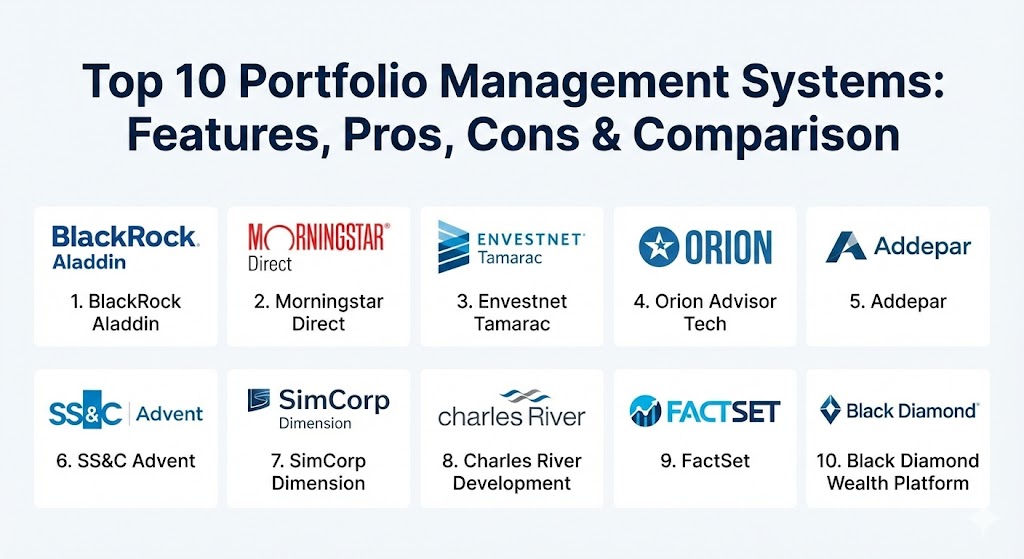
Top 10 Portfolio Management Systems Tools
1 — BlackRock Aladdin
Aladdin (Asset, Liability, Debt and Derivative Investment Network) is arguably the most powerful investment platform in the world. Originally built for internal use by BlackRock, it is now the industry standard for institutional risk management and portfolio construction.
- Key features:
- “One System” approach integrating risk analytics, trading, and operations.
- Sophisticated Monte Carlo simulations for portfolio stress testing.
- Global multi-asset class coverage including complex derivatives and private debt.
- Automated compliance monitoring against investment mandates.
- Advanced ESG integration for sustainability-linked portfolio analysis.
- Collective intelligence through shared data standards across all users.
- Real-time cash management and liquidity forecasting.
- Pros:
- Unrivaled risk analytics that can model almost any global economic scenario.
- Provides a single “source of truth” across the entire investment lifecycle.
- Cons:
- Extremely high cost and complexity; typically only accessible to the largest institutions.
- Significant implementation timeline, often requiring dedicated internal teams.
- Security & compliance: SOC 2 Type II, ISO 27001, GDPR, and localized regulatory compliance in 50+ jurisdictions. Features military-grade encryption and granular audit logs.
- Support & community: Dedicated relationship managers, 24/7 global “Aladdin Help,” and exclusive “Aladdin Community” events for institutional peers.
2 — Morningstar Direct
Morningstar Direct is the premier investment analysis platform for asset managers and wealth advisors. It combines Morningstar’s legendary proprietary data with institutional-grade portfolio construction and reporting tools.
- Key features:
- Access to Morningstar’s complete global database of stocks, funds, and ETFs.
- Advanced performance attribution and peer group benchmarking.
- Custom report builder for professional, white-labeled client presentations.
- “Sustainability Rating” integration for deep ESG portfolio analysis.
- Manager research and selection tools for multi-manager portfolios.
- Quantitative analytics including factor-based modeling.
- Pros:
- The most trusted data source in the industry for fund research and benchmarking.
- Excellent reporting capabilities that make complex data digestible for end-clients.
- Cons:
- More focused on research and analysis than back-office accounting or trading.
- Data-heavy interface can have a steep learning curve for new users.
- Security & compliance: SOC 2, GDPR, and ISO 27001. Employs robust SSO and encrypted data transmission.
- Support & community: High-quality documentation, Morningstar Academy training, and a massive community of financial professionals globally.
3 — Envestnet | Tamarac
Tamarac is a leading suite of integrated portfolio management, reporting, and rebalancing software designed specifically for RIAs. It is widely praised for its ability to scale the operations of mid-to-large independent advisory firms.
- Key features:
- Automated portfolio rebalancing and tax-loss harvesting.
- Dynamic client portal with interactive performance dashboards.
- Comprehensive billing and payout management for complex fee structures.
- Direct integration with almost all major custodians (Schwab, Fidelity, etc.).
- White-labeled reporting suite with customizable templates.
- Automated data aggregation and reconciliation.
- Pros:
- The rebalancing engine is considered one of the best for large-scale RIA operations.
- Deep integration with the broader Envestnet ecosystem, including CRM and financial planning.
- Cons:
- Can be more expensive than standalone rebalancers or reporting tools.
- Feature set might be broader than what very small firms actually need.
- Security & compliance: SOC 2 Type II, HIPAA (for relevant data), GDPR, and AES-256 encryption.
- Support & community: Dedicated service teams, extensive “Tamarac University” training, and an active user community focused on RIA best practices.
4 — Orion Advisor Tech
Orion provides a “tech-first” portfolio management solution that aims to help advisors compete with “robo-advisors” by offering a superior digital experience. It focuses on the “prospect-to-plan” journey.
- Key features:
- Real-time performance calculation engine.
- “Eclipse” trading and rebalancing platform with tax-intelligent logic.
- Integrated financial planning tools and “Hidden Levers” risk analytics.
- High-end mobile app for clients to track their goals.
- Automated billing and audit-ready compliance reporting.
- Open API architecture for custom tech stack builds.
- Pros:
- Exceptional user interface (UI) for both the advisor and the client.
- One of the most aggressive innovators in the space, constantly adding new features.
- Cons:
- Rapid feature expansion can sometimes lead to a “fragmented” feel within the UI.
- Customer support response times can fluctuate during high-growth periods.
- Security & compliance: SOC 2 Type II, ISO 27001, and FIPS-compliant data protection.
- Support & community: Comprehensive “Orion Academy,” 24/7 chat support, and the “Orion Ascent” annual conference.
5 — Addepar
Addepar is a high-end portfolio management platform specifically designed for the needs of family offices and ultra-high-net-worth (UHNW) advisors. It excels at tracking complex, non-traditional assets.
- Key features:
- Unrivaled tracking for private equity, real estate, and venture capital.
- “Ownership mapping” for complex multi-entity legal structures.
- High-performance data aggregation from 400+ feed sources.
- Customizable performance dashboards with “look-through” capabilities.
- Multi-currency and multi-language reporting for global families.
- Strategic modeling and “what-if” scenario analysis.
- Pros:
- The best tool for investors who hold more than just stocks and bonds.
- Beautifully designed reports that satisfy the aesthetic demands of UHNW clients.
- Cons:
- High cost of entry; typically not suitable for firms with low AUM per client.
- Trading and rebalancing modules are not as natively deep as Orion or Tamarac.
- Security & compliance: SOC 2 Type II, ISO 27001, GDPR, and localized data residency support.
- Support & community: Premium relationship management model and a community of the world’s most elite family offices.
6 — SS&C Advent (Geneva/APX)
Advent is a veteran in the space, offering two primary solutions: Geneva for hedge funds/global managers and APX for RIAs. It is known for its “rock-solid” accounting backbone.
- Key features:
- Real-time “Investment Book of Record” (IBOR) and “Accounting Book of Record” (ABOR).
- Support for high-volume, global transactions across all asset classes.
- Sophisticated shadow accounting and fund administration features.
- Automated reconciliation with global custodians and prime brokers.
- Integrated portfolio construction and modeling tools.
- Pros:
- Widely considered the most accurate and robust accounting engine in the industry.
- Highly reliable for firms that operate across multiple time zones and currencies.
- Cons:
- The user interface for legacy products (APX) can feel dated compared to newer SaaS rivals.
- Implementation is technical and often requires certified Advent specialists.
- Security & compliance: SOC 1 & 2, GDPR, HIPAA, and ISO 27001. Extensive audit trail capabilities.
- Support & community: Global 24/7 support network and an established user group (Advent Users Group).
7 — SimCorp Dimension
SimCorp Dimension is an integrated front-to-back investment management platform used primarily by large institutional asset managers, pension funds, and insurance companies.
- Key features:
- Truly integrated front-to-back office workflow on a single database.
- Advanced investment accounting and valuation for complex instruments.
- Comprehensive regulatory reporting (MiFID II, Solvency II, etc.).
- Real-time IBOR providing a consolidated view of positions.
- Sophisticated collateral management and securities lending tools.
- Pros:
- Eliminates the need for multiple disparate systems, reducing operational risk.
- Exceptional at handling the heavy regulatory burdens of European and Global markets.
- Cons:
- Massive software footprint that requires significant infrastructure (or managed cloud).
- Licensing and implementation costs are strictly in the “large enterprise” bracket.
- Security & compliance: ISO 27001, SOC 1/2, GDPR, and specialized insurance compliance modules.
- Support & community: Enterprise-grade SLA support and a robust network of global implementation partners.
8 — Charles River Development (State Street)
Owned by State Street, Charles River provides an end-to-end investment management solution (Charles River IMS) that excels in trading, compliance, and wealth management at scale.
- Key features:
- Institutional-grade Order Management System (OMS) and Execution Management (EMS).
- Real-time global compliance monitoring (pre-trade, post-trade, and intraday).
- Managed data services to reduce the burden of feed maintenance.
- Integrated ESG data and analytics for “green” portfolio mandates.
- Automated trade allocation and settlement workflows.
- Pros:
- The gold standard for pre-trade compliance and institutional trading.
- Strong backing from State Street, offering deep custodial and data synergies.
- Cons:
- Can be overly complex for RIAs that do not do heavy daily trading.
- Integration with non-State Street custodians can sometimes be less seamless.
- Security & compliance: SOC 2 Type II, ISO 27001, FedRAMP (for specific government clients), and GDPR.
- Support & community: Comprehensive professional services and a global “Charles River Client Portal” for support and documentation.
9 — FactSet
FactSet is a powerful competitor to Bloomberg and Morningstar, offering a portfolio management suite that is deeply integrated with its massive financial data and analytics engine.
- Key features:
- Multi-asset class performance attribution (Brinson, risk-based, etc.).
- Risk modeling using FactSet’s proprietary factor models (Multi-Factor Risk).
- Integrated portfolio construction with optimizer constraints.
- Digital portals for client reporting and executive dashboards.
- Deep “look-through” into ETFs and mutual funds.
- Seamless integration of market data and portfolio holdings.
- Pros:
- Excellent for portfolio managers who want their data and management tools in one app.
- Performance attribution is widely considered some of the most accurate in the industry.
- Cons:
- Licensing is often per-user and can be expensive for larger teams.
- The platform is highly technical and requires a strong analytical background.
- Security & compliance: SOC 2, ISO 27001, GDPR, and rigorous data privacy controls.
- Support & community: Dedicated “Consultant” model (one-on-one support) and the FactSet Learning training center.
10 — Black Diamond Wealth Platform (by SS&C)
Black Diamond is the cloud-native, modern RIA platform from SS&C Advent. It focuses on providing a “great digital experience” for both the advisor and their clients, positioning itself as a hub for the firm’s technology.
- Key features:
- Daily reconciled data from hundreds of sources.
- Interactive client portal with “Wealth View” for financial planning.
- Modern, web-based reporting with drag-and-drop customization.
- Integrated rebalancing and trading module.
- Automated billing with complex tiering and “household” logic.
- “Integration Hub” connecting to CRM, planning, and custodial tools.
- Pros:
- The most modern and user-friendly interface in the SS&C family.
- Strong focus on “advisor-client” communication and relationship management.
- Cons:
- While robust, the accounting backbone is not as deep as Geneva for hedge funds.
- Users sometimes report that the rebalancing engine is less powerful than Tamarac.
- Security & compliance: SOC 1 & 2, GDPR, HIPAA, and ISO 27001. High-level encryption and SSO.
- Support & community: Proactive service teams, extensive online help, and a very active user base in the independent advisor space.
Comparison Table
| Tool Name | Best For | Platform(s) Supported | Standout Feature | Rating (Gartner/TrueReview) |
| BlackRock Aladdin | Global Institutions | Web / Cloud / API | Risk Analytics Engine | 4.8 / 5 |
| Morningstar Direct | Fund Research & RIAs | Desktop / Web | Proprietary Research Data | 4.6 / 5 |
| Envestnet Tamarac | Large RIAs | Web / SaaS | Tax-Intelligent Rebalancing | 4.4 / 5 |
| Orion Advisor Tech | Modern Digital RIAs | Web / Mobile / API | “Eclipse” Rebalancer | 4.5 / 5 |
| Addepar | Family Offices / UHNW | Web / Mobile | Private Asset Tracking | 4.7 / 5 |
| SS&C Advent | Hedge Funds / Accounting | On-Prem / Cloud | Multi-Currency Accounting | 4.3 / 5 |
| SimCorp Dimension | Pensions / Global Asset Mgmt | Managed Cloud | Front-to-Back Integration | 4.2 / 5 |
| Charles River | Institutional Trading | Cloud / Managed | Pre-Trade Compliance | 4.4 / 5 |
| FactSet | Analytics & Attribution | Desktop / Web / Mobile | Multi-Factor Risk Modeling | 4.6 / 5 |
| Black Diamond | Mid-to-Large RIAs | Web / SaaS | Client Portal Experience | 4.7 / 5 |
Evaluation & Scoring of Portfolio Management Systems
When selecting a PMS, firms must weigh various factors based on their specific business model. The following table represents our scoring rubric for the current market.
| Category | Weight | Evaluation Criteria |
| Core Features | 25% | Multi-asset support, rebalancing, performance calculation, and billing. |
| Ease of Use | 15% | UI/UX for the manager and the client portal design. |
| Integrations | 15% | Connectivity with custodians, CRMs, and financial planning software. |
| Security & Compliance | 10% | Certifications (SOC 2), encryption, and automated audit trails. |
| Performance & Reliability | 10% | Data accuracy, system uptime, and speed of reconciliation. |
| Support & Community | 10% | Quality of documentation, training academy, and user community. |
| Price / Value | 15% | Total cost of ownership (TCO) relative to efficiency gains. |
Which Portfolio Management Systems Tool Is Right for You?
Selecting a PMS is a major operational decision that usually lasts for 5–10 years. Here is a guide to navigating the choice:
- Solo Users & SMB Advisors: If you are a single advisor or part of a small firm, Morningstar Direct (for research) or a lighter-weight version of Black Diamond is often the best fit. These tools provide the necessary professionalism without requiring a full-time operations staff.
- Mid-Market RIAs (AUM $500M – $5B): This is the sweet spot for Orion Advisor Tech and Envestnet | Tamarac. These firms need high-end rebalancing and a great client portal but don’t yet need the “military-grade” risk modeling of Aladdin.
- Family Offices & UHNW Managers: Addepar is the clear winner here. Its ability to show a client their “total net worth”—including their wine collection, private jet, and venture capital stakes—is indispensable for this segment.
- Institutional Asset Managers & Hedge Funds: BlackRock Aladdin, SimCorp Dimension, and SS&C Advent are the primary contenders. The choice often comes down to whether you prioritize risk management (Aladdin), accounting accuracy (Advent), or full front-to-back integration (SimCorp).
- Budget-Conscious vs. Premium Solutions: If budget is the primary concern, modular tools with open APIs allow you to build a custom stack. However, for most firms, the “all-in-one” premium platforms like Orion pay for themselves through massive reductions in manual labor.
Frequently Asked Questions (FAQs)
1. What is the difference between a PMS and an Order Management System (OMS)?
A PMS tracks what you currently own, its performance, and its history. An OMS is used to execute new trades, manage the lifecycle of an order, and ensure compliance before the trade is sent to the market.
2. Can these systems handle cryptocurrency and digital assets?
As of 2026, most top-tier systems (like Addepar and Orion) have integrated feeds for digital assets. However, some legacy on-premise systems may still require third-party aggregators to “bridge” crypto data into the ledger.
3. How long does a typical implementation take?
For an RIA using a SaaS platform like Black Diamond, implementation takes 30–90 days. For an institutional platform like Aladdin or SimCorp, the process can take 12–18 months.
4. Do these systems include financial planning tools?
Some, like Orion, have built-in financial planning. Others, like Addepar, prefer a “best-of-breed” approach where they integrate deeply with specialized planning software like eMoney or MoneyGuidePro.
5. How much do these systems typically cost?
Pricing is often based on a percentage of Assets Under Management (AUM), usually ranging from 1 to 5 basis points ($1,000 to $5,000 per $10M managed), or a flat fee per account.
6. Is data security a major concern with cloud-based PMS?
Yes, but cloud vendors like BlackRock and SS&C spend billions on security. For most firms, a SOC 2 compliant cloud-native PMS is significantly more secure than an old on-premise server in their office.
7. Can a PMS help with tax-loss harvesting?
Yes, tools like Tamarac and Orion have automated algorithms that scan all client accounts daily to find opportunities to sell losing positions and replace them with similar assets, optimizing the client’s tax bill.
8. What is “GIPS Compliance” and does a PMS help?
Global Investment Performance Standards (GIPS) are voluntary ethical standards for calculating and presenting investment performance. A high-end PMS like Advent or FactSet provides the audit trails needed to maintain GIPS compliance.
9. Can I manage multiple currencies in these systems?
Yes, institutional systems like SimCorp and Advent Geneva are designed specifically for multi-currency accounting, including the management of complex FX forwards and hedging strategies.
10. Do these tools provide mobile access for clients?
Almost all modern PMS providers now offer white-labeled mobile apps. These allow clients to see their “Total Wealth” view and receive messages from their advisor securely on their smartphone.
Conclusion
The landscape of portfolio management has transitioned from simple record-keeping to a sophisticated science of risk, transparency, and experience. Choosing the right Portfolio Management System is about aligning your firm’s specific complexity with a tool that can grow alongside you. Whether you require the institutional powerhouse of BlackRock Aladdin, the RIA-scaling capabilities of Tamarac, or the private-asset elegance of Addepar, the goal remains the same: to turn fragmented data into actionable investment intelligence.