Introduction
A Core Banking System is the fundamental software used by banks to support their most common transactions. This includes everything from opening accounts and processing deposits or withdrawals to calculating interest on loans and managing customer records. In the modern era, these systems have evolved from monolithic, on-premises mainframes to cloud-native, API-first platforms that allow banks to launch new products in weeks rather than years.
The importance of a robust CBS cannot be overstated. It ensures operational continuity, regulatory compliance, and provides the data foundation for personalized customer experiences. Key real-world use cases include real-time payment processing, automated KYC (Know Your Customer) checks, and multi-currency support for international trade. When evaluating these tools, decision-makers should look for modularity, cloud readiness, security architecture, and the vibrancy of the integration ecosystem.
Best for: Large-scale retail and commercial banks, neobanks (challenger banks), credit unions, and microfinance institutions that require a centralized, automated ledger to manage high volumes of transactions.
Not ideal for: Non-financial retail businesses, small accounting firms, or decentralized entities that do not hold a banking license. While these organizations need ledgers, they are better served by ERP or general accounting software.
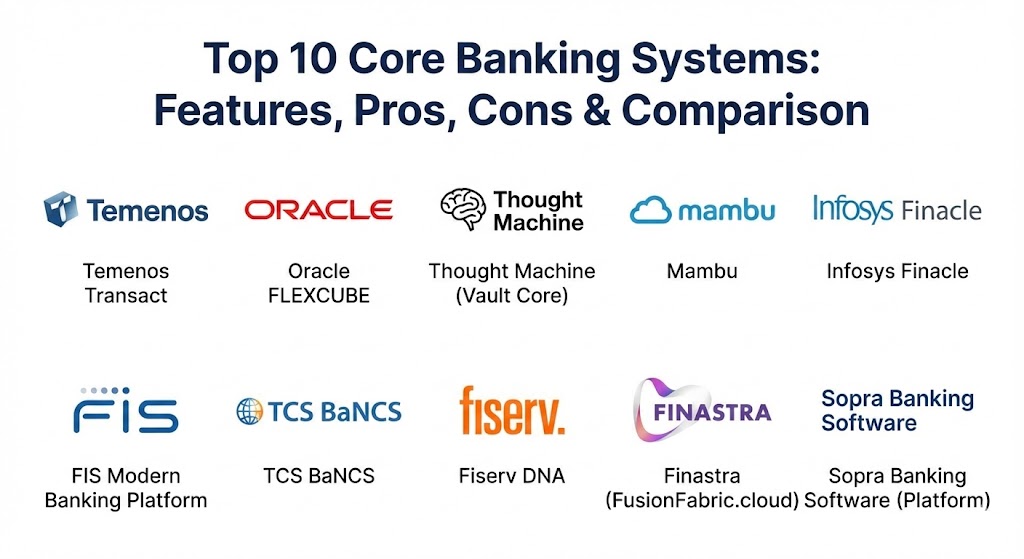
Top 10 Core Banking Systems
1 — Temenos Transact
Temenos Transact is widely recognized as the market leader in the core banking space. It is a cloud-native, platform-agnostic system that serves over 3,000 financial institutions globally, ranging from the world’s largest banks to digital startups.
- Key features:
- Composable banking architecture allowing for modular upgrades.
- Native support for retail, corporate, and wealth management.
- Integrated AI for predictive customer insights and credit scoring.
- Pre-configured “country layers” to meet local regulatory requirements.
- High-volume real-time transaction processing.
- Embedded ESG (Environmental, Social, and Governance) tracking tools.
- Extensive API library for third-party FinTech integrations.
- Pros:
- Unmatched scalability, capable of handling hundreds of millions of accounts.
- Rapid time-to-market due to pre-packaged business processes.
- Cons:
- Highly complex implementation that often requires expensive specialized consultants.
- The licensing model can be prohibitively expensive for smaller institutions.
- Security & compliance: ISO 27001, SOC 2, GDPR, and HIPAA compliant. Features robust end-to-end encryption and biometric authentication support.
- Support & community: Offers “Temenos Learning Community” (TLC), 24/7 global enterprise support, and a massive partner ecosystem for implementation.
2 — Oracle FLEXCUBE
Oracle FLEXCUBE is a deep-rooted enterprise solution designed to help banks transform their front-to-back operations. It is particularly strong in corporate and investment banking but has evolved into a formidable retail player as well.
- Key features:
- Comprehensive coverage for lending, leasing, and trade finance.
- Machine learning-based fraud detection integrated into the core.
- Open API framework for seamless “Open Banking” compliance.
- Multi-entity and multi-tenant architecture for global groups.
- Advanced analytics for real-time profitability tracking.
- “Digital Experience” (DX) layer for modernizing legacy UIs.
- Pros:
- Extremely mature feature set that can handle almost any banking product out of the box.
- Strong stability and reliability backed by Oracle’s enterprise technology stack.
- Cons:
- Can feel “legacy-heavy” despite recent cloud updates.
- Upgrades can be cumbersome and time-consuming for heavily customized versions.
- Security & compliance: FIPS 140-2, SOC 1/2, GDPR, and PCI DSS. Includes Oracle’s high-end database security features.
- Support & community: Global support network; extensive Oracle University training paths and a well-established user base.
3 — Thought Machine (Vault Core)
Thought Machine is a “next-generation” provider that has discarded legacy code entirely. Its flagship product, Vault Core, is built on a microservices architecture that uses “Smart Contracts” to define banking products.
- Key features:
- Smart Contracts allow banks to build any financial product from scratch.
- 100% cloud-native and platform-agnostic (AWS, GCP, Azure).
- Real-time ledger with zero downtime during upgrades.
- Horizontal scalability using Kafka and Kubernetes.
- “Vault Configuration” approach instead of “Custom Coding.”
- Deep support for DeFi and crypto-asset integration.
- Pros:
- Absolute flexibility—you are not limited by pre-defined product templates.
- Exceptionally clean code and documentation for developer-centric teams.
- Cons:
- Requires a high degree of technical expertise to configure “Smart Contracts.”
- Newer in the market, so it has fewer “ready-made” localizations compared to Temenos.
- Security & compliance: SOC 2 Type II, ISO 27001, and GDPR. Employs a Zero Trust security model.
- Support & community: High-touch engineering support; growing community of modern FinTech developers.
4 — Mambu
Mambu is the leading SaaS-only (Software as a Service) core banking platform. It pioneered the “composable banking” movement, allowing banks to plug in various best-of-breed components for lending, deposits, and cards.
- Key features:
- Pure SaaS model with automatic, non-disruptive updates.
- Light-weight, high-speed engine focused on agile lending and deposits.
- Extensive marketplace of pre-integrated partners (e.g., Backbase, Marqeta).
- Low-code/No-code configuration tools for business analysts.
- Multi-region cloud deployment for data residency compliance.
- Streamlined KYC and AML integration through third-party hubs.
- Pros:
- One of the fastest implementation timelines in the industry (weeks to months).
- Lower Total Cost of Ownership (TCO) due to the absence of infrastructure management.
- Cons:
- Less comprehensive for ultra-complex corporate banking or complex trade finance.
- Dependency on third-party integrations for features that are “baked-in” to larger suites.
- Security & compliance: ISO 27001, SOC 2, GDPR, and local data residency support in dozens of countries.
- Support & community: Highly praised customer success team; “Mambu Academy” for online certification.
5 — Infosys Finacle
Finacle, a product of EdgeVerve (an Infosys company), is a highly scalable suite that powers some of the world’s largest digital banks. It is known for its deep investment in AI and blockchain.
- Key features:
- Finacle Digital Engagement Suite for omnichannel customer journeys.
- Native blockchain support for cross-border trade and payments.
- AI-driven virtual assistant (Finacle Assist) for automated banking.
- Comprehensive treasury and liquidity management modules.
- Support for “Islamic Banking” with specialized Sharia-compliant modules.
- Robust data lake integration for advanced business intelligence.
- Pros:
- Exceptionally strong in emerging markets and large-scale digital transformations.
- One of the most technologically advanced stacks in terms of AI/ML integration.
- Cons:
- Administrative interface can be complex and requires significant training.
- Implementation often relies heavily on Infosys’s own professional services.
- Security & compliance: ISO 27001, SOC 2, GDPR, and HIPAA. Strong emphasis on data masking and privacy.
- Support & community: Extensive global support network; Finacle Conclave (user conference) and a large developer portal.
6 — FIS Modern Banking Platform
FIS is a global leader in financial technology. Their Modern Banking Platform is a component-based, cloud-native solution designed to help traditional banks migrate away from legacy mainframes incrementally.
- Key features:
- Deployed on a modern, API-first architecture.
- “Ready-to-bank” configurations for specific regional markets.
- Real-time ledger and interest calculation.
- Integrated risk and compliance monitoring tools.
- Seamless integration with FIS’s massive payment and card processing network.
- Advanced customer data platform for 360-degree views.
- Pros:
- High reliability—FIS processes a significant portion of the world’s wealth.
- Excellent migration paths for banks already using legacy FIS systems.
- Cons:
- Can be difficult to integrate with non-FIS third-party systems.
- Primarily focused on large, established institutions; less agile for tiny startups.
- Security & compliance: FIPS 140-2, SOC 1/2/3, GDPR, and PCI DSS.
- Support & community: World-class enterprise support and a vast global presence.
7 — TCS BaNCS
TATA Consultancy Services (TCS) provides BaNCS, a suite that is synonymous with stability and high-performance processing. It is used by some of the most prominent financial groups in the UK, India, and Australia.
- Key features:
- Integrated suite covering banking, capital markets, and insurance.
- Quartz blockchain technology for secure asset tokenization.
- Advanced “Wealth Management” module integrated into the core.
- High-concurrency processing engine for national-scale institutions.
- Cognitive-driven operations (ignio) for automated IT management.
- Pros:
- Rock-solid reliability; rarely experiences the “performance lag” seen in older suites.
- Very strong regulatory localization for the European and Asian markets.
- Cons:
- The user interface for back-office staff can feel dated compared to Thought Machine or Mambu.
- High resource requirement for maintenance and system tuning.
- Security & compliance: ISO 27001, SOC 2, GDPR, and ISO 22301 (Business Continuity).
- Support & community: Global delivery centers provide 24/7 support; strong executive-level community.
8 — Fiserv DNA
Fiserv DNA is a popular choice for credit unions and community banks in North America. It is built on a “person-centric” data model rather than an “account-centric” one, providing a unique view of the customer.
- Key features:
- Person-centric architecture for better cross-selling and relationship management.
- DNAappstore for downloading third-party “apps” that extend core functionality.
- Integrated document management and imaging.
- Advanced commercial lending and participation tools.
- Built-in business intelligence and profitability reporting.
- Pros:
- Excellent for institutions that prioritize customer relationships over pure transaction volume.
- “App Store” model makes it easy to add features without core code changes.
- Cons:
- Limited global presence; primarily optimized for North American regulations.
- Moving to a cloud-hosted model from on-prem can be a complex transition.
- Security & compliance: FIPS 140-2, SOC 2, and rigorous NCUA/FDIC compliance reporting.
- Support & community: Active user groups and strong regional support networks in the US and Canada.
9 — Finastra (FusionFabric.cloud)
Finastra’s Fusion platform (specifically Fusion Essence and Fusion Equation) has transitioned into an “Open Finance” model via its FusionFabric.cloud developer ecosystem.
- Key features:
- Open platform for collaboration between banks and FinTechs.
- Strong “Universal Banking” capabilities (Retail + Corporate).
- Integrated treasury and capital markets functionality.
- AI-driven “Next Best Action” for front-line tellers and digital apps.
- Modular “Essence” core for cloud-native retail banking.
- Pros:
- One of the best platforms for banks wanting to become “Platform Players.”
- Deep integration with Microsoft Azure for superior cloud performance.
- Cons:
- Navigating the multiple “Fusion” products can be confusing for new buyers.
- Some modules still rely on legacy architecture in the background.
- Security & compliance: SOC 1/2, ISO 27001, GDPR, and HIPAA.
- Support & community: Robust developer portal (FusionFabric.cloud) and a large global support team.
10 — Sopra Banking Software (Platform)
Sopra Banking is a European powerhouse that specializes in helping banks modernize their infrastructure without the risk of a “big bang” migration.
- Key features:
- Specialized “Lending” and “Asset Finance” modules that are industry-leading.
- Sopra Banking Cloud for end-to-end managed services.
- Strong focus on European regulatory compliance (PSD2, etc.).
- Integrated “Digital Branch” and “Engagement” tools.
- Modular architecture allowing for “progressive” core replacement.
- Pros:
- Excellent for specialized lenders or banks with a heavy European footprint.
- Very pragmatic approach to modernization that minimizes operational risk.
- Cons:
- Smaller presence in North American and Asian markets.
- Ecosystem of third-party “apps” is smaller than Mambu or Fiserv.
- Security & compliance: ISO 27001, GDPR, and SOC 2. High focus on European data privacy standards.
- Support & community: Strong European support presence and deep consultancy expertise.
Comparison Table
| Tool Name | Best For | Platform(s) Supported | Standout Feature | Rating (Expert Consensus) |
| Temenos Transact | Global Enterprises | Cloud-Native, Agnostic | Composable Architecture | 4.8 / 5 |
| Oracle FLEXCUBE | Corporate & Global | Cloud, On-Premise | Maturity & Stability | 4.6 / 5 |
| Thought Machine | Neobanks / Tier 1 | Cloud-Native (AWS/GCP) | Smart Contract Logic | 4.7 / 5 |
| Mambu | Agile SaaS / Lending | Cloud-Native (SaaS) | Rapid Implementation | 4.5 / 5 |
| Infosys Finacle | Digital Innovation | Cloud, Hybrid | AI & Blockchain Native | 4.6 / 5 |
| FIS Modern Banking | Legacy Migration | Cloud-Native (Azure) | FIS Ecosystem Integration | 4.4 / 5 |
| TCS BaNCS | High-Volume Stability | Cloud, On-Premise | Quartz Blockchain | 4.5 / 5 |
| Fiserv DNA | Credit Unions (US) | Cloud, On-Premise | Person-Centric Data | 4.3 / 5 |
| Finastra Fusion | Open Banking | Cloud (Azure) | FusionFabric Ecosystem | 4.4 / 5 |
| Sopra Banking | European Lenders | Cloud, Hybrid | Progressive Modernization | 4.2 / 5 |
Evaluation & Scoring of Core Banking Systems
To provide a clear assessment of these systems, we have evaluated them across seven key metrics. Use this scoring to align with your institution’s specific priorities.
| Category | Weight | Evaluation Criteria |
| Core Features | 25% | Depth of ledger, loan management, and multi-currency support. |
| Ease of Use | 15% | Intuitiveness of the back-office UI and developer experience. |
| Integrations | 15% | API availability and strength of the third-party ecosystem. |
| Security | 10% | Encryption, Zero Trust architecture, and biometric support. |
| Performance | 10% | Real-time processing speed and horizontal scalability. |
| Support | 10% | Documentation, onboarding, and 24/7 enterprise availability. |
| Price / Value | 15% | Licensing TCO relative to efficiency gains and scalability. |
Which Core Banking System Is Right for You?
The decision to migrate or implement a core banking system is often a multi-decade commitment. Here is a guide to making the right choice:
- Solo Users vs SMBs: Core banking is generally not for solo users. However, for SMB financial services or micro-lenders, Mambu is the clear winner due to its SaaS pricing and low infrastructure overhead.
- Mid-Market Banks: Institutions looking for a balance between modern tech and proven stability should consider Thought Machine or SAP Litmos (if focusing on training/HR) or Sopra Banking. These offer modern UIs without the astronomical price tag of a full Oracle or Temenos stack.
- Tier 1 Enterprises: For the world’s largest banks, Temenos, Oracle, and TCS BaNCS are the “safe bets.” They have the global support and processing power required to handle national-level transaction volumes.
- Neobanks and Tech-First Firms: If your bank is built by developers, Thought Machine Vault is the standout. Its “Smart Contract” approach allows for unlimited creativity in product design.
- Budget-Conscious vs Premium: SaaS solutions like Mambu offer lower upfront costs but can become expensive as transaction volume scales. On-premises solutions like TCS BaNCS have higher upfront costs but may offer better long-term TCO for massive volumes.
Frequently Asked Questions (FAQs)
1. What is the difference between a core banking system and an ERP?
An ERP manages internal resources (HR, inventory), while a core banking system manages the external financial products (ledgers, deposits, loans) and real-time transaction processing.
2. How long does a core banking implementation take?
For modern SaaS platforms, it can take 3–9 months. For large-scale legacy migrations in major banks, the process can take 2–5 years of phased implementation.
3. Is cloud-native better than on-premises?
In 2026, yes. Cloud-native systems offer better scalability, faster updates, and lower infrastructure costs. However, some countries still require on-premises data storage due to sovereignty laws.
4. Can these systems handle cryptocurrency?
Yes, platforms like Thought Machine and Infosys Finacle have native modules for asset tokenization and managing digital currency wallets alongside traditional fiat accounts.
5. What is “Composable Banking”?
It is an architectural approach where the “core” is kept thin, and specific features (like cards or AML) are “composed” by plugging in specialized third-party software via APIs.
6. Do I need to replace my whole system at once?
No. Solutions like FIS Modern Banking and Sopra allow for “progressive modernization,” where you move specific products (like a new digital savings account) to the new core while leaving legacy loans on the old system.
7. How do these systems ensure security?
They use multi-layer encryption, Zero Trust frameworks, and hardware security modules (HSMs) to protect data both at rest and in transit, complying with global standards like GDPR and PCI DSS.
8. What is the impact of AI on core banking?
AI is now used natively for “hyper-personalization,” where the system automatically suggests the best product for a customer, and for real-time fraud detection at the point of transaction.
9. Can a CBS handle multiple countries and currencies?
Yes, most enterprise-level systems (Temenos, Oracle, TCS) are built specifically to handle global groups with different currencies, time zones, and tax regulations.
10. What is an API-first core banking system?
It is a system built with the primary goal of communicating with other software. This makes it incredibly easy for the bank to connect to external apps like PayPal, Google Pay, or localized FinTech tools.
Conclusion
The “heart” of banking has evolved. Choosing a Core Banking System in 2026 is no longer just an IT decision; it is a strategic business pivot. Whether you prioritize the absolute flexibility of Thought Machine, the proven global scale of Temenos, or the agile SaaS model of Mambu, the goal remains the same: to create a foundation that is invisible to the customer but invincible in terms of performance and security.
The most successful banks will be those that view their core system not as a static ledger, but as a dynamic engine for innovation. By choosing a system that prioritizes open APIs and cloud-native scalability, you ensure that your institution is ready for whatever the next decade of financial technology brings.