Introduction
A Mortgage Loan Origination System (LOS) is the centralized engine used by banks, credit unions, and mortgage brokers to process real estate loans. Its primary role is to ensure that every piece of data—borrower income, property appraisals, title reports, and credit scores—is collected, verified, and stored in a way that satisfies both internal risk parameters and external regulatory requirements. In 2026, the best LOS platforms go beyond simple data entry; they utilize AI-driven OCR (Optical Character Recognition) for document indexing and automated underwriting engines to provide near-instant conditional approvals.
Choosing the right LOS is critical because it dictates the “cost to produce” a loan. Evaluation criteria typically include the depth of third-party integrations (POS, CRM, and Credit), the flexibility of the workflow engine, and the speed at which the vendor updates the system for new CFPB or TRID regulations. Real-world use cases involve retail lenders scaling high volumes during rate drops, or wholesale lenders managing complex broker relationships through a single portal.
Best for: Mortgage bankers, community banks, credit unions, and independent mortgage brokerages. It is essential for compliance officers, loan officers, and underwriters who require a “single source of truth” for loan files.
Not ideal for: General personal loan providers or small-scale private lenders who handle only a few loans per year and do not require the rigorous regulatory reporting and MISMO-standard data structures found in a full-scale Mortgage LOS.
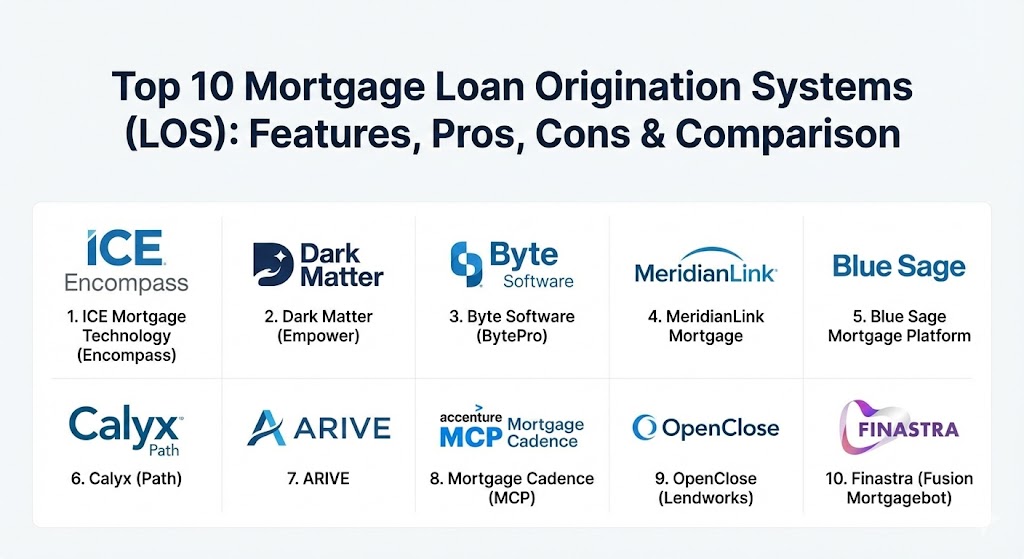
Top 10 Mortgage Loan Origination Systems (LOS) Tools
1 — ICE Mortgage Technology (Encompass)
Encompass remains the dominant force in the mortgage industry, known for its “all-in-one” approach. It is a highly comprehensive system that covers the entire loan lifecycle and offers the deepest integration network in the business.
- Key features:
- Extensive automation via the Encompass Lending Platform API.
- Native integration with the ICE PPE (Product and Pricing Engine).
- Advanced compliance checks integrated directly into the workflow.
- Comprehensive document management and eClosing capabilities.
- Built-in CRM and POS options for a seamless borrower experience.
- Real-time reporting and business intelligence dashboards.
- Support for Retail, Wholesale, and Correspondent channels.
- Pros:
- The most widely used platform, making it easy to find experienced staff.
- Unrivaled third-party partner network for credit, appraisal, and title.
- Cons:
- Known for being slower and more complex to configure than newer cloud-native tools.
- Total cost of ownership can be very high for smaller lenders.
- Security & compliance: SOC 2 Type II, GLBA compliant, AES-256 encryption, and full audit logs for every user action.
- Support & community: Massive user community (Experience Conference), dedicated account managers for enterprise clients, and an extensive online training portal.
2 — Dark Matter (Empower)
Empower is a high-volume, enterprise-level LOS that focuses on “lights-out” automation. It is designed for large lenders who want to automate as much of the origination process as possible to reduce the human touchpoints.
- Key features:
- Exception-based processing engine to highlight only files needing human review.
- Native task management that triggers automated workflows.
- Seamless integration with MSP (Mortgage Servicing Platform).
- Real-time data validation against investor guidelines.
- Built-in eSign and eDelivery modules.
- Configurable business rules for tiered underwriting.
- Pros:
- Incredible scalability for massive institutions.
- Strong focus on reducing the “cost to produce” through automation.
- Cons:
- Implementation can be a long, multi-month process.
- The user interface is functional but can feel “heavy” for non-power users.
- Security & compliance: ISO 27001, SOC 2, and rigorous data residency controls.
- Support & community: High-touch enterprise support with dedicated implementation teams and regular regional user groups.
3 — Byte Software (BytePro)
BytePro is a favorite among mid-market lenders and credit unions who prioritize efficiency and ease of customization. It is known for being lightweight yet powerful enough to handle complex loan scenarios.
- Key features:
- User-defined fields and custom macro creation.
- Advanced validation tools to catch errors before submission.
- Native support for wholesale and retail channels.
- Integrated document imaging and paperless workflow.
- Comprehensive secondary marketing and shipping modules.
- Easy integration with most third-party POS systems.
- Pros:
- Extremely flexible; users can create their own custom data tracking easily.
- Very fast system performance compared to heavier legacy platforms.
- Cons:
- Does not have as many “out-of-the-box” native integrations as Encompass.
- The interface looks slightly dated, though it is highly functional.
- Security & compliance: SOC 2, HIPAA (for relevant data), and MISMO-compliant data exports.
- Support & community: Excellent documentation and highly praised US-based customer support.
4 — MeridianLink Mortgage (formerly LendingQB)
MeridianLink Mortgage is a cloud-native LOS that emphasizes a “best-of-breed” philosophy, allowing lenders to plug and play with their preferred third-party vendors.
- Key features:
- Open API architecture for custom integrations.
- Browser-based interface accessible from any device.
- Automated document recognition and indexing.
- Integrated Price Discovery and lock management.
- Highly configurable workflow milestones.
- Strong focus on the borrower’s digital journey.
- Pros:
- Modern, intuitive UI that requires less training for new employees.
- Great flexibility for lenders who want to build their own “tech stack.”
- Cons:
- Lacks some of the “built-in” features found in all-in-one suites.
- Reporting can be complex to set up for highly specialized data sets.
- Security & compliance: SOC 2, GDPR (if applicable), and SSO integration.
- Support & community: Strong online knowledge base and dedicated onboarding specialists.
5 — Blue Sage Mortgage Platform
Blue Sage is a modern, digital-first platform built on a browser-based architecture. It is designed to handle the entire process—from POS to LOS—on a single, unified codebase.
- Key features:
- Unified POS and LOS data stream (no data re-entry).
- Automated compliance engine with real-time feedback.
- Cloud-native architecture for high-speed performance.
- Built-in eClosing and remote online notarization (RON) support.
- Real-time pricing and automated underwriting feedback.
- Mobile-responsive design for loan officers in the field.
- Pros:
- Eliminates the “sync issues” between a separate POS and LOS.
- Very modern look and feel that appeals to digital-native loan officers.
- Cons:
- Newer to the market; integration library is still growing.
- Lacks the historical enterprise track record of ICE or Dark Matter.
- Security & compliance: SOC 2 Type II, AES encryption, and multi-factor authentication (MFA).
- Support & community: Direct access to engineering teams for enterprise clients; focus on agile updates.
6 — Calyx (Path)
Path by Calyx is a highly flexible, cloud-based LOS designed to provide banks and credit unions with a managed, compliant environment that is easy to navigate.
- Key features:
- Managed compliance (Calyx handles the regulatory updates).
- Role-based workflows to streamline user tasks.
- Integrated Fannie Mae and Freddie Mac connectivity.
- Dynamic document generation based on loan data.
- Centralized data management for multi-branch operations.
- Automated fee management and disclosure tracking.
- Pros:
- Reduces the administrative burden of keeping the system compliant.
- Very straightforward learning curve for staff.
- Cons:
- Less “extensible” than platforms with an open API focus.
- Customization is more limited compared to BytePro or Encompass.
- Security & compliance: SOC 2, GLBA, and encrypted data backups.
- Support & community: Extensive library of video tutorials and a dedicated client support portal.
7 — ARIVE
ARIVE is a modern, cloud-based LOS specifically designed for mortgage brokers and small-to-midsize wholesale lenders. It has gained massive popularity for its modern UI and affordable pricing.
- Key features:
- All-in-one POS, LOS, and PPE (Pricing Engine).
- Wholesale lender integration (direct pulls of lender rates).
- Automated document collection and e-signing.
- Loan officer landing pages and borrower portals.
- Real-time pipeline management for broker shops.
- Credit report and VOE/VOI integrations.
- Pros:
- The best choice for independent brokers who want a modern “tech-forward” brand.
- Eliminates the need for multiple separate subscriptions.
- Cons:
- Not designed for large retail banks or complex servicing needs.
- Lacks the heavy customization required for non-conforming, niche lending.
- Security & compliance: SOC 2, HIPAA readiness, and bank-level data encryption.
- Support & community: Active Facebook user group and very responsive chat-based support.
8 — Mortgage Cadence (MCP)
Owned by Accenture, Mortgage Cadence Platform (MCP) is an enterprise-grade, cloud-based solution that offers a highly customizable and scalable experience for large lenders.
- Key features:
- Single database for all loan channels (Retail, Wholesale, Correspondent).
- Highly configurable user interface (UI) to match brand identity.
- Seamless “Collaboration Center” for third-party service providers.
- Advanced analytics and forecasting tools.
- Built-in document imaging and workflow automation.
- Native integration with major servicing platforms.
- Pros:
- Backed by Accenture’s massive consulting and professional services power.
- Offers a “white-label” feel that large banks often desire.
- Cons:
- Pricing is generally at the top of the market.
- Implementation requires a significant internal or consultant team.
- Security & compliance: ISO 27001, SOC 2, GDPR, and rigorous global security standards.
- Support & community: Dedicated enterprise support teams and executive-level account management.
9 — OpenClose (Lendworks)
OpenClose is a multi-channel LOS that prides itself on being a “pure-SaaS” platform, offering high speed and a low administrative footprint for lenders.
- Key features:
- Decisioning engine that works across all channels.
- Built-in PPE (Product and Pricing Engine).
- Automated disclosure generation and tracking.
- Social media and CRM integration.
- Mobile-friendly borrower portal and LO tools.
- Native vendor management for appraisals and credit.
- Pros:
- Fast “time to market” compared to legacy systems.
- The built-in pricing engine is very strong and reduces third-party costs.
- Cons:
- UI can feel a bit traditional compared to Blue Sage or ARIVE.
- Integration depth for niche fintech tools is still catching up.
- Security & compliance: SOC 2, GLBA, and AES-256 encryption.
- Support & community: High-quality documentation and personalized onboarding support.
10 — Finastra (Fusion Mortgagebot)
Finastra’s Mortgagebot is a highly respected LOS among community banks and credit unions, known for its strong compliance and integration with broader core banking systems.
- Key features:
- Seamless integration with Fusion Digital Banking.
- End-to-end origination from application to secondary market.
- Automated compliance engine with real-time audit trails.
- Configurable workflows for different loan products (CONV, FHA, VA).
- Integrated document management and secure delivery.
- Strong reporting for HMDA and CRA requirements.
- Pros:
- The best choice for lenders already using the Finastra banking ecosystem.
- Very strong track record for regulatory compliance and audit readiness.
- Cons:
- Can feel “rigid” for lenders who want to experiment with highly custom workflows.
- Not as focused on the wholesale or broker channels.
- Security & compliance: SOC 1/2/3, ISO 27001, and HIPAA compliance.
- Support & community: Global support network and a structured “Finastra University” for training.
Comparison Table
| Tool Name | Best For | Platform(s) Supported | Standout Feature | Rating (Gartner / TrueReview) |
| Encompass | High Volume / All-in-One | Windows / Cloud | Partner Ecosystem | 4.3 / 5 |
| Empower | Massive Enterprises | Cloud / SaaS | “Lights-out” Automation | 4.2 / 5 |
| BytePro | Mid-Market / Custom | Windows / Cloud | User-Defined Fields | 4.6 / 5 |
| MeridianLink | “Best-of-Breed” Stacks | Cloud / Browser | Open API Architecture | 4.1 / 5 |
| Blue Sage | Digital-First Lenders | Cloud / Browser | Unified POS/LOS Code | 4.5 / 5 |
| Path | Banks / Credit Unions | Cloud / SaaS | Managed Compliance | 4.0 / 5 |
| ARIVE | Independent Brokers | Cloud / Browser | Native Wholesale PPE | 4.8 / 5 |
| MCP | White-Label / Large Bank | Cloud / SaaS | Collaboration Center | 4.2 / 5 |
| OpenClose | Multi-Channel / Speed | SaaS / Browser | Built-in Pricing Engine | 4.3 / 5 |
| Mortgagebot | Community Banks | SaaS / Browser | Core Banking Integration | 4.1 / 5 |
Evaluation & Scoring of Mortgage Loan Origination Systems (LOS)
Choosing an LOS requires a weighted approach based on long-term ROI and operational stability.
| Category | Weight | Evaluation Criteria |
| Core Features | 25% | Application intake, pricing, underwriting, and closing doc generation. |
| Ease of Use | 15% | Intuitiveness for loan officers and the learning curve for new processors. |
| Integrations | 15% | Depth of connections to credit, appraisals, title, and secondary markets. |
| Security & Compliance | 10% | SOC 2 status, encryption, and speed of regulatory logic updates. |
| Performance | 10% | System uptime, page load speeds, and API responsiveness. |
| Support | 10% | Onboarding quality, help desk speed, and user community resources. |
| Price / Value | 15% | Per-loan costs vs. efficiency gains and eliminated 3rd party tool costs. |
Which Mortgage Loan Origination Systems (LOS) Tool Is Right for You?
The “right” tool depends more on your business model than the software’s feature list.
- Solo Users & Small Brokers: For the independent broker, ARIVE is currently the undisputed leader. Its all-in-one pricing (POS/LOS/PPE) and direct connections to wholesale lenders make it unbeatable for small shops that need to look big and move fast.
- Small to Mid-Market Lenders (SMB): If you have a dedicated operations team but want to avoid the massive overhead of Encompass, BytePro offers the best customization for the price. If you prefer a more modern, cloud-first experience, MeridianLink Mortgage provides a great balance of power and flexibility.
- Mid-Market to Enterprise: For lenders with 50+ loan officers, Encompass is the standard for a reason. Its vast network means you can automate almost any vendor interaction. However, if your focus is strictly on retail digital origination, Blue Sage offers a cleaner, more modern codebase.
- Large Enterprises & Banks: Empower and Mortgage Cadence are built for the heavy lifting of thousands of loans per month. If you are a bank that wants to minimize IT risk, Finastra (Mortgagebot) provides the safest path by integrating with your core banking system.
- Budget-conscious vs. Premium: ARIVE and BytePro are generally more budget-friendly. Encompass and Empower are premium solutions that require significant capital but provide a “forever” platform that scales to infinite volume.
Frequently Asked Questions (FAQs)
1. What is the difference between a POS and an LOS?
The POS (Point of Sale) is the borrower-facing “front end” where they fill out the application. The LOS is the “back end” where the lender processes, underwrites, and funds the loan. Many modern tools now combine both.
2. Can I switch LOS platforms easily?
No. Switching an LOS is like a heart transplant for a mortgage company. It requires months of data mapping, staff training, and vendor re-integration. It is a decision that should be made for a 5-to-10-year horizon.
3. Do LOS platforms handle TRID compliance automatically?
Most do, but the level of automation varies. Top-tier tools like Encompass and Path have “hard stops” that prevent a loan from moving forward if a disclosure timing requirement hasn’t been met.
4. How much does a Mortgage LOS cost?
Pricing is usually a mix of a monthly base fee plus a “per-click” or “per-funded-loan” fee. Small shops might pay $500–$1,000/month, while large lenders pay hundreds of thousands in annual licensing.
5. What is MISMO, and why does my LOS need to support it?
MISMO is the industry-standard data format. Your LOS must support it so you can seamlessly send loan data to Fannie Mae, Freddie Mac, and other investors without data corruption.
6. Is cloud-based LOS safer than on-premise?
In 2026, yes. Cloud providers like AWS and Azure (used by MeridianLink and Blue Sage) offer security and redundancy that most private lenders cannot afford to maintain on their own servers.
7. Can these systems handle specialized loans like VA or USDA?
Yes, but check the “Form” library. Most major LOS platforms have native support for FHA, VA, and USDA forms, including the automated underwriting connections for each.
8. Do I need a separate pricing engine (PPE) with my LOS?
Some platforms (like ARIVE and OpenClose) have them built-in. Others (like Encompass) have native integrations, but you may still pay a separate fee for the pricing data.
9. How does AI improve a modern LOS?
AI is now used for “automated document indexing” (knowing a PDF is a W-2 without a human looking at it) and “income calculation,” which significantly speeds up the underwriting process.
10. What is a “Correspondence Channel” in an LOS?
This is a module that allows a lender to buy completed loans from other smaller lenders. Not all LOS platforms support this; Encompass and Mortgage Cadence are the leaders in this niche.
Conclusion
The Mortgage LOS market in 2026 is a battle between legacy depth and cloud-native agility. While Encompass continues to hold the largest market share due to its massive integration network, newer players like Blue Sage and ARIVE are winning over lenders who prioritize speed and a modern user experience. Ultimately, the best LOS is the one that reduces your “cost to produce” while keeping you perfectly compliant. Before committing, lenders should perform a deep “workflow audit” to ensure the software matches their actual day-to-day operations rather than just a demo-day feature list.