Introduction
Reinsurance Management Tools are enterprise software solutions designed to automate the lifecycle of reinsurance contracts. These platforms handle everything from treaty definition and placement to technical accounting, claims recovery, and regulatory reporting. At their core, they serve as a single source of truth for an insurer’s outwards reinsurance program (the risk they give away) and an inward reinsurance program (the risk they take on).
The importance of these tools cannot be overstated. Without a dedicated system, insurers frequently suffer from “leakage”—unrecovered claims that go unnoticed because the manual tracking of thousands of policies against multiple layers of reinsurance is prone to human error. Modern tools solve this by providing real-time calculations and automated “bordering” (reporting). When choosing a platform, evaluation criteria should include the ability to handle multi-currency transactions, support for both Life and P&C (Property & Casualty) business lines, robust audit trails, and the flexibility to integrate with existing Policy Administration Systems (PAS).
Best for: Large multi-national carriers, mid-sized insurers managing complex risk structures, MGAs (Managing General Agents) with significant capacity arrangements, and professional reinsurers. It is especially vital for roles such as Reinsurance Accountants, Actuaries, and Compliance Officers.
Not ideal for: Small, local insurance agencies that do not cede risk or those whose reinsurance needs are extremely basic (e.g., a simple 10% quota share on a single line of business). In those cases, the built-in modules of a standard policy admin system or even basic financial software may be sufficient.
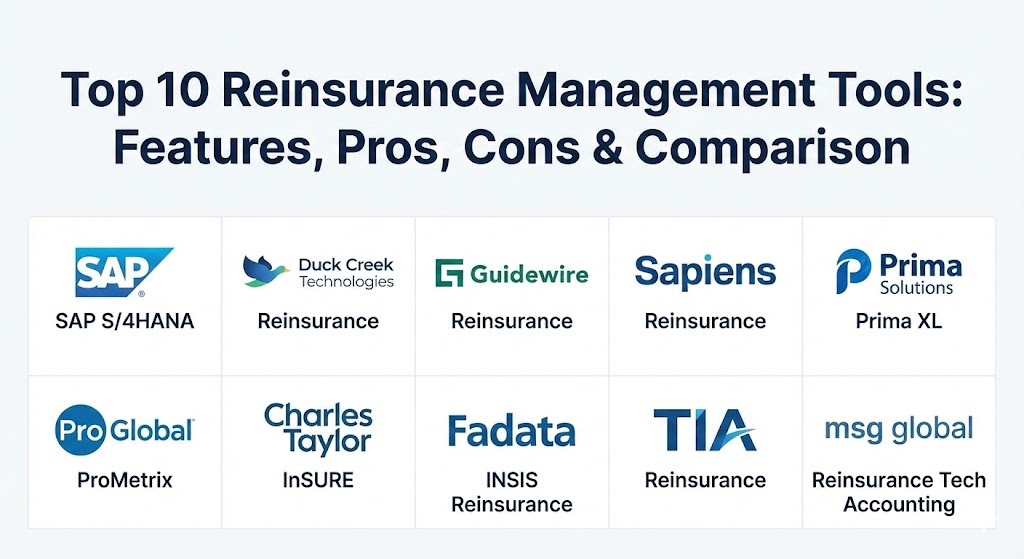
Top 10 Reinsurance Management Tools
1 — SAP S/4HANA for Reinsurance Management (FS-RI)
SAP is the heavyweight champion of the enterprise world, and its FS-RI module is designed for massive carriers that require deep integration with their financial core. It is built to handle the highest levels of complexity in both inward and outward reinsurance.
- Key features:
- Full lifecycle management for both treaty and facultative business.
- Highly automated technical accounting and settlement processes.
- Multi-currency and multi-GAAP (Generally Accepted Accounting Principles) support.
- Deep integration with SAP General Ledger for real-time financial reporting.
- Advanced calculation engine for proportional and non-proportional programs.
- Robust auditing capabilities to satisfy global regulatory bodies.
- Native support for IFRS 17 compliance.
- Pros:
- Unmatched scalability; if your organization is global and multi-billion dollar, this tool can handle it.
- Eliminates data silos by living within the broader SAP ecosystem.
- Cons:
- Implementation is a major project that requires significant time, budget, and specialized consultants.
- The user interface can feel traditional and “dense” compared to modern cloud-native startups.
- Security & compliance: SOC 1/2, ISO 27001, GDPR compliant, and built-in SSO with granular role-based access controls.
- Support & community: World-class enterprise support; a massive global ecosystem of implementation partners and a dedicated user community via SAP SAPPHIRE.
2 — Duck Creek Reinsurance
Duck Creek has redefined the reinsurance space with a cloud-native approach that emphasizes agility. Formerly known as CedeRight, this tool is designed for insurers who want to move away from legacy debt and adopt a more modern, flexible interface.
- Key features:
- Automated cession processing across all lines of business.
- Real-time tracking of reinsurance recoveries to eliminate leakage.
- Strategic “What-If” scenario modeling for program optimization.
- Seamless integration with Duck Creek Policy and Claims modules.
- Intuitive dashboards for monitoring aggregate limits and exposures.
- Automated billing and statement generation for reinsurers.
- Comprehensive reporting suite for internal and external stakeholders.
- Pros:
- Extremely user-friendly interface that reduces the time needed for training.
- Cloud-first architecture ensures regular updates without painful manual upgrades.
- Cons:
- Best utilized when already within the Duck Creek ecosystem; standalone integration can be complex.
- Can be expensive for smaller carriers due to the premium cloud-service model.
- Security & compliance: SOC 2 Type II, HIPAA, GDPR, and AES-256 encryption for data at rest and in transit.
- Support & community: High-quality documentation and a growing “Duck Creek University” for user certification and training.
3 — Guidewire Reinsurance Management
Guidewire is a household name in the P&C industry. Its reinsurance module is part of the InsuranceSuite, focusing on providing a seamless transition between policy administration and risk cession.
- Key features:
- Embedded reinsurance logic within the underwriting workflow.
- Automatic identification of facultative requirements at the point of sale.
- Centralized treaty management with flexible rule-based engines.
- Integration with Guidewire ClaimCenter for automated recovery triggers.
- Scalable architecture for high-volume transaction processing.
- Multi-language and multi-currency capabilities for global deployments.
- Pros:
- The integration between PolicyCenter and Reinsurance Management is arguably the best in the industry.
- Strong focus on operational efficiency and reducing manual touches.
- Cons:
- The software is highly proprietary; moving away from it later can be difficult.
- Implementation cycles are typically long, consistent with major core transformations.
- Security & compliance: ISO 27001, SOC 1/2, and GDPR. Built for enterprise-grade security standards.
- Support & community: Extensive partner network and a very active “Guidewire Community” portal for troubleshooting and best practices.
4 — Sapiens Reinsurance
Sapiens offers a comprehensive, standalone solution that is particularly strong in the European and international markets. It is designed to manage the entire range of reinsurance activities for both General Insurance and Life sectors.
- Key features:
- Comprehensive support for complex Excess of Loss (XOL) and Stop Loss treaties.
- Dedicated module for Life & Annuity reinsurance.
- Automated calculation of unearned premium reserves (UPR).
- Sophisticated technical accounting with automated reconciliation.
- Built-in compliance tools for Solvency II and IFRS 17.
- Flexible API architecture for connecting to third-party data sources.
- Pros:
- One of the few platforms that handles both Life and P&C with equal depth.
- Excellent “technical accounting” capabilities that please finance teams.
- Cons:
- Onboarding can be technical; requires a solid understanding of reinsurance logic.
- Not as much of a “household name” in the North American market compared to SAP or Guidewire.
- Security & compliance: GDPR, ISO 27001, and SOC 2. Encryption is standard for all database layers.
- Support & community: Strong localized support in Europe and Asia; documentation is thorough but highly technical.
5 — Prima XL (by Prima Solutions)
Prima XL is a cloud-based reinsurance software used by carriers, brokers, and reinsurers. It is known for its versatility and its ability to act as a “hub” for diverse data sources.
- Key features:
- Centralized repository for all reinsurance documents and contracts.
- Automated calculation of retrocessions (reinsurance for reinsurers).
- Intuitive “Treaty Builder” for configuring complex layers.
- Real-time alert system for limit breaches or claim triggers.
- Advanced analytics for measuring program profitability.
- Secure portal for sharing data with external auditors and partners.
- Pros:
- Highly flexible; can be configured for virtually any type of reinsurance arrangement.
- Very strong reporting tools that allow for customized, granular views of risk.
- Cons:
- The breadth of features can be overwhelming for smaller teams.
- Configuration requires a high level of expertise in the Prima-specific logic.
- Security & compliance: SOC 2, GDPR, and ISO 27001. Features robust audit logs that track every change to a contract.
- Support & community: Provides a dedicated customer success manager for enterprise accounts and a comprehensive online help center.
6 — ProMetrix (by Pro Global)
Pro Global is a specialist in the insurance services space, and ProMetrix is their technology answer to the challenges of technical accounting and claims management in reinsurance.
- Key features:
- Focus on data quality and the elimination of “spreadsheet risk.”
- Specialized tools for managing legacy and run-off portfolios.
- Automated technical accounting and cash call management.
- Detailed claims tracking with integrated document management.
- Strategic reporting for regulatory and board-level oversight.
- Pros:
- Excellent for organizations dealing with complex legacy data or mergers/acquisitions.
- The tool is built by people who perform reinsurance outsourcing, so the logic is very practical.
- Cons:
- Less focus on the “front-end” underwriting side of the business.
- The user interface is more functional than modern/sleek.
- Security & compliance: ISO 27001, GDPR, and strong emphasis on data residency requirements.
- Support & community: Boutique-style support; you often deal with reinsurance experts rather than just software support staff.
7 — Charles Taylor InSURE
Charles Taylor is a global provider of professional services to the insurance market. Their InSURE platform is a modular suite where the reinsurance component is particularly robust for MGAs and specialty carriers.
- Key features:
- Modular design allowing you to buy only the reinsurance piece if needed.
- Native support for Lloyd’s of London market standards and messaging.
- Automated calculation of commissions and brokerage fees.
- Real-time visibility into “aggregates” across various geographic zones.
- Cloud-native deployment for rapid scaling.
- Pros:
- Best-in-class for those operating within the Lloyd’s or London Market ecosystems.
- Modular approach makes it more “digestible” for growing mid-market companies.
- Cons:
- Documentation can be fragmented across the different modules.
- Integration with non-Charles Taylor core systems requires custom API work.
- Security & compliance: Cyber Essentials Plus, ISO 27001, and GDPR compliant.
- Support & community: Global presence ensures 24/7 support availability for critical issues.
8 — Fadata (INSIS Reinsurance)
Fadata’s INSIS platform is a leading core system in Europe and emerging markets, offering a highly modular reinsurance component that is praised for its logical structure.
- Key features:
- Unified data model for both direct insurance and reinsurance.
- Support for proportional and non-proportional treaties.
- Automated cession calculations based on complex risk-sharing rules.
- Comprehensive claims recovery management.
- Regulatory reporting templates for Solvency II.
- Pros:
- Very strong “out-of-the-box” functionality for standard treaty structures.
- The modularity allows for a phased implementation approach.
- Cons:
- Customizing the system for very “exotic” reinsurance structures can be difficult.
- User community in the US is smaller than that of Guidewire or Duck Creek.
- Security & compliance: ISO 27001, GDPR, and regular third-party vulnerability assessments.
- Support & community: Strong European support network and a structured onboarding program for new clients.
9 — TIA Technology (TIA Reinsurance)
TIA is a veteran in the insurance software space. Its reinsurance module is designed to provide a “single source of truth” by keeping reinsurance data tightly coupled with policy and claims data.
- Key features:
- Automated calculation of premiums, commissions, and claims.
- Rule-based cession engine that handles multi-layer programs.
- Integrated document management for contract storage.
- Standardized reports for financial and regulatory compliance.
- Support for both outward and inward reinsurance.
- Pros:
- Highly stable and reliable; many customers have used TIA for decades.
- Very clear audit trails for every transaction.
- Cons:
- The system can feel a bit rigid compared to newer, low-code platforms.
- Updates can be slower than cloud-native competitors.
- Security & compliance: ISO 27001 and GDPR. Standard SSO and role-based permissions are included.
- Support & community: Well-established support processes and a dedicated “TIA Professional Services” team for upgrades.
10 — msg global (Reinsurance Technical Accounting)
Working closely with the SAP ecosystem, msg global provides specialized tools that enhance the technical accounting and “nitty-gritty” processing of reinsurance.
- Key features:
- Deep focus on technical accounting and financial closing.
- Automated processing of bordereaux (detailed reports).
- Sophisticated validation rules to ensure data accuracy before posting.
- High-performance processing for large data volumes.
- Seamless bridge between insurance operations and the general ledger.
- Pros:
- Essential for SAP users who need more “surgical” control over their reinsurance accounting.
- The team is composed of deep reinsurance domain experts.
- Cons:
- Very niche; not a “full-suite” PAS for companies looking for an all-in-one tool.
- Heavily reliant on the existence of an SAP or similar enterprise environment.
- Security & compliance: SOC 2, ISO 27001, and GDPR.
- Support & community: Excellent technical support; strong partnership with SAP ensures long-term viability.
Comparison Table
| Tool Name | Best For | Platform(s) Supported | Standout Feature | Rating (Gartner Peer Insights) |
| SAP FS-RI | Global Enterprise | On-prem / Cloud | ERP Core Integration | 4.5 / 5 |
| Duck Creek | Modern Agile Teams | Cloud (SaaS) | Agility & UI Design | 4.6 / 5 |
| Guidewire | Guidewire Users | Cloud (SaaS) | Policy-to-Risk Linkage | 4.7 / 5 |
| Sapiens | Multi-Line (Life/P&C) | Cloud / Hybrid | Life Reinsurance Depth | 4.4 / 5 |
| Prima XL | Flexibility / Brokers | Cloud (SaaS) | Multi-Source Data Hub | 4.5 / 5 |
| ProMetrix | Legacy / Run-off | Cloud / Hybrid | Technical Accounting | 4.3 / 5 |
| Charles Taylor | London Market / MGAs | Cloud (SaaS) | Lloyd’s Market Support | 4.2 / 5 |
| Fadata INSIS | Emerging Markets | Cloud / Hybrid | Unified Data Model | 4.1 / 5 |
| TIA Technology | Stability / Core Users | On-prem / Cloud | Transaction Reliability | 4.0 / 5 |
| msg global | SAP Tech Accounting | Cloud / Hybrid | Bordereau Processing | 4.4 / 5 |
Evaluation & Scoring of Reinsurance Management Tools
Choosing a reinsurance tool requires a balance between technical depth and operational ease. Below is our scoring rubric based on industry standards.
| Category | Weight | Evaluation Criteria |
| Core Features | 25% | Treaty/Facultative support, technical accounting, and claims recovery automation. |
| Ease of Use | 15% | Intuitive UI, dashboarding, and ease of building new treaties. |
| Integrations | 15% | API availability and native connections to General Ledgers and PAS systems. |
| Security | 10% | Data encryption, audit trails, SSO, and SOC 2/ISO compliance. |
| Performance | 10% | Processing speed for large-scale “bordering” and high-volume cessions. |
| Support | 10% | Global availability, quality of documentation, and technical expertise. |
| Price / Value | 15% | Total cost of ownership relative to the reduction in “leakage.” |
Which Reinsurance Management Tool Is Right for You?
The right choice depends on your starting point and your ultimate destination.
- Solo Users vs SMB vs Enterprise: If you are a large carrier already using SAP or Guidewire, staying within that ecosystem is usually the path of least resistance. However, if you are a mid-market carrier looking for a standalone solution, Prima XL or Sapiens offer high-end features without requiring a full ERP overhaul.
- Budget-conscious vs Premium: Duck Creek and Guidewire are premium, high-cost solutions that provide immense value through automation. If budget is a constraint, looking at modular systems like Charles Taylor or specialized accounting tools like ProMetrix can provide the necessary compliance at a lower entry point.
- Feature Depth vs Ease of Use: If your primary pain point is complex “technical accounting,” SAP or msg global are the masters. If your pain point is that your underwriters find reinsurance too confusing, Duck Creek’s modern UI is the winner.
- Integration and Scalability: Cloud-native platforms (Duck Creek, Prima XL) are the easiest to scale globally. If you have significant legacy debt or are managing “run-off” business, the specialized legacy management of ProMetrix is invaluable.
- Security and Compliance: If your primary driver is IFRS 17 or Solvency II compliance, Sapiens and SAP have the most robust, built-in regulatory reporting frameworks.
Frequently Asked Questions (FAQs)
1. What is “leakage” in reinsurance, and how does software stop it?
Leakage occurs when an insurer pays a claim but forgets to bill their reinsurer for their share because the contract was managed on a spreadsheet. Software stops this by automatically matching every claim to the relevant reinsurance layers and alerting the user to bill the reinsurer.
2. Can these tools handle IFRS 17?
Most modern reinsurance tools (like SAP and Sapiens) have built-in modules specifically designed for IFRS 17. They provide the necessary data granularity and discounting calculations required by the new standard.
3. Is it better to use a module from my Policy Admin System (PAS) or a standalone tool?
A PAS module is easier to integrate but often lacks the depth for complex treaties. A standalone tool is more powerful but requires a solid API connection to your policy and claims data.
4. How long does a typical implementation take?
For a mid-sized insurer, a standalone implementation can take 6 to 12 months. Large enterprise transformations (SAP/Guidewire) can take 18 to 24 months.
5. Do these tools support both Life and P&C business?
Some do (like Sapiens and SAP), while others are specialized. It is crucial to verify this, as Life reinsurance (long-term, actuarial-based) is fundamentally different from P&C (short-term, event-based).
6. What is “Technical Accounting” in this context?
Technical accounting is the specific process of managing premiums, commissions, and claims between the insurer and the reinsurer. It involves high-volume, multi-currency reconciliations that are too complex for standard accounting software.
7. Are these tools hosted on-premise or in the cloud?
The industry is moving rapidly toward the cloud (SaaS), with Duck Creek and Prima XL leading the way. However, many legacy systems (SAP, TIA) still offer on-premise or hybrid options for high-security environments.
8. Can a broker use these tools?
Yes, many brokers use platforms like Prima XL or Charles Taylor to manage the placement and administration of reinsurance on behalf of their clients.
9. How do these tools handle “Facultative” vs. “Treaty” reinsurance?
A “Treaty” is a broad contract covering many policies, while “Facultative” covers a single, specific risk. Good software automates the treaty cessions while allowing manual “fac” placements to be tracked alongside them.
10. What is a “Bordereau”?
A bordereau is a detailed report of premiums or claims sent from the insurer to the reinsurer. Modern tools automate the creation of these reports, which used to take days of manual Excel work.
Conclusion
Managing reinsurance without a dedicated tool in 2026 is akin to trying to fly a jumbo jet with a paper map. The complexity of modern risk, combined with the strict demands of IFRS 17, means that automation is no longer optional. Whether you choose the massive enterprise power of SAP, the cloud-native agility of Duck Creek, or the specialized technical accounting of ProMetrix, the goal remains the same: accuracy, compliance, and the elimination of unrecovered claims. The “best” tool is the one that fits your specific lines of business and integrates most cleanly with your existing financial data.