Introduction
Demand planning tools are sophisticated software solutions designed to predict future customer demand and align supply chain operations accordingly. Unlike basic spreadsheets that rely on simple historical averages, modern demand planning platforms leverage advanced statistical algorithms, artificial intelligence (AI), and machine learning (ML) to process vast datasets. These tools analyze historical sales, market trends, seasonal patterns, and external causal factors like weather or economic shifts to generate highly accurate forecasts.
The importance of these tools lies in their impact on the bottom line. By providing a clearer picture of future requirements, they help organizations reduce stockouts (lost sales), minimize excess inventory (tied-up capital), and optimize production schedules. Real-world use cases range from a fashion retailer predicting the next seasonal trend to a pharmaceutical company ensuring life-saving medications are available across global clinics. When evaluating tools in this category, users should look for forecast accuracy, ease of integration with existing ERP systems, the ability to perform “what-if” scenario modeling, and collaborative features that allow sales and operations teams to align their goals.
Best for: Supply chain managers, demand planners, and operations leads in medium to large-scale enterprises. It is particularly vital for companies in retail, fast-moving consumer goods (FMCG), manufacturing, and automotive sectors where inventory complexity is high.
Not ideal for: Service-based businesses that do not hold physical inventory, or very small “mom-and-pop” shops where manual tracking of a handful of SKUs is sufficient. It may also be overkill for businesses with perfectly stable, non-fluctuating demand that requires no predictive analysis.
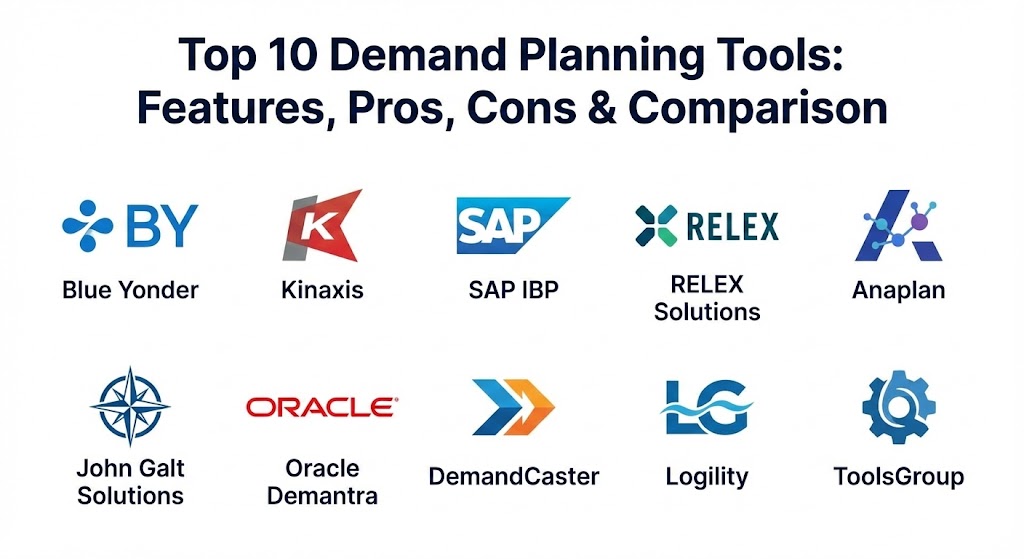
Top 10 Demand Planning Tools
1 — Blue Yonder (Luminate Planning)
Blue Yonder is a global leader in digital supply chain transformations. Its Luminate Planning suite uses a “digital twin” approach to provide end-to-end visibility and autonomous forecasting powered by a deep AI engine.
- Key features:
- AI-driven demand forecasting that adapts to real-time market shifts.
- Autonomous “What-If” scenario analysis for supply chain disruptions.
- Integration of external data like weather, social media trends, and news.
- Collaborative S&OP (Sales and Operations Planning) workflows.
- Seamless synchronization between demand, supply, and retail planning.
- Probabilistic forecasting to manage uncertainty and risk.
- Pros:
- Industry-leading AI accuracy that significantly reduces manual touches.
- Highly scalable for massive, multi-national SKU portfolios.
- Cons:
- High total cost of ownership (TCO) makes it inaccessible for smaller firms.
- Implementation is a major undertaking that requires specialized consultants.
- Security & compliance: SOC 2 Type II, ISO 27001, GDPR, and HIPAA compliant. High-level encryption and SSO support.
- Support & community: Extensive global support network, a dedicated user portal, and a massive community of supply chain experts.
2 — Kinaxis RapidResponse
Kinaxis is renowned for its “concurrent planning” architecture. It breaks down silos between different departments, allowing everyone in the supply chain to see how a change in demand impacts production and logistics instantly.
- Key features:
- Concurrent planning that updates all supply chain nodes simultaneously.
- Rapid scenario modeling that provides results in seconds, not hours.
- Automated exception management to flag potential stockouts early.
- Collaborative environment for demand, supply, and inventory teams.
- Multi-tier visibility into supplier networks.
- Built-in machine learning for sensing demand signals.
- Pros:
- The speed of its calculation engine is unmatched for “what-if” planning.
- Excellent for highly volatile industries like high-tech and aerospace.
- Cons:
- The user interface has a steeper learning curve than some modern SaaS tools.
- Requires high-quality data input to realize its full concurrent potential.
- Security & compliance: SOC 2, ISO 27001, GDPR, and FedRAMP authorized for government use.
- Support & community: Strong professional services, Kinaxis Learning Center, and a very active “Knowledge Network.”
3 — SAP IBP (Integrated Business Planning)
SAP IBP is a cloud-based solution that extends the power of the SAP ecosystem. It is designed for companies already using SAP S/4HANA who want a natively integrated, high-performance planning environment.
- Key features:
- Deep, native integration with SAP ERP and S/4HANA systems.
- Microsoft Excel-based front end for user familiarity and ease of use.
- Advanced demand sensing to capture short-term market changes.
- Comprehensive Sales and Operations Planning (S&OP) module.
- Inventory optimization based on multi-echelon logic.
- Real-time supply chain monitoring via the Digital Boardroom.
- Pros:
- If you are an SAP shop, the integration benefits are unbeatable.
- The Excel interface makes adoption much easier for traditional planners.
- Cons:
- Can be rigid if your business processes don’t align with “the SAP way.”
- Licensing can be complex and expensive as you add more modules.
- Security & compliance: ISO 27001, SOC 1/2, GDPR, and various local data residency certifications.
- Support & community: Massive global ecosystem of partners, SAP Community forums, and 24/7 enterprise support.
4 — RELEX Solutions
RELEX is a specialist in the retail and grocery sectors. Its platform is built to handle the extreme complexity of perishable goods and high-frequency retail promotions.
- Key features:
- Unified retail planning (Demand, Merchandising, and Supply).
- Specific logic for managing shelf-life and freshness in grocery.
- Automated promotional forecasting and cannibalization analysis.
- AI-driven space and floor planning integration.
- Real-time “living” forecasts that update with every transaction.
- Advanced workforce planning based on predicted store traffic.
- Pros:
- Outstanding results for the grocery sector in reducing food waste.
- Very fast implementation compared to traditional legacy systems.
- Cons:
- Less focused on heavy industrial manufacturing or complex engineering.
- The tool’s UI is specialized for retail, which may confuse industrial users.
- Security & compliance: SOC 2 Type II, GDPR, and ISO 27001. Data is encrypted in transit and at rest.
- Support & community: High-touch customer success model with a focus on localized retail expertise.
5 — Anaplan
Anaplan is a “Connected Planning” platform that functions like a highly sophisticated, multi-dimensional spreadsheet on steroids. It is known for its extreme flexibility and modular design.
- Key features:
- “Hyperblock” engine that allows for massive, complex calculations.
- Multi-dimensional modeling that connects Finance, HR, and Supply Chain.
- User-built “Apps” or models tailored to specific business needs.
- Robust collaborative features with real-time data entry.
- Integration with major data lakes and BI tools.
- Flexible workflow and approval hierarchies.
- Pros:
- Total flexibility; you can build exactly the model your business needs.
- Excellent for aligning demand planning with financial budgeting.
- Cons:
- Requires a dedicated “Anaplanner” or specialist to build and maintain models.
- High build effort compared to “out-of-the-box” demand tools.
- Security & compliance: ISO 27001, SOC 2, HIPAA, and GDPR. Robust SSO and RBAC features.
- Support & community: Large partner network and the “Anaplan Community” for sharing best practices and models.
6 — John Galt (Atlas Planning Platform)
John Galt Solutions provides the Atlas Planning Platform, a highly scalable and resilient solution that has become a favorite for mid-market and enterprise companies alike.
- Key features:
- End-to-end supply chain visibility from raw materials to end-users.
- AI-powered demand sensing that filters out “noise” from the data.
- Automated inventory optimization and replenishment logic.
- Advanced S&OP and IBP (Integrated Business Planning) workflows.
- Multi-enterprise collaboration for working with suppliers and partners.
- High-speed, in-memory processing for scenario testing.
- Pros:
- Exceptional customer service and a focus on long-term partnerships.
- Easier to deploy and manage than the “big three” legacy vendors.
- Cons:
- Lacks the massive global marketing presence of SAP or Oracle.
- Some advanced visualization features require higher-tier licensing.
- Security & compliance: SOC 2, GDPR, and high-standard encryption protocols.
- Support & community: Strong focus on customer success with a dedicated “Knowledge Base” and training academy.
7 — Oracle Demantra
Oracle Demantra is a traditional powerhouse in the statistical forecasting world. While it is now part of Oracle’s broader cloud suite, it remains a favorite for organizations that need deep statistical rigor.
- Key features:
- Sophisticated Bayesian statistical models for high-accuracy forecasting.
- Real-time sales and operations planning (S&OP).
- Trade promotion management and optimization.
- Deductive logic for new product introductions (NPI).
- Settlement and deduction management for retail.
- Seamless integration with Oracle E-Business Suite and JD Edwards.
- Pros:
- One of the most robust statistical engines available.
- Proven track record in complex consumer goods environments.
- Cons:
- The interface can feel dated and clunky compared to modern SaaS.
- Implementation often requires significant technical resources.
- Security & compliance: ISO 27001, SOC 2, and comprehensive Oracle cloud security frameworks.
- Support & community: Extensive global support and a massive community of Oracle users worldwide.
8 — DemandCaster
DemandCaster (now part of Plex/Rockwell Automation) is a cloud-native solution designed specifically for SMBs and mid-market manufacturers who need professional planning without extreme complexity.
- Key features:
- Direct integration with mid-market ERPs like NetSuite and Microsoft Dynamics.
- Automated demand forecasting and inventory optimization.
- Sales and Operations Planning (S&OP) templates.
- Distribution requirements planning (DRP).
- Capacity planning and master production scheduling.
- User-friendly dashboards for tracking planning health.
- Pros:
- Very fast time-to-value; can be up and running in weeks.
- Highly affordable for companies transitioning away from Excel.
- Cons:
- Lacks the deep AI/ML capabilities of high-end enterprise platforms.
- Not suitable for massive, multi-billion dollar global conglomerates.
- Security & compliance: SOC 2 Type II, GDPR, and standard cloud encryption.
- Support & community: Responsive technical support and a library of self-service training videos.
9 — Logility (Digital Supply Chain Platform)
Logility focuses on the “Digital Supply Chain,” providing a visual and intuitive platform that helps planners make better decisions through advanced visualization.
- Key features:
- AI-driven demand sensing and shaping.
- Multi-echelon inventory optimization (MEIO).
- Sourcing and sustainability tracking built into the planning layer.
- Advanced analytics for identifying “hidden” supply chain risks.
- Collaborative workflows for internal and external stakeholders.
- Automated replenishment and production planning.
- Pros:
- Beautiful, modern UI that planners actually enjoy using.
- Strong focus on ethical and sustainable supply chain planning.
- Cons:
- Pricing is on the higher end for the mid-market.
- Some users find the configuration of complex models to be tedious.
- Security & compliance: ISO 27001, SOC 2, and GDPR compliant.
- Support & community: “Logility University” provides extensive training; strong global support presence.
10 — ToolsGroup (Service Optimizer 99+)
ToolsGroup is unique because it focuses on “Service Level Optimization.” It is designed for companies that need to maintain extremely high availability of parts or products while minimizing inventory.
- Key features:
- Probabilistic demand forecasting that handles intermittent demand well.
- Multi-echelon inventory optimization (MEIO) to balance stock across sites.
- Automated “machine-learning” for identifying seasonality.
- Trade promotion optimization for retail users.
- S&OP and production planning modules.
- Specific logic for spare parts and aftermarket service.
- Pros:
- Best-in-class for managing “slow-moving” or intermittent SKUs.
- Exceptional at hitting “99% service level” targets without overstocking.
- Cons:
- The underlying math can be a “black box” that is hard for some users to trust.
- Less focus on the “financial” side of planning compared to Anaplan.
- Security & compliance: SOC 2, GDPR, and ISO 27001.
- Support & community: Strong expert-led support and a growing community of “Reliability” focused planners.
Comparison Table
| Tool Name | Best For | Platform(s) Supported | Standout Feature | Rating (Gartner Peer Insights) |
| Blue Yonder | Large Global Enterprise | Cloud / SaaS | Autonomous AI Engine | 4.6 / 5 |
| Kinaxis | Disruptive Industries | Cloud / SaaS | Concurrent Planning | 4.7 / 5 |
| SAP IBP | SAP Ecosystem Users | Cloud / SaaS | Native S/4HANA Sync | 4.5 / 5 |
| RELEX | Retail & Grocery | Cloud / SaaS | Perishables Management | 4.8 / 5 |
| Anaplan | Connected Finance/Ops | Cloud / SaaS | Multi-dimensional Modeling | 4.6 / 5 |
| John Galt | Mid-to-Enterprise | Cloud / SaaS | Customer Success Focus | 4.7 / 5 |
| Oracle Demantra | Deep Statistics | Hybrid / Cloud | Bayesian Logic Engine | 4.2 / 5 |
| DemandCaster | Mid-Market / SMB | Cloud / SaaS | Fast ERP Integration | 4.5 / 5 |
| Logility | Visual/Ethical Supply | Cloud / SaaS | Sustainability Tracking | 4.4 / 5 |
| ToolsGroup | High Service Levels | Cloud / SaaS | Probabilistic Forecasting | 4.6 / 5 |
Evaluation & Scoring of Demand Planning Tools
To provide an objective perspective, we have scored these tools based on seven critical factors for supply chain success.
| Category | Weight | Evaluation Criteria |
| Core Features | 25% | Forecast accuracy (AI/ML), scenario modeling, and S&OP depth. |
| Ease of Use | 15% | UI intuitiveness, dashboard quality, and the learning curve. |
| Integrations | 15% | Connectivity with major ERPs (SAP, Oracle, NetSuite) and data lakes. |
| Security & Compliance | 10% | Data encryption, SOC 2, GDPR, and SSO support. |
| Performance | 10% | Calculation speed, system uptime, and concurrency handling. |
| Support | 10% | Documentation quality, speed of support, and community size. |
| Price / Value | 15% | Licensing cost relative to efficiency gains and inventory reduction. |
Which Demand Planning Tool Is Right for You?
Selecting a tool is not about finding the “best” software on paper, but finding the right fit for your organization’s technical maturity and business goals.
- Solo Users vs. SMBs: If you are a small growing business, look at DemandCaster. It offers professional-grade planning that integrates directly with mid-market ERPs without requiring a multi-million dollar budget or a team of data scientists.
- Mid-Market Companies: For companies that have outgrown Excel and need a partner who will help them scale, John Galt (Atlas) and Logility are standout choices. They offer a balance of power and approachability that is ideal for growing operations.
- Large Enterprises: If you are a global conglomerate with thousands of employees, the “heavy hitters” like Blue Yonder or Kinaxis are essential. Their ability to manage millions of SKUs and simulate complex global disruptions is worth the high investment.
- Budget-Conscious vs. Premium: DemandCaster is the budget-friendly professional choice. Blue Yonder and Kinaxis are premium solutions that provide a higher “top end” for those who can afford it.
- Industry Specifics: If you are in grocery or high-turnover retail, RELEX is non-negotiable—its perishability logic is unmatched. If you manage an airline or automotive service center with millions of “slow-moving” spare parts, ToolsGroup is your best bet.
- ERP-Centric: If your organization is “Blue-Blooded SAP,” moving to SAP IBP is the most logical path for data integrity. Similarly, Oracle users should start with Oracle Demantra.
Frequently Asked Questions (FAQs)
1. Is demand planning the same as forecasting?
No. Forecasting is a calculation based on historical data. Demand planning is a broader process that takes the forecast and adds human intelligence, market signals, and strategic goals to create a consensus plan.
2. Can these tools replace a demand planner?
No. While AI-driven tools like Blue Yonder can automate many routine forecasts, the human planner is still needed to manage exceptions, understand strategic shifts, and collaborate with sales and marketing.
3. How long does it take to implement demand planning software?
For a mid-market tool, implementation usually takes 3 to 6 months. For a massive enterprise rollout of SAP IBP or Blue Yonder, it can take 12 to 18 months.
4. Will this software integrate with my current ERP?
Most modern SaaS planning tools are “ERP agnostic” and connect via APIs or pre-built connectors to major systems like NetSuite, SAP, Oracle, and Microsoft Dynamics.
5. How much accuracy improvement can I expect?
Companies transitioning from Excel to professional tools typically see a 10% to 25% improvement in forecast accuracy, which translates to millions in inventory savings.
6. Do I need a data scientist to run these tools?
Generally, no. Modern tools like Logility and John Galt are designed for supply chain professionals. However, some tools like Anaplan require specialized training to “build” the environment.
7. Can these tools handle “New Product Introductions” (NPI)?
Yes. Advanced tools use “attribute-based forecasting” to find similar past products and create a baseline for a new item that has no historical data.
8. What is “Multi-Echelon Inventory Optimization” (MEIO)?
MEIO is a feature in tools like ToolsGroup that balances inventory across the entire supply chain (factory, warehouse, store) rather than just looking at each location in isolation.
9. Is cloud-based software secure enough for supply chain data?
Yes. Modern SaaS providers use bank-level encryption and are audited to SOC 2 and ISO 27001 standards, which is often more secure than a typical company’s on-premise server.
10. What is a “What-If” scenario?
This is a simulation where you change a variable (e.g., “What if a major supplier goes on strike?” or “What if a hurricane hits Florida?”) to see how it impacts your inventory and ability to meet demand.
Conclusion
The evolution of demand planning tools from simple calculators to autonomous AI platforms has fundamentally changed how businesses operate. Choosing the right tool is a journey of aligning your company’s scale, industry, and budget with a software partner that understands your unique challenges.
Whether you prioritize the visual elegance of Logility, the retail-specific power of RELEX, or the concurrent speed of Kinaxis, the goal is the same: clarity in a chaotic market. Remember that the “best” tool is the one that your team will actually use—focus on adoption and data quality, and the ROI will follow.