Introduction
A Supply Chain Control Tower is a centralized hub that integrates data from across an entire supply chain ecosystem—including suppliers, manufacturers, carriers, and warehouses—into a single, unified view. Unlike basic tracking dashboards, a true control tower platform utilizes Artificial Intelligence (AI) and Machine Learning (ML) to not only “see” disruptions but also to predict their downstream impacts and recommend (or execute) corrective actions. It acts as a layer of “decision intelligence” that sits atop existing ERP and TMS systems.
The importance of these platforms has skyrocketed due to the increasing complexity of multi-tier global networks. Key real-world use cases include managing port congestion by rerouting shipments in transit, optimizing inventory levels across multiple echelons to prevent stockouts, and coordinating ESG (Environmental, Social, and Governance) compliance across thousands of sub-tier suppliers. When choosing a platform, evaluation criteria should include the breadth of the carrier network, the depth of AI-driven prescriptive analytics, ease of integration with legacy stacks, and the ability to support “what-if” scenario modeling.
Best for: Large-scale enterprises with complex, multi-modal global supply chains; logistics directors aiming for end-to-end visibility; and procurement roles focused on multi-tier risk management in industries like high-tech, automotive, pharma, and retail.
Not ideal for: Small businesses with localized sourcing and simple distribution models; organizations that lack the data maturity to feed a control tower; or companies looking for a standalone “quick fix” without the willingness to integrate disparate internal systems.
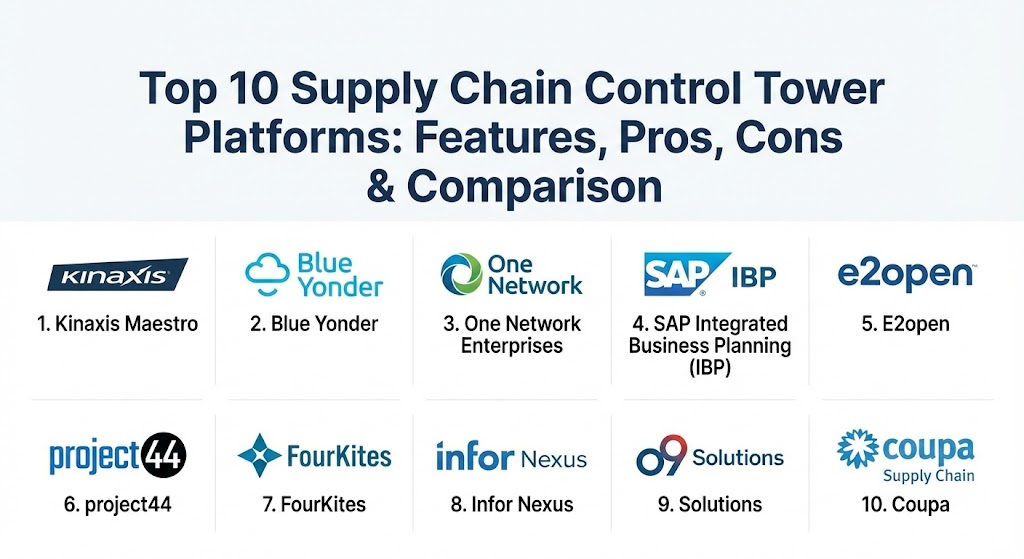
Top 10 Supply Chain Control Tower Platforms
1 — Kinaxis Maestro
Kinaxis Maestro (formerly RapidResponse) is a leader in concurrent planning and control tower capabilities. It is designed for enterprises that need to bridge the gap between long-term strategic planning and immediate operational execution.
- Key features:
- Concurrent Planning: Synchronizes demand, supply, and inventory in real-time.
- AI-Driven Anomaly Detection: Identifies deviations from the plan before they escalate.
- What-If Scenario Modeling: Allows users to simulate the impact of disruptions in seconds.
- Automated Exception Handling: Suggests resolutions for common supply chain “hiccups.”
- Multi-Tier Visibility: Tracks deep into the sub-supplier network.
- Collaborative Workflows: Integrated communication tools for cross-functional teams.
- Pros:
- Exceptionally fast processing speed for complex “what-if” scenarios.
- High user adoption due to the “Excel-like” but powerful interface.
- Cons:
- Can be expensive for organizations with lower revenue.
- Requires high data quality from the outset to be truly effective.
- Security & compliance: SOC 2 Type II, GDPR, HIPAA, and ISO 27001 compliant. Supports SSO and end-to-end encryption.
- Support & community: Extensive “Kinaxis Academy” for training; robust user group community; 24/7 global enterprise support.
2 — Blue Yonder (Luminate Control Tower)
Blue Yonder’s Luminate Control Tower is a cloud-native platform that leverages the Microsoft Azure ecosystem. It focuses on end-to-end orchestration, from the first mile to the last mile.
- Key features:
- Sensing & Responding: Real-time visibility combined with AI-based prescriptive alerts.
- Virtual Assistant (Alaia): An AI interface that helps users navigate data via natural language.
- Unified Data Model: Consolidates data from WMS, TMS, and ERP systems.
- ML-Based ETAs: Highly accurate arrival predictions for all transport modes.
- Dynamic Tiering: Moves inventory between nodes based on real-time demand shifts.
- ESG Tracking: Monitors the carbon footprint of transportation routes.
- Pros:
- Deep integration with Microsoft tools and broad industrial ecosystems.
- Strong emphasis on the “last mile” and retail fulfillment.
- Cons:
- Implementation can be a lengthy process for multi-national rollouts.
- Some advanced modules require separate licensing, increasing TCO.
- Security & compliance: ISO 27001, SOC 2, FedRAMP (select versions), and GDPR compliant.
- Support & community: Global support network; extensive partner ecosystem for implementation and custom development.
3 — One Network Enterprises (Intelligent Control Tower)
One Network is unique for its “Multi-Party Network” architecture, which treats all participants in the supply chain as part of a single, collaborative grid.
- Key features:
- NEO AI Agents: Autonomous agents that resolve supply-demand imbalances.
- Single Version of Truth: All partners see the same data in real-time.
- Global Available-to-Promise: Real-time inventory visibility across the entire network.
- Multi-Echelon Inventory Optimization (MEIO): Optimizes stock across all tiers.
- Integrated Logistics & Planning: Merges TMS functions with supply planning.
- Blockchain Integration: Optional ledger for high-security transaction tracking.
- Pros:
- Best-in-class for true “multi-tier” collaboration where suppliers also use the tool.
- Reduced latency because data doesn’t need to be “passed” between systems.
- Cons:
- The user interface is functional but can feel “industrial” compared to modern SaaS.
- Onboarding thousands of small suppliers can be a logistical challenge.
- Security & compliance: FedRAMP authorized, SOC 2, HIPAA, and GDPR compliant.
- Support & community: Strong federal and defense-sector support; comprehensive developer network.
4 — SAP Integrated Business Planning (IBP)
SAP IBP offers a control tower module that is the natural choice for organizations already deeply embedded in the SAP S/4HANA ecosystem.
- Key features:
- Real-Time Integration: Direct connection with SAP ERP master and transactional data.
- Exception-Based Monitoring: Dashboards that highlight only the critical issues.
- Supply Chain Map: Geographic visualization of the entire network health.
- Intelligent Alerts: AI-based notifications that prioritize issues by financial impact.
- Case Management: Integrated tracking for resolution of supply chain disruptions.
- Collaboration via SAP Jam: Built-in social collaboration for planners.
- Pros:
- Seamless “plug-and-play” with other SAP modules.
- Highly reliable and trusted by the world’s largest Fortune 500 companies.
- Cons:
- Can be rigid; customizing workflows outside the SAP “standard” is difficult.
- Integration with non-SAP systems (competitor ERPs) can be complex.
- Security & compliance: ISO 27001, SOC 1/2, GDPR, and rigorous internal audit logs.
- Support & community: Massive global community; thousands of certified consultants; SAP Enterprise Support.
5 — E2open (Intelligent Control Tower)
E2open is a massive platform built through the acquisition of various best-of-breed logistics tools, resulting in a comprehensive end-to-end network.
- Key features:
- Harmony Platform: A unified interface for planning, logistics, and global trade.
- Multi-Tier Discovery: Automatically maps sub-tier supplier relationships.
- Global Trade Management: Built-in compliance for cross-border shipping.
- Demand Sensing: Uses point-of-sale data to refine short-term forecasts.
- Logistics Orchestration: Direct management of carriers and freight spend.
- Massive Partner Network: Connections to over 400,000 carriers and suppliers.
- Pros:
- Unrivaled breadth; covers everything from trade compliance to carrier booking.
- “Overlay” capability allows it to sit on top of multiple disparate ERPs.
- Cons:
- The platform can feel “modular” rather than “unified” due to its history of acquisitions.
- Implementation requires significant data mapping across different modules.
- Security & compliance: SOC 2, HIPAA, GDPR, and ISO 27001. Advanced encryption for B2B data.
- Support & community: Professional services focus; extensive technical documentation; annual user conference.
6 — project44 (Movement)
Project44 is the industry leader in real-time transportation visibility (RTTV). Its “Movement” platform has evolved into a decision intelligence control tower for global shipping.
- Key features:
- High-Fidelity Tracking: Real-time GPS and ELD data across all modes (Ocean, Air, Road).
- Port Intel: Detailed visibility into port congestion and terminal status.
- AI Disruption Navigator: Predicts the impact of weather or strikes on ETAs.
- Inventory-in-Transit: Tracks down to the SKU level while goods are moving.
- Freight Audit & Settlement: Automates payment and dispute resolution.
- Carrier Connectivity Center: Tools to onboard and manage carrier compliance.
- Pros:
- The most accurate and complete transportation data in the market.
- Very easy to use; focuses on actionable visibility rather than complex planning.
- Cons:
- Primarily focused on the “logistics” side; less depth in production planning.
- Relies heavily on carrier participation for data accuracy.
- Security & compliance: SOC 2 Type II, GDPR, and ISO 27001. Strong data privacy for carrier drivers.
- Support & community: Fast-growing community; dedicated customer success managers; extensive API documentation.
7 — FourKites (Intelligent Control Tower)
FourKites is a pioneer in the RTTV space that has rapidly expanded into yard management and inbound logistics orchestration through its Intelligent Control Tower.
- Key features:
- Digital Twin Technology: Creates a living model of the entire physical supply chain.
- AI Agent (Tracy): An AI assistant that automates carrier follow-ups.
- Dynamic Yard: Integrates warehouse and yard operations with inbound shipments.
- OTIF Penalties Mitigation: Proactively alerts users to delivery risks to avoid fines.
- Sustainability Dashboard: Tracks Scope 3 emissions across the carrier network.
- Collaborative Scheduling: Automated appointment booking for warehouses.
- Pros:
- Excellent for CPG and Retail companies obsessed with OTIF (On-Time In-Full) metrics.
- Very intuitive, modern user interface that requires minimal training.
- Cons:
- Smaller sub-tier supplier network compared to One Network or Kinaxis.
- Some deep analytics features require additional “premium” subscriptions.
- Security & compliance: SOC 2, GDPR, and ISO 27001. Features data anonymization for benchmarks.
- Support & community: Active “FourKites University”; strong presence on G2 and Peer Insights; responsive support.
8 — Infor Nexus (Control Center)
Infor Nexus is a business network-based platform that specializes in the orchestration of global trade and financial supply chains.
- Key features:
- Multi-Enterprise Connectivity: Connects buyers, sellers, and banks on one platform.
- Supply Chain Finance: Integrated tools to free up working capital.
- Procure-to-Pay Automation: Digital management of the entire order-to-cash cycle.
- In-Context Decision Support: Provides relevant data alongside every alert.
- ESG and Traceability: Tracks raw materials from source to final product.
- Global TMS Integration: Direct control over international freight movements.
- Pros:
- Strongest choice for companies focusing on “Physical + Financial” supply chain convergence.
- Built for high-compliance industries like footwear, apparel, and electronics.
- Cons:
- The interface can be complex due to the heavy focus on financial and trade data.
- Best suited for global trade; less focus on domestic, local distribution.
- Security & compliance: SOC 1/2, ISO 27001, GDPR, and PCI-DSS compliance for payments.
- Support & community: High-touch enterprise support; localized teams in major global trade hubs.
9 — o9 Solutions (o9 Digital Brain)
The o9 Digital Brain is a modern platform that emphasizes the “Digital Twin” of the business, connecting sales, finance, and operations in a single AI-powered graph.
- Key features:
- Enterprise Knowledge Graph: Maps the relationships between all entities in the supply chain.
- AIOps for Supply Chain: High-level automation for routine planning tasks.
- Market Sensing: Incorporates external data (weather, social trends) into plans.
- Unified Business Planning: Merges S&OP with the control tower view.
- Self-Learning Algorithms: Models that improve accuracy based on historical results.
- Multi-Site Orchestration: Coordinates complex manufacturing across global plants.
- Pros:
- Unmatched AI and graph technology for complex “root cause” analysis.
- Beautifully designed, modern dashboards and visualizations.
- Cons:
- Can be resource-heavy to implement; requires significant data science collaboration.
- A relatively newer player compared to titans like SAP or Blue Yonder.
- Security & compliance: SOC 2, GDPR, and ISO 27001. Strict data isolation for multi-tenant cloud.
- Support & community: Very active “o9 Council” of industry leaders; comprehensive training webinars.
10 — Coupa (Supply Chain Design & Planning)
Following the acquisition of LLamasoft, Coupa has integrated world-class supply chain design with its spend management platform to offer a continuous-design control tower.
- Key features:
- Continuous Design: Merges “designing the network” with “running the network.”
- Cost-to-Serve Analytics: Real-time visibility into the profitability of every order.
- Sourcing Optimization: Links control tower alerts to new sourcing events.
- Risk Scenarios: Pre-built models for supplier bankruptcy or port closures.
- Inventory Policy Design: Automatically adjusts safety stock levels based on volatility.
- Sustainability Scoring: Integrated ESG risk scores for all suppliers.
- Pros:
- The best tool for making “financial + operational” trade-off decisions.
- Powerful for companies that want to rethink their network layout while monitoring it.
- Cons:
- The “Control Tower” is often seen as an extension of the design tool, not a standalone tracker.
- Can be “overkill” for companies that just want simple transportation visibility.
- Security & compliance: SOC 2, HIPAA, GDPR, and PCI-DSS. Heavy focus on procurement security.
- Support & community: Massive “Coupa Community”; extensive library of pre-built supply chain models.
Comparison Table
| Tool Name | Best For | Platform Supported | Standout Feature | Rating (Gartner / TrueReview) |
| Kinaxis Maestro | Concurrent Planning | Cloud (SaaS) | Rapid What-If Simulation | 4.6 / 5 |
| Blue Yonder | End-to-End Retail | Cloud (Azure) | Virtual Assistant (Alaia) | 4.4 / 5 |
| One Network | Multi-Party Collab | Cloud (SaaS) | Multi-Tier AI Agents | 4.5 / 5 |
| SAP IBP | SAP Ecosystem | Cloud (S/4HANA) | Seamless ERP Integration | 4.2 / 5 |
| E2open | Global Trade / Logistics | Cloud (SaaS) | Massive Partner Network | 4.1 / 5 |
| project44 | Ocean/Road Visibility | Cloud (SaaS) | High-Fidelity Tracking | 4.7 / 5 |
| FourKites | OTIF / Yard Mgmt | Cloud (SaaS) | Digital Twin Visibility | 4.6 / 5 |
| Infor Nexus | Supply Chain Finance | Cloud (SaaS) | Financial Integration | 4.3 / 5 |
| o9 Solutions | AI/Knowledge Graphs | Cloud (SaaS) | Digital Brain Modeling | 4.7 / 5 |
| Coupa | Design & Spend Mgmt | Cloud (SaaS) | Continuous Network Design | 4.4 / 5 |
Evaluation & Scoring of Supply Chain Control Tower Platforms
To help you weigh your options, we evaluated these platforms using a weighted scoring rubric designed for enterprise procurement and logistics leaders.
| Category | Weight | Evaluation Criteria |
| Core Features | 25% | Presence of digital twins, real-time alerts, scenario modeling, and AI/ML. |
| Ease of Use | 15% | Intuitiveness of dashboards, mobile accessibility, and learning curve. |
| Integrations | 15% | API availability, native ERP/TMS connectors, and partner network size. |
| Security | 10% | SOC 2/ISO compliance, data encryption, and SSO/IAM support. |
| Performance | 10% | Latency of data updates, processing speed for scenarios, and uptime. |
| Support | 10% | Quality of documentation, speed of response, and community resources. |
| Price / Value | 15% | Transparency of pricing vs. measurable ROI (downtime/cost reduction). |
Which Supply Chain Control Tower Platform Tool Is Right for You?
Selecting a platform is not a “one size fits all” decision. The right tool depends on your digital maturity and specific business pain points.
- Solo Users vs SMB vs Enterprise:
- Solo/Small Business: Most true Control Towers are designed for enterprises. SMBs should look at lighter visibility tools like project44 or FourKites rather than full planning platforms.
- Mid-Market: E2open or o9 Solutions offer modular approaches that can scale with your growth.
- Enterprise: Kinaxis, Blue Yonder, or One Network are the standard for massive, global operations.
- Budget-Conscious vs Premium Solutions:
- Budget-Conscious: Focus on “Visibility-only” tools first. Project44 provides high ROI without the massive overhead of a full planning suite.
- Premium: Kinaxis and o9 Solutions represent the high end of the market but offer the most significant gains in “autonomous” orchestration.
- Feature Depth vs Ease of Use:
- If you want a beautiful, easy UI, choose FourKites or Limble (in the CMMS space).
- If you need deep, complex logic, SAP IBP or One Network are the heavy lifters.
- Integration and Scalability Needs:
- For an SAP-heavy shop, SAP IBP is the logical choice to minimize integration headaches.
- For a complex multi-ERP environment, Kinaxis or E2open are better at aggregating data from different sources.
- Security and Compliance Requirements:
- For Government/Defense, One Network and SAP have the most established high-security (FedRAMP) environments.
- For Global Trade/Finance, Infor Nexus is the leader in compliance and auditability.
Frequently Asked Questions (FAQs)
1. What is the difference between a “Dashboard” and a “Control Tower”?
A dashboard is static and shows “what happened.” A Control Tower is interactive, real-time, and uses AI to show “what will happen” and “how to fix it.”
2. Can a Control Tower replace my ERP system?
No. A Control Tower sits on top of your ERP. The ERP handles the transactions (buying/selling), while the Control Tower handles the orchestration and decision intelligence.
3. How long does implementation typically take?
For visibility-focused tools, it can be 3–4 months. For full enterprise planning control towers, expect a 6–12 month rollout depending on data complexity.
4. What is “Multi-Tier Visibility”?
It is the ability to see not just your direct suppliers (Tier 1), but also their suppliers (Tier 2) and beyond, helping identify risks deep in the raw material stage.
5. Do I need a team of data scientists to run these?
Modern platforms like Blue Yonder or FourKites use “Low-Code/No-Code” interfaces, so standard supply chain planners can run them without coding knowledge.
6. How do these tools help with sustainability (ESG)?
They track transportation carbon footprints, monitor supplier ethical scores, and help optimize routes to reduce waste and fuel consumption.
7. Is my carrier data shared with competitors?
No. While platforms use aggregated “network data” to provide benchmarks, your specific carrier rates, routes, and volumes are protected by strict data isolation protocols.
8. Can I manage air, ocean, and road freight in one place?
Yes. All the top-tier platforms (project44, E2open, Kinaxis) are “multi-modal,” allowing you to see a shipment change from ship to rail to truck.
9. What is “Autonomous Orchestration”?
It is when the AI identifies a minor issue (like a 2-hour delay) and automatically updates the warehouse schedule or notifies the customer without human intervention.
10. What is the most common reason for Control Tower failure?
Poor data quality. If the data coming from your ERP or your carriers is incorrect, the Control Tower’s AI will provide “garbage-in, garbage-out” recommendations.
Conclusion
A Supply Chain Control Tower is the single most important investment an organization can make to build resilience in a volatile world. Whether you choose the deep planning power of Kinaxis, the massive network of E2open, or the high-fidelity tracking of project44, the objective remains the same: total visibility and rapid action. In the modern economy, the winner isn’t the company with the biggest warehouse, but the one with the fastest and most accurate information.