Introduction
Logistics Visibility Platforms are cloud-native solutions that provide real-time tracking and predictive insights for goods in transit across all modes of transport—road, rail, ocean, and air. By aggregating data via APIs and IoT sensors, these platforms offer end-to-end transparency, allowing businesses to move away from “reactive” firefighting toward “proactive” orchestration. These systems integrate directly with Enterprise Resource Planning (ERP) and Transportation Management Systems (TMS) to automate workflows and improve operational efficiency.
The importance of these platforms lies in their ability to reduce costs associated with detention and demurrage, improve customer satisfaction through accurate ETAs, and enhance supply chain resilience. Key real-world use cases include managing port congestion by diverting shipments in real-time, monitoring temperature-sensitive pharmaceuticals via IoT, and optimizing warehouse labor based on precise truck arrival times. When choosing a platform, users should evaluate the depth of the carrier network, the accuracy of machine-learning-driven ETAs, the ease of integration with existing tech stacks, and the robustness of data security.
Best for: Global shippers, third-party logistics (3PL) providers, and manufacturers with complex, multi-modal supply chains. It is particularly beneficial for logistics managers, supply chain directors, and customer service teams in high-stakes industries like automotive, retail, and life sciences.
Not ideal for: Small, local businesses with limited shipping volumes or those relying on a single carrier who already provides adequate basic tracking. Organizations with very simple “last-mile-only” needs may find a dedicated delivery app more cost-effective than a full enterprise visibility suite.
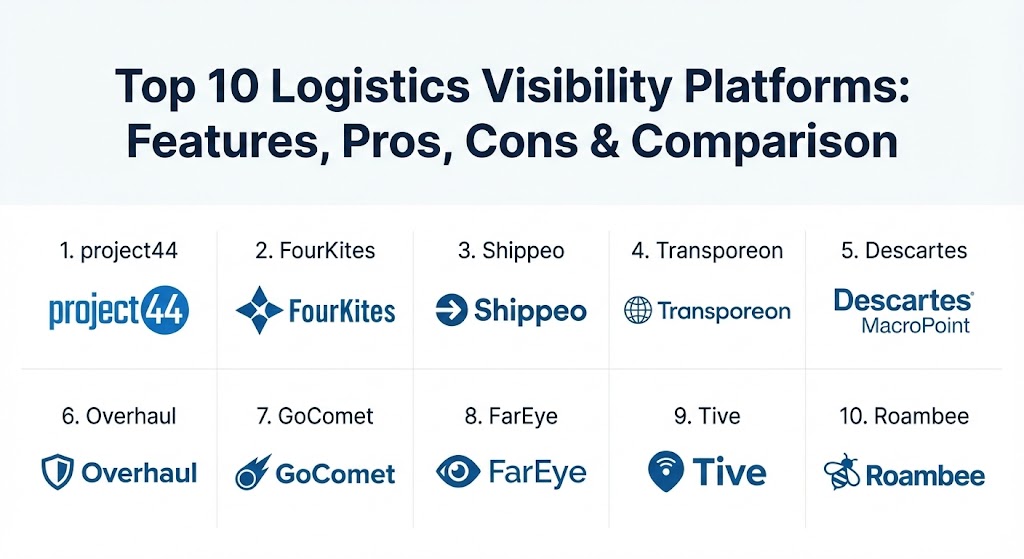
Top 10 Logistics Visibility Platforms
1 — project44 (Movement)
project44 is widely regarded as a market leader, operating a vast global network that serves as the “connective tissue” for the world’s supply chains. Its Movement platform focuses on high-fidelity data and predictive analytics to drive end-to-end visibility.
- Key features:
- High-fidelity, multi-modal tracking across road, rail, ocean, and air.
- Predictive ETAs powered by advanced machine learning models.
- Order-level and SKU-level granular visibility for precise inventory tracking.
- Automated exception management and proactive delay alerts.
- Direct API integrations with thousands of global carriers and telematics providers.
- Sustainability dashboards for monitoring and reporting carbon emissions.
- Integrated yard management and dock scheduling capabilities.
- Pros:
- Unmatched global carrier network density, especially for international ocean and air.
- Highly accurate predictive insights that significantly reduce “check calls” and manual tracking.
- Cons:
- Onboarding can be a complex process for organizations with fragmented legacy data.
- The platform’s extensive feature set may be overwhelming for smaller, less mature logistics teams.
- Security & compliance: SOC 2 Type II, GDPR, ISO 27001, and FIPS 140-2 compliance.
- Support & community: Offers comprehensive 24/7 global support, an extensive help center, and a “Preferred Carrier” program to ensure data quality.
2 — FourKites
FourKites is a global supply chain intelligence platform that focuses heavily on predictive visibility and execution. It is particularly strong in the North American market and offers deep insights into yard and warehouse operations.
- Key features:
- Real-time multi-modal shipment tracking with a patented AI system.
- Integrated Yard Management System (YMS) for dock and gate visibility.
- Sustainable supply chain tools for tracking and reducing carbon footprints.
- Dynamic ETA engine with high accuracy for over-the-road shipments.
- Automated appointment scheduling to streamline warehouse arrivals.
- Carrier performance analytics and benchmarking tools.
- Collaborative workflows for shippers, carriers, and 3PLs to communicate in-app.
- Pros:
- Industry-leading yard management features that bridge the gap between transit and warehouse.
- Highly intuitive user interface that requires less training for frontline staff.
- Cons:
- While expanding rapidly, its international ocean network is sometimes viewed as slightly less robust than project44.
- Some advanced analytics features require higher-tier subscription levels.
- Security & compliance: SOC 2 Type II, HIPAA-ready, GDPR, and ISO 27001 compliance.
- Support & community: Strong emphasis on customer success with dedicated account managers and a vibrant “FourKites Community” for knowledge sharing.
3 — Shippeo
Shippeo is a European-headquartered platform that has gained global recognition for its focus on data quality and sustainable supply chains. It is a preferred choice for organizations requiring high-precision tracking and Transport Process Automation.
- Key features:
- Proprietary machine learning algorithm for industry-leading ETA accuracy.
- Multi-modal visibility covering road, sea, air, and rail.
- Real-time carbon emission monitoring and ESG reporting.
- Transport Process Automation to streamline status updates and documentation.
- Deep integration with over 1,000 TMS, telematics, and ELD systems.
- Specialized visibility tools for the APAC and Mainland China regions.
- Exception management dashboards with proactive disruption alerts.
- Pros:
- Renowned for having the highest “willingness to recommend” scores among users.
- Strongest presence and carrier connectivity in the European and APAC markets.
- Cons:
- North American carrier network is growing but currently less dense than domestic-first rivals.
- Advanced automation workflows may require significant initial configuration.
- Security & compliance: ISO 27001, GDPR, and SOC 2 Type II compliance.
- Support & community: Highly rated technical support team and detailed professional training programs.
4 — Transporeon (Visibility Hub)
Now part of Trimble, Transporeon’s Visibility Hub is an integral part of a larger freight network. It excels at combining transport execution with real-time tracking, making it a “one-stop shop” for many logistics professionals.
- Key features:
- Unified platform for freight procurement, execution, and visibility.
- Real-time truck monitoring with dynamic dock scheduling.
- AI-driven market intelligence for better procurement decisions.
- Multi-modal coverage including a strong focus on European road freight.
- Collaborative platform for seamless carrier and shipper coordination.
- Automated freight settlement and invoice reconciliation.
- Predictive alerts for potential delivery delays and capacity bottlenecks.
- Pros:
- Excellent for companies that want to manage the entire transport lifecycle in one ecosystem.
- Deep penetration in the carrier market, ensuring high data connectivity rates.
- Cons:
- The platform can feel “modular,” and purchasing separate tools can increase total costs.
- Less specialized for “sensor-only” high-value cargo monitoring than niche IoT players.
- Security & compliance: ISO 27001, GDPR, and SOC 2.
- Support & community: Global presence with local support teams and a large network of carriers already on the platform.
5 — Descartes MacroPoint
Descartes MacroPoint leverages one of the world’s largest carrier networks to provide reliable, GPS-based shipment tracking. It is a workhorse for freight brokers and shippers who prioritize broad carrier connectivity and simplicity.
- Key features:
- Real-time GPS-based tracking for truckload, LTL, and ocean shipments.
- Massive network of pre-connected carriers and tracking devices.
- Automated load status updates to eliminate manual check-calls.
- Predictive insights and risk analysis to identify potential delays.
- Compliance and audit-ready reporting for transportation logs.
- Seamless integration with hundreds of TMS and ERP systems.
- Mobile-friendly interface for carriers and drivers.
- Pros:
- “Plug-and-play” simplicity; many carriers are already familiar with and connected to MacroPoint.
- Extremely cost-effective for organizations primarily focused on road freight visibility.
- Cons:
- Lacks the deep AI-driven “decision intelligence” features found in project44 or FourKites.
- Reporting and analytics are functional but less customizable than premium competitors.
- Security & compliance: GDPR, SOC 2, and standard enterprise encryption.
- Support & community: Very responsive customer support and a massive, established user base in the trucking industry.
6 — Overhaul
Overhaul distinguishes itself by focusing on risk management and high-value cargo security. It is the platform of choice for pharmaceutical, tech, and luxury goods companies where the “condition” of the goods is as important as the location.
- Key features:
- Real-time visibility combined with active risk monitoring and theft prevention.
- Incident detection and immediate alerting for route deviations or tampering.
- Compliance monitoring for specialized temperature and shock requirements.
- Route risk analysis based on historical crime and weather data.
- Integrated law enforcement response protocols for stolen cargo.
- Mobile app for real-time driver communication and verification.
- Sophisticated data cleansing to ensure “truthful” visibility.
- Pros:
- Best-in-class for high-security shipments; goes far beyond simple location tracking.
- Excellent customer success teams that act as an extension of the user’s security operations.
- Cons:
- The heavy focus on risk may make it more expensive than needed for low-value, standard commodities.
- Not a standalone “transportation management” tool; requires a companion TMS for full execution.
- Security & compliance: SOC 2 Type II, HIPAA, and GDPR compliance.
- Support & community: Highly personalized support with a focus on mission-critical response times.
7 — GoComet
GoComet is an AI-powered logistics platform that focuses on automating the “unstructured” parts of international logistics. It is particularly strong for international ocean and air freight visibility and freight rate management.
- Key features:
- AI-powered multi-modal tracking with automated updates via machine learning.
- Automated freight rate procurement and benchmarking.
- Integrated invoice reconciliation to prevent overbilling.
- Collaborative dashboards for managing multiple freight forwarders.
- Predictive ETAs for ocean shipments with port congestion tracking.
- Specialized “Container Tracking” tools for global shippers.
- No-code workflow builder for automating logistics procedures.
- Pros:
- High ROI due to the combination of visibility and freight spend management.
- Modern, clean UI that is very easy for logistics coordinators to adopt.
- Cons:
- Domestic trucking visibility is functional but not as deep as the North American giants.
- Smaller carrier network compared to project44 or Descartes.
- Security & compliance: GDPR, ISO 27001, and data encryption.
- Support & community: Rapidly growing community with highly praised customer support and fast onboarding.
8 — FarEye
FarEye is a leading platform that specializes in the complexity of the “last-mile.” While it handles the mid-mile, it is the preferred tool for retailers and delivery-heavy businesses that need to manage the final customer experience.
- Key features:
- Real-time delivery tracking with a focus on the customer-facing experience.
- AI-driven route optimization and dynamic re-routing.
- Automated dispatch and intelligent driver allocation.
- Predictive analytics for last-mile delivery windows.
- Electronic Proof of Delivery (ePOD) and digital documentation.
- Real-time communication portal for customers and drivers.
- Sustainability tracking for electric vehicle and bicycle delivery fleets.
- Pros:
- Unmatched for optimizing the cost and efficiency of local deliveries.
- Significant impact on customer satisfaction scores (NPS) due to precise delivery windows.
- Cons:
- Less focused on long-haul multi-modal “ocean and air” visibility than Shippeo or project44.
- Can be complex to set up for businesses with highly varied, non-standard delivery flows.
- Security & compliance: ISO 27001, GDPR, and SOC 2 Type II.
- Support & community: Strong presence in APAC and Europe with a growing North American support team.
9 — Tive
Tive is an IoT-powered platform that relies on proprietary hardware (trackers) to provide real-time location and condition data. It is essential for shipments where environment monitoring is mandatory.
- Key features:
- Proprietary 5G/LTE IoT trackers for real-time location and condition sensing.
- Monitoring of temperature, humidity, shock, and light exposure.
- Global roaming capabilities for seamless tracking across borders.
- Collaborative “Tive Solo” platform for sharing data with external partners.
- Automated geofencing and arrival/departure alerts.
- Open API for integrating sensor data into existing ERP and TMS systems.
- Chain-of-custody reporting for regulated industries.
- Pros:
- Provides the most “granular” data; you know exactly what happened to your cargo and when.
- Not dependent on carrier data; the sensor provides the “truth” regardless of what the truck says.
- Cons:
- Hardware-dependent model requires the management and retrieval/recycling of trackers.
- Higher per-shipment cost compared to purely software-based visibility.
- Security & compliance: ISO 27001, GDPR, and standard IoT security protocols.
- Support & community: Excellent technical documentation and a “Green Program” for tracker recycling.
10 — Roambee
Roambee is a sensor-driven visibility and intelligence platform that focuses on “Signals” to provide prescriptive insights. It is designed for large enterprises requiring autonomous supply chain monitoring.
- Key features:
- Multi-sensor intelligence for tracking goods and assets worldwide.
- Predictive analytics that anticipate disruptions before they occur.
- Cold-chain monitoring with real-time alerts for temperature excursions.
- Autonomous “Bee” sensors that do not require external infrastructure.
- Integrated platform for managing both in-transit goods and static warehouse assets.
- Condition-based insurance integration for high-value freight.
- Advanced analytics for identifying “lane-level” performance risks.
- Pros:
- High-fidelity data that is ideal for audit trails in the pharmaceutical and food industries.
- Subscription-based “hardware-as-a-service” model simplifies budgeting.
- Cons:
- Like Tive, it requires physical hardware management which adds a layer of operational complexity.
- Analytics focus is heavy on “risk” and “condition,” which may be overkill for standard freight.
- Security & compliance: SOC 2 Type II, GDPR, and ISO 27001 compliance.
- Support & community: Enterprise-focused support with a strong track record in regulated industries.
Comparison Table
| Tool Name | Best For | Platform(s) Supported | Standout Feature | Rating (Gartner / G2) |
| project44 | Global Enterprises | Web, API, Mobile | Multi-Modal Global Network | 4.7 / 5 |
| FourKites | Yard & Dock Optimization | Web, Mobile, IoT | Integrated Yard Management | 4.5 / 5 |
| Shippeo | Data Quality / Sustainability | Web, API, Mobile | ML-Driven ETA Accuracy | 4.8 / 5 |
| Transporeon | Freight Execution + Tracking | Web, API | Trimble Ecosystem Integration | 4.7 / 5 |
| Descartes MacroPoint | Brokerage & Road Freight | Web, Mobile | Carrier Network Density | 4.5 / 5 |
| Overhaul | High-Value / Risk Mgmt | Web, IoT | Real-time Theft Prevention | 4.6 / 5 |
| GoComet | International Ocean / Air | Cloud, SaaS | AI Spend + Visibility Hub | 4.9 / 5 |
| FarEye | Last-Mile / Customer CX | Web, Mobile | Last-Mile Route Optimization | 4.7 / 5 |
| Tive | Environment-Sensitive Cargo | IoT, Cloud | Location + Condition Sensors | 4.6 / 5 |
| Roambee | Autonomous Monitoring | IoT, Cloud | Multi-Sensor Intelligence | 4.5 / 5 |
Evaluation & Scoring of Logistics Visibility Platforms
When selecting a platform, it is crucial to weight features based on your specific operational needs. A “risk-heavy” pharmaceutical company will value security differently than a “volume-heavy” retail chain.
| Category | Weight | Evaluation Criteria |
| Core Features | 25% | Multi-modal tracking, predictive ETAs, alerts, and exception management. |
| Ease of Use | 15% | UI/UX intuitiveness, mobile app maturity, and dashboard customization. |
| Integrations | 15% | ERP/TMS connectivity, API documentation, and carrier network depth. |
| Security & Compliance | 10% | Data encryption, SOC 2 / ISO standards, and regional privacy (GDPR). |
| Performance & Reliability | 10% | Data accuracy (ETA vs Actual), system uptime, and carrier connectivity rates. |
| Support & Community | 10% | Quality of documentation, 24/7 global support, and carrier onboarding help. |
| Price / Value | 15% | Total cost of ownership vs efficiency gains and reduction in manual work. |
Which Logistics Visibility Platforms Tool Is Right for You?
The “best” platform depends on where your specific logistics pain points lie.
- Solo Users vs SMB vs Mid-Market: For smaller teams or those primarily using road freight, Descartes MacroPoint or GoComet offer the best entry point with lower complexity and high ROI.
- Enterprise Giants: If you are managing thousands of shipments across the ocean, air, and land, project44 or FourKites are the standard choices due to their massive networks and advanced analytics.
- Budget-Conscious vs Premium Solutions: If tracking is a “check-the-box” requirement, MacroPoint is a budget-friendly powerhouse. If you need predictive “decision intelligence” and sustainability tracking, premium investments in Shippeo or project44 are justified.
- Feature Depth vs Ease of Use: FarEye offers incredible depth for the last-mile but requires setup. Hanwha WAVE and MacroPoint are known for their rapid “plug-and-play” ease of use.
- Security & Compliance Requirements: If you are moving high-theft electronics or temperature-sensitive medicines, Overhaul, Tive, or Roambee are the only solutions that provide the sensor-level data required for compliance.
Frequently Asked Questions (FAQs)
1. What is the difference between a TMS and a Visibility Platform?
A Transportation Management System (TMS) handles the “execution” (booking, tendering, and invoicing). A Visibility Platform handles the “tracking” and “prediction.” While many platforms now integrate both, visibility platforms focus on real-time data from carriers and sensors.
2. Can these platforms track shipments in real-time?
Yes, though “real-time” varies by mode. For trucking, it’s typically every 15 minutes via GPS or ELD. For ocean freight, it relies on AIS (satellite) and port data. Platforms like Tive provide truly continuous real-time updates via IoT sensors.
3. Do I need to buy sensors for all my shipments?
Not necessarily. Most shipments can be tracked via software integrations (API/EDI) with carriers. Sensors (like Tive or Roambee) are typically reserved for high-value, high-risk, or temperature-controlled goods.
4. How accurate are predictive ETAs?
Modern platforms like Shippeo and project44 claim over 95% accuracy. These models factor in historical lane data, real-time traffic, weather, and port congestion to provide a more accurate arrival time than the carrier’s initial estimate.
5. How long does it take to implement a visibility platform?
A basic setup can take 2-4 weeks, but a full global enterprise implementation with thousands of carriers can take 3-6 months. The timeline mostly depends on the speed of carrier onboarding and TMS integration.
6. Will my carriers actually share their data?
Leading platforms have “carrier success” teams to help with this. Most carriers are willing to share data because it reduces the number of phone calls they receive from shippers asking “where is my truck?”
7. Can these tools help with sustainability (ESG)?
Yes. Platforms like FourKites and Shippeo have specific dashboards that calculate the carbon emissions of your shipments based on mode, distance, and weight, which is essential for modern compliance.
8. What is “Exception Management”?
Instead of watching every shipment, you only get an alert when something is wrong—such as a truck being 2 hours late or a container being stuck at customs. This allow logistics teams to manage by exception rather than monitoring everything.
9. Are these platforms secure from cyber threats?
Top-tier platforms prioritize cybersecurity, using SOC 2 Type II and ISO 27001 standards. They use encrypted APIs to ensure that sensitive shipment data is not exposed to unauthorized parties.
10. Do visibility platforms work in all countries?
Most global platforms have good coverage in North America, Europe, and major Asian ports. However, coverage in Mainland China or remote parts of Africa may require specialized partners or IoT sensors.
Conclusion
Logistics visibility has transitioned from a passive “tracking” function into an active “orchestration” engine. The platforms that have thrived are those that can turn raw, often messy carrier data into clean, actionable insights that impact the bottom line. Whether you prioritize the global network of project44, the yard-level depth of FourKites, or the sensor-based “truth” of Tive, the goal remains the same: eliminating the blind spots in your supply chain. The best tool is the one that fits your specific modal mix and risk profile while offering the scalability to grow with your global ambitions.