Introduction
Airport Operations Management Software is a suite of integrated tools designed to automate and optimize the daily functions of an airport. At its core, it usually revolves around an Airport Operational Database (AODB), which acts as the single source of truth for flight data. Surrounding this are modules for Resource Management Systems (RMS), which assign gates and staff, and Flight Information Display Systems (FIDS), which communicate real-time updates to passengers.
The importance of AOMS lies in its ability to reduce delays and operational costs. By utilizing real-time data and predictive analytics, these tools allow airport managers to anticipate bottlenecks before they happen—such as a sudden influx of diverted flights or a staffing shortage at security checkpoints. Key evaluation criteria for these tools include the ability to support Airport Collaborative Decision Making (A-CDM), cloud-native scalability, ease of integration with airline systems, and the robustness of the billing and revenue management modules.
Best for: Commercial international hubs, regional airports, ground handling agencies, and civil aviation authorities that require high levels of automation to manage high passenger volumes and complex flight schedules.
Not ideal for: Small, private landing strips with minimal daily traffic or general aviation facilities that handle only a few hobbyist flights per week, where manual logs and basic calendar tools are often sufficient.
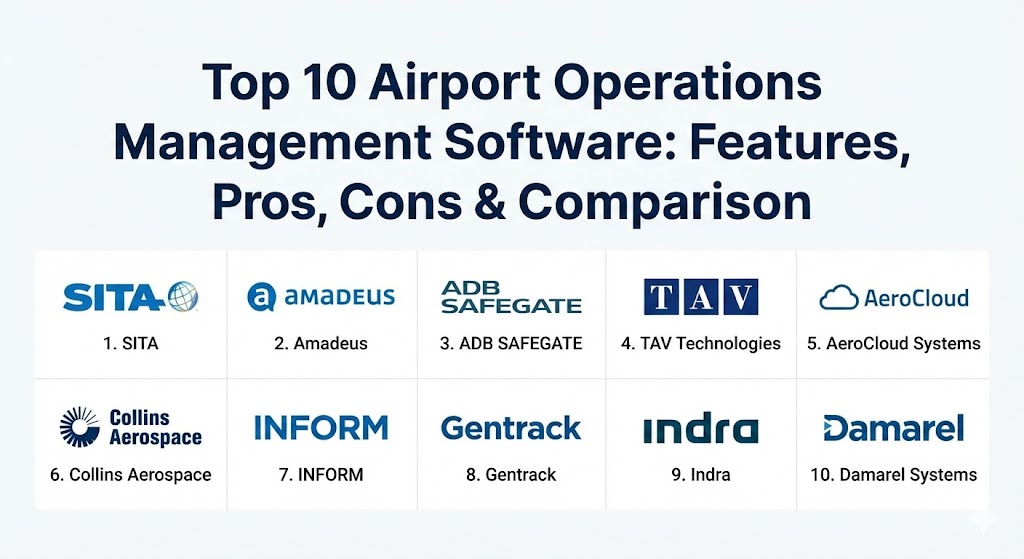
Top 10 Airport Operations Management Software Tools
1 — SITA Airport Management Solution (AMS)
SITA is a global leader in air transport communications and information technology. Their Airport Management Solution is an integrated suite that helps airports manage operations from the airside to the terminal, used by hundreds of airports worldwide.
- Key features:
- Centralized AODB providing a single source of truth for all stakeholders.
- AI-driven Resource Management System for gates, check-in desks, and carousels.
- Comprehensive Flight Information Display System (FIDS) with multi-language support.
- Support for A-CDM to improve air traffic predictability and efficiency.
- Advanced analytics for historical reporting and trend forecasting.
- Automated billing and aeronautical revenue management.
- Pros:
- Unrivaled global presence and deep industry expertise.
- Highly scalable, making it suitable for the world’s largest mega-hubs.
- Cons:
- Implementation can be exceptionally long and complex.
- High total cost of ownership (TCO) compared to newer cloud-native entries.
- Security & compliance: ISO 27001, GDPR, and SOC 2 compliant. Includes robust SSO and role-based access control (RBAC).
- Support & community: 24/7 global support centers, extensive professional services, and a well-established user community with annual conferences.
2 — Amadeus Airport Management
Amadeus offers a modern, cloud-focused approach to airport operations. Their platform is designed to break down the silos between airlines, ground handlers, and airport authorities.
- Key features:
- Cloud-native architecture allowing for rapid deployment and remote access.
- Real-time data synchronization with Amadeus Altea airline systems.
- Sophisticated “What-if” scenario planning for disruption management.
- Mobile-first resource management for ground crews and apron staff.
- Integrated baggage tracking and management modules.
- Automated aeronautical billing with complex contract management.
- Pros:
- Superior integration with airline data, leading to better flight arrival accuracy.
- Modern, intuitive user interface that reduces training time for new staff.
- Cons:
- Performance can be dependent on high-speed internet connectivity for cloud modules.
- Some legacy hardware integrations can be challenging.
- Security & compliance: SOC 2, ISO 27001, and GDPR compliant. Uses high-level encryption for data at rest and in transit.
- Support & community: Comprehensive online training portal, dedicated account management, and extensive technical documentation.
3 — ADB SAFEGATE (AS-Vision)
ADB SAFEGATE is renowned for its airside expertise. Their AS-Vision platform focuses on a holistic view of the airport, connecting the tower, apron, and terminal for maximum throughput.
- Key features:
- Real-time apron management and gate monitoring.
- Integration with airfield lighting and docking systems.
- AODB with advanced filtering and customizable dashboards.
- Resource management focused on turn-around time (TAT) optimization.
- Automated alerts for operational deviations or safety risks.
- Sustainability tracking to monitor and reduce fuel burn on the ground.
- Pros:
- Best-in-class for managing the transition between the runway and the gate.
- Strong focus on safety and reducing ground-level incidents.
- Cons:
- Less focus on passenger-facing terminal features compared to SITA or Amadeus.
- UI can feel more “industrial” and technical than modern SaaS apps.
- Security & compliance: ISO 9001 and ISO 27001 compliant. Detailed audit logs for safety investigations.
- Support & community: Strong engineering-led support with a focus on mission-critical airfield infrastructure.
4 — TAV Technologies Airport Operations Suite
Coming from a background of airport operators, TAV Technologies builds software “by airport people, for airport people.” Their suite is comprehensive and covers every facet of the operation.
- Key features:
- Total Airport Management System (TAMS) integrating AODB, RMS, and FIDS.
- Slot Management and Slot Coordination tools for busy airports.
- Commercial Management module for retail and parking revenue.
- Mobile application for operational staff and management.
- Ground handling management and service level agreement (SLA) tracking.
- Passenger flow monitoring and queue management.
- Pros:
- Deeply practical features based on real-world operator experience.
- Excellent balance between airside efficiency and terminal commercial success.
- Cons:
- Documentation is sometimes criticized for lacking depth in certain modules.
- Smaller third-party developer ecosystem compared to global giants.
- Security & compliance: ISO 27001, GDPR, and support for multi-factor authentication.
- Support & community: Dedicated support teams with experience in physical airport management.
5 — AeroCloud Systems
AeroCloud is a disruptor in the space, offering a 100% cloud-native platform with a unique usage-based pricing model that has gained significant traction among mid-market airports.
- Key features:
- Pure SaaS architecture with no on-site server requirements.
- AI-powered gate management and passenger flow prediction.
- Unlimited user seats included in the standard subscription.
- Real-time gate management via a drag-and-drop interface.
- Integrated FIDS that can run on any smart TV or display.
- Rapid implementation (often weeks instead of months).
- Pros:
- Highly cost-effective; eliminates the need for expensive hardware refreshes.
- The most modern and accessible UI in the AOMS industry.
- Cons:
- Newer to the market; lacks the decades of historical data of SITA.
- May lack some niche “deep” features required by the largest mega-hubs.
- Security & compliance: SOC 2 Type II, GDPR, and Hosted on AWS with high redundancy.
- Support & community: Highly responsive Slack-based support and a modern customer success model.
6 — Collins Aerospace (ARINC Airport Solutions)
Part of the Raytheon Technologies family, Collins Aerospace provides the ARINC suite of tools, which are industry standards for passenger processing and operational efficiency.
- Key features:
- ARINC AirVue for high-fidelity flight information displays.
- ARINC Ops for integrated flight and resource management.
- Self-service biometric passenger processing integrations.
- Reliable data exchange between airlines and airports via the ARINC network.
- Cybersecurity-focused architecture for critical infrastructure.
- Support for remote tower and apron operations.
- Pros:
- Extremely high reliability and uptime—essential for Tier 1 airports.
- Exceptional security posture, meeting government-level requirements.
- Cons:
- The software suite can feel fragmented across different acquisitions.
- Premium pricing reflects its status as a high-end enterprise solution.
- Security & compliance: FIPS 140-2, ISO 27001, SOC 2, and extensive government certifications.
- Support & community: Global 24/7 technical support and professional training academies.
7 — INFORM (GroundStar)
INFORM specializes in optimization and AI. Their GroundStar suite is the gold standard for ground handling and workforce management within the airport environment.
- Key features:
- AI-based real-time staff and equipment scheduling.
- Optimized turn-around management for ground handlers.
- Fleet management and tracking for apron vehicles.
- Hub management for large airlines operating within an airport.
- Detailed cost-benefit analysis tools for resource allocation.
- Service recording and automated billing for ground services.
- Pros:
- The most powerful optimization engine for complex staff rosters.
- Proven to significantly reduce turn-around times and fuel costs.
- Cons:
- Focused primarily on “resources” and “ground” rather than the full AODB.
- Requires high-quality data input to realize the full benefits of the AI.
- Security & compliance: GDPR, ISO 27001, and support for secure API integrations.
- Support & community: Deep technical support with a focus on operations research and mathematical optimization.
8 — Gentrack (Airport 20/20)
Airport 20/20 by Gentrack is a long-standing player known for its strong financial and aeronautical billing capabilities, alongside its core operational database.
- Key features:
- High-performance AODB with real-time flight tracking.
- Aeronautical billing engine that handles complex landing fee structures.
- Resource management for gates, check-in, and stands.
- Passenger information systems and mobile integration.
- Property and lease management for airport tenants.
- Comprehensive reporting for regulatory and financial audits.
- Pros:
- One of the best tools for the “financial” side of airport management.
- Very stable and reliable platform with a loyal customer base.
- Cons:
- The user interface feels dated compared to cloud-native competitors.
- Slower to adopt new features like AI-driven predictive analytics.
- Security & compliance: ISO 27001, GDPR, and standard enterprise audit logging.
- Support & community: Solid support network with particular strength in the Asia-Pacific and European regions.
9 — Indra (InAir)
Indra is a Spanish multinational that provides a wide range of aviation technology, including air traffic control and airport management systems.
- Key features:
- InAir AODB for unified flight data management.
- Integrated RMS for automated resource assignment.
- Collaborative Decision Making (CDM) portal for all airport partners.
- Security management modules including CCTV and access control integration.
- Environmental monitoring for noise and air quality.
- FIDS with integrated advertising and commercial content management.
- Pros:
- Excellent at integrating air traffic control (ATC) data with airport operations.
- Very strong presence in Europe and Latin America.
- Cons:
- Can be difficult to customize without significant developer intervention.
- The platform can feel heavy and “modular,” requiring multiple licenses.
- Security & compliance: ISO 27001, SOC 2, and European aviation safety standards.
- Support & community: Large-scale enterprise support with global reach.
10 — Damarel Systems (FiND)
Damarel is a specialist in passenger processing and ground handling. Their FiND suite is a lightweight but powerful set of tools for smaller to medium-sized airports.
- Key features:
- FiND AODB for simple, effective flight data management.
- NetCheck for low-cost, high-performance check-in.
- L-DCS (Departure Control System) for local flight processing.
- Automated billing based on flight movements and services.
- Statistics and reporting for operational oversight.
- Easy integration with third-party FIDS and RMS.
- Pros:
- Exceptional value for regional airports that don’t need “mega-hub” features.
- Very reliable and requires minimal IT overhead to maintain.
- Cons:
- Lacks the advanced AI and predictive features of SITA or AeroCloud.
- Not designed for airports with extremely high complexity or multi-terminal needs.
- Security & compliance: GDPR compliant and uses standard industry encryption.
- Support & community: Personalized, high-touch support often praised for its “human” approach.
Comparison Table
| Tool Name | Best For | Platform(s) Supported | Standout Feature | Rating (Gartner / TrueReview) |
| SITA AMS | Global Mega-Hubs | On-prem / Hybrid | Global Ubiquity | 4.4 / 5 |
| Amadeus Airport | Cloud Integration | Cloud / SaaS | Airline Data Sync | 4.6 / 5 |
| ADB SAFEGATE | Apron/Tower Sync | On-prem | Airside Safety Logic | 4.3 / 5 |
| TAV Tech Suite | All-in-One Operations | On-prem / Cloud | Operator-Led Design | 4.5 / 5 |
| AeroCloud | Mid-Market SaaS | Pure Cloud | Unlimited User Seats | 4.8 / 5 |
| Collins ARINC | Tier 1 Hubs | Hybrid | ARINC Network Integration | 4.5 / 5 |
| INFORM | Ground Handling | Cloud / On-prem | AI Staff Optimization | 4.7 / 5 |
| Gentrack 20/20 | Financial/Billing | On-prem | Aero-Billing Engine | 4.2 / 5 |
| Indra InAir | ATC Integration | On-prem | ATC-Airport Bridge | 4.2 / 5 |
| Damarel FiND | Regional Airports | On-prem | Departure Control System | 4.4 / 5 |
Evaluation & Scoring of Airport Operations Management Software
Choosing the right AOMS requires balancing the need for deep, mission-critical functionality with the desire for a modern, easy-to-use interface. We have evaluated these tools using the following weighted rubric.
| Category | Weight | Evaluation Criteria |
| Core Features | 25% | Quality of AODB, RMS flexibility, FIDS robustness, and A-CDM support. |
| Ease of Use | 15% | Intuitiveness of dashboards, mobile accessibility, and training requirements. |
| Integrations | 15% | API availability, airline system connectivity, and third-party hardware support. |
| Security & Compliance | 10% | Data encryption, SSO, SOC 2/ISO certifications, and audit logs. |
| Performance | 10% | Uptime records, real-time data processing speed, and latency. |
| Support & Community | 10% | Documentation quality, 24/7 support availability, and user forums. |
| Price / Value | 15% | Implementation costs, licensing model, and hardware requirements. |
Which Airport Operations Management Software Tool Is Right for You?
The “perfect” AOMS depends heavily on your airport’s size, its strategic goals, and your existing technical infrastructure.
- Regional & Small Airports: If you are a smaller airport with a limited IT team, look toward AeroCloud or Damarel FiND. AeroCloud is ideal if you want a modern, subscription-based cloud model, while Damarel is perfect if you need a reliable, on-premise departure control system without the bells and whistles of a mega-hub.
- Large International Hubs: For airports handling 20+ million passengers per year, the legacy and scale of SITA or Collins Aerospace are hard to ignore. These tools are built to handle extreme concurrency and complex multi-terminal environments.
- Ground Handlers & Contractors: If your primary job is managing people and equipment on the apron, INFORM (GroundStar) is the industry leader for optimization. It will likely save you more in labor costs than any other tool on this list.
- Technology & Marketing Forward Airports: If you want to leverage data for passenger experience and marketing, Amadeus or Hubilo (for terminal engagement) are the strongest. Amadeus, in particular, offers the best visibility into airline systems, helping you provide better information to your passengers.
- Budget vs. Premium: AeroCloud offers the most disruptive pricing (unlimited users), whereas SITA and Collins are premium solutions that require significant capital investment but offer long-term stability and high-level government certifications.
Frequently Asked Questions (FAQs)
1. What is an AODB?
The Airport Operational Database (AODB) is the core of any airport management system. it stores and manages all flight-related data (schedules, gate info, aircraft types) and distributes it to other systems like FIDS and RMS.
2. Can these systems help reduce flight delays?
Yes. By using A-CDM (Airport Collaborative Decision Making) modules, these systems allow airports to share data with airlines and ATC. This improves the predictability of arrivals and departures, reducing taxi times and ground delays.
3. Do I need on-site servers for this software?
Not necessarily. Modern tools like Amadeus and AeroCloud are cloud-based, meaning they run on remote servers and you access them via a browser. Legacy systems may still require on-site hardware for low-latency airside functions.
4. How long does implementation take?
For cloud-native solutions, it can take 4–8 weeks. For large-scale enterprise implementations at major hubs, the process can take 12–24 months due to the complexity of integrating with legacy airline and ATC systems.
5. Is the software compatible with all airlines?
Most AOMS tools use standard industry protocols (like IATA messages) to communicate with airlines. However, some tools (like Amadeus) have deeper native integrations with specific airline host systems.
6. Can it manage airport commercial revenue?
Many AOMS suites include modules for aeronautical billing (landing fees) and some (like TAV or Gentrack) include commercial modules for managing retail leases, parking, and concessions.
7. How does the software handle emergencies?
AOMS tools often include “incident management” modes that allow airport managers to quickly reassign gates, update FIDS with emergency messaging, and coordinate with ground services during a crisis.
8. What is the difference between an RMS and a FIDS?
An RMS (Resource Management System) is used by airport staff to assign resources like gates and baggage belts. A FIDS (Flight Information Display System) is the public-facing screen that shows those assignments to passengers.
9. Can small airports afford this technology?
Yes. The shift toward SaaS (Software as a Service) models has made AOMS much more accessible. Regional airports can now pay a monthly subscription instead of millions in upfront licensing fees.
10. Is biometric processing part of AOMS?
While not always “built-in,” modern AOMS suites (especially Amadeus and Collins) are designed to integrate directly with biometric gates and check-in kiosks to streamline the passenger journey.
Conclusion
The selection of an Airport Operations Management Software is a multi-decade decision that impacts every stakeholder, from the pilot on the taxiway to the passenger in the lounge. Whether you prioritize the global reliability of SITA, the optimization power of INFORM, or the cloud-native flexibility of AeroCloud, the key is to choose a partner that understands the unique cadence of your facility. In a world where data is as critical as jet fuel, the right AOMS is your most powerful tool for ensuring that your airport remains efficient, safe, and profitable.