Introduction
Travel Management Software is a specialized digital platform designed to handle the end-to-end lifecycle of business travel. From booking flights and hotels within company policy to managing expense reimbursements and tracking traveler safety (duty of care), these tools provide a “single pane of glass” for both employees and finance teams. In 2026, the best solutions in this category have evolved beyond simple booking engines, incorporating AI-driven cost optimization, real-time carbon footprint tracking, and seamless integrations with HR and accounting systems.
The importance of TMS lies in its ability to eliminate “travel leakage”—the practice of employees booking outside company channels—which often leads to invisible costs and security risks. Real-world use cases include automating complex multi-leg international itineraries, enforcing per-diem limits across different geographic regions, and providing 24/7 support for stranded travelers during disruptions. When evaluating these tools, users should prioritize inventory depth, the intuitiveness of the mobile experience, the flexibility of travel policies, and the robustness of the reporting analytics.
Best for: Corporate travel managers, finance directors, and HR operations in growing SMBs, mid-market firms, and global enterprises. It is ideal for companies with frequent travelers who need to maintain strict budget oversight while providing a consumer-grade booking experience.
Not ideal for: Solo entrepreneurs or very small teams with minimal travel needs (less than 2–3 trips per year), where direct consumer booking sites or simple expense apps might be more cost-effective than a dedicated management platform.
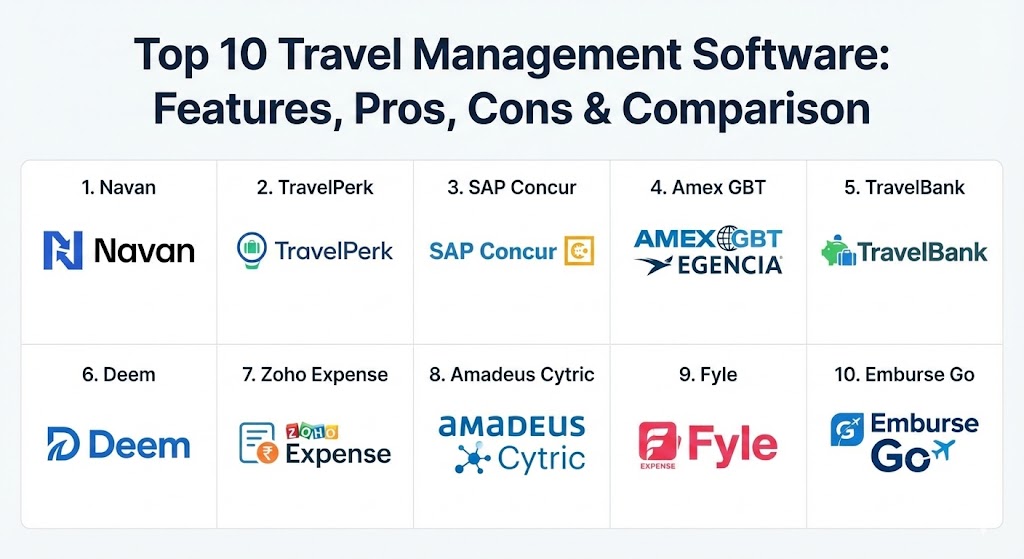
Top 10 Travel Management Software Tools
1 — Navan (formerly TripActions)
Navan is a cloud-native, AI-driven platform that has redefined the business travel experience by combining travel, corporate cards, and expense management into one unified app. It is designed for modern companies that value speed and traveler incentives.
- Key features:
- AI-powered personalization that learns traveler preferences over time.
- Integrated “Navan Connect” for using existing corporate cards.
- Real-time traveler tracking and emergency communications.
- Rewards program that gives employees Amazon gift cards for choosing cheaper travel options.
- Granular policy controls that automate approvals for compliant bookings.
- Extensive global inventory with exclusive direct-connect rates.
- Sustainability dashboard for tracking and offsetting carbon emissions.
- Pros:
- The most intuitive mobile interface in the market, leading to high employee adoption.
- Unified travel and expense data eliminates the need for manual reconciliation.
- Cons:
- Can be more expensive than basic competitors for very small teams.
- Some users report that the “rewards” logic can occasionally hide the absolute cheapest flight options.
- Security & compliance: SOC 2 Type II, GDPR, PCI DSS, and ISO 27001 compliant. Includes SSO and multi-factor authentication.
- Support & community: 24/7 global chat, phone, and email support with an average response time of under 60 seconds.
2 — TravelPerk
TravelPerk is a dominant player in the European and North American markets, known for its “no-fee” booking model (on basic plans) and its industry-leading “FlexiPerk” cancellation policy.
- Key features:
- FlexiPerk: Cancel any trip up to 2 hours before departure for an 80% refund.
- Massive inventory including low-cost carriers and Airbnb for Work.
- Automated VAT recovery for European travel expenses.
- Group booking tools for organizing offsites and conferences.
- Integrated “GreenPerk” for carbon offsetting and sustainability reporting.
- Centralized invoicing that groups all trip costs into one document.
- Open API for custom integrations with HRIS and ERP systems.
- Pros:
- Exceptional customer support that feels like a concierge service rather than a software help desk.
- The most flexible cancellation policy in the industry, perfect for volatile schedules.
- Cons:
- The expense management features are not as deep as dedicated expense tools.
- Limited offline capabilities in the mobile app.
- Security & compliance: GDPR, SOC 2, and PCI DSS. Data is encrypted at rest and in transit.
- Support & community: 24/7 human support in English, Spanish, and German; dedicated account managers for Pro users.
3 — SAP Concur (Travel)
SAP Concur remains the enterprise standard for global corporations. It is a highly robust, “heavy-duty” solution designed to manage the most complex travel policies and massive employee bases.
- Key features:
- Deep integration with the SAP ERP ecosystem and other major financial systems.
- “Concur Select Access” for booking non-GDS content like direct-connect airlines.
- Automated policy enforcement across multiple entities and currencies.
- Detailed “Intelligence” reporting for multi-year spend forecasting.
- Risk messaging and traveler safety alerts via “Locate.”
- TripIt Pro integration for a consolidated traveler itinerary.
- Mobile receipt capture with OCR (Optical Character Recognition).
- Pros:
- Unmatched scalability for organizations with 10,000+ employees.
- The most comprehensive auditing and compliance features available.
- Cons:
- The user interface can feel dated and clunky compared to modern startups.
- Implementation is a long, complex process that usually requires professional services.
- Security & compliance: FedRAMP, SOC 1/2, ISO 27001, HIPAA, and GDPR compliant.
- Support & community: Extensive global support network, training certifications, and a massive enterprise user community.
4 — Amex GBT Egencia
Egencia was acquired by American Express Global Business Travel (GBT), combining Egencia’s modern technology with the world’s largest travel inventory and human support network.
- Key features:
- Access to the Amex GBT supply chain, including negotiated hotel rates.
- “Egencia Smart Mix” which uses machine learning to prioritize the best-value flights.
- Integrated duty of care with real-time traveler maps.
- High-quality mobile app for on-the-go flight and hotel changes.
- Travel savings advisor that highlights missed savings opportunities.
- Global consistency across 60+ countries for multinational firms.
- Integrated expense data for seamless reporting.
- Pros:
- Benefit from the massive negotiating power of American Express.
- A very stable platform that rarely experiences downtime or glitches.
- Cons:
- Some users find the customer support wait times long during global travel crises.
- The “Mix” algorithm can sometimes feel restrictive if a traveler has a specific brand preference.
- Security & compliance: ISO 27001, GDPR, PCI DSS, and SOC 2.
- Support & community: 24/7 support via the app and phone; access to Amex GBT’s global travel consultants.
5 — TravelBank
TravelBank is a budget-first platform that gained popularity by gamifying cost savings. It is particularly effective for small-to-medium businesses that want to incentivize employees to spend wisely.
- Key features:
- “Market-based” budgeting that adjusts based on real-time travel costs.
- Rewards program that splits savings with the employee.
- One-click expense filing via camera-based receipt scanning.
- Managed travel services for complex group or executive bookings.
- Integrated corporate card program with automated reconciliation.
- Simple, fast booking flow for flights, hotels, and cars.
- Multi-level approval workflows for managers.
- Pros:
- Very cost-effective for smaller teams; focuses on saving the company money instantly.
- Extremely fast setup; a company can be “live” in less than 48 hours.
- Cons:
- Lacks some of the “deep enterprise” features like multi-entity VAT recovery.
- Inventory in rural or international niche markets can be thinner than Amex or Concur.
- Security & compliance: SOC 2, GDPR, and PCI DSS.
- Support & community: 24/7 chat support and a dedicated onboarding team for mid-market clients.
6 — Deem
Deem (now owned by Travelport) focuses on the “Etta” experience—a mobile-first booking platform that emphasizes accessibility and traveler wellness. It is often used by companies that prefer a “best-of-breed” approach.
- Key features:
- Etta: A high-rated mobile app focused on the traveler’s physical journey.
- “Eco-Check” indicators for comparing the carbon impact of different flights.
- Integration with Uber for Business for seamless ground transport.
- Proactive alerts for flight delays, gate changes, and security wait times.
- Support for “Universal Policy” allowing for different rules for different groups.
- Automated ticket exchange for managing canceled flight credits.
- Advanced accessibility features for travelers with disabilities.
- Pros:
- One of the best mobile user experiences in the industry.
- Highly flexible; can plug into many different travel agencies (TMCs).
- Cons:
- Since it is often a “middleware” tool, user support depends partly on your travel agency.
- Reporting dashboards are less “built-in” than all-in-one tools like Navan.
- Security & compliance: SOC 2, PCI DSS, and HIPAA-ready.
- Support & community: Direct technical support plus extensive documentation for IT admins.
7 — Zoho Expense (Travel Module)
Zoho Expense is part of the massive Zoho ecosystem. While primarily an expense tool, its travel management module is incredibly powerful for teams already using Zoho CRM or Books.
- Key features:
- Automated travel request and approval workflows.
- Multi-currency support and automatic exchange rate conversion.
- Integrated online booking through partnerships (e.g., Waybeo).
- Detailed travel policy enforcement (per-diems, mileage, flight class).
- Carbon footprint tracking for every business trip.
- “Travel Advance” management for providing cash to employees.
- Deep integration with Zoho CRM for project-based travel tracking.
- Pros:
- Incredible value for money; often much cheaper than dedicated enterprise TMS.
- Seamless data flow into accounting software for instant reconciliation.
- Cons:
- The booking inventory is not as “direct” as Navan or TravelPerk.
- Requires some configuration to get the most out of the travel policies.
- Security & compliance: ISO 27001, SOC 2, HIPAA, and GDPR compliant.
- Support & community: 24/5 or 24/7 support (depending on plan); massive community of Zoho experts.
8 — Amadeus Cytric
Amadeus Cytric is a powerhouse for global corporations, particularly those that use Microsoft 365. Its “Cytric Easy” integration allows users to book travel directly inside Microsoft Teams.
- Key features:
- Cytric Easy: Book and share travel itineraries within Microsoft Teams.
- Shared “Collaboration” trips where teams can see each other’s flight times.
- Extensive global content from Amadeus GDS (including rail and local transport).
- Integrated expense management with automated receipt matching.
- Advanced “Safe Travel” alerts and duty of care dashboards.
- Mobile app with “offline” itinerary access.
- Sustainability data integrated into the booking flow.
- Pros:
- If your company lives in Microsoft Teams, this is the most seamless experience available.
- Access to the deepest global travel inventory through the Amadeus network.
- Cons:
- Implementation can be complex and requires technical IT involvement.
- The interface, while improving, still feels very “corporate.”
- Security & compliance: ISO 27001, SOC 2, and GDPR.
- Support & community: Enterprise-grade support with global coverage and multi-language assistance.
9 — Fyle
Fyle is an expense-first platform that specializes in real-time travel expense reporting. It is perfect for organizations that want to eliminate “manual entry” for their traveling staff.
- Key features:
- Real-time receipt filing via Gmail, Outlook, Slack, and WhatsApp.
- Automated reconciliation of business travel card spend.
- Trip request workflows with multi-level manager approvals.
- Direct integrations with travel booking sites like TravelPerk.
- Automated mileage tracking and per-diem calculations.
- Detailed project-based travel accounting.
- “Shadow IT” detection to find unauthorized travel spend.
- Pros:
- The easiest tool for employees to submit receipts (no need to open a specific app).
- Excellent for field teams who are moving quickly and lose paper receipts.
- Cons:
- It is not a booking engine itself; you must pair it with a partner or book elsewhere.
- The travel policy engine is slightly less robust than Navan or SAP Concur.
- Security & compliance: SOC 1/2 Type II, PCI DSS, and GDPR.
- Support & community: Dedicated account managers and 24/7 email/chat support.
10 — Emburse Go
Emburse Go is the traveler-centric arm of the Emburse ecosystem. It focuses on the “delight” of the traveler, providing a high-end personal assistant experience on the phone.
- Key features:
- Consolidated “One Itinerary” that pulls data from any booking source.
- Real-time flight alerts and “Taxi Driver” cards with local addresses.
- In-app duty of care messaging for emergencies.
- Curated city guides with local safety and cultural information.
- Gamified rewards for policy-compliant choices.
- Sustainability insights for the individual traveler.
- Seamless integration with Emburse Chrome and Captio for expenses.
- Pros:
- Boosts traveler morale by making the actual trip much less stressful.
- Very strong for “leakage” management, as it captures data even from direct bookings.
- Cons:
- Works best when paired with other Emburse products (additional cost).
- Advanced customization can be difficult for non-technical administrators.
- Security & compliance: SOC 2, GDPR, and ISO 27001.
- Support & community: High-quality enterprise support and a large network of financial partners.
Comparison Table
| Tool Name | Best For | Platform(s) Supported | Standout Feature | Rating (Gartner) |
| Navan | Modern SMB/Mid-Market | iOS, Android, Web | Integrated AI & Rewards | 4.7 / 5 |
| TravelPerk | Flexibile SMBs | iOS, Android, Web | FlexiPerk Refunds | 4.6 / 5 |
| SAP Concur | Global Enterprises | iOS, Android, Web | Enterprise Scale & Audit | 4.2 / 5 |
| Egencia | Global Inventory | iOS, Android, Web | Amex GBT Supply Chain | 4.3 / 5 |
| TravelBank | Budget-Conscious Teams | iOS, Android, Web | Market-based Budgeting | 4.5 / 5 |
| Deem | Mobile-First/Wellness | iOS, Android, Web | Etta Mobile Experience | 4.3 / 5 |
| Zoho Expense | Existing Zoho Users | iOS, Android, Web | Ecosystem Integration | 4.5 / 5 |
| Amadeus Cytric | Microsoft Teams Users | iOS, Android, Teams | MS Teams Integration | 4.1 / 5 |
| Fyle | Real-Time Expenses | iOS, Android, Slack | Receipt Filing via IM | 4.6 / 5 |
| Emburse Go | Traveler Satisfaction | iOS, Android | “One Itinerary” Console | 4.4 / 5 |
Evaluation & Scoring of Travel Management Software
| Category | Weight | Evaluation Criteria |
| Core Features | 25% | Booking inventory, policy engine, duty of care, and reporting. |
| Ease of Use | 15% | Mobile app intuitiveness and administrative dashboard clarity. |
| Integrations | 15% | Connection to HRIS (Workday), ERP (NetSuite/SAP), and Slack/Teams. |
| Security | 10% | SOC 2 status, GDPR compliance, and data encryption standards. |
| Reliability | 10% | Uptime, booking synchronization speed, and 24/7 support. |
| Support | 10% | Average response time and availability of dedicated managers. |
| Price / Value | 15% | Transparent pricing vs. hidden fees and ROI on travel savings. |
Which Travel Management Software Tool Is Right for You?
The Solo Traveler and Micro-Business
If you are a team of one or two, you likely don’t need a heavy TMS. However, using the free version of Zoho Expense or a lightweight tool like Fyle can help you keep track of receipts for tax time without the overhead of a corporate travel contract.
The Growing SMB
For businesses with 10–200 employees, TravelPerk is often the winner. Its transparent pricing and “FlexiPerk” option give you the flexibility that small teams need when plans change at the last minute. If you want to gamify savings and keep budgets tight, TravelBank is an excellent alternative.
The Tech-Forward Mid-Market
If your company prioritizes a “modern” work culture and employee happiness, Navan is the industry leader. It feels like a consumer app (like Airbnb or Expedia) but gives the finance team total control and real-time visibility that legacy tools lack.
The Global Enterprise
For massive organizations with 5,000+ employees and offices in 20 countries, SAP Concur or Egencia are the only choices with the necessary depth. They handle complex tax regulations, multi-entity accounting, and global security requirements that startups simply cannot match. If your company is heavily invested in the Microsoft stack, Amadeus Cytric should be on your shortlist.
The Performance and Speed Seeker
If your main pain point is the time it takes to file expenses after a trip, Fyle should be your primary choice. Its ability to “fyle” an expense directly from a WhatsApp or Slack message is a game-changer for busy sales teams.
Frequently Asked Questions (FAQs)
1. What is the difference between a TMS and a Travel Agency (TMC)?
A TMS is the software you use to book and manage travel. A TMC (Travel Management Company) is the service provider (the people) behind the scenes who help with support and negotiated rates. Modern tools like Navan and TravelPerk are both software and agency combined.
2. Can these tools help me save money?
Yes. Most companies save 10% to 30% by using negotiated corporate rates, preventing out-of-policy bookings, and leveraging “rewards” programs that encourage employees to pick cheaper options.
3. Do these tools work with low-cost carriers like Southwest or Ryanair?
Most modern TMS tools (TravelPerk, Navan) have direct connections to low-cost carriers, ensuring you see the same prices on the app as you do on the airline’s website.
4. What is “Duty of Care”?
Duty of Care is a legal and moral obligation for employers to ensure their traveling employees are safe. TMS tools provide real-time maps showing where travelers are and allow admins to send emergency alerts if a crisis occurs.
5. How long does it take to implement this software?
For SMB tools like TravelPerk or TravelBank, it can take 1–3 days. For enterprise systems like SAP Concur, it can take 3–6 months depending on the complexity of your financial integrations.
6. Can I still earn frequent flyer miles?
Absolutely. All the tools listed allow travelers to store their loyalty numbers in their profiles, ensuring they earn miles and status just like they would with direct bookings.
7. Is my data secure with these providers?
Yes, all top-tier providers are SOC 2 compliant and follow GDPR rules. They use high-level encryption to protect sensitive data like passport numbers and corporate credit card details.
8. Can employees book personal travel on these platforms?
Some tools (like Navan and TravelPerk) offer a “Personal Travel” toggle. This allows employees to use the corporate booking engine for vacations (getting the corporate discount) while paying with their own credit card.
9. Do these tools handle rail and car rentals?
Yes. Comprehensive TMS tools include inventory for trains (Amtrak, Eurostar, etc.), rental cars, and even ride-sharing services like Uber or Lyft.
10. What happens if an employee books “out of policy”?
The software can be set to either block the booking entirely, flag it for manager approval, or simply record it in a “leakage” report for the finance team to review later.
Conclusion
Choosing the right Travel Management Software is a strategic decision that affects every layer of your business. The best tools are those that balance finance-driven control with traveler-focused delight. There is no “one size fits all” winner; a 50-person startup has vastly different needs than a 50,000-person conglomerate. However, by focusing on inventory depth, mobile ease of use, and seamless integration with your existing tech stack, you can find a partner that turns business travel from a headache into a competitive advantage.