Introduction
A Building Energy Management System (BEMS) is a sophisticated, computer-based control system that monitors and manages a building’s energy-related subsystems. While a traditional Building Management System (BMS) focuses on the basic operation of equipment, a BEMS adds a layer of intelligence focused specifically on energy efficiency, carbon footprint reduction, and utility cost optimization. By integrating sensors, meters, and software, these systems provide real-time visibility into where energy is being wasted and automate the response to fluctuating energy prices.
The importance of BEMS in 2026 cannot be overstated. With rising energy costs and strict ESG (Environmental, Social, and Governance) reporting mandates, organizations must prove their sustainability efforts. Real-world use cases include peak shaving (reducing load during expensive peak hours), predictive maintenance of boilers and chillers, and “grid-interactive” buildings that sell energy back to the utility. When evaluating a BEMS, users should prioritize interoperability (the ability to speak protocols like BACnet or Modbus), cloud-native scalability, AI-driven predictive analytics, and the quality of the user interface for non-technical staff.
Best for: Facility managers, sustainability directors, and energy engineers in large commercial real-estate firms, hospitals, data centers, and industrial manufacturing plants. It is ideal for those managing complex portfolios who need to centralize energy data to meet regulatory or corporate carbon-neutral goals.
Not ideal for: Small residential homes or tiny retail storefronts with a single HVAC unit. For these scenarios, a smart Wi-Fi thermostat or a basic home automation hub is usually sufficient and far more cost-effective.
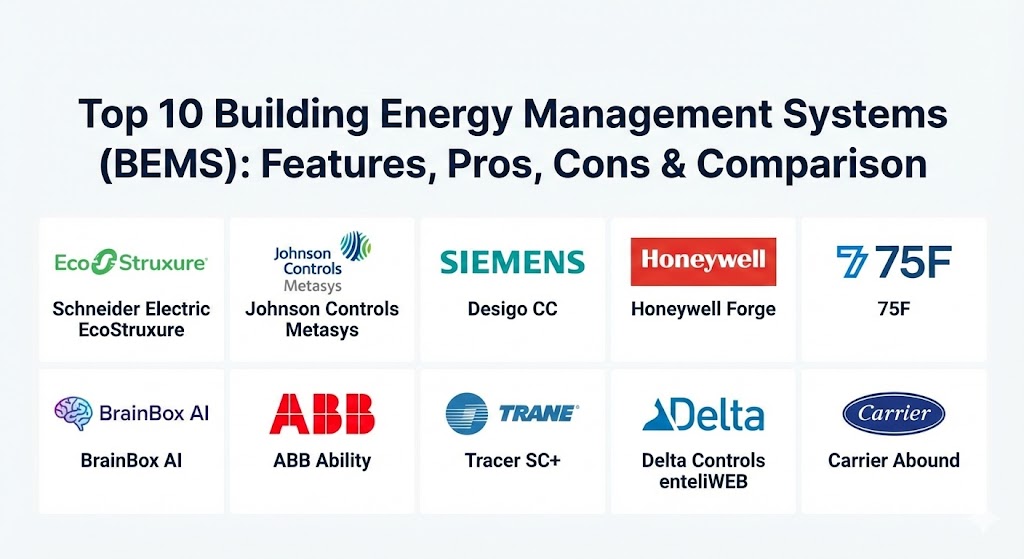
Top 10 Building Energy Management Systems (BEMS) Tools
1 — Schneider Electric EcoStruxure
Schneider Electric is a perennial leader in the BEMS space. EcoStruxure Building is an open, IoT-enabled platform that allows for the seamless integration of devices from the floor to the cloud, making it a powerhouse for large-scale energy management.
- Key features:
- Native support for open protocols like BACnet, Modbus, and Zigbee.
- Predictive maintenance modules for electrical distribution and HVAC.
- Advanced ESG reporting dashboards for carbon footprint tracking.
- Edge-control capabilities to ensure local operations continue during cloud outages.
- Integrated workplace management to adjust energy based on room occupancy.
- Mobile-first architecture for facility teams in the field.
- Pros:
- Exceptionally scalable, capable of managing a single building or a global portfolio.
- One of the most mature ecosystems with a massive library of hardware integrations.
- Cons:
- Significant initial investment and licensing costs.
- Requires certified professional installers, which can limit agility for smaller DIY-minded teams.
- Security & compliance: SOC 2 Type II, ISO 27001, GDPR, and advanced encryption for IoT end-points.
- Support & community: Extensive global network of partners, 24/7 enterprise support, and the comprehensive Exchange community for developers.
2 — Johnson Controls Metasys
Metasys is one of the most established names in the industry. It excels at providing a unified view of all building systems, with a particular strength in high-performance HVAC control and energy optimization.
- Key features:
- Adaptive control algorithms that learn building patterns over time.
- Cyber-hardened system controllers to prevent unauthorized network access.
- Enterprise-level scheduling for complex multi-building campuses.
- Fault Detection and Diagnostics (FDD) to pinpoint energy leaks.
- Integration with OpenBlue for AI-powered sustainability insights.
- Highly granular user access controls for large operations teams.
- Pros:
- The user interface is one of the best for visualizing complex mechanical systems.
- Robust reliability; many systems remain operational for decades with proper maintenance.
- Cons:
- Can feel “closed-off” compared to newer open-source alternatives.
- Updates to older legacy hardware can be complex and expensive.
- Security & compliance: FIPS 140-2, ISO 27001, and HIPAA-compliant data handling for healthcare facilities.
- Support & community: Direct support from Johnson Controls field offices and a vast internal technical knowledge base.
3 — Siemens Desigo CC
Siemens Desigo CC is an integrated building management platform that places a heavy emphasis on total building performance. It is designed to converge fire safety, security, and energy management into a single point of control.
- Key features:
- Multi-discipline integration (fire, security, HVAC, lighting).
- Flexible, modular design that grows with the building’s needs.
- Support for Digital Twin technology to simulate energy-saving scenarios.
- Native integration with Siemens’ MindSphere IoT operating system.
- Advanced lighting control integration to maximize daylight harvesting.
- Comprehensive historical data logging for audit-ready compliance.
- Pros:
- Unmatched flexibility in terms of customizing dashboards and logic.
- Strong global presence ensures availability of parts and expertise anywhere in the world.
- Cons:
- Steep learning curve for the administrative back-end.
- The platform can be resource-heavy, requiring substantial local server hardware.
- Security & compliance: IEC 62443 (for industrial cybersecurity), GDPR, and SOC 2.
- Support & community: Global technical support and the Siemens “Building Technologies” training academy.
4 — Honeywell Forge
Honeywell Forge is a “Performance Plus” BEMS that leverages cloud-based AI to optimize energy. It is less about “turning things on and off” and more about high-level data orchestration for enterprise portfolios.
- Key features:
- AI-powered autonomous control that optimizes HVAC without human intervention.
- “Sustainability Manager” module for real-time carbon emissions tracking.
- Occupant health and air quality monitoring integrated with energy data.
- Vendor-neutral data integration (can pull data from non-Honeywell systems).
- Financial analytics to bridge the gap between energy use and utility billing.
- Predictive asset maintenance to extend the life of expensive equipment.
- Pros:
- Excellent for C-suite reporting; translates technical energy data into financial metrics.
- The autonomous control feature can lead to immediate 15–20% energy savings.
- Cons:
- Relies heavily on cloud connectivity for its most advanced features.
- Some users find the transition from legacy Honeywell systems to Forge to be jarring.
- Security & compliance: ISO 27001, SOC 2 Type II, and rigorous cloud security protocols.
- Support & community: Dedicated enterprise success managers and 24/7 global help desk.
5 — 75F
75F is the modern, “disruptor” choice in the BEMS market. Built natively for the cloud and IoT, it eliminates much of the complexity and hardware associated with traditional systems, making it a favorite for mid-market commercial buildings.
- Key features:
- Wireless sensor-based architecture for rapid deployment.
- Predictive “Cloud Computing” that uses weather forecasts to pre-condition buildings.
- Dynamic Airflow Balancing for improved occupant comfort and energy savings.
- Built-in Indoor Air Quality (IAQ) monitoring.
- Mobile-first management for owners who are not always on-site.
- Vertical integration (75F makes both the software and the hardware).
- Pros:
- Significantly lower installation costs than traditional “wired” BEMS.
- The system is incredibly easy for non-engineers to use and understand.
- Cons:
- Not as “customizable” for highly complex industrial processes.
- Hardware-lock; you generally must use 75F controllers to get the full benefit.
- Security & compliance: AES-256 encryption, SSO integration, and GDPR.
- Support & community: Excellent documentation and a proactive remote support team.
6 — BrainBox AI
BrainBox AI is a unique entry that acts as an “overlay” for existing BEMS. It uses deep learning and autonomous AI to control a building’s HVAC system, turning a “dumb” building into a “smart” one without replacing hardware.
- Key features:
- Autonomous HVAC control that requires zero human intervention.
- Integration with existing systems via BACnet or specialized gateways.
- Predictive weather and occupancy modeling.
- Automated demand response participation (earning money from the grid).
- Rapid deployment (can be operational in a few weeks).
- ESG reporting suite focused on Scope 2 emissions.
- Pros:
- The fastest ROI in the industry; often pays for itself in under a year.
- Does not require ripping and replacing existing building hardware.
- Cons:
- Only manages HVAC; other energy users (like lighting) require separate tools.
- The “Black Box” nature of the AI can be intimidating for traditional engineers.
- Security & compliance: SOC 2, ISO 27001, and read-only access options for data safety.
- Support & community: High-touch onboarding and 24/7 performance monitoring by AI experts.
7 — ABB Ability
ABB Ability is a collection of digital solutions that bring together ABB’s deep expertise in electrification. It is the preferred BEMS for facilities where electrical power management is as important as HVAC management.
- Key features:
- Deep integration with smart circuit breakers and electrical switchgear.
- Real-time power quality monitoring and harmonic analysis.
- Energy asset health tracking for high-voltage equipment.
- Integration of renewable energy sources (Solar/EV charging) into the BEMS.
- Asset performance management for industrial-scale utility users.
- Cloud-based energy forecasting and optimization.
- Pros:
- Superior to all others when it comes to managing the electrical “spine” of a building.
- Highly modular; you can start with one room and scale to a city.
- Cons:
- The interface can feel more like an industrial control system than a modern web app.
- Requires a high level of electrical engineering knowledge to fully utilize.
- Security & compliance: IEC 62443, ISO 27001, and SOC 2.
- Support & community: Global engineering support and the ABB Ability Marketplace for additional apps.
8 — Trane Tracer SC+
Trane is synonymous with HVAC, and their Tracer SC+ system is the logical choice for facilities where the mechanical plant is the primary energy consumer. It offers a robust, reliable platform for streamlining complex mechanical operations.
- Key features:
- Optimized Chiller Plant Control for maximum efficiency.
- Web-based interface accessible from any device.
- Pre-engineered HVAC applications for faster commissioning.
- Support for “Trane Intelligent Services” for remote monitoring.
- Data visualization tools for mechanical performance trends.
- Seamless integration with other HVAC brands via BACnet.
- Pros:
- If you have Trane hardware, this system offers the deepest level of control possible.
- Highly rugged and designed for the realities of the mechanical room.
- Cons:
- The software can feel slightly dated compared to cloud-native startups.
- Less focus on “whole-building” data (like security or fire) than Siemens.
- Security & compliance: ISO 27001 and support for modern IT security protocols.
- Support & community: One of the largest service networks in the world; local Trane technicians are available everywhere.
9 — Delta Controls enteliWEB
Delta Controls (a Delta Group company) focuses on open-protocol architecture. Their enteliWEB platform is a web-based BEMS that aggregates data from all building systems into one dashboard.
- Key features:
- “Single-seat” management of an entire building portfolio.
- Native energy management module for tracking consumption targets.
- Customizable “Dash-board” reports for different stakeholders (execs vs. engineers).
- Powerful alarm management and notification system.
- Mobile integration via the enteliVIZ visualization engine.
- Extensive library of historical data for long-term trend analysis.
- Pros:
- A champion of open protocols; very easy to integrate with 3rd party hardware.
- The interface is clean, logical, and easy to navigate.
- Cons:
- The advanced analytics are not as “AI-forward” as Honeywell Forge.
- Requires a robust local network infrastructure to handle high data throughput.
- Security & compliance: SOC 2, ISO 27001, and GDPR.
- Support & community: Strong network of authorized partners and a dedicated training portal.
10 — Carrier Abound
Carrier Abound is a cloud-native platform that focuses on the intersection of air quality, energy efficiency, and occupant health. It is particularly relevant in the post-pandemic era where air quality is a non-negotiable part of energy management.
- Key features:
- Real-time IAQ (Indoor Air Quality) monitoring and scoring.
- Energy usage intensity (EUI) tracking across multiple sites.
- “Healthy Building” certifications tracking (WELL, LEED).
- Asset health monitoring for HVAC and mechanical equipment.
- Cloud-based data aggregation for legacy building systems.
- Intuitive mobile apps for tenants to view their space’s performance.
- Pros:
- The best tool for organizations that prioritize occupant health as part of their energy strategy.
- Modern, SaaS-based architecture makes it very easy to scale.
- Cons:
- Relatively new platform compared to legacy players like Siemens or JCI.
- Some features are still being rolled out for complex industrial applications.
- Security & compliance: ISO 27001, GDPR, and SOC 2 Type II.
- Support & community: Rapidly growing ecosystem with Carrier’s global service network as the backbone.
Comparison Table
| Tool Name | Best For | Platform(s) Supported | Standout Feature | Rating (Gartner/TrueReview) |
| Schneider EcoStruxure | Global Portfolios | Web, Cloud, On-Prem | IoT Ecosystem Depth | 4.7 / 5 |
| Johnson Metasys | High-Perf HVAC | Windows, Web | Mechanical Visuals | 4.5 / 5 |
| Siemens Desigo CC | Integrated Safety/Energy | Web, Windows | Digital Twin Support | 4.6 / 5 |
| Honeywell Forge | Enterprise Reporting | Cloud / SaaS | Financial Energy ROI | 4.4 / 5 |
| 75F | SMB / Mid-Market | Cloud / Mobile | Wireless Deployment | 4.8 / 5 |
| BrainBox AI | HVAC Optimization | Cloud (Overlay) | Autonomous AI Control | 4.9 / 5 |
| ABB Ability | Electrical / Power | Cloud, Web | Electrical Spine Mgmt | 4.3 / 5 |
| Trane Tracer SC+ | Mechanical Plants | Web, Local | Chiller Plant Logic | 4.5 / 5 |
| Delta enteliWEB | Open Protocols | Web / Cloud | Portfolio-Wide View | 4.6 / 5 |
| Carrier Abound | Healthy Buildings | Cloud / Mobile | IAQ + Energy Synergy | 4.7 / 5 |
Evaluation & Scoring of BEMS Tools
Choosing a BEMS is a long-term commitment. To assist in your evaluation, we have scored the market based on the following weighted rubric, reflecting the priorities of 2026 buyers.
| Category | Weight | Evaluation Criteria |
| Core Features | 25% | Capacity for HVAC, lighting, and power control; predictive maintenance; ESG reporting. |
| Ease of Use | 15% | Dashboard clarity; mobile accessibility; learning curve for new operators. |
| Integrations | 15% | Support for BACnet/Modbus; API openness; ability to manage 3rd party hardware. |
| Security | 10% | Cybersecurity hardening; encryption; compliance with data privacy laws. |
| Reliability | 10% | System uptime; edge-control capabilities; hardware longevity. |
| Support | 10% | Availability of local technicians; documentation quality; training programs. |
| Price / Value | 15% | Initial CapEx vs. ongoing OpEx; speed of ROI through energy savings. |
Which BEMS Tool Is Right for You?
The “right” BEMS depends heavily on your current infrastructure and your long-term sustainability goals.
- Solo Users vs. SMBs: Small business owners should look at 75F. It bypasses the need for expensive consultants and custom wiring, allowing for a smart building setup that works “out of the box.”
- Mid-Market and Managed Portfolios: If you are managing 10–50 buildings and want to see immediate savings without a full retrofit, BrainBox AI is an excellent overlay. If you need a full management system, Delta Controls or Carrier Abound offer a great balance of features and usability.
- Enterprise & Mission-Critical: For hospitals, data centers, or high-rise offices, the legacy “Big Four” (Schneider, Siemens, Honeywell, Johnson Controls) are essential. They provide the depth of security, redundancy, and local support that large-scale operations demand.
- Sustainability & ESG-Focused: If your primary goal is carbon reporting for investors, Honeywell Forge or Schneider EcoStruxure provide the most advanced reporting modules that can feed directly into your corporate sustainability reports.
- Integration Needs: If you have a “Frankenstein” building with equipment from five different vendors, prioritize Delta Controls enteliWEB or Schneider EcoStruxure for their superior open-protocol support.
Frequently Asked Questions (FAQs)
1. What is the difference between BMS and BEMS?
A BMS (Building Management System) is the basic infrastructure used to control equipment. A BEMS (Building Energy Management System) is a subset that specifically uses data and analytics to optimize energy consumption and cost.
2. Can BEMS work with my existing old equipment?
Yes. Most modern BEMS use protocols like BACnet or Modbus, which can talk to older controllers through gateways. Tools like BrainBox AI are designed specifically to “sit on top” of existing systems.
3. How much energy can I realistically save?
On average, a well-configured BEMS can save between 15% and 30% on annual energy bills. AI-driven systems often see even higher peaks during extreme weather seasons.
4. Is a BEMS difficult to install?
Traditional wired systems (Siemens, JCI) require professional installation and can take months. Modern IoT systems (75F) use wireless sensors and can be deployed in a matter of days.
5. How long does it take to see an ROI?
Payback periods usually range from 18 months to 3 years. However, AI-only overlays that don’t require hardware replacement can sometimes reach ROI in 6 to 12 months.
6. Does BEMS help with LEED or WELL certification?
Absolutely. BEMS provide the precise data needed for energy credits and occupant comfort points required for LEED, WELL, and BREEAM certifications.
7. Can I manage multiple buildings from one place?
Yes. Cloud-native platforms like Schneider, Honeywell, and Delta allow you to aggregate data from global sites into a single “command center” dashboard.
8. What happens if the internet goes out?
Enterprise systems use “Edge Control,” meaning the local building controllers continue to run their last known schedule and logic even if the cloud connection is lost.
9. Why is cybersecurity important for a BEMS?
Because BEMS are connected to the building’s network, they can be entry points for hackers. Choosing a system with SOC 2 or ISO 27001 certification is vital for protecting your data.
10. Do I need an engineer to run the system daily?
While you need an engineer for setup, modern BEMS are designed with intuitive dashboards that a facility manager or sustainability officer can use without technical training.
Conclusion
Building Energy Management Systems have evolved from simple scheduling tools into the “brains” of the modern enterprise. In 2026, choosing a BEMS is no longer just an IT or mechanical decision; it is a financial and ethical one. Whether you choose a legacy powerhouse like Schneider Electric or a cloud-native disruptor like 75F, the key is to prioritize data openness and scalability. The best tool is the one that provides the actionable insights you need to turn your energy consumption from a liability into a strategic advantage.