Introduction
An event ticketing platform is a specialized software solution that enables organizers to create event listings, sell tickets online, and manage the check-in process at the door. Far beyond simple digital sales, these platforms offer sophisticated marketing tools, real-time analytics, and integration with customer relationship management (CRM) systems. They serve as the primary bridge between an organizer’s vision and the attendee’s first interaction with the event.
In 2026, the importance of these tools has shifted from mere “box office” functionality to providing a comprehensive “attendee experience.” Today’s platforms leverage AI for dynamic pricing, blockchain for fraud-proof ticketing, and deep data analytics to help organizers understand their audience better. When evaluating a platform, users should look for key criteria: the fee structure (flat vs. percentage), mobile check-in capabilities, customization options for branding, and the robustness of their security protocols.
Best for: Event planners, marketing teams, nonprofit organizations, and enterprise-level corporations. It is ideal for anyone needing to scale ticket sales while maintaining a secure, professional, and automated registration process.
Not ideal for: One-off personal parties (like a small birthday) where a simple RSVP through social media or messaging apps is sufficient, or highly specialized boutique events that require custom-built proprietary software for unique entry requirements.
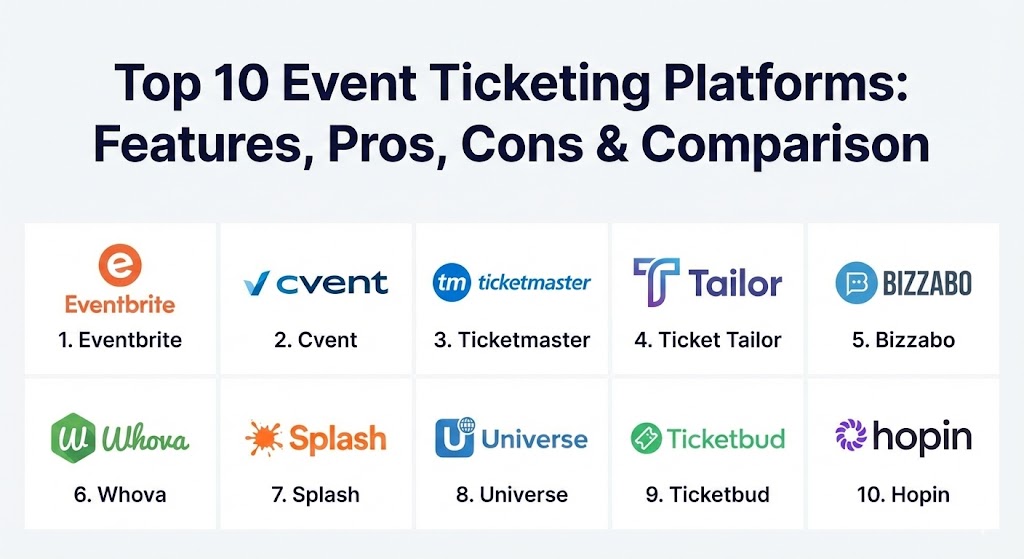
Top 10 Event Ticketing Platforms
1 — Eventbrite
Eventbrite remains the global leader in the self-service ticketing market. It is designed for creators of all types, from local yoga instructors to large-scale festival organizers who want to tap into a massive built-in marketplace.
- Key features:
- Extensive marketplace discovery to help new attendees find your event.
- Integrated email marketing and social media promotion tools.
- Mobile app (Eventbrite Organizer) for seamless gate management and check-ins.
- Highly customizable registration forms and multiple ticket tiers.
- Real-time sales analytics and attendee tracking.
- Embedded checkout widgets for direct sales on your own website.
- Pros:
- Unmatched brand recognition that builds immediate trust with ticket buyers.
- Free to use for free events, making it the perfect starting point for community builders.
- Cons:
- Fees for paid tickets are among the highest in the industry.
- Customer support for smaller accounts is primarily self-service through a help center.
- Security & compliance: PCI DSS Level 1 compliant, GDPR compliant, and supports SSO for enterprise accounts.
- Support & community: Massive knowledge base, 24/7 support for premium tiers, and a large global community of event creators.
2 — Cvent
Cvent is the “heavyweight” of the event management world. It is a comprehensive suite built specifically for corporate planners and large-scale professional organizations that manage hundreds of events annually.
- Key features:
- Advanced venue sourcing with access to a global database of hotels.
- Sophisticated registration logic (e.g., conditional paths based on attendee type).
- Integrated mobile event apps for attendee networking and agendas.
- Robust “Attendee Hub” for hybrid and virtual event hosting.
- In-depth financial reporting and budget tracking.
- Comprehensive lead capture tools for exhibitors and sponsors.
- Pros:
- Incredible depth of features; there is virtually no event scenario Cvent cannot handle.
- High-level reporting that provides clear ROI data for corporate stakeholders.
- Cons:
- Very high cost and complex contracts compared to self-service platforms.
- The learning curve is steep, often requiring dedicated training or staff.
- Security & compliance: SOC 2 Type II, ISO 27001 certified, HIPAA, and GDPR compliant.
- Support & community: Cvent Academy for training, dedicated account managers, and 24/7 global phone support.
3 — Ticketmaster
Ticketmaster is the dominant force in the live entertainment and sports industry. It is designed for major venues, professional sports teams, and global touring artists who require massive scale and fraud prevention.
- Key features:
- Presence on the world’s largest ticket marketplace.
- “Verified Fan” system to combat bots and ensure tickets reach real people.
- Dynamic pricing models that adjust based on real-time demand.
- Integrated secondary market (resale) that keeps revenue within the platform.
- Advanced gate control hardware for high-speed entry at stadiums.
- Deep integration with artist and venue marketing ecosystems.
- Pros:
- Able to handle hundreds of thousands of concurrent users during a high-demand “onsale.”
- Industry-leading fraud protection and ticket authentication.
- Cons:
- High service fees that are often a point of contention for fans.
- Limited customization for the organizer’s personal brand on the checkout page.
- Security & compliance: PCI DSS compliant, utilizes sophisticated AI for bot detection and security.
- Support & community: Enterprise-level support for venue partners; limited direct support for ticket buyers.
4 — Ticket Tailor
Ticket Tailor has carved out a niche as the “honest” alternative to Eventbrite. It is designed for cost-conscious organizers who want a professional ticketing system without the heavy per-ticket percentage fees.
- Key features:
- Flat-fee pricing model (no percentage of your ticket price taken).
- Fully white-label options to keep your branding front and center.
- Support for recurring events and time-slotted bookings.
- Direct payment processing via Stripe or PayPal (funds reach you immediately).
- Integrated waitlist management for sold-out events.
- Multi-user access with granular permission settings.
- Pros:
- Significantly cheaper for high-priced tickets because of the flat fee.
- You maintain full control over your customer data and branding.
- Cons:
- Lacks the massive “discovery” marketplace that Eventbrite offers.
- Marketing tools are more basic and may require third-party integrations.
- Security & compliance: PCI DSS compliant through payment gateways, GDPR compliant.
- Support & community: Renowned for fast, human-led customer support via chat and email.
5 — Bizzabo
Bizzabo is the “Event Experience OS” designed for modern B2B marketing teams. It focuses on using events as a catalyst for business growth and meaningful networking.
- Key features:
- “Klik” smart wearables for contact exchange and behavioral tracking.
- Deep CRM and marketing automation integrations (Salesforce, Hubspot).
- Customizable event website builder with modern templates.
- Advanced speaker and sponsor management portals.
- Interactive networking features for virtual, in-person, and hybrid formats.
- Real-time “Community” features where attendees can interact before the event.
- Pros:
- The best platform for fostering attendee engagement and networking.
- Provides superior data insights into how attendees are actually interacting with content.
- Cons:
- Pricing is enterprise-level and can be prohibitive for small nonprofits.
- Some features are overkill for simple, transactional ticketing needs.
- Security & compliance: SOC 2 Type II, ISO 27001, GDPR, and CCPA compliant.
- Support & community: Dedicated customer success managers and 24/7 technical support.
6 — Whova
Whova is famous for its award-winning event app that significantly boosts attendee participation. It is ideally suited for academic conferences, trade shows, and corporate workshops.
- Key features:
- Highly engaging mobile app with “Community Boards” and icebreakers.
- Automated name badge generation and check-in tools.
- Logistics management for complex, multi-track agendas.
- Powerful exhibitor and sponsor lead retrieval via QR scanning.
- Integrated virtual booth and live streaming capabilities.
- Document sharing and photo galleries for attendee collaboration.
- Pros:
- Attendee engagement rates are typically much higher than on other platforms.
- Simplifies complex logistics like abstract management and speaker sessions.
- Cons:
- The interface can feel a bit “busy” due to the high number of engagement features.
- The desktop experience is not as robust as the mobile app experience.
- Security & compliance: GDPR compliant, data encryption at rest and in transit.
- Support & community: Excellent onboarding support and a very active user knowledge base.
7 — Splash (SplashThat)
Splash is an event marketing platform that prioritizes design and brand consistency. It is the go-to choice for creative brands (like Red Bull or Nike) that want their event pages to look like premium websites.
- Key features:
- Industry-leading visual editor for event pages and emails.
- Advanced brand governance tools (locks fonts and colors for team-wide use).
- Automated “Smart RSVP” forms that change based on the guest.
- Strong integration with the marketing stack (Marketo, Eloqua).
- Enterprise-grade guest list management and check-in.
- Strategic data insights to track event impact on sales pipelines.
- Pros:
- The most aesthetically pleasing event pages in the industry.
- Exceptional for maintaining brand standards across global offices.
- Cons:
- The “Designer Pro” mode has a significant learning curve.
- Can be expensive if you only need basic registration functionality.
- Security & compliance: SOC 2 Type II compliant, SSO, and GDPR ready.
- Support & community: Professional services for custom design and high-level enterprise support.
8 — Universe
Owned by Ticketmaster, Universe is a versatile platform that blends the power of enterprise technology with a sleek, user-friendly interface. It is great for art shows, food festivals, and independent creators.
- Key features:
- Seamless “buy” button integration for any external website.
- Social discovery features that reward users for sharing your event.
- Flexible payment options, including support for global currencies.
- Easy-to-use check-in app (Universe Box Office) for volunteers.
- Robust reporting for sales and attendee demographics.
- Custom discount codes and automated email reminders.
- Pros:
- Extremely intuitive; you can go from setup to selling in under 10 minutes.
- Benefits from Ticketmaster’s backend security and reliability.
- Cons:
- Lacks some of the deep “community” and “networking” features of Bizzabo.
- The fee structure can be slightly confusing when combined with Ticketmaster’s.
- Security & compliance: PCI DSS compliant, GDPR compliant.
- Support & community: Strong online documentation and responsive email support.
9 — Ticketbud
Ticketbud is designed for the “hustling” event organizer who needs their money fast. It is a solid, mid-market platform that excels in providing early payouts to help cover event costs.
- Key features:
- Daily payouts (get your ticket revenue before the event starts).
- Simple, flat-rate pricing for all organizers.
- Integrated point-of-sale (POS) for on-site ticket sales.
- Custom sponsorship tracking to see which partners are driving sales.
- Dedicated customer support representative for every event.
- Advanced mapping tools for large festival footprints.
- Pros:
- Access to funds early is a massive advantage for organizers with tight cash flows.
- The human-led customer service is exceptional for a mid-market platform.
- Cons:
- The UI is functional but lacks the high-end design of Splash.
- Analytics are not as granular as those found in enterprise suites.
- Security & compliance: PCI compliant, SSL encryption, and GDPR ready.
- Support & community: Real-time phone support and a dedicated “Success Manager” for larger events.
10 — Hopin (RingCentral Events)
Hopin (now integrated into RingCentral Events) revolutionized the virtual event space and has since expanded into a powerful hybrid and in-person ticketing solution.
- Key features:
- All-in-one virtual venue with main stages, sessions, and networking.
- Robust registration and ticketing for online and offline attendees.
- Integrated “Backstage” for speakers to manage their sessions.
- Detailed analytics on attendee dwell time and session popularity.
- Instant 1-on-1 networking (like “chat roulette” for professionals).
- Native integration with RingCentral’s communication suite.
- Pros:
- The best platform for virtual-first or complex hybrid events.
- Scales incredibly well for global audiences with no latency.
- Cons:
- Can be complex to set up for simple, in-person-only events.
- Frequent rebrandings (Hopin to RingCentral) can be confusing for legacy users.
- Security & compliance: SOC 2 Type II certified, GDPR compliant, and SSO support.
- Support & community: 24/7 global support and extensive virtual event training materials.
Comparison Table
| Tool Name | Best For | Platform(s) Supported | Standout Feature | Rating (Gartner Peer Insights) |
| Eventbrite | Discovery & Reach | Web, iOS, Android | Built-in Marketplace | 4.4 / 5 |
| Cvent | Enterprise Corporates | Web, iOS, Android | Global Venue Sourcing | 4.6 / 5 |
| Ticketmaster | Live Entertainment | Web, iOS, Android | Verified Fan System | 4.2 / 5 |
| Ticket Tailor | Budget Conscious | Web, iOS, Android | Flat-Fee Pricing | 4.8 / 5 |
| Bizzabo | B2B Networking | Web, iOS, Android | Smart Wearable Tech | 4.7 / 5 |
| Whova | Academic & Trade Shows | Web, iOS, Android | High Mobile Engagement | 4.8 / 5 |
| Splash | Brand Marketing | Web, iOS, Android | Visual Design Editor | 4.5 / 5 |
| Universe | Local Independence | Web, iOS, Android | Social Selling Tools | 4.3 / 5 |
| Ticketbud | Cash Flow / Payouts | Web, iOS, Android | Daily Payouts | 4.4 / 5 |
| Hopin | Hybrid & Virtual | Web, iOS, Android | Virtual Networking Hub | 4.5 / 5 |
Evaluation & Scoring of Event Ticketing Platforms
Selecting the right platform requires looking beyond the price tag. Below is our weighted scoring rubric to help you evaluate which platform provides the best holistic value.
| Category | Weight | Evaluation Criteria |
| Core Features | 25% | Ticket tiers, registration logic, and check-in efficiency. |
| Ease of Use | 15% | Intuitiveness for both the organizer and the ticket buyer. |
| Integrations | 15% | Compatibility with CRMs, email marketing, and payment gateways. |
| Security | 10% | Fraud protection, data encryption, and GDPR compliance. |
| Reliability | 10% | Uptime during high-traffic sales and mobile app stability. |
| Support | 10% | Access to human help, documentation, and training. |
| Price / Value | 15% | Transparency of fees and overall return on investment. |
Which Event Ticketing Platform Is Right for You?
The “perfect” platform doesn’t exist; only the platform that is perfect for your specific event. Use this guide to narrow your choice:
- Solo Users vs. Small Businesses: If you are just starting out, Eventbrite is excellent for its discovery features. However, if you already have an audience and want to save on fees, Ticket Tailor is the superior economic choice.
- Budget-Conscious Organizers: Avoid percentage-based fees if your tickets are expensive ($100+). Ticket Tailor or Ticketbud will likely save you thousands in the long run.
- Mid-Market Marketing Teams: If you need your event to look high-end and drive sales leads, Splash is the clear winner for design, while Whova is better if your primary goal is attendee networking.
- Large Enterprises & Global Corporations: Cvent is the industry standard for a reason. If you need to manage hundreds of events across multiple departments with strict security requirements, Cvent’s suite is unmatched.
- High-Volume Entertainment: For concerts or sports where scalping and bot traffic are major concerns, Ticketmaster or Universe offer the specialized security tools needed to manage the rush.
Frequently Asked Questions (FAQs)
1. How do event ticketing platforms make money?
Most platforms charge a service fee per ticket sold. This is usually either a percentage (e.g., 2% + $0.99) or a flat fee. Some platforms, like Ticket Tailor, offer monthly subscriptions instead.
2. Can I use these platforms for free events?
Yes, most platforms (like Eventbrite, Universe, and Ticketbud) allow you to use their core features for free if your tickets are free. This is a great way to build a community without upfront costs.
3. What is “White Labeling” in ticketing?
White labeling allows you to remove the ticketing platform’s branding and replace it with your own. This ensures that the entire customer journey, from your website to the checkout, looks consistent.
4. When do I get paid for my ticket sales?
It varies by platform. Some, like Ticketbud, offer daily or weekly payouts. Others, like Eventbrite, typically hold the funds until after the event has successfully concluded to ensure they can handle any refunds.
5. Do I need special hardware to check people in?
No, most modern platforms have an “Organizer App” that turns any smartphone into a QR code scanner. For massive events, you can rent specialized high-speed scanners that integrate with the platform.
6. Can these tools handle “Hybrid Events”?
Yes. Platforms like Hopin and Bizzabo are specifically built for hybrid events, allowing you to sell different ticket types for those attending in person and those watching the live stream.
7. How do these platforms prevent ticket fraud?
They use digital tickets with rotating QR codes or blockchain technology to ensure that a ticket cannot be screenshotted and resold multiple times. Ticketmaster’s “Verified Fan” system also checks for bot behavior.
8. Is it possible to integrate these tools with my CRM?
Yes. Most enterprise platforms have native integrations with Salesforce and HubSpot. For smaller platforms, you can often use Zapier to connect ticket sales to your email marketing or database.
9. Can I collect custom data from attendees during registration?
Absolutely. Most platforms allow you to add custom questions to the checkout process, such as dietary requirements, T-shirt sizes, or how the attendee heard about the event.
10. What happens if I need to issue a mass refund?
Most platforms have a “Bulk Refund” tool. However, be aware that while the ticket price is usually refunded, the platform’s service fees are often non-refundable depending on their terms of service.
Conclusion
Choosing an event ticketing platform is one of the most critical decisions an organizer will make. It impacts your branding, your cash flow, and—most importantly—the experience of your attendees. Whether you prioritize the massive discovery marketplace of Eventbrite, the budget-friendly flat fees of Ticket Tailor, or the high-engagement networking of Whova, your choice should align with your event’s specific goals. In the end, the best platform is the one that stays out of the way of your attendees while providing you with the data and security you need to succeed.