Introduction
A Hotel Revenue Management System (RMS) is a technology solution that aggregates historical, current, and future market data to provide real-time pricing recommendations. By analyzing variables like local events, competitor rates, weather patterns, and historical booking curves, an RMS ensures that every room is sold at the optimal price point to maximize total revenue.
The importance of an RMS lies in its ability to process millions of data points that are humanly impossible to track manually. Real-world use cases include dynamic pricing (adjusting rates based on a sudden surge in local concert demand), overbooking management to account for cancellations, and group displacement analysis (calculating if a large wedding block is more profitable than individual transient bookings). When evaluating these tools, hoteliers should prioritize AI accuracy, the speed of data refreshes, the quality of PMS (Property Management System) integrations, and the intuitiveness of the user interface.
Best for: Revenue managers, General Managers, and ownership groups of all sizes—from independent boutique hotels to global enterprise chains like Marriott or Hilton. It is especially vital for properties in competitive urban markets or seasonal resorts where demand fluctuations are extreme.
Not ideal for: Very small, owner-operated B&Bs with only 2–3 rooms and minimal competition, or “static rate” properties such as long-term student housing or corporate dormitories where pricing rarely changes.
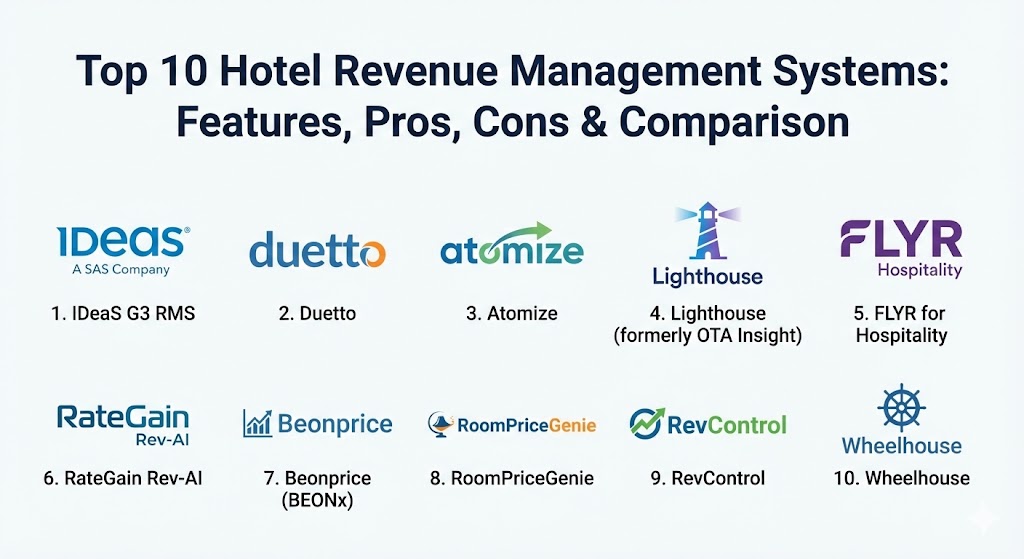
Top 10 Hotel Revenue Management Systems
1 — IDeaS G3 RMS
Owned by SAS, IDeaS is the industry titan and often considered the most “scientific” RMS on the market. Its G3 platform uses advanced analytics to deliver room-type level pricing and inventory controls.
- Key features:
- Automated room-class pricing and distribution.
- What-if analysis for testing pricing strategies.
- Group evaluation tool for displacement analysis.
- Multi-property views for cluster revenue managers.
- Advanced forecasting powered by SAS® High-Performance Analytics.
- Market-driven inventory controls (Hurdle rates).
- Pros:
- Unrivaled accuracy in forecasting and yield management for complex properties.
- Excellent scalability for massive hotel groups and casinos.
- Cons:
- Can be overly complex for smaller, independent properties.
- Higher price point than many entry-level competitors.
- Security & compliance: SOC 2 Type II, GDPR, SSO support, and high-level data encryption.
- Support & community: 24/7 global support, IDeaS academic partnership programs, and extensive training through IDeaS University.
2 — Duetto
Duetto changed the game with its “Open Pricing” philosophy, which allows hotels to price all segments, channels, and room types independently rather than using rigid fixed tiers.
- Key features:
- GameChanger for real-time dynamic pricing.
- ScoreBoard for high-level financial reporting and BI.
- BlockBuster for optimizing group and event business.
- 365-day forward-looking market demand data.
- Personalized pricing for loyalty members.
- Real-time integration with leading PMS providers.
- Pros:
- The “Open Pricing” model offers significantly more flexibility than traditional systems.
- Very modern, user-friendly interface that reduces the learning curve.
- Cons:
- Requires a strong understanding of revenue strategy to get the most out of it.
- Implementation can be time-consuming for large legacy portfolios.
- Security & compliance: ISO 27001, GDPR, and secure API protocols.
- Support & community: Dedicated customer success managers and a robust online documentation hub.
3 — Atomize
Atomize is known for its “Autopilot” focus. It is built for the modern hotelier who wants a lean, highly automated system that can run with minimal manual intervention.
- Key features:
- Real-time price optimization (RTO) that reacts to market shifts instantly.
- Full Autopilot mode for automatic rate updates.
- Multi-property dashboard for centralized management.
- Future demand insights based on flight searches and local events.
- Seamless 2-way PMS integrations (especially strong with Mews).
- Pros:
- Saves an average of 20–30 hours per month for revenue managers.
- Extremely fast setup and one of the most intuitive UIs in the industry.
- Cons:
- Lacks some of the “deep-dive” group displacement tools found in IDeaS.
- May feel too “automated” for managers who prefer granular manual control.
- Security & compliance: GDPR compliant, encryption at rest and in transit.
- Support & community: Fast-response chat support and detailed video onboarding.
4 — Lighthouse (formerly OTA Insight)
Lighthouse has evolved from a rate shopper into a full-scale commercial platform. It provides some of the most comprehensive market intelligence data available to hoteliers.
- Key features:
- Rate Insight for real-time competitor tracking.
- Market Insight for predictive demand (flight and search data).
- Revenue Insight for internal performance BI.
- Parity Insight to track price discrepancies across OTAs.
- Event intelligence database for local demand drivers.
- Pros:
- The best data visualization in the hospitality tech space.
- Provides a “single source of truth” for parity and market positioning.
- Cons:
- Historically stronger on “insights” than on “pricing execution” (though this is changing).
- Can be expensive if you subscribe to all modules.
- Security & compliance: SOC 2, GDPR, and ISO 27001.
- Support & community: Extensive knowledge hub and regular industry webinars.
5 — FLYR for Hospitality (formerly Pace Revenue)
FLYR uses a unique primary-demand-led approach, focusing on how your specific hotel’s demand is trending rather than just following what the guy next door is doing.
- Key features:
- Automated pricing at the hourly level.
- Performance analytics with A/B testing capabilities.
- Intelligent business intelligence (BI) integration.
- Group pricing and displacement analysis.
- Multi-currency and multi-language support.
- Pros:
- Doesn’t suffer from the “follow the leader” pricing trap.
- Very strong for boutique and independent hotels looking for an edge.
- Cons:
- The algorithmic approach is different from traditional RMS, requiring a mindset shift.
- User base is smaller than IDeaS or Duetto, though growing rapidly.
- Security & compliance: GDPR, HIPAA (if applicable), and secure SSO.
- Support & community: Highly rated for customer friendliness and onboarding.
6 — RateGain (Rev-AI)
RateGain is a massive travel tech provider, and its Rev-AI tool is built specifically to bridge the gap between revenue management and car rental/hotel pricing.
- Key features:
- Rev-AI Clarity: An AI conversational assistant for revenue data.
- Deep historical data analysis from RateGain’s global network.
- AI-driven demand forecasting and price sensitivity modeling.
- Integrated channel management and distribution.
- Competitor set benchmarking.
- Pros:
- The conversational AI (Clarity) makes data analysis accessible to non-experts.
- Deep integration into the broader RateGain ecosystem of distribution.
- Cons:
- The system can feel a bit “corporate” and heavy for small hotels.
- Customer support can sometimes be slow due to the size of the company.
- Security & compliance: PCI DSS, GDPR, and ISO 27001.
- Support & community: Global presence with regional support offices worldwide.
7 — Beonprice (BEONx)
Based in Europe, Beonprice focuses on “Total Profitability,” looking beyond just room revenue to incorporate guest quality and reputation into pricing.
- Key features:
- HQi (Hotel Quality Index) for reputation-based pricing.
- Segmentation and channel-mix optimization.
- Demand-based forecasting and price recommendations.
- Automation rules and override controls.
- Distribution connectivity with 200+ PMS/CRS partners.
- Pros:
- Unique focus on reputation score makes it great for high-end boutique hotels.
- Very transparent pricing algorithms that explain “why” a rate was chosen.
- Cons:
- Market presence is stronger in Europe than in North America.
- Some users report a steeper learning curve for the HQi metrics.
- Security & compliance: GDPR, SSO, and secure data storage.
- Support & community: Strong educational webinars and local European support.
8 — RoomPriceGenie
Designed specifically for the “underserved” small-to-midsize hotel market, RoomPriceGenie focuses on simplicity and affordability.
- Key features:
- 1-click pricing automation.
- Simple dashboard with key metrics (ADR, OCC, RevPAR).
- Automated rate uploading to PMS/Channel Managers.
- “Set and forget” pricing rules.
- Competitor price tracking.
- Pros:
- Specifically built for managers who don’t have time to be “full-time” revenue managers.
- Extremely affordable compared to enterprise-grade systems.
- Cons:
- Lacks advanced group displacement and long-term financial forecasting.
- Not suitable for large hotels with 200+ rooms.
- Security & compliance: GDPR compliant and secure API connections.
- Support & community: Known for very personalized, high-touch support for small owners.
9 — RevControl
RevControl is a cloud-based RMS that strikes a balance between automated recommendations and manual strategic control.
- Key features:
- Daily rate recommendations for up to 365 days out.
- Competitor rate shopping included.
- Multi-property management dashboard.
- Forecasting based on historical and market data.
- Easy-to-use “traffic light” system for rate acceptance.
- Pros:
- Great price-to-value ratio for independent hotels.
- The interface is clean and doesn’t overwhelm the user with data.
- Cons:
- Integration list is not as extensive as IDeaS or Lighthouse.
- Fewer AI-driven “predictive” features for ancillary revenue.
- Security & compliance: Varies / Standard encryption protocols.
- Support & community: Reliable documentation and direct email/phone support.
10 — Wheelhouse (for Hotels)
Originally a powerhouse in the short-term rental market, Wheelhouse has expanded into the hotel space, bringing a fresh, data-heavy perspective to pricing.
- Key features:
- Dynamic pricing based on millions of local data points.
- “Flexibility” settings to control how aggressive the AI should be.
- Comp-set performance benchmarking.
- Deep-dive seasonality and day-of-week analytics.
- Portfolio-wide pricing strategy controls.
- Pros:
- One of the most modern and beautiful user interfaces in the industry.
- Excellent for “hybrid” properties (hotels that also have apartment-style units).
- Cons:
- Still a relatively new player in the traditional hotel market.
- Integration with legacy PMS systems can be limited.
- Security & compliance: GDPR and SOC 2 (in progress).
- Support & community: High-quality chat support and modern help articles.
Comparison Table
| Tool Name | Best For | Platform(s) Supported | Standout Feature | Rating (Gartner/HotelTech) |
| IDeaS G3 RMS | Enterprise/Casinos | Cloud/Web | Group Displacement Science | 4.8 / 5 |
| Duetto | Mid-Large Groups | Cloud/Web | Open Pricing Philosophy | 4.7 / 5 |
| Atomize | Automation-First | Cloud/Mobile | Real-Time Autopilot | 4.9 / 5 |
| Lighthouse | Market Intel | Cloud/Web | Predictive Demand Data | 4.8 / 5 |
| FLYR Hospitality | Boutique Hotels | Cloud/Web | Primary-Demand Focus | 4.6 / 5 |
| RateGain Rev-AI | Large Tech Ecosystem | Cloud/Web | Conversational AI Assistant | 4.4 / 5 |
| Beonprice | Reputation Pricing | Cloud/Web | Hotel Quality Index (HQi) | 4.5 / 5 |
| RoomPriceGenie | Small/Independent | Cloud/Mobile | 1-Click Simple Setup | 4.8 / 5 |
| RevControl | Value Seekers | Cloud/Web | Visual Traffic Light UI | 4.3 / 5 |
| Wheelhouse | Hybrid/Modern | Cloud/Web | Data-Driven Agility | 4.7 / 5 |
Evaluation & Scoring of Hotel Revenue Management Systems
To help you decide, we have evaluated these tools based on a weighted scoring rubric that reflects what matters most to modern hospitality professionals.
| Category | Weight | Evaluation Criteria |
| Core Features | 25% | AI accuracy, forecasting, group evaluation, and dynamic pricing depth. |
| Ease of Use | 15% | Interface intuitiveness, mobile access, and dashboard clarity. |
| Integrations | 15% | Number and quality of 2-way PMS and Channel Manager connections. |
| Security | 10% | SOC 2, GDPR, data encryption, and user access controls. |
| Reliability | 10% | System uptime and speed of data/rate refreshes. |
| Support | 10% | Onboarding quality, global 24/7 availability, and user community. |
| Price / Value | 15% | ROI potential vs. the cost of the subscription. |
Which Hotel Revenue Management System Tool Is Right for You?
Selecting an RMS is a major investment. Here is a practical decision guide based on your specific situation:
- Solo Owners & B&Bs: You need something that doesn’t require a math degree to operate. RoomPriceGenie is built for you. It automates the pricing so you can focus on guest service.
- Independent & Boutique Hotels: You need to stand out. FLYR for Hospitality or Beonprice are excellent because they focus on your property’s unique demand and reputation rather than just following the big chains.
- Mid-Market & Regional Groups: You likely need a balance of deep data and easy management. Atomize or RevControl offer powerful automation that allows one person to manage revenue for multiple properties efficiently.
- Enterprise Chains & Casinos: You need the “heavy lifting.” IDeaS G3 and Duetto are the only systems with the scientific horsepower to manage complex inventories, thousands of rooms, and massive group business.
- Data-Hungry Teams: If you already have an RMS but feel like you’re missing market context, adding Lighthouse for market intelligence can provide the competitive edge you need.
Frequently Asked Questions (FAQs)
1. What is the difference between a Revenue Management System (RMS) and a PMS?
A PMS (Property Management System) is your operational “hub” (check-ins, billing, housekeeping). An RMS is the “brain” that tells the PMS what price to charge for each room to maximize profit.
2. Can an RMS really replace a human Revenue Manager?
While an RMS like Atomize can handle routine pricing on “autopilot,” it cannot replace human strategy for high-level tasks like contract negotiations, brand positioning, or crisis management.
3. How much does a Hotel RMS typically cost?
Pricing is usually based on the number of rooms. Small hotels might pay $100–$300 per month, while large enterprise systems can cost thousands of dollars per property monthly.
4. How long does it take to implement an RMS?
For modern cloud systems like RoomPriceGenie, setup can take a few days. For enterprise systems like IDeaS, implementation (including staff training) can take 4–8 weeks.
5. Does an RMS work for vacation rentals?
Yes, but you may want to look at tools like Wheelhouse, which were built for the short-term rental market and have specialized algorithms for that sector.
6. What data does an RMS need to work?
It typically needs at least 1–2 years of historical booking data from your PMS, current on-the-books data, and external market data (competitor rates, events, etc.).
7. Is an RMS necessary for a hotel with only 20 rooms?
It’s not “necessary,” but it’s highly recommended. Even small hotels can see a 5–15% revenue lift by using an automated system to capture high-demand periods.
8. What is “Group Displacement Analysis”?
It is a calculation that determines whether accepting a group booking (like a corporate retreat) will result in losing more money from high-paying individual guests who would have booked those rooms otherwise.
9. Can I override the recommendations of the AI?
Yes. Every reputable RMS allows for “manual overrides.” You can always set price floors, ceilings, or manually change a rate if you know something the system doesn’t.
10. What is a “2-way integration”?
It means the RMS pulls data from the PMS to analyze it, and then pushes the new prices back to the PMS automatically without you needing to type them in manually.
Conclusion
Choosing the right Hotel Revenue Management System is one of the most impactful decisions a hotel owner can make. In 2026, the gap between “tech-forward” hotels and those using spreadsheets is widening. The “best” tool isn’t necessarily the most expensive one; it’s the one that integrates seamlessly with your current PMS and matches the technical skills of your team. Whether you choose the scientific depth of IDeaS, the open flexibility of Duetto, or the effortless automation of Atomize, the goal remains the same: selling the right room to the right guest at the right price.