Introduction
A Hospitality Property Management System (PMS) is a software platform used by lodging properties to manage their daily operations. It centralizes critical functions such as room reservations, front desk check-in/check-out, housekeeping coordination, guest billing, and inventory management. In a modern context, a PMS also acts as a bridge between various departments, integrating with payment gateways, channel managers, and revenue management systems to provide a unified view of the business.
The importance of a PMS cannot be overstated. It eliminates manual errors, optimizes room occupancy through real-time data sync, and empowers staff to focus on guest interaction rather than paperwork. Real-world use cases include automating “contactless” mobile check-ins, dynamically adjusting room rates based on local event demand, and tracking housekeeping productivity to ensure rooms are ready for early arrivals. When evaluating these tools, users should look for cloud-native architecture, “open API” connectivity, ease of staff training, and deep reporting capabilities.
Best for: Independent boutique hotels, large-scale global chains, vacation rental managers, and multi-property resorts seeking to centralize operations, automate routine tasks, and enhance the guest journey through data-driven insights.
Not ideal for: Very small, single-room homestays or casual “mom-and-pop” B&Bs with minimal turnover that can be managed with a simple digital calendar. It may also be overkill for properties with zero internet connectivity or those that do not utilize online booking channels.
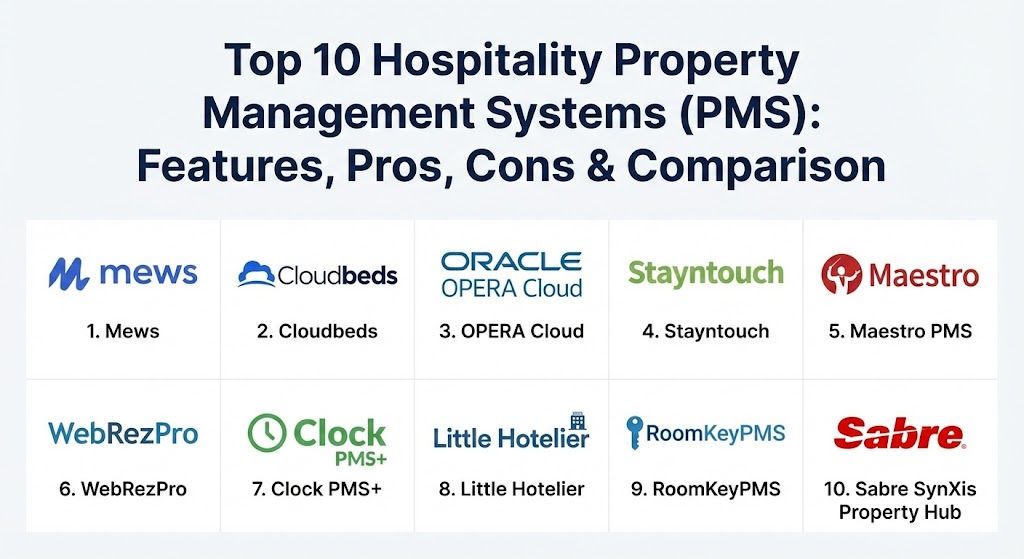
Top 10 Hospitality Property Management Systems (PMS) Tools
1 — Mews
Mews is a cloud-native hospitality platform designed to redefine the guest experience through automation and a “guest-centric” philosophy. It is widely considered a leader in modernizing legacy hotel operations for tech-forward brands.
- Key features:
- Mews Terminals: Fully integrated payment processing that automates all card transactions.
- Mews Kiosk: Self-service check-in/out options to reduce front desk queues.
- Open API: Access to the Mews Marketplace with 600+ integrations.
- Automation Engine: Handles routine tasks like administrative reporting and guest emails.
- Housekeeping App: Real-time room status updates for staff on mobile devices.
- Multi-property Dashboard: Centralized view for management teams overseeing multiple sites.
- Pros:
- Industry-leading user interface that feels like modern consumer software.
- Exceptional automation that significantly reduces manual administrative labor.
- Cons:
- Premium pricing structure compared to budget-focused alternatives.
- Occasional “bugs” reported during the rollout of highly frequent weekly updates.
- Security & compliance: PCI-DSS Level 1, GDPR compliant, SOC 2 Type II, and multi-factor authentication (MFA) support.
- Support & community: “Mews University” provides comprehensive online training; 24/7 technical support is available, along with a thriving community of modern hoteliers.
2 — Cloudbeds
Cloudbeds is an all-in-one hotel management suite that combines a PMS, channel manager, and booking engine into a single platform. It is particularly popular among mid-sized properties looking for an “all-under-one-roof” solution.
- Key features:
- Integrated Channel Manager: Real-time sync with 300+ OTAs like Booking.com and Expedia.
- Commission-Free Booking Engine: Directly integrated into the property’s website.
- PIE (Pricing Intelligence Engine): Automated rate suggestions based on market data.
- Multi-currency & Multi-language: Support for international guests and properties.
- Guest Engagement Tools: Automated SMS and email communication throughout the stay.
- Detailed Financial Reporting: Tracking of RevPAR, ADR, and occupancy metrics.
- Pros:
- Elimination of “overbookings” due to the seamless integration of its channel manager.
- Very easy to set up, making it ideal for properties with limited IT staff.
- Cons:
- Some advanced enterprise customization options are missing.
- Third-party integrations outside their own ecosystem can sometimes be limited.
- Security & compliance: PCI-DSS certified, GDPR compliant, and secure data encryption at rest and in transit.
- Support & community: Offers an extensive knowledge base, webinars, and 24/7 live chat support.
3 — Oracle OPERA Cloud
As the evolution of the industry-standard legacy system, OPERA Cloud is a highly configurable, enterprise-grade PMS designed for large hotel chains and full-service resorts.
- Key features:
- Deep Customization: Thousands of configuration options to suit complex operations.
- Oracle Hospitality Integration Platform (OHIP): Thousands of REST APIs for custom dev.
- Sales & Event Management: Comprehensive tools for group bookings and banqueting.
- Advanced Profile Management: Global guest profiles shared across entire hotel chains.
- Mobile-First Interface: Designed to work across tablets and smartphones for floor staff.
- Comprehensive Reporting: Predictive analytics and “Golden Record” data management.
- Pros:
- Unmatched scalability—if your property grows to 5,000 rooms, OPERA can handle it.
- The most widely recognized system by trained hotel professionals globally.
- Cons:
- High complexity results in a steep learning curve for new employees.
- Implementation times are significantly longer than cloud-native “plug-and-play” tools.
- Security & compliance: Enterprise-level security, SOC 1 & 2, ISO 27001, GDPR, and HIPAA compliance.
- Support & community: Massive global support network; Oracle University offers formal certifications.
4 — Stayntouch
Stayntouch focuses on the “mobile guest journey,” providing a cloud-native PMS that emphasizes self-service and flexibility for both staff and guests.
- Key features:
- Mobile Check-In: Guests can check in via their smartphone before arrival.
- Tablet-Based Front Desk: Staff can check guests in from the lobby or even a shuttle.
- Guest Smart Kiosks: Automated key card dispensing and check-out.
- Streamlined Housekeeping: Instant mobile notifications for room readiness.
- Open API: Easy connectivity with existing hotel tech stacks.
- Upsell Features: Automated prompts for room upgrades and late check-outs.
- Pros:
- Significantly reduces wait times at the front desk through mobile empowerment.
- Minimalistic design makes training staff exceptionally fast.
- Cons:
- Limited advanced reporting features compared to legacy enterprise systems.
- Some users report challenges with complex group booking modifications.
- Security & compliance: PCI-DSS, GDPR, and secure cloud hosting with regular audit logs.
- Support & community: Responsive customer support team and detailed documentation for onboarding.
5 — Maestro PMS
Maestro is a comprehensive PMS that excels in the “resort” and “independent group” space, offering a massive array of built-in modules without requiring third-party add-ons.
- Key features:
- 20+ Integrated Modules: Includes Spa, Activities, Condo, and Club management.
- Yield Management: Sophisticated built-in revenue optimization tools.
- ResWave: Integrated online booking engine for groups and individuals.
- Contactless Mobile Tools: Digital registration and mobile “pre-arrival” forms.
- Real-time Housekeeping: Coordination of cleaning and maintenance tasks.
- Flexible Hosting: Available as a cloud, self-hosted, or hybrid solution.
- Pros:
- The most feature-rich “single-database” system for complex resorts.
- Exceptional customer service and a philosophy of “service-first” support.
- Cons:
- The user interface can feel slightly more “utilitarian” than newer competitors.
- Initial implementation can be daunting due to the sheer volume of modules.
- Security & compliance: PA-DSS certified, GDPR compliant, and strong role-based access controls.
- Support & community: Renowned for their “Diamond Plus” support; very active user community.
6 — WebRezPro
WebRezPro is a powerful, cost-effective cloud PMS designed for all types of lodging, from boutique hotels to campgrounds and vacation rentals.
- Key features:
- Paperless Check-In: Mobile-optimized registration cards and signatures.
- Automated E-mails: Customizable templates for confirmations and post-stay surveys.
- Accounting Integration: Direct export to QuickBooks and other financial tools.
- GDS/OTA Integration: Syncing with major travel sites and wholesalers.
- Unit/Condo Management: Specialized tools for properties with varying owner types.
- Inventory Management: Precise tracking of room types and availability.
- Pros:
- Highly affordable for smaller properties while maintaining robust functionality.
- Known for a very stable and reliable cloud infrastructure.
- Cons:
- The booking engine design is less customizable than some modern competitors.
- Lacks some of the more advanced “AI-driven” revenue management modules.
- Security & compliance: PCI compliant, GDPR ready, and daily data backups with encryption.
- Support & community: Reliable technical support and easy-to-follow online tutorials.
7 — Clock PMS+
Clock PMS+ is a digital-first solution that blends property management with guest engagement tools, aiming to eliminate the gap between the hotel and the traveler.
- Key features:
- MyBooking Portal: A dedicated digital space for guests to manage their own stay.
- Integrated ID/Passport Scanner: Faster registration using mobile device cameras.
- Payment Automation: Instant capture of deposits and pre-authorizations.
- Advanced Rate Management: Rule-based pricing based on occupancy levels.
- Restaurant POS: Built-in point-of-sale for hotel bars and cafes.
- Event Management: Basic banquet and meeting room scheduling.
- Pros:
- Outstanding focus on the digital guest journey (web check-in, app-less guest portal).
- Excellent value-for-money, as it includes many “premium” features in the base price.
- Cons:
- The interface, while powerful, has a slightly higher learning curve for housekeeping.
- Limited marketplace of integrations compared to Mews.
- Security & compliance: PCI-DSS, 3D Secure 2, GDPR, and ISO-standard hosting.
- Support & community: High-quality onboarding support and regular feature updates.
8 — Little Hotelier
Little Hotelier is the “small property” specialist branch of SiteMinder, designed specifically for bed and breakfasts, inns, and small guest houses.
- Key features:
- Simple Calendar View: Manage all bookings from a single, intuitive screen.
- Front Desk App: Manage your entire property from a smartphone.
- Website Builder: Create a professional hotel website in minutes.
- Direct Booking Engine: Convert website visitors without paying commissions.
- Basic Reporting: Simple insights into occupancy and revenue.
- Automatic Sync: Connection to 400+ OTAs via SiteMinder technology.
- Pros:
- The most user-friendly system for non-technical property owners.
- Quickest time-to-value; you can be “live” and taking bookings in a day.
- Cons:
- Lacks advanced features like complex group billing or spa management.
- Not suitable for properties with more than 30-50 rooms.
- Security & compliance: PCI compliant and basic data privacy controls.
- Support & community: Helpful community forums and 24/7 email/chat support.
9 — RoomKeyPMS
RoomKeyPMS is a cloud-based solution that emphasizes “connecting” with the guest to drive higher direct revenue and loyalty.
- Key features:
- Integrated CRM: Deep tracking of guest history and preferences.
- Mobile Guest App: Communication and check-in via a branded application.
- Online Distribution: Strong connections to GDS and top travel sites.
- Financial Reconciliation: Automated night audit and payment processing.
- Dynamic Upselling: Prompts for room upgrades during the booking process.
- Performance Dashboards: Visual representation of property health.
- Pros:
- Strong emphasis on guest retention and loyalty marketing tools.
- The support team is highly rated for their “hotelier-to-hotelier” approach.
- Cons:
- Some users find the reporting module could be more “drag-and-drop” friendly.
- The system can occasionally experience slowness during peak data syncs.
- Security & compliance: PCI-DSS, GDPR, and encrypted tokenization for payments.
- Support & community: Known for high-touch customer service and professional training.
10 — Sabre SynXis Property Hub
SynXis Property Hub is part of the massive Sabre ecosystem, designed to provide a unified platform for distribution and property management for large hotels.
- Key features:
- Unified Distribution: Deep integration with the SynXis Central Reservation System (CRS).
- Bulk Reservation Management: Efficiently handle large tour groups and air crews.
- Cloud-Native Architecture: Accessible from any browser with zero installation.
- Automated Task Management: Intelligent scheduling for maintenance and cleaning.
- Guest Profile Sharing: Access to guest data across the Sabre network.
- Real-time Inventory: Precise room control across all sales channels.
- Pros:
- Best-in-class for hotels that rely heavily on Global Distribution Systems (GDS).
- Streamlined workflows for check-in and billing that boost staff productivity.
- Cons:
- Can be technically complex for smaller, independent properties.
- Some users report occasional system “freezes” during high-volume updates.
- Security & compliance: Enterprise-grade security, FIPS 140-2, and global compliance standards.
- Support & community: 24/7 global support desk and dedicated account management for enterprise clients.
Comparison Table
| Tool Name | Best For | Platform(s) Supported | Standout Feature | Rating (Gartner/TrueReview) |
| Mews | Tech-Forward Hotels | Cloud (Web/Mobile) | Marketplace Integrations | 4.7 / 5 |
| Cloudbeds | Mid-Sized Properties | Cloud (Web/Mobile) | All-in-One Integration | 4.6 / 5 |
| Opera Cloud | Large Enterprise Chains | Cloud (Web/Mobile) | Unmatched Configuration | 4.2 / 5 |
| Stayntouch | Mobile Guest Journey | Cloud (Tablet/Mobile) | Mobile Check-In | 4.5 / 5 |
| Maestro PMS | Full-Service Resorts | Cloud/On-Prem/Hybrid | Built-in Resort Modules | 4.8 / 5 |
| WebRezPro | Value & Flexibility | Cloud (Web/Mobile) | Unit/Condo Support | 4.5 / 5 |
| Clock PMS+ | Digital Engagement | Cloud (Web/Mobile) | MyBooking Guest Portal | 4.6 / 5 |
| Little Hotelier | B&Bs and Small Inns | Cloud (Web/Mobile) | Simplicity & Mobile App | 4.4 / 5 |
| RoomKeyPMS | Loyalty & Guest CRM | Cloud (Web/Mobile) | Integrated Guest CRM | 4.3 / 5 |
| SynXis Hub | GDS-Heavy Hotels | Cloud (Web/Mobile) | CRS Integration | 4.4 / 5 |
Evaluation & Scoring of Hospitality Property Management Systems (PMS)
When selecting a PMS, we recommend using a weighted rubric to ensure the system aligns with your property’s specific priorities.
| Category | Weight | Evaluation Criteria |
| Core Features | 25% | Booking engine, front desk ops, housekeeping, and basic reporting. |
| Ease of Use | 15% | Intuitive UI, mobile accessibility, and training time for new staff. |
| Integrations | 15% | Connection to OTAs, GDS, Payment Gateways, and POS systems. |
| Security | 10% | PCI-DSS compliance, GDPR/Data privacy, and audit trails. |
| Reliability | 10% | Cloud uptime, system speed, and frequency of technical bugs. |
| Support | 10% | 24/7 availability, quality of documentation, and community resources. |
| Price / Value | 15% | Total cost of ownership vs. revenue-generating potential (e.g., upsells). |
Which Hospitality Property Management Systems (PMS) Tool Is Right for You?
The “perfect” PMS depends entirely on your property type and your future growth goals.
- Solo Owners vs. SMB: If you manage a small B&B or a few vacation rentals, Little Hotelier or WebRezPro offer the best balance of simplicity and cost. They provide everything you need without the “enterprise bloat.”
- Mid-Market Hotels: For boutique hotels or mid-sized properties (50-150 rooms), Cloudbeds is excellent for its integrated approach, while Mews is the winner if you want to push the boundaries of guest-facing automation.
- Enterprise & Resorts: Large-scale resorts with spas, golf courses, and multiple F&B outlets should look toward Maestro PMS or Opera Cloud. These systems are designed to handle the high volume and complexity of multi-departmental billing.
- Budget-Conscious Solutions: If cost is the primary driver, WebRezPro remains a standout for offering enterprise-grade features at a fraction of the cost of its premium rivals.
- Integration & Scalability: If you plan on building a custom “tech stack” with various niche apps, Mews and Stayntouch offer the most “open” environments for developers to integrate third-party tools.
Frequently Asked Questions (FAQs)
1. What is the difference between a cloud PMS and a legacy PMS?
A cloud PMS is hosted on the vendor’s servers and accessed via the internet, offering remote access and lower IT costs. A legacy PMS is usually hosted on-site, requiring physical servers and manual updates.
2. Can a PMS help me reduce commissions paid to OTAs?
Yes. Most modern PMS tools include a “Direct Booking Engine” for your website, allowing guests to book directly with you, which eliminates the 15-20% commission typically charged by Booking.com or Expedia.
3. Is it difficult to switch from one PMS to another?
It is a significant project. It involves migrating guest data, room history, and future reservations. Most vendors offer “migration services” to handle the data transfer and staff training.
4. Does a PMS manage housekeeping?
Yes. Modern systems include a housekeeping module where room attendants can use a smartphone to mark a room as “clean,” which instantly updates the front desk dashboard for check-ins.
5. Is PCI compliance important for my hotel?
Absolutely. If you handle guest credit card data, you must be PCI-DSS compliant. Using a PMS that “tokenizes” card data ensures that sensitive information is never actually stored on your local computers.
6. What is a “Channel Manager”?
It is a tool (often built into the PMS) that automatically updates your room availability across all booking sites. If a room is booked on your website, it is instantly removed from Expedia to prevent overbookings.
7. Can I manage multiple properties with one PMS?
Yes, most enterprise and mid-market systems offer “Multi-Property” dashboards, allowing management to see occupancy and revenue trends across an entire portfolio from one login.
8. Do I need a PMS if I only have five rooms?
While you can manage five rooms manually, a simple PMS like Little Hotelier will save you hours of work by automating guest emails, payments, and OTA updates.
9. How long does it take to train staff on a new PMS?
For modern cloud systems (Mews, Stayntouch), basic training can take as little as a few days. For complex enterprise systems (OPERA), it can take several weeks of formal training.
10. What are “open APIs” in the context of hospitality?
An open API allows your PMS to “talk” to other software. For example, your PMS could automatically send a notification to a “smart lock” system to generate a digital key for a guest upon check-in.
Conclusion
Choosing a Hospitality Property Management System is one of the most consequential decisions a hotelier will make. In 2026, the trend is clear: the industry is moving toward automation, mobile empowerment, and guest self-service. While Opera Cloud remains the heavyweight for massive chains, and Mews leads the charge for tech-focused boutiques, the “best” tool is the one that removes friction from your specific operations. Prioritize a system that integrates seamlessly with your existing tools and empowers your staff to focus on what matters most—delivering exceptional hospitality.