Introduction
Catering Management Software is a specialized suite of tools designed to centralize and automate every aspect of a catering operation. Unlike general restaurant Point of Sale (POS) systems, these platforms focus on the unique “event-based” nature of catering, where orders are often placed weeks in advance, customized for specific headcounts, and delivered to remote locations. These tools provide a “single source of truth” for everything from lead generation and digital proposals to kitchen production sheets and final invoicing.
The importance of these tools lies in their ability to protect profit margins through precise food costing and to reduce human error through automated reminders and synchronized calendars. Key real-world use cases include managing high-volume corporate lunch drop-offs, orchestrating complex multi-course wedding banquets, and tracking inventory across various prep kitchens. When evaluating software, users should look for intuitive menu builders, integrated payment processing, robust CRM capabilities, and mobile accessibility for on-site staff.
Best for: Catering companies of all sizes, hotel banquet departments, corporate dining services, and specialized food service providers (like florists who offer catering or wedding planners). It is particularly beneficial for businesses looking to scale their operations without exponentially increasing their administrative headcount.
Not ideal for: Small, independent cafes that only do occasional “one-off” sandwich platters or traditional dine-in restaurants with no dedicated catering division. For these businesses, a simple add-on to their existing POS or a basic project management tool may be more cost-effective.
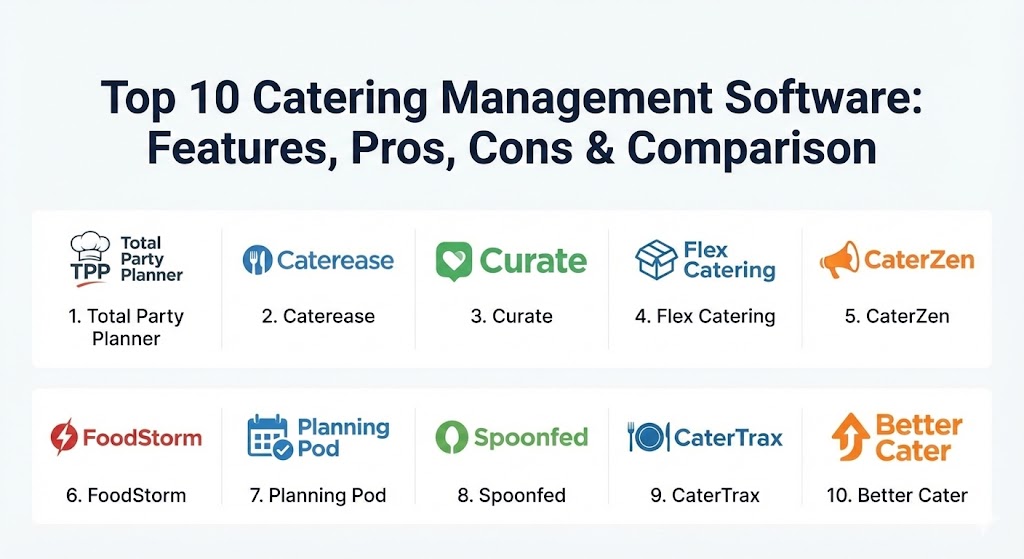
Top 10 Catering Management Software Tools
1 — Total Party Planner
Total Party Planner (TPP) is a cloud-based catering software developed by industry veterans. It is designed to act as an all-in-one operations hub, focusing heavily on protecting the “bottom line” through deep financial insights and recipe costing.
- Key features:
- Advanced recipe costing with real-time price updates for ingredients.
- Automated generation of production sheets, pack lists, and shopping lists.
- Integrated CRM for tracking client history, preferences, and communications.
- Customizable digital proposals and contracts with e-signature support.
- Comprehensive reporting dashboard for sales, costs, and profit margins.
- Calendar sync with popular platforms like Google and Outlook.
- Integrated payment processing to streamline accounts receivable.
- Pros:
- Built by caterers, for caterers, ensuring the workflow matches real-world needs.
- Exceptional customer support and “white-glove” onboarding experience.
- Cons:
- The interface, while functional, can feel slightly dated compared to newer SaaS rivals.
- Steeper learning curve for users who are not already familiar with catering terminology.
- Security & compliance: Uses enterprise-grade encryption for all data; PCI-DSS compliant for payment processing; GDPR compliant features for data privacy.
- Support & community: Offers extensive video tutorials, a dedicated account manager for higher tiers, and a very active user community that shares best practices.
2 — Caterease
Caterease is widely considered an industry heavyweight, offering a massive feature set that can be tailored to businesses ranging from small boutiques to massive hotel chains. It is known for its extreme level of customization.
- Key features:
- Highly customizable displays and print templates for any document type.
- Advanced staff scheduling with conflict alerts and mobile app access.
- Robust menu management with “drag-and-drop” functionality.
- Integrated diagramming tools for event floor plans.
- Powerful inquiry tracking to convert more leads into bookings.
- Mobile app that allows staff to access event details from the field.
- Query tools to generate hyper-specific reports on any data point.
- Pros:
- Unmatched flexibility; if you want a specific workflow, Caterease can usually build it.
- Scalable architecture that grows from a single user to a multi-site enterprise.
- Cons:
- The sheer volume of features can be overwhelming for new or small users.
- Pricing can become expensive as you add various modules and seats.
- Security & compliance: SOC 2 Type II certified; data encryption at rest and in transit; SSO (Single Sign-On) support for enterprise clients.
- Support & community: Comprehensive documentation; tiered support plans including 24/7 emergency assistance; regular “Caterease Regional Training” events.
3 — Curate
Curate takes a modern, visual-first approach to catering management. It is designed to make the proposal process as beautiful and fast as possible, which is a major differentiator for caterers focusing on high-end social events and weddings.
- Key features:
- Visually rich, interactive digital proposals that include images and videos.
- Real-time profitability analysis as you build a menu for a client.
- Automated ingredient “shopping lists” derived directly from the proposal.
- Integrated payment processing and automated payment reminders.
- Task management system for team collaboration.
- Simplified CRM to manage leads through a visual sales pipeline.
- Rental inventory tracking to ensure equipment isn’t double-booked.
- Pros:
- Dramatically reduces the time it takes to create a professional proposal.
- Modern, “SaaS-native” interface that is extremely intuitive to navigate.
- Cons:
- Lacks some of the deep back-office production features found in TPP or Caterease.
- Not ideal for high-volume corporate “drop-off” catering with hundreds of daily orders.
- Security & compliance: Secure cloud hosting; PCI compliant; standard SSL/TLS encryption for all client-facing portals.
- Support & community: High marks for responsiveness; includes a library of “Curate University” videos and templates.
4 — Flex Catering
Flex Catering focuses on the “flexibility” of modern catering models, specifically those that combine traditional event catering with a heavy volume of online ordering and corporate drop-offs.
- Key features:
- Advanced online ordering website that integrates directly with the back-end.
- Modular system architecture—pay only for the features you need.
- Integrated delivery management with driver routing and tracking.
- Corporate client portals for self-service ordering and house accounts.
- Real-time inventory tracking with multi-supplier direct ordering.
- Automated allergen and nutritional labeling for all menu items.
- Multi-location management for caterers with several kitchens or brands.
- Pros:
- The best online ordering interface in the catering-specific software market.
- Excellent for B2B corporate catering where recurring orders are common.
- Cons:
- May feel “too modular” for users who just want a single, simple price for everything.
- Implementation takes time due to the deep integration between the website and the back-end.
- Security & compliance: GDPR and HIPAA compliant; uses OAuth2 for secure integrations; PCI-DSS compliant.
- Support & community: Strong technical documentation; personalized onboarding sessions; active developer API for custom integrations.
5 — CaterZen
CaterZen differentiates itself by focusing on the “marketing and sales” side of catering. It is designed for businesses that want to aggressively grow their revenue through automation and database mining.
- Key features:
- Built-in CRM with automated “re-order” reminders for corporate clients.
- Integrated email marketing engine with pre-designed catering templates.
- “Catering Call Tracking” to monitor the effectiveness of sales staff.
- Online ordering system designed specifically for catering (not just a restaurant add-on).
- Automated “Thank You” and loyalty programs for repeat customers.
- Delivery management with driver app and GPS tracking.
- Proposal generator with integrated e-signatures.
- Pros:
- Unique focus on sales and marketing that helps businesses actually find new clients.
- Very cost-effective for the breadth of automation it provides.
- Cons:
- The production and kitchen management features are less robust than competitors.
- The UI can feel cluttered due to the high density of marketing tools.
- Security & compliance: Secure data centers; regular third-party security audits; standard encryption protocols.
- Support & community: Known for high-energy customer service; offers “CaterZen Coaching” to help users grow their business.
6 — FoodStorm
FoodStorm is a powerhouse in the retail and grocery catering space. It is specifically built to handle the complexity of large-scale production where hundreds of small orders are processed through multiple fulfillment points.
- Key features:
- High-volume production forecasting and “bulk prep” lists.
- Deep integration with grocery POS systems and e-commerce platforms.
- Advanced customer portals for retail catering pickup and delivery.
- Real-time demand insights to optimize kitchen staffing.
- Integrated payment processing with support for “house accounts.”
- Automated production scheduling based on pickup/delivery windows.
- Detailed analytics on waste reduction and ingredient utilization.
- Pros:
- The clear leader for retail, grocery, and campus-style catering.
- Extremely stable and reliable under very high transaction volumes.
- Cons:
- Not designed for “event-heavy” caterers (e.g., weddings with complex itineraries).
- Higher starting price point makes it less accessible for small independent startups.
- Security & compliance: ISO 27001 certified; SOC 2 Type II compliant; GDPR ready.
- Support & community: Enterprise-level support with dedicated success managers; comprehensive training portal.
7 — Planning Pod
Planning Pod is unique because it blends “catering management” with “event management.” It is ideal for caterers who also function as full-service event planners or venues.
- Key features:
- Over 30 integrated tools including floor plan designers and guest lists.
- Comprehensive budget tracking and invoicing for entire events.
- Collaborative client portals where hosts can manage RSVPs and menus.
- Task management and team collaboration tools with automated alerts.
- Integrated CRM and lead tracking to manage the sales pipeline.
- Simple menu builder and proposal generator.
- Mobile-responsive design that works across all devices without an app.
- Pros:
- Excellent value for money given the massive suite of event tools included.
- One of the best user interfaces in the industry—clean, modern, and fast.
- Cons:
- The catering-specific features (like recipe costing) are not as deep as TPP.
- Not ideal for “drop-off only” caterers who don’t need the event planning tools.
- Security & compliance: SSO support; PCI-DSS compliant; data backup and encryption standards.
- Support & community: Great self-service knowledge base; active social media presence; responsive email support.
8 — Spoonfed
Spoonfed is an UK-based solution (with global reach) that has specialized in the “corporate drop-off” niche. It is designed to be lean, fast, and highly automated for businesses that do high-frequency, low-complexity orders.
- Key features:
- High-speed online ordering with “smart” delivery window management.
- Automated production planning and kitchen labels.
- Integrated multi-van delivery routing with driver app.
- Customer feedback loops integrated directly into the dashboard.
- Centralized menu sync for multi-site operations.
- Permission-based menus for different corporate clients.
- Robust invoicing system that handles complex corporate billing.
- Pros:
- Exceptional efficiency for corporate lunch and meeting catering.
- Very easy for customers to use, which drives higher online conversion rates.
- Cons:
- Limited features for managing large-scale, multi-course banquet events.
- Primarily focused on order-taking rather than deep inventory or event planning.
- Security & compliance: GDPR compliant; secure payment gateway integrations; data encryption.
- Support & community: Strong presence in Europe and North America; proactive customer success outreach.
9 — CaterTrax
CaterTrax is the go-to solution for institutional and managed food service, such as those found in hospitals, universities, and large corporate campuses.
- Key features:
- Specialized portals for healthcare and education environments.
- Deep compliance and dietary tracking for institutional standards.
- Advanced reporting on cost-per-patient or cost-per-student.
- Integrated inventory control and floor-stock tracking.
- Multi-site management with centralized administrative control.
- Online ordering with “one-click” reordering for frequent users.
- Comprehensive billing that handles internal departmental chargebacks.
- Pros:
- The industry standard for institutional catering and dining services.
- Excellent at handling the complex administrative needs of massive organizations.
- Cons:
- Too complex and “corporate” for small independent catering companies.
- The interface can feel rigid and difficult to customize for creative needs.
- Security & compliance: HIPAA compliant; SOC 2; FIPS 140-2 compatibility; robust audit logs.
- Support & community: Offers dedicated implementation teams; highly structured onboarding process.
10 — Better Cater
Better Cater is a “breath of fresh air” for small caterers. It focuses on doing the basics—proposals, calendars, and invoicing—exceptionally well and at a very accessible price point.
- Key features:
- Simple, mobile-friendly interface designed for speed.
- Professional proposal templates that are easy to edit.
- Event calendar that syncs with your mobile device.
- Basic recipe costing and shopping list generation.
- Integrated online payment processing.
- Client management database for repeat business tracking.
- Task management to keep the team organized on event day.
- Pros:
- Most affordable professional catering software on the market.
- Almost zero learning curve—you can be up and running in an hour.
- Cons:
- Lacks advanced features like delivery routing or deep production analytics.
- Not suitable for very large, multi-location catering enterprises.
- Security & compliance: Standard SSL encryption; PCI-DSS compliant payment processing.
- Support & community: Responsive email support; easy-to-follow getting started guides.
Comparison Table
| Tool Name | Best For | Platform(s) Supported | Standout Feature | Rating (Gartner / TrueReview) |
| Total Party Planner | Recipe Costing / ROI | Web, Mobile | Deep Financial Analytics | 4.8 / 5 |
| Caterease | Large Scale / Hotels | Windows, Web, App | Extreme Customization | 4.5 / 5 |
| Curate | Proposals / Visuals | Web, Mobile | Interactive Proposals | 4.7 / 5 |
| Flex Catering | Online Order / Hybrid | Web, Mobile | B2B Online Portals | 4.6 / 5 |
| CaterZen | Sales / Marketing | Web, App | Marketing Automation | 4.4 / 5 |
| FoodStorm | Retail / Grocery | SaaS, Cloud | Production Forecasting | 4.7 / 5 |
| Planning Pod | Event + Catering | Web, Mobile | All-in-One Event Suite | 4.8 / 5 |
| Spoonfed | Corporate Drop-off | Web, App | Delivery Efficiency | 4.3 / 5 |
| CaterTrax | Campus / Healthcare | Web, SaaS | Institutional Compliance | 4.2 / 5 |
| Better Cater | SMBs / Startups | Web, Mobile | Affordability & Ease | 4.6 / 5 |
Evaluation & Scoring of Catering Management Software
When selecting a tool, it is important to understand the weighted factors that define a “top-tier” solution. The following rubric represents how industry experts typically evaluate these platforms.
| Criteria | Weight | Evaluation Notes |
| Core Features | 25% | Proposal generation, recipe costing, kitchen production lists, and CRM. |
| Ease of Use | 15% | Intuitiveness for staff, mobile accessibility, and UI modernness. |
| Integrations | 15% | Connection to accounting (QuickBooks), POS, and payment processors. |
| Security | 10% | PCI compliance, data encryption, and user permission levels. |
| Performance | 10% | System uptime, loading speeds for large menus, and mobile responsiveness. |
| Support | 10% | Onboarding quality, technical documentation, and response times. |
| Price / Value | 15% | ROI based on time saved and potential for revenue growth. |
Which Catering Management Software Tool Is Right for You?
The “right” software depends entirely on your specific business model and your stage of growth.
- Solo Users & Startups: If you are just starting out, prioritize simplicity and low overhead. Better Cater is the perfect entry point. It gives you professional-looking documents without the high monthly cost of an enterprise system.
- Small to Medium Businesses (SMBs): If you are growing and need to protect your margins, Total Party Planner or Curate are the frontrunners. TPP is better for those who want deep costing, while Curate is better for those who want to “wow” high-end social clients.
- Mid-Market Growth Caterers: If your business is shifting toward corporate lunch drop-offs and B2B accounts, Flex Catering or Spoonfed will provide the automated online ordering and delivery tools you need to stay efficient.
- Large Enterprise & Hotels: For massive operations with hundreds of employees and multi-site kitchens, Caterease or FoodStorm offer the necessary depth and scalability. These platforms require dedicated administrators but provide the most control.
- Security and Compliance: If you operate in healthcare or education, CaterTrax is non-negotiable due to its institutional compliance features. For standard commercial catering, ensure whatever you choose is PCI-compliant and offers granular user permissions to protect your financial data.
Frequently Asked Questions (FAQs)
1. Is catering software different from restaurant POS software?
Yes. Restaurant POS is designed for “on-demand” orders where customers eat immediately. Catering software is designed for “pre-planned” events, requiring tools for proposals, future scheduling, and multi-location logistics.
2. Can I use these tools on my tablet or phone?
Most modern solutions like Planning Pod and Curate are cloud-based and mobile-responsive, meaning they work in any browser. Others like Caterease offer dedicated mobile apps for staff.
3. Does this software help with food safety and allergens?
Yes. Advanced tools like Flex Catering allow you to tag ingredients with allergens, which then automatically populates on your menus, production sheets, and customer-facing labels.
4. How long does it take to get started?
Simple tools like Better Cater take less than an hour. Comprehensive systems like Caterease or TPP usually require 4–8 weeks of onboarding to properly input your recipes and train your team.
5. Do these tools integrate with QuickBooks?
Almost all the top 10 tools offer an integration with QuickBooks Online or Desktop. This ensures that when an invoice is paid in your catering software, your accounting records are updated automatically.
6. Can I build my menus directly in the software?
Yes. Most platforms include a menu builder where you can drag and drop items, set pricing, and even calculate the profit margin based on current ingredient costs.
7. How do these tools help reduce food waste?
By generating exact “shopping lists” based on confirmed headcounts and precise recipes, the software ensures you only buy what you need for each specific event.
8. Is my data secure in the cloud?
Top-tier vendors use enterprise-level data centers with regular backups and encryption. Always check for SOC 2 or similar certifications if you have high security requirements.
9. Can customers pay their deposits online?
Yes. Integrated payment processing is a core feature of most catering tools, allowing clients to pay via credit card or ACH directly through their digital proposal.
10. What happens if I want to switch software later?
Most vendors allow you to export your client lists and menu data in CSV format. However, complex recipe structures and historical event data can be difficult to migrate between different platforms.
Conclusion
The catering industry in 2026 is faster and more data-driven than ever before. Choosing the right management software is no longer about just “digitizing your calendar”—it’s about building a scalable engine for your business. Whether you prioritize beautiful proposals to win high-end weddings or robust delivery tools to dominate the corporate lunch market, the right tool will reduce your administrative burden and protect your profit margins. Remember, the “best” tool isn’t the one with the most features; it’s the one that your team will actually use every single day.