Introduction
Shipping rate management tools are specialized software solutions designed to aggregate, compare, and optimize shipping costs across multiple carriers. These platforms act as a central nervous system for logistics, connecting e-commerce storefronts and ERP systems with global carriers like FedEx, UPS, DHL, and local postal services. By providing real-time rate shopping, automated label generation, and dimensional weight calculations, these tools allow businesses to choose the most cost-effective shipping method for every single package automatically.
The importance of these tools lies in their ability to eliminate manual guesswork and “rate shopping” fatigue. Key real-world use cases include calculating accurate live shipping rates at a website’s checkout to prevent “cart abandonment,” managing high-volume freight negotiations, and automating cross-border documentation for international trade. When evaluating these tools, users should look for deep carrier integration, API uptime, automated rule engines, and robust reporting that identifies long-term spending trends.
Best for: E-commerce retailers, warehouse managers, third-party logistics (3PL) providers, and enterprise supply chain directors who need to manage multi-carrier volumes across different regions.
Not ideal for: Hyper-local businesses using their own delivery fleets or very low-volume sellers who ship fewer than ten items a month, where the subscription cost may outweigh the shipping savings.
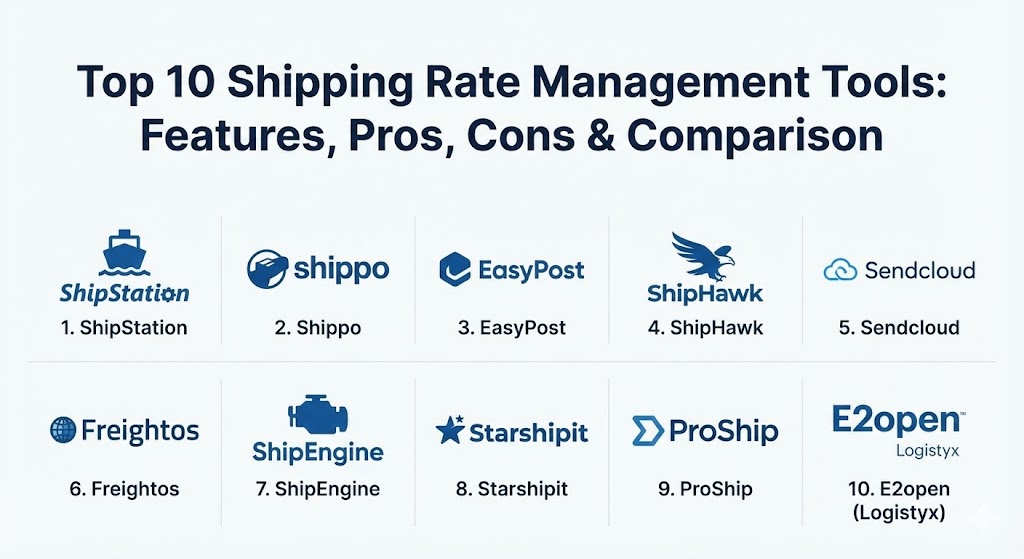
Top 10 Shipping Rate Management Tools
1 — ShipStation
ShipStation is widely regarded as the gold standard for small to medium-sized e-commerce businesses. It offers a highly intuitive web-based interface that consolidates orders from over 100 different marketplaces and shopping carts into one place for easy rate comparison.
- Key features:
- Multi-carrier rate shopping with deep discounts on USPS, UPS, and DHL.
- Automated “Shipping Rules” based on weight, destination, or order value.
- Batch label processing for hundreds of orders simultaneously.
- Branded tracking pages and automated customer notification emails.
- Inventory management and stock level alerts.
- Mobile app for managing shipments and rates on the go.
- Pros:
- Extensive integration library covering almost every major marketplace (Amazon, eBay, Shopify).
- User interface is exceptionally easy to learn for new employees.
- Cons:
- Customer support can be slow on the lower-tier plans.
- Occasionally experiences lag when syncing very large order volumes.
- Security & compliance: SOC 2 Type II compliant, GDPR ready, and uses AES-256 encryption for data at rest.
- Support & community: Comprehensive knowledge base, community forums, and tiered support (email, chat, and phone for higher plans).
2 — Shippo
Shippo is a streamlined, API-first shipping platform that excels in simplicity and scalability. It is particularly popular with growing businesses that want a “pay-as-you-go” model without heavy monthly commitments.
- Key features:
- Instant access to pre-negotiated carrier rates from 85+ global carriers.
- Comprehensive API for custom integrations into proprietary software.
- Automated address validation to reduce “undeliverable” surcharges.
- Support for international customs forms and commercial invoices.
- Return label generation included in the standard workflow.
- Transparent tracking API for real-time delivery updates.
- Pros:
- Excellent “Starter” plan with no monthly fees—only pay per label.
- Very fast setup process that allows businesses to ship within minutes.
- Cons:
- Lacks some of the deep “warehouse management” features found in ShipStation.
- Limited automation rules compared to enterprise-grade competitors.
- Security & compliance: PCI DSS compliant, GDPR compliant, and uses SSO for enterprise accounts.
- Support & community: Email support for all tiers; live chat and dedicated account managers for “Premier” users.
3 — EasyPost
EasyPost is a developer-centric shipping API designed for businesses that want to build their own custom shipping logic. It provides a single integration point for hundreds of carriers, making it highly flexible for complex logistics needs.
- Key features:
- Single “Universal API” for rating, tracking, and label generation.
- “SmartRate” API that provides accurate transit times based on historical data.
- Carbon offset shipping options to meet sustainability goals.
- Real-time tracking webhooks for automated internal status updates.
- High-volume batching capabilities for millions of shipments per month.
- Advanced insurance options for high-value goods.
- Pros:
- Unrivaled uptime and API reliability (99.99%).
- Extremely scalable for high-growth tech companies and marketplaces.
- Cons:
- Not a “plug-and-play” solution; requires developer resources to implement.
- The dashboard is functional but lacks a visual “shipping manager” interface.
- Security & compliance: SOC 2 compliant, GDPR, and HIPAA compliant infrastructure.
- Support & community: Robust API documentation, developer Slack channel, and professional services for enterprise implementation.
4 — ShipHawk
ShipHawk is an enterprise-grade solution that specializes in “Dimensional Shipping.” It is designed for businesses with complex catalogs, including oversized items, furniture, or fragile goods that require specific packing logic.
- Key features:
- Automated packing algorithms that suggest the best box size to minimize dimensional weight.
- Support for both small parcel and LTL (Less Than Truckload) freight.
- Deep integration with NetSuite and other major ERP systems.
- Warehouse management features like “wave picking” and “put-away.”
- Advanced rule engine for multi-origin fulfillment logic.
- Real-time freight rating for oversized items at the point of sale.
- Pros:
- Significant cost savings for businesses shipping heavy or oddly shaped items.
- Bridges the gap between small parcel shipping and heavy freight.
- Cons:
- Much higher price point than entry-level tools like ShipStation.
- Implementation takes longer due to the complexity of the packing logic.
- Security & compliance: SOC 2 Type II, GDPR, and CCPA compliant.
- Support & community: Dedicated implementation managers and 24/7 enterprise technical support.
5 — Sendcloud
Sendcloud is the leading shipping platform for the European market. It is specifically designed to handle the complexities of cross-border European shipping, including different VAT requirements and localized carrier networks.
- Key features:
- Access to 100+ European carriers (DHL, DPD, Royal Mail, PostNL, etc.).
- “Service Point Delivery” options for customers to pick up at local lockers.
- Multi-lingual tracking and return portals.
- Smart “Shipping Rules” based on destination country and parcel size.
- Automated customs documentation for UK-EU shipping (post-Brexit).
- Integrated checkout tool that shows dynamic shipping costs.
- Pros:
- The absolute best tool for businesses primarily targeting the EU and UK markets.
- Excellent focus on the “Post-Purchase” experience with branded returns.
- Cons:
- Limited carrier options for purely US-based domestic shipping.
- Higher tiers are required for full automation capabilities.
- Security & compliance: ISO 27001 certified, GDPR compliant, and hosted on secure EU-based servers.
- Support & community: Multilingual support teams, extensive help center, and localized partner agencies.
6 — Freightos
Freightos is the “Expedia” of the shipping world, but specifically for international freight. While most SRM tools focus on small parcels, Freightos manages the rates for containers, air cargo, and ocean freight.
- Key features:
- Real-time freight marketplace for ocean, air, and trucking.
- Instant quote comparison from hundreds of freight forwarders.
- Digital “Freight Cockpit” for managing global supply chain shipments.
- Automated document management for bills of lading and customs.
- Built-in cargo insurance and financing options.
- Port-to-door tracking for international logistics.
- Pros:
- Brings transparency to the historically opaque freight industry.
- Essential for importers and manufacturers moving goods from Asia or Europe.
- Cons:
- Not designed for small parcel shipping (e.g., individual customer orders).
- Rates fluctuate daily based on global market conditions.
- Security & compliance: Varies by forwarder; platform is SOC 2 and GDPR compliant.
- Support & community: Live freight experts available for chat, 24/7 marketplace support.
7 — ShipEngine
ShipEngine is a “white-label” shipping API owned by the same company as ShipStation. It is designed for developers, SaaS platforms, and large enterprises that want to embed shipping functionality directly into their own products.
- Key features:
- Multi-carrier rate shopping across 100+ carriers.
- Address validation in over 20 countries.
- Label generation for domestic and international shipments.
- Tracking webhooks and real-time status updates.
- Batch processing of up to 10,000 labels in a single request.
- Integration into ERPs, WMSs, and e-commerce platforms.
- Pros:
- Highly modular; only pay for the specific APIs you use (labels vs. tracking).
- Built on the robust infrastructure used by ShipStation and ShippingEasy.
- Cons:
- No user interface; strictly a set of APIs for technical teams.
- Pricing is volume-dependent, which can be difficult to predict.
- Security & compliance: SOC 2 Type II, GDPR, and FIPS 140-2 encryption standards.
- Support & community: Detailed API documentation, GitHub repositories, and developer support tiers.
8 — Starshipit
Starshipit is the leading shipping automation platform for the Australasia region (Australia and New Zealand), providing excellent local carrier support and regional expertise.
- Key features:
- Direct integrations with Australia Post, StarTrack, NZ Post, and Aramex.
- Automatic “Live Rates” at the checkout for Shopify, Magento, and WooCommerce.
- Multi-location fulfillment support for businesses with multiple warehouses.
- Branded tracking pages and SMS notifications.
- Simple “Write-back” to ERPs and marketplaces.
- Automated packing slips and pick lists.
- Pros:
- Deepest localized support for Australian and New Zealand retailers.
- High level of reliability for regional carriers that global tools often ignore.
- Cons:
- Interface feels slightly less modern than ShipStation or Sendcloud.
- Limited focus on the European and North American domestic markets.
- Security & compliance: GDPR and Privacy Act (Australia/NZ) compliant.
- Support & community: Locally-based support teams, online webinars, and active partner network.
9 — ProShip
ProShip is a heavyweight enterprise solution designed for high-volume shippers (millions of packages per year). It focuses on millisecond-level response times and complex, multi-carrier logic.
- Key features:
- On-premise or cloud deployment for maximum control.
- “Millisecond rate shopping” to ensure warehouse throughput isn’t slowed down.
- Support for “Complex Shipments” (Dangerous goods, dry ice, etc.).
- Advanced “Time-in-Transit” logic to optimize for the fastest delivery.
- Native integration with SAP, Oracle, and Manhattan Associates.
- Carrier contract management to ensure negotiated rates are applied.
- Pros:
- The most powerful engine for high-velocity distribution centers.
- Handles extreme complexity that would crash standard SaaS shipping tools.
- Cons:
- Significant upfront investment and ongoing maintenance costs.
- Requires professional services for implementation and updates.
- Security & compliance: ISO 27001, SOC 2, HIPAA, and GDPR compliant.
- Support & community: 24/7 mission-critical support, dedicated engineers, and extensive user training.
10 — E2open (Logistyx)
E2open’s Global Parcel solution (formerly Logistyx) is a global multi-carrier shipping software that focuses on end-to-end supply chain visibility and cost management for the world’s largest enterprises.
- Key features:
- Network of 550+ carriers globally—the largest in the industry.
- “Freight Audit and Payment” to identify overcharges by carriers automatically.
- Predictive analytics for transit times and cost-saving opportunities.
- Compliance management for restricted party screening (international).
- Unified visibility into parcels, LTL, and ocean freight.
- Advanced simulation tools to “test” the impact of adding new carriers.
- Pros:
- Unrivaled global reach for multinational corporations.
- Deep focus on “Logistics Intelligence” rather than just printing labels.
- Cons:
- Far too complex and expensive for small e-commerce sellers.
- User interface is designed for professional logistics analysts.
- Security & compliance: SOC 2, ISO 27001, FedRAMP authorized, and GDPR compliant.
- Support & community: Global enterprise support network, consultative onboarding, and executive education.
Comparison Table
| Tool Name | Best For | Platform(s) Supported | Standout Feature | Rating (Gartner Peer Insights) |
| ShipStation | SMB E-commerce | Cloud / SaaS | 100+ Integrations | 4.6 / 5 |
| Shippo | Startups / Scaleups | Cloud / API | Pay-as-you-go Pricing | 4.5 / 5 |
| EasyPost | Tech Platforms | API-First | SmartRate Accuracy | 4.7 / 5 |
| ShipHawk | Oversized / ERP | Cloud / SaaS | Dimensional Packing | 4.4 / 5 |
| Sendcloud | European Sellers | Cloud / SaaS | Service Point Picker | 4.6 / 5 |
| Freightos | Int’l Freight | Web Marketplace | Ocean/Air Marketplace | 4.4 / 5 |
| ShipEngine | White-label SaaS | API-Only | Modular API Pricing | 4.5 / 5 |
| Starshipit | Australasia Market | Cloud / SaaS | Regional Carrier Depth | 4.7 / 5 |
| ProShip | High-Volume Ent. | On-Prem / Cloud | Millisecond Response | 4.8 / 5 |
| E2open | Global Logistics | Cloud / SaaS | 550+ Carrier Network | 4.3 / 5 |
Evaluation & Scoring of Shipping Rate Management Tools
To determine which tool offers the best value for your specific operation, we use a weighted scoring rubric that prioritizes the core functionality of rate management and integration.
| Category | Weight | Evaluation Criteria |
| Core Features | 25% | Rate shopping, label generation, dimensional logic, and multi-carrier support. |
| Ease of Use | 15% | Intuitive UI, ease of onboarding, and mobile accessibility. |
| Integrations | 15% | Breadth of marketplace, ERP, and WMS connectivity. |
| Security | 10% | Compliance certifications (SOC 2, GDPR) and data encryption. |
| Reliability | 10% | API uptime, server stability, and performance during peak (Black Friday). |
| Support | 10% | Quality of documentation, community forums, and response times. |
| Price / Value | 15% | Transparent pricing relative to the savings generated in shipping costs. |
Which Shipping Rate Management Tool Is Right for You?
Selecting the right tool depends on your technical resources, your volume, and where you are shipping.
- Solo Users & SMBs: If you are a small team running a Shopify or Amazon store, ShipStation is almost always the right starting point due to its ease of use. If your volume is unpredictable, Shippo’s no-monthly-fee plan is an excellent alternative.
- Mid-Market Growth: If you have moved beyond simple parcel shipping and are now dealing with palletized freight or oversized items, ShipHawk is a specialized choice that can save you thousands in dimensional weight surcharges.
- Developer-Led & SaaS: For companies building their own software or marketplaces that need to offer shipping to their users, EasyPost or ShipEngine are the industry leaders in API-first logistics.
- Enterprise & High Volume: If you ship more than 5,000 packages a day, milliseconds matter. ProShip offers the speed and on-premise stability required for high-velocity distribution centers. For global companies needing cross-border compliance and freight auditing, E2open is the comprehensive choice.
- Regional Specialists: If your business is based in the EU, Sendcloud will save you countless hours of cross-border headache. Likewise, Starshipit is the mandatory choice for businesses in the Australia/New Zealand region.
Frequently Asked Questions (FAQs)
1. How much can a shipping rate management tool actually save me?
Most businesses see a 15% to 30% reduction in shipping costs. This comes from accessing pre-negotiated carrier discounts, avoiding manual address errors, and automatically picking the cheapest carrier for every zone.
2. Can I still use my own negotiated carrier rates with these tools?
Yes. All the tools on this list allow you to “Bring Your Own Account” (BYOA). The tool will then compare your private rates against the platform’s discounted rates to find the lowest price.
3. What is “Dimensional Weight” and why does it matter?
Carriers charge based on the space a package takes up, not just its weight. SRM tools like ShipHawk use algorithms to ensure you are using the smallest possible box, preventing you from paying “large package” fees.
4. Do I need a developer to set these up?
Tools like ShipStation and Sendcloud are “no-code” and connect to your store with a few clicks. API-first tools like EasyPost and ShipEngine require a developer to write code to connect the services.
5. How do these tools handle international customs?
The best SRM tools automatically generate commercial invoices and customs declarations. They digitally transmit this data to the carrier, reducing the risk of packages getting stuck in customs.
6. Is it worth using an SRM if I only use one carrier?
Even with one carrier, these tools automate label printing, tracking, and returns. However, the biggest value comes from “Rate Shopping,” where the tool checks multiple carriers to find a cheaper option you might have missed.
7. What happens if the shipping software goes down?
Reliability is key. Leading tools like ShipEngine and EasyPost have 99.99% uptime. For high-volume enterprise users, ProShip offers on-premise installations that can run even if the external internet is unstable.
8. Can these tools help with “Ransomware” or data security?
While not security tools themselves, they handle sensitive customer data. Choosing a SOC 2 compliant tool ensures that customer addresses and order details are handled with enterprise-grade security.
9. Do these tools manage freight (LTL) as well as parcels?
Parcel-focused tools (ShipStation, Shippo) do not typically handle freight. You would need a tool like ShipHawk, ProShip, or Freightos for palletized or container-based shipping.
10. What is a “Shipping Rule”?
A rule is a piece of automation logic. For example: “If an order is over $500 and weighs less than 2lbs, ship via UPS Next Day Air.” These rules save hours of manual decision-making daily.
Conclusion
The “best” shipping rate management tool is the one that removes the most friction from your unique logistics workflow. As global supply chains become more complex and carrier fees more volatile, having a tool that provides real-time visibility and automation is no longer a luxury—it is a requirement for survival. Whether you are just starting out with the simplicity of ShipStation or managing a global empire with E2open, the goal remains the same: deliver the product to the customer as fast as possible, for the lowest possible price, with the highest possible transparency.