Introduction
An Investor Relations (IR) Platform is a specialized suite of software tools designed to manage the complex interactions between a company and the investment community. These platforms serve as a centralized hub for tracking shareholder ownership, managing investor outreach (CRM), hosting virtual events, and maintaining compliant IR websites. In an era of heightened shareholder activism and instant market volatility, these tools are essential for maintaining a “fair” valuation and building long-term trust with both institutional and retail investors.
The importance of these platforms lies in their ability to turn raw market data into actionable intelligence. Real-world use cases include identifying new institutional targets, preparing for activist defense, and automating the distribution of regulatory filings. When evaluating these tools, users should look for depth of data (ownership visibility), ease of reporting, integration with existing web infrastructure, and robust security protocols that satisfy legal departments.
Best for: Public companies (Mid-cap and Large-cap) seeking to scale their investor outreach, Private Equity firms managing complex LP relations, and IROs (Investor Relations Officers) who need to prove the ROI of their engagement strategies.
Not ideal for: Early-stage startups with a handful of angel investors who can be managed via simple email or spreadsheet, or micro-cap companies with extremely limited budgets where a generic CRM might suffice.
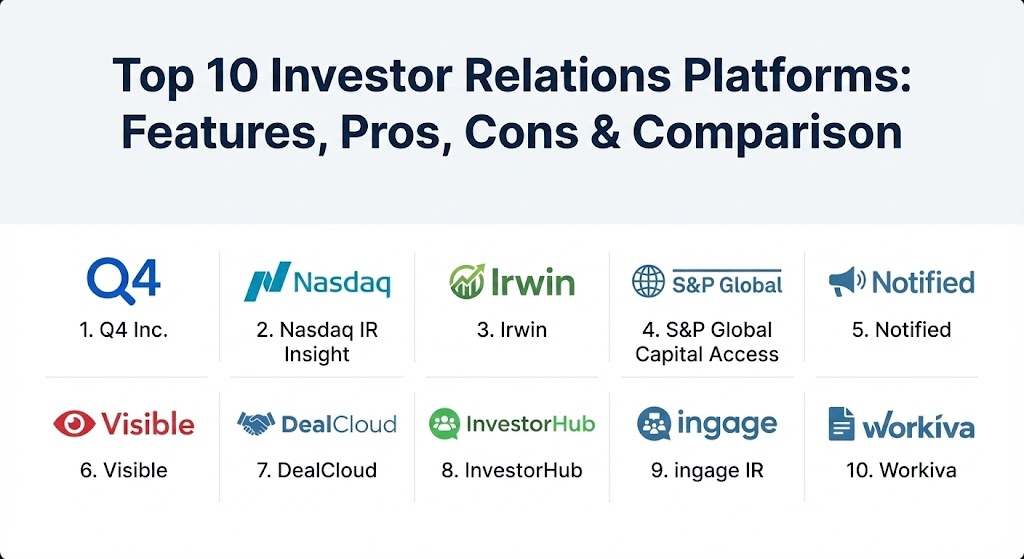
Top 10 Investor Relations Platforms
1 — Q4 Inc.
Q4 is widely considered the industry leader in unified investor relations operations. It offers a comprehensive “end-to-end” experience that combines IR websites, virtual events, and capital markets intelligence into one platform.
- Key features:
- Integrated IR website hosting with automatic news and filing updates.
- Q4 Desktop: A specialized CRM tailored specifically for capital markets.
- Virtual Events platform designed for high-stakes earnings calls and AGMs.
- Advanced shareholder identification and surveillance tools.
- Engagement analytics to see which investors are visiting your site or downloading reports.
- Seamless integration between the website and CRM for tracking “intent” signals.
- Pros:
- The most cohesive user experience; everything is under one roof.
- Exceptional customer service with dedicated success managers for public companies.
- Cons:
- Can be one of the most expensive options on the market.
- The sheer number of features may be overwhelming for a one-person IR team.
- Security & compliance: SOC 2 Type II, GDPR compliant, SSO integration, and 256-bit encryption for all data in transit.
- Support & community: 24/7 global support, a dedicated “Q4 Community” for IROs, and extensive white-glove onboarding.
2 — Nasdaq IR Insight
Leveraging its position as a global exchange, Nasdaq offers a powerful intelligence platform that focuses heavily on shareholder analytics, market surveillance, and direct targeting.
- Key features:
- Deep institutional ownership data powered by Nasdaq’s proprietary market feeds.
- Advanced targeting algorithms to find the “next best” investor for your story.
- Integrated CRM with mobile accessibility for roadshows.
- Real-time market sentiment analysis and peer benchmarking.
- Seamless connection to Nasdaq’s webcasting and disclosure services.
- Pros:
- Unrivaled data accuracy due to its direct connection to exchange data.
- Excellent for large-cap companies that need deep market surveillance to track trading patterns.
- Cons:
- The interface can feel data-heavy and less “modern” than SaaS-native competitors.
- Higher pricing tiers for the most advanced surveillance modules.
- Security & compliance: ISO 27001, SOC 2, and rigorous compliance standards required for a global financial exchange.
- Support & community: Access to Nasdaq’s global network of analysts and a dedicated service team for exchange-listed companies.
3 — Irwin
Irwin has disrupted the IR market by focusing on modern UX and ease of use. It is designed to be a high-speed, intuitive CRM and targeting tool for the modern IR professional who doesn’t want to spend hours in training.
- Key features:
- Automated shareholder monitoring and identification.
- Highly intuitive CRM with drag-and-drop workflow management.
- “Smart Targeting” that uses AI to match your company profile with institutional mandates.
- Itinerary and roadshow management tools with mobile sync.
- Seamless data integration from major financial providers like FactSet.
- Pros:
- Much faster to implement and learn than legacy platforms.
- Excellent value-to-price ratio for small and mid-cap companies.
- Cons:
- Does not offer its own webcasting/website hosting natively (usually integrates).
- Smaller historical data set compared to giants like S&P or Nasdaq.
- Security & compliance: SOC 2 Type II, GDPR, and robust role-based access controls.
- Support & community: Known for highly responsive customer support and a simplified onboarding process.
4 — S&P Global Capital Access
Built on the backbone of the Capital IQ database, S&P Global’s platform is the gold standard for financial intelligence. It is the go-to for IR teams that prioritize deep fundamental data.
- Key features:
- Access to the full Capital IQ institutional database and analyst estimates.
- Sophisticated targeting based on specific investment styles and mandates.
- Integrated CRM that links directly to S&P’s global contact directory.
- Powerful peer analysis and valuation modeling tools.
- Multi-asset class coverage for companies with complex debt/equity structures.
- Pros:
- The “gold standard” for data depth; if an investor exists, they are in here.
- Excellent Excel plugin for custom financial modeling and reporting.
- Cons:
- High complexity; requires a significant amount of training to master.
- Expensive, especially if you add multiple user seats and data modules.
- Security & compliance: ISO 27001, SOC 1/2, and global regulatory compliance for financial data providers.
- Support & community: Global 24/7 support with access to subject matter experts for data-specific queries.
5 — Notified (formerly Intrado)
Notified focuses on the “communications” side of IR, offering a world-class platform for press release distribution (GlobeNewswire), webcasting, and social media monitoring.
- Key features:
- GlobeNewswire integration for direct regulatory and media disclosure.
- High-reliability webcasting platform used for thousands of earnings calls.
- Media monitoring to track sentiment across news sites and social platforms.
- IR Website hosting with a focus on multimedia and video integration.
- ESG (Environmental, Social, and Governance) reporting modules.
- Pros:
- Best-in-class for disclosure and distribution; essential for getting news out fast.
- Very reliable technical infrastructure for live video and audio events.
- Cons:
- Its CRM and targeting features are not as deep as Nasdaq or S&P.
- Pricing can feel fragmented as it’s often sold in separate modules.
- Security & compliance: SOC 2, HIPAA (for relevant segments), and GDPR compliant.
- Support & community: 24/7 technical event support which is critical during live earnings calls.
6 — Visible
Visible is the leading platform specifically designed for private companies and venture-backed startups to manage their investor reporting and relationship management.
- Key features:
- Automated data collection from internal systems (QuickBooks, Xero, etc.).
- Beautifully designed investor update templates and dashboards.
- “Investor CRM” to track potential leads for future funding rounds.
- Secure data room for sharing sensitive financial documents during due diligence.
- Net Promoter Score (NPS) and engagement tracking for existing investors.
- Pros:
- Optimized for the unique needs of private companies (KPI tracking vs. stock ticker tracking).
- Very user-friendly and aesthetically pleasing for high-growth startups.
- Cons:
- Not suitable for public companies requiring SEC filing integration or stock surveillance.
- Limited institutional database compared to public market tools.
- Security & compliance: SOC 2, encryption at rest and in transit, and robust privacy controls.
- Support & community: Strong content library on “how to write a great investor update” and active startup community.
7 — DealCloud (by Intapp)
DealCloud is the premier CRM for the private capital markets, specifically tailored for Private Equity (PE) and Venture Capital (VC) firms managing Limited Partner (LP) relations.
- Key features:
- Complex relationship mapping to track “who knows whom” across firms.
- Fundraising and pipeline management for new funds.
- Institutional-grade reporting for LP performance updates.
- Deep integration with Microsoft Outlook and the Office suite.
- Specialized ESG and compliance tracking for private portfolios.
- Pros:
- The most powerful CRM for relationship-heavy private equity workflows.
- Highly customizable to fit the specific “deal-flow” of a firm.
- Cons:
- Very high cost and long implementation period.
- Requires a dedicated administrator to maintain the system’s data integrity.
- Security & compliance: SOC 2 Type II, ISO 27001, and advanced audit logging for compliance-heavy environments.
- Support & community: High-touch enterprise support with a focus on the global financial services industry.
8 — InvestorHub
InvestorHub is a modern platform that focuses on Retail Investor Engagement. In the age of “meme stocks” and democratized trading, it helps companies build a community around their stock.
- Key features:
- Digital hub for direct-to-investor communication and newsletters.
- Verified shareholder Q&A tools (similar to Say Technologies).
- Analytics on retail investor sentiment and engagement.
- Automated social media distribution for corporate updates.
- Integrated “Subscribe” features to build a first-party investor database.
- Pros:
- Excellent for companies with a large retail base (e.g., consumer brands, tech).
- Helps IROs capture data on retail investors that traditional surveillance misses.
- Cons:
- Does not replace the need for an institutional CRM or targeting tool.
- Still a relatively niche focus compared to all-in-one platforms.
- Security & compliance: GDPR, standard web encryption, and secure email authentication.
- Support & community: Innovative focus on community building; offers great strategy advice for retail engagement.
9 — ingage IR
ingage is a London-based platform that has gained significant traction by providing a clean, efficient CRM and meeting management tool for quoted companies and pre-IPO firms.
- Key features:
- Streamlined meeting and roadshow management.
- Direct feedback loops from investors and analysts post-meetings.
- Integrated institutional contact database.
- Mobile-first design for executives who are constantly traveling.
- Secure document sharing and investor portal capabilities.
- Pros:
- Very focused on “doing one thing well”—managing the IR calendar and meetings.
- Clean, uncluttered UI that executives actually enjoy using.
- Cons:
- Lacks the deep surveillance and market data found in Nasdaq or S&P.
- Less brand recognition in the North American market compared to Q4.
- Security & compliance: ISO 27001, GDPR, and secure cloud hosting.
- Support & community: High-touch service with a personal feel, particularly strong in the European and UK markets.
10 — Workiva
Workiva is the undisputed leader in SEC compliance and financial reporting. While not a “traditional” IR platform, it is the engine that powers the data IR teams present to the world.
- Key features:
- Integrated platform for 10-K, 10-Q, and 8-K filings.
- Wdesk: Collaborative document editing with “linked data” to ensure consistency.
- ESG reporting and sustainability disclosure management.
- Audit-ready record keeping and version control.
- Direct connection to XBRL and Inline XBRL tagging requirements.
- Pros:
- The industry standard for financial reporting; if your CFO uses it, IR should too.
- Eliminates manual errors by linking data from spreadsheets directly into IR presentations.
- Cons:
- It is a reporting tool, not an investor targeting or CRM platform.
- High price point for the full compliance suite.
- Security & compliance: FedRAMP, SOC 1/2, ISO 27001, and bank-grade security protocols.
- Support & community: Massive user community and a professional services team for complex filings.
Comparison Table
| Tool Name | Best For | Platform(s) Supported | Standout Feature | Rating (Gartner/TrueReview) |
| Q4 Inc. | Unified IR Ops | Web, Mobile, Desktop | All-in-One Integrated Suite | 4.7 / 5 |
| Nasdaq IR Insight | Market Surveillance | Web, Mobile, Desktop | Proprietary Exchange Data | 4.5 / 5 |
| Irwin | SMB & Modern UX | Web, Mobile | AI Smart Targeting | 4.8 / 5 |
| S&P Global | Deep Data Analytics | Desktop (CapIQ), Web | Gold Standard Financial Data | 4.6 / 5 |
| Notified | Disclosure & Events | Web, Cloud | GlobeNewswire Integration | 4.4 / 5 |
| Visible | Private Companies | Web, SaaS | Automated KPI Reporting | 4.7 / 5 |
| DealCloud | PE & VC Firms | Web, Mobile, Outlook | Relationship Intelligence | 4.6 / 5 |
| InvestorHub | Retail Engagement | Web, SaaS | Direct-to-Retail Community | 4.5 / 5 |
| ingage IR | Meeting Management | Web, Mobile | Clean Executive Interface | 4.3 / 5 |
| Workiva | SEC Compliance | Cloud, Desktop | Linked Data Technology | 4.9 / 5 |
Evaluation & Scoring of Investor Relations Platforms
We have scored these platforms based on a weighted rubric to help you identify where each tool excels.
| Category | Weight | Top Performer | Scoring Rationale |
| Core Features | 25% | Q4 Inc. | Comprehensive breadth from websites to CRM and intelligence. |
| Ease of Use | 15% | Irwin | Minimal learning curve and high-speed UI for modern teams. |
| Integrations | 15% | Workiva | Essential connection between raw financial data and filings. |
| Security | 10% | Nasdaq | Backed by exchange-grade infrastructure and protocols. |
| Performance | 10% | Notified | Unbeatable reliability for high-stakes live webcasts. |
| Support | 10% | S&P Global | Global expert network available for complex data queries. |
| Price / Value | 15% | Visible | Perfect price point for growing private companies. |
Which Investor Relations Platform Is Right for You?
Selecting the right IR platform is a strategic decision that depends on your company’s stage and stakeholder base.
- Solo IRO vs. Small Team: If you are a one-person shop at a mid-cap company, Irwin or ingage offer the efficiency you need without the bloat of an enterprise suite.
- Large-Cap Public Companies: For teams managing multi-billion dollar market caps, the data depth of S&P Global combined with the surveillance of Nasdaq is often the required combo.
- Budget-Conscious vs. Premium: If budget is no object and you want a single vendor, Q4 Inc. is the premium “concierge” choice. For those looking for value, a combination of a basic CRM and a tool like InvestorHub for engagement can be more cost-effective.
- Private vs. Public: Visible is the clear winner for private companies, while DealCloud is the mandatory choice for PE firms managing fund-level relations.
- Compliance Priority: If your biggest headache is regulatory filings and ensuring the “numbers match” across every document, Workiva is an essential addition to your stack regardless of which CRM you choose.
Frequently Asked Questions (FAQs)
1. What is the main difference between an IR CRM and a sales CRM like Salesforce?
A sales CRM tracks customers and revenue. An IR CRM is pre-loaded with an institutional database (fund managers, analysts) and tracks ownership, share buybacks, and regulatory mandates.
2. Can I manage IR with just a spreadsheet?
Technically yes, but you lose out on real-time ownership updates, targeting intelligence, and the audit trail required for compliance with SEC or local exchange rules.
3. How do these platforms track who is buying my stock?
Most use “Surveillance” which combines public 13F filings with real-time settlement data and “voter” data to provide a near real-time estimate of your top holders.
4. Are these platforms useful for IPO-bound companies?
Yes. Modern platforms like Irwin and Q4 have “Pre-IPO” modules that help teams build an institutional pipeline before the roadshow begins.
5. How much do Investor Relations platforms cost?
Pricing is rarely transparent, but small-cap packages often start around $10,000–$15,000 annually, while large-cap enterprise suites can exceed $100,000.
6. Do these tools help with ESG reporting?
Most modern platforms (especially Q4, Notified, and Workiva) now have dedicated ESG modules to help companies track and report on sustainability metrics to investors.
7. Can an IR platform help prevent shareholder activism?
While it can’t “prevent” it, tools like Nasdaq or S&P provide early warning signs of aggressive buying patterns, allowing boards to prepare a defense.
8. Is data security really that important for IR?
Yes. IR platforms hold non-public material information (earnings drafts, targeting lists). A breach can lead to insider trading or significant legal liability.
9. Do these platforms integrate with my corporate website?
Yes, most (like Q4 and Notified) offer “IR Room” widgets or full hosting to ensure your website’s financial data is automatically synced.
10. What is the learning curve for these tools?
Modern SaaS tools like Irwin can be learned in a day, while legacy platforms like Capital IQ or Nasdaq IR Insight may require several days of professional training.
Conclusion
The “best” Investor Relations platform is the one that aligns with your company’s specific narrative and resource level. Public companies seeking a seamless, high-touch experience will find Q4 Inc. unbeatable, while data-hungry analysts will gravitate toward S&P Global. For the rising tide of private companies, Visible has redefined how startups talk to their backers. Ultimately, the goal of these tools is to remove the “noise” of the market, allowing you to build authentic, transparent relationships with the people who fund your company’s future.