Introduction
Tax compliance software is a specialized category of financial technology designed to automate the calculation, collection, reporting, and filing of various taxes, including sales tax, Value Added Tax (VAT), Goods and Services Tax (GST), and corporate income tax. By integrating directly with your ERP, e-commerce platform, or billing system, these tools determine the correct tax rate in real-time based on the customer’s precise location and the specific taxability of the product or service being sold.
The importance of these tools lies in risk mitigation. Authorities are increasingly using AI-driven audits to find discrepancies; tax compliance software provides a “defensible” audit trail and ensures accuracy that human teams simply cannot match at scale. Key real-world use cases include managing “Economic Nexus” (tracking when you’ve sold enough in a state to trigger tax obligations), handling tax-exempt certificates for B2B sales, and automating the “remittance” process where the software actually files the returns on your behalf. When evaluating these tools, users should prioritize jurisdictional coverage, the speed of their calculation engine, and the robustness of their integration ecosystem.
Best for: E-commerce retailers, SaaS providers, global enterprises, and mid-market companies that operate in multiple tax jurisdictions or sell digital products. It is indispensable for finance teams looking to reduce manual overhead and avoid the heavy penalties associated with non-compliance.
Not ideal for: Micro-businesses that operate strictly out of a single physical location with no online sales, or companies in industries with zero tax complexity that can easily manage their obligations within a standard, basic accounting package like QuickBooks or Xero.
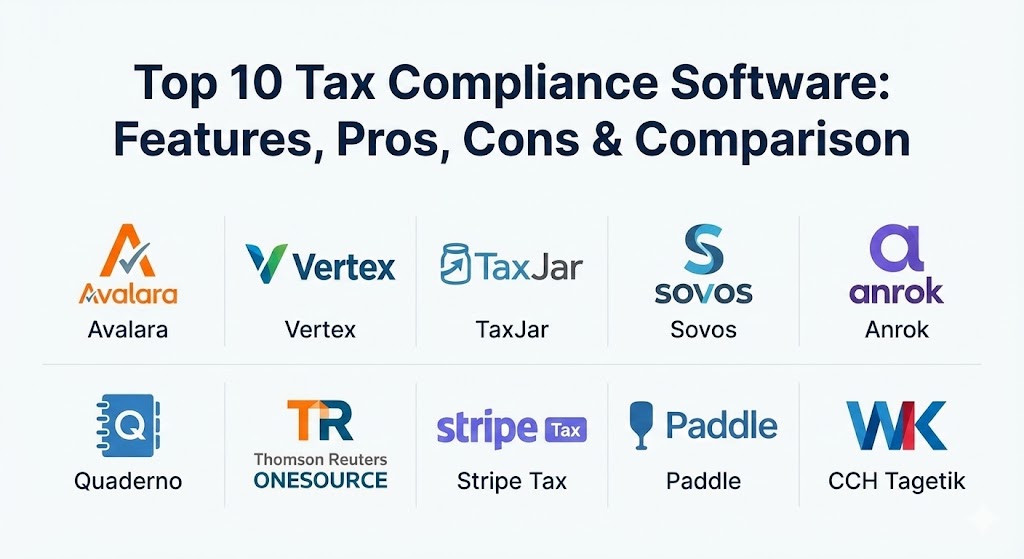
Top 10 Tax Compliance Software Tools
1 — Avalara
Avalara is the undisputed heavyweight in the tax automation space. Its flagship product, AvaTax, is a cloud-native engine that provides real-time tax calculations for over 12,000 jurisdictions worldwide.
- Key features:
- AvaTax: Real-time calculation engine that handles sales and use tax, VAT, and GST.
- Avalara Returns: Fully automated filing and remittance service for all US states.
- CertCapture: Digital management of tax-exempt certificates for B2B transactions.
- Cross-Border Compliance: Automated calculation of customs duties and import taxes.
- Heat Maps: Visual representation of where your business has reached “nexus” thresholds.
- Product Mapping: AI-driven tools to map your inventory to the correct tax codes.
- Pros:
- The most extensive integration library in the industry (700+ pre-built connectors).
- Excellent for businesses that need a “set it and forget it” solution for US sales tax.
- Cons:
- Pricing can be steep for high-volume, low-margin businesses.
- Customer support response times can be slow during peak tax seasons.
- Security & compliance: SOC 2 Type II, GDPR, HIPAA, and PCI DSS compliant. Data is encrypted at rest and in transit.
- Support & community: Extensive documentation, a robust user community forum, and “Avalara University” for structured onboarding and certification.
2 — Vertex
Vertex is an enterprise-grade tax technology solution designed for large, global corporations with complex supply chains and intricate regulatory requirements.
- Key features:
- Vertex O Series: A highly scalable calculation engine for indirect tax (Sales, VAT, GST).
- Tax GIS: Precision location technology that goes beyond zip codes to exact latitudes/longitudes.
- Cloud, On-Premise, or Hybrid: Flexible deployment options for high-security environments.
- Chain Flow: Specialized tools for managing multi-stage global supply chain taxes.
- Vertex Returns: Global filing capabilities across multiple countries and languages.
- Advanced Reporting: Deep-dive analytics into tax liabilities and historical trends.
- Pros:
- Superior performance for massive transaction volumes (millions of lines per hour).
- Deep, native integrations with Tier-1 ERPs like SAP, Oracle, and Microsoft Dynamics 365.
- Cons:
- The user interface is more traditional/corporate and lacks the “SaaS-modern” feel.
- Implementation usually requires a specialized consultant or system integrator.
- Security & compliance: ISO 27001, SOC 1/2, GDPR, and rigorous internal audit protocols.
- Support & community: Enterprise-level support with dedicated account managers; extensive technical documentation and formal training programs.
3 — TaxJar (by Stripe)
TaxJar, now owned by Stripe, revolutionized the market by making sales tax compliance accessible and easy for e-commerce entrepreneurs and high-growth startups.
- Key features:
- AutoFile: Automated filing and remittance in all US states with a “100% Accuracy Guarantee.”
- Real-time Calculations: Sub-second tax rate API for checkout pages.
- Economic Nexus Tracker: Instant alerts when you are approaching tax thresholds in new states.
- SmartReports: Summarizes sales data into easy-to-read reports for manual filing.
- Multi-channel Sync: Aggregates data from Amazon, Shopify, Walmart, and Etsy.
- Classification AI: Automatically suggests tax categories for new products.
- Pros:
- The most user-friendly interface in the category; very short learning curve.
- Transparent, tiered pricing that is easy for SMBs to budget for.
- Cons:
- Primarily focused on US sales tax; limited functionality for international VAT/GST.
- Lacks some of the “Direct Tax” (Income Tax) features of enterprise rivals.
- Security & compliance: SOC 2, PCI DSS, and GDPR compliant. Integrated with Stripe’s high-security infrastructure.
- Support & community: Highly praised email support, comprehensive blog/guides, and a very active community of e-commerce sellers.
4 — Sovos
Sovos focuses on “The Intelligent Compliance Cloud,” providing a holistic view of tax compliance, including real-time reporting and e-invoicing requirements which are becoming mandatory in many countries.
- Key features:
- Global VAT/GST Determination: Handles the nuances of complex European and Latin American tax laws.
- E-Invoicing Compliance: Real-time reporting of invoices to government authorities.
- Tax Information Reporting: Specialized tools for 1099, 1042-S, and FATCA reporting.
- E-Way Bill Management: Digital documentation for the physical movement of goods.
- Regulatory Analysis: A team of experts that keeps the software updated with global law changes.
- S1 Filing Platform: Centralized dashboard for all global tax filings.
- Pros:
- The leader in “continuous transaction controls” (e-invoicing).
- Excellent for companies with a heavy footprint in Brazil, India, or the EU.
- Cons:
- Can be overly complex for businesses only operating in the United States.
- Fragmented user experience due to several legacy acquisitions.
- Security & compliance: ISO 27001, SOC 2, HIPAA, and GDPR compliant.
- Support & community: Dedicated global support centers; focuses on enterprise partnerships and deep technical consulting.
5 — Anrok
Anrok is a specialized tax compliance platform built specifically for SaaS and software companies. It manages the unique challenges of recurring billing and digital service taxes.
- Key features:
- SaaS-Specific Logic: Handles the “where you are” and “where your customer is” for software-specific tax.
- Billing Integration: Native connectors for Stripe, Chargebee, Recurly, and Paddle.
- Nexus Monitoring: Real-time tracking of SaaS-specific economic nexus laws.
- Automated Filing: Streamlined filing for software companies in all US states and select global regions.
- Exposure Analysis: Historical look-backs to identify past tax liabilities.
- Unified Dashboard: Shows revenue, tax collected, and tax due in a single view.
- Pros:
- The only tool that truly “understands” the nuances of recurring SaaS billing.
- Very modern, developer-friendly API and clean administrative UI.
- Cons:
- Limited coverage for physical goods or complex supply chain retail.
- Coverage is currently expanding; not as globally established as Avalara.
- Security & compliance: SOC 2 Type II, GDPR, and CCPA compliant.
- Support & community: Direct access to tax experts for onboarding; high-quality documentation for developers.
6 — Quaderno
Quaderno is a lightweight, high-performance tax automation tool for digital businesses, designed to take the stress out of VAT, GST, and sales tax for digital products.
- Key features:
- Global VAT Handling: Exceptional support for EU VAT MOSS and digital tax rules.
- Automated Invoicing: Generates tax-compliant invoices in multiple languages and currencies.
- Revenue Threshold Alerts: Notifies you when you cross tax limits in over 50 countries.
- One-Click Reports: Generates the data needed for filing in seconds.
- Multi-Platform Integration: Connects with Stripe, PayPal, Braintree, and Amazon.
- Historic Data Import: Allows you to import old sales data to check for previous exposure.
- Pros:
- Very affordable for smaller digital creators and mid-sized SaaS teams.
- Focuses on “silent” compliance—it runs in the background without needing constant attention.
- Cons:
- Does not offer full “remittance” (the filing service) in all regions.
- Lacks the enterprise features like certificate management or supply chain logic.
- Security & compliance: GDPR compliant, SSL/TLS encryption, and secure cloud hosting.
- Support & community: Fast email support, helpful “Tax Guides for Humans,” and a simple onboarding process.
7 — Thomson Reuters ONESOURCE
ONESOURCE is a powerful, integrated tax platform that covers the entire tax lifecycle for large corporations, including corporate income tax and transfer pricing.
- Key features:
- Corporate Income Tax: Sophisticated tools for managing complex business tax returns.
- Transfer Pricing: Global management of intercompany transactions.
- Indirect Tax Determination: Global sales tax and VAT calculation.
- Statutory Reporting: Localized financial reporting for multi-national subsidiaries.
- Tax Provision: Automates the calculation of tax for financial statements.
- Operational Transfer Pricing: Links tax strategy to actual operational data.
- Pros:
- The most comprehensive tool for “Direct Tax” (Income Tax) on the market.
- Backed by the immense research and legal resources of Thomson Reuters.
- Cons:
- Significant cost and complexity; requires a dedicated tax department to operate.
- Integration with modern SaaS billing platforms is not as “plug-and-play” as rivals.
- Security & compliance: SOC 1/2, ISO 27001, GDPR, and HIPAA.
- Support & community: High-end professional services; extensive training via the ONESOURCE University.
8 — Stripe Tax
For businesses already using the Stripe ecosystem, Stripe Tax offers a “one-click” way to handle sales tax and VAT without ever leaving the payment processor.
- Key features:
- Automatic Calculation: Determines tax directly during the Stripe Checkout session.
- Threshold Monitoring: Uses your Stripe data to show exactly where you have nexus.
- Registrations Management: Guides you through the process of registering for tax in new states.
- Consolidated Reporting: All transaction and tax data in one Stripe dashboard.
- Export to Filing Partners: Easy data export to partners like TaxJar for automated filing.
- Digital Product Support: Specific logic for taxing ebooks, apps, and software.
- Pros:
- The lowest possible friction for existing Stripe users.
- No separate integration required; just toggle a setting in the dashboard.
- Cons:
- Does not handle “off-platform” sales (e.g., sales made via a different processor).
- Automated filing is not native; requires an additional service or partner.
- Security & compliance: PCI DSS Level 1, SOC 2, and GDPR compliant.
- Support & community: 24/7 chat/email support; massive developer community.
9 — Paddle (Merchant of Record)
Paddle is technically a “Merchant of Record” (MoR), which goes a step beyond software. They actually take on the legal tax liability for your sales, effectively “becoming” the seller.
- Key features:
- Total Tax Indemnity: Paddle handles all tax collection and filing; you never deal with tax authorities.
- Global Compliance: Handles VAT, GST, and sales tax in 200+ regions.
- Integrated Subscription Billing: Full-featured billing engine built-in.
- Fraud Protection: Managed fraud detection and chargeback handling.
- Localized Checkout: Dynamic currency and language support.
- Revenue Recovery: Dunning and automated renewal management.
- Pros:
- Eliminates tax complexity entirely—you only have one “customer” (Paddle).
- Perfect for startups looking to scale globally without hiring a tax team.
- Cons:
- They take a percentage of every transaction (usually 5% + $0.50), which is more than pure software.
- You lose some control over the “legal” relationship with your customer.
- Security & compliance: SOC 2, GDPR, PCI DSS, and full legal compliance in 200+ countries.
- Support & community: Excellent seller support and a dedicated community for SaaS founders.
10 — Wolters Kluwer CCH Tagetik
CCH Tagetik is a comprehensive financial platform that integrates tax compliance with corporate performance management (CPM) and ESG reporting.
- Key features:
- Tax Consolidation: Unified view of tax across all global entities.
- Global Minimum Tax (Pillar Two): Specialized modules for the latest OECD tax regulations.
- Provisioning and Reporting: Links tax data directly to the corporate balance sheet.
- Workflows & Audit: Visual trackers for all tax filing deadlines and statuses.
- Direct and Indirect Tax: Support for both income tax and transaction-based taxes.
- ESG Reporting: Integrated environmental tax and carbon tax tracking.
- Pros:
- Best for organizations that want tax to be part of a broader financial planning system.
- Unrivaled for managing the new “Global Minimum Tax” (Pillar Two) requirements.
- Cons:
- The UI is accountant-focused and can feel dense for non-experts.
- Implementation is a significant corporate project.
- Security & compliance: ISO 27001, SOC 1/2, and GDPR compliant.
- Support & community: High-touch enterprise support; strong presence in the global CFO and Controller communities.
Comparison Table
| Tool Name | Best For | Platform(s) Supported | Standout Feature | Rating (Gartner) |
| Avalara | Multi-channel Retail | 700+ Integrations | CertCapture (Exemptions) | 4.6 / 5 |
| Vertex | High-Volume Enterprise | ERP-Native | Latitude/Longitude Precision | 4.5 / 5 |
| TaxJar | E-commerce SMBs | Shopify, Amazon | User Experience/UX | 4.7 / 5 |
| Sovos | Global E-invoicing | Global SaaS | Continuous Transaction Controls | 4.4 / 5 |
| Anrok | SaaS / Subscriptions | Billing-Integrated | SaaS-Specific Nexus Logic | 4.8 / 5 |
| Quaderno | Digital Creators | API / Stripe | “Silent” Background Compliance | 4.5 / 5 |
| ONESOURCE | Corporate Direct Tax | Desktop / Cloud | Transfer Pricing Module | 4.3 / 5 |
| Stripe Tax | Stripe-only Users | Stripe-Native | One-Click Activation | 4.6 / 5 |
| Paddle | Global Startups (MoR) | Merchant of Record | Legal Tax Indemnity | 4.7 / 5 |
| CCH Tagetik | Finance/Accounting | Enterprise Cloud | Pillar Two Compliance | 4.5 / 5 |
Evaluation & Scoring of Tax Compliance Software
Choosing the right tax tool is a high-stakes decision. The following table represents our weighted rubric for evaluating these tools in a 2026 environment.
| Category | Weight | Evaluation Criteria |
| Core Features | 25% | Nexus tracking, real-time calculation accuracy, and filing automation. |
| Ease of Use | 15% | UI/UX design, mobile accessibility, and dashboard clarity. |
| Integrations | 15% | Quality of connectors for ERPs, e-commerce, and billing platforms. |
| Security & Compliance | 10% | SOC 2/ISO certifications, encryption, and data privacy protocols. |
| Performance | 10% | Calculation speed during peak volumes and uptime reliability. |
| Support & Community | 10% | Documentation, 24/7 support availability, and peer communities. |
| Price / Value | 15% | TCO vs. risk reduction and administrative time saved. |
Which Tax Compliance Software Tool Is Right for You?
The “best” tool depends entirely on your business model and where you sell.
- Solo Users vs SMB vs Mid-market vs Enterprise: * Solo/Freelance:Quaderno or Stripe Tax are perfect for those starting out.
- High-growth SMB: TaxJar is the standard for retail, while Anrok is the choice for SaaS.
- Mid-Market: Avalara provides the best balance of power and ease of use.
- Enterprise: Vertex or ONESOURCE are necessary for the volume and complexity required.
- Budget-conscious vs Premium Solutions: If you want to eliminate the cost of a tax team entirely, Paddle (the MoR) is the premium but effective choice. If you want low-cost automation, TaxJar or Quaderno are the best values.
- Feature Depth vs Ease of Use: If you need to manage complex physical supply chains (warehouses, shipping, etc.), you must sacrifice some ease of use for the depth of Vertex or Avalara.
- Integration and Scalability Needs: Always check for Native Integrations. If you run NetSuite, look for an “SDN” partner like Avalara. If you are a custom-coded SaaS, choose Anrok or Stripe Tax for their superior APIs.
- Security and Compliance Requirements: If you handle sensitive health data or government contracts, prioritize Vertex or ONESOURCE for their high-level ISO and SOC standards.
Frequently Asked Questions (FAQs)
1. What is “Nexus” and why does it matter?
Nexus is the legal connection between a business and a state that triggers tax obligations. In 2026, this is usually “Economic Nexus”—meaning if you sell over a certain dollar amount in a state, you must collect tax there, even if you have no physical office.
2. Can software really guarantee 100% accuracy?
Many tools (like TaxJar and Avalara) offer “accuracy guarantees,” but they only apply if you’ve correctly mapped your products to the right tax codes. The software is the engine; your data is the fuel.
3. Does tax compliance software file my returns for me?
Most top-tier tools offer “Managed Returns” or “AutoFile” services where they take the money from your account and remit it to the government on your behalf. This is usually an additional fee.
4. How does the software know if a customer is tax-exempt?
Tools like Avalara and Vertex have “Certificate Management” modules. The customer uploads their certificate once, and the software automatically removes tax from their future orders until the certificate expires.
5. Is there a free version of these tools?
Very few offer a truly free version. Most offer a free trial or a “Free Nexus Check” to show you where you might owe money. Stripe Tax is affordable for low volumes, but almost all require a subscription.
6. What is the difference between a Tax Software and a Merchant of Record (MoR)?
Software helps you stay compliant. A Merchant of Record (like Paddle) sells on your behalf and takes on the legal liability. With software, you are responsible for an audit. With an MoR, they are.
7. How long does it take to implement these tools?
For Stripe Tax or TaxJar, it can take 15 minutes. For Vertex or ONESOURCE integrating with a legacy SAP system, it can take 3 to 9 months.
8. Can these tools handle European VAT and the new digital taxes?
Yes, but coverage varies. Sovos and Quaderno are particularly strong in European compliance, while Anrok focuses on the global “SaaS tax” crisis.
9. Are these tools safe to use with my banking data?
Yes. These platforms use bank-level encryption (AES-256) and undergo SOC 2 Type II audits. They are designed to be the most secure part of your financial stack.
10. What happens if I ignore tax compliance?
Authorities are increasingly using automated systems to find “unregistered” sellers. Penalties often include the back-tax owed plus 25-50% in fines, plus interest. It is almost always cheaper to automate than to get caught.
Conclusion
The transition to automated tax compliance is no longer a strategic option; it is a fundamental requirement for business survival in 2026. The complexity of global “Pillar Two” regulations and the granularity of local sales tax laws have made manual management impossible. Whether you choose the massive ecosystem of Avalara, the SaaS-specific brilliance of Anrok, or the total legal indemnity of Paddle, the goal remains the same: precision, security, and scalability.
As you make your choice, remember that the “best” tool is the one that integrates most seamlessly into your existing workflow. Compliance should be an invisible foundation that lets you focus on growth, not a weight that holds you back.