Introduction
Sales Tax Automation Tools are cloud-based software solutions designed to manage the entire tax compliance lifecycle. They integrate directly with your shopping cart, ERP, or billing system to provide real-time tax calculations at the point of sale, track economic nexus (the legal threshold for when you must collect tax), manage exemption certificates, and automate the filing of returns. By digitizing these processes, businesses eliminate the risk of human error and ensure they are always following the latest legislative changes.
The importance of these tools cannot be overstated. Following the landmark Wayfair decision, almost every transaction involves a tax obligation based on where the customer is located. Real-world use cases include an e-commerce brand selling on Shopify that needs to calculate varying rates for 50 states, or a SaaS company that must navigate the “taxability” of digital software in different European countries. When evaluating tools, users should look for nexus tracking accuracy, integration depth, audit readiness, and filing automation reliability.
Best for:
- E-commerce & D2C Brands: Managing high transaction volumes across thousands of jurisdictions.
- SaaS & Digital Service Providers: Dealing with complex “digital goods” taxability rules.
- Accounting Firms: Who need to manage compliance for dozens of clients under a single dashboard.
- Mid-Market to Enterprise Firms: Companies with multi-channel sales and complex supply chains.
Not ideal for:
- Hyper-Local Small Businesses: A local brick-and-mortar store with no online presence and a single physical location may find these tools unnecessary.
- Sole Proprietors with Low Volume: If you sell only within your home state and stay under the economic nexus thresholds of other states, the software cost may outweigh the benefits.
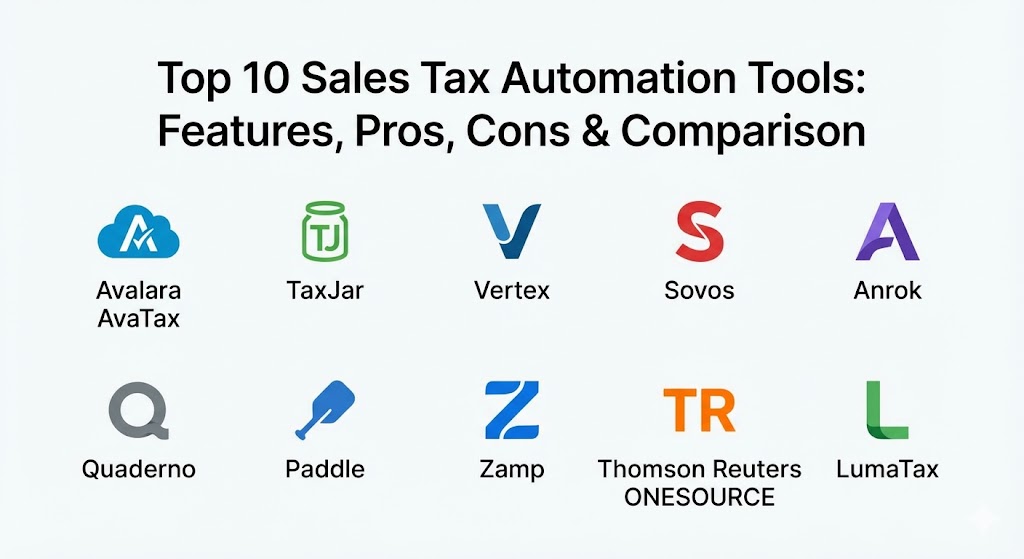
Top 10 Sales Tax Automation Tools
1 — Avalara AvaTax
Avalara is the undisputed heavyweight in the sales tax space. Their flagship product, AvaTax, is a cloud-native engine that provides real-time tax calculations for millions of products across the globe. It is built for businesses that require “set-it-and-forget-it” reliability.
- Key features:
- Real-Time Calculation: Instant tax rates based on precise geolocation rather than just zip codes.
- Economic Nexus Tracking: A visual dashboard that monitors your sales against state-specific thresholds.
- Exemption Certificate Management: Automated collection and storage of tax-exempt documents.
- Returns & Remittance: End-to-end filing service where Avalara handles the paperwork and payments.
- Cross-Border Compliance: Integrated duties and customs calculations for international shipping.
- Vast Integration Library: Over 1,200 pre-built connectors for ERPs, CRMs, and e-commerce platforms.
- Pros:
- Unrivaled accuracy and the most extensive database of tax rules in the world.
- Scales perfectly from small Shopify stores to Fortune 500 enterprises.
- Cons:
- Pricing can be complex and expensive as transaction volume increases.
- Customer support response times can lag during peak tax seasons.
- Security & compliance: SOC 2 Type II, GDPR compliant, 256-bit encryption, and SSO support.
- Support & community: Extensive documentation, Avalara University training, and a massive ecosystem of certified implementation partners.
2 — TaxJar
Acquired by Stripe, TaxJar has become the favorite for modern developers and e-commerce entrepreneurs. It is known for its “clean” interface and straightforward pricing, making it the top choice for companies that value ease of use.
- Key features:
- AutoFile: Automated filing of sales tax returns in every US state.
- SmartCalcs API: A high-speed API for developers to integrate tax calculations into custom apps.
- Nexus Insights: Automated alerts when you are approaching the threshold to register in a new state.
- State-Level Reporting: Clear, easy-to-read reports that break down what you owe and where.
- Multi-Channel Sync: Pulls data from Amazon, eBay, Shopify, and Walmart into one view.
- Pros:
- Extremely intuitive user interface; requires almost no training to navigate.
- Pricing is transparent and predictable, which is rare in the tax industry.
- Cons:
- International support (VAT/GST) is not as robust as Avalara or Vertex.
- Less flexible for enterprise companies with highly complex, non-standard tax needs.
- Security & compliance: SOC 2, PCI DSS compliant, and GDPR ready.
- Support & community: Strong developer documentation, active community forums, and a highly responsive email support team.
3 — Vertex
Vertex is an enterprise-grade solution that specializes in complex corporate tax environments. It is often the choice for companies with massive datasets and complex global supply chains that require on-premise or hybrid cloud deployments.
- Key features:
- Vertex O Series: A sophisticated calculation engine for indirect tax (Sales, VAT, GST).
- Data Management: Advanced tools for cleaning and mapping financial data before tax calculation.
- Exemption Management: Enterprise-level handling of massive volumes of exemption certificates.
- Audit Defense: Robust logging and reporting specifically designed to withstand government audits.
- Global Compliance: Native support for the complex tax laws of over 190 countries.
- Pros:
- Superior performance for high-volume, enterprise-level data processing.
- Highly customizable to fit unique business structures (e.g., leasing, construction).
- Cons:
- The implementation process is long and usually requires a specialized consultant.
- The user interface is functional but feels “dated” compared to modern SaaS tools.
- Security & compliance: ISO 27001, SOC 2, HIPAA compliant, and highest-tier encryption.
- Support & community: Dedicated account managers for enterprise clients and professional services for global rollout.
4 — Sovos
Sovos focuses on “The Intelligent Compliance Cloud.” They are particularly strong in the European and Latin American markets, where real-time reporting to government tax authorities is often mandatory.
- Key features:
- S1 Platform: A unified global engine for sales tax, VAT, and e-invoicing.
- Continuous Transaction Controls: Real-time reporting of invoices to government servers.
- Tax Determination: Intelligent mapping of product codes to taxability rules.
- Tax Filing: Managed filing services for global jurisdictions.
- Certificate Management: Automated workflows for B2B tax exemptions.
- Pros:
- Best-in-class for international real-time reporting compliance.
- Strong emphasis on risk mitigation and “regulatory-first” design.
- Cons:
- Can be overly complex for a domestic US e-commerce business.
- Higher price point targeted at mid-to-large organizations.
- Security & compliance: SOC 1/2/3, ISO 27001, GDPR, and localized data residency support.
- Support & community: Professional services for global implementation and 24/7 global support desk.
5 — Anrok
Anrok is a modern, specialized tax tool built specifically for SaaS (Software as a Service) companies. It understands the nuances of “digital taxability” and “SaaS-specific” nexus rules better than general-purpose tools.
- Key features:
- SaaS Tax Engine: Understands the different tax rates for software subscriptions vs. professional services.
- Billing Integration: Native, deep integrations with Stripe, Recurly, and Chargebee.
- Global Exposure Tracking: Real-time monitoring of where your SaaS customers are located globally.
- Automated Registration: Helps SaaS founders register for tax permits in new states instantly.
- Accrual Reporting: Real-time visibility into tax liabilities for the finance team.
- Pros:
- Perfect for software companies; it eliminates the “misclassification” of digital goods.
- Modern UI that feels like other high-end SaaS tools (Linear, Notion).
- Cons:
- Not suitable for businesses selling physical inventory or shipping hardware.
- Limited integration with “old school” legacy ERPs.
- Security & compliance: SOC 2 Type II, GDPR compliant, and SSO ready.
- Support & community: High-touch onboarding and a dedicated support team that understands the SaaS business model.
6 — Quaderno
Quaderno is a “revenue-based” tax automation tool that focuses on providing a frictionless experience for global digital entrepreneurs and small teams selling digital downloads or courses.
- Key features:
- Automatic Invoicing: Generates tax-compliant invoices in the customer’s local language and currency.
- Global VAT/GST/Sales Tax: Handles tax rules for the EU, UK, US, Canada, and Australia.
- Threshold Alerts: Notifies you when you reach 80% of a tax threshold in a new country.
- Historical Data Import: Allows you to upload old sales to check for past compliance issues.
- Pros:
- Extremely affordable for small to mid-sized digital businesses.
- Simplifies the “EU VAT” headache better than almost any other tool.
- Cons:
- Does not offer managed “filing” services; you must use their reports to file yourself.
- Less robust for physical goods with complex shipping/nexus rules.
- Security & compliance: GDPR compliant, SSL encryption, and secure API access.
- Support & community: Excellent self-service documentation and responsive email support.
7 — Paddle
While often classified as a “billing” tool, Paddle acts as a Merchant of Record (MoR). This means they actually take over the tax liability for you, becoming the most “hands-off” tax solution on the market.
- Key features:
- Merchant of Record Model: Paddle is the “seller,” so they handle all tax collection and remittance.
- Unified Tax Liability: You have zero tax liability in the eyes of the government; Paddle has it.
- Global Compliance: Handles Sales Tax, VAT, and GST in over 200 countries.
- Fraud Management: Integrated security that flags risky transactions automatically.
- Pros:
- The only way to 100% “outsource” the risk of sales tax.
- No need to register for tax permits in 50 states; you only deal with Paddle.
- Cons:
- You lose some control over the checkout experience and customer data.
- Higher “take rate” (percentage of revenue) compared to a SaaS tool like TaxJar.
- Security & compliance: Fully GDPR, PCI DSS, and SOC 2 compliant.
- Support & community: Strong developer support and a dedicated success team for scaling startups.
8 — Zamp
Zamp is a newer entrant that positions itself as a “managed service” for sales tax. They pair high-end software with a team of tax experts who handle the “unpleasant parts” of compliance on your behalf.
- Key features:
- Managed Registrations: Their team handles the permit application process in every state.
- Precise Product Mapping: Experts review your catalog to ensure correct taxability codes.
- Liability Monitoring: Real-time tracking across all 50 states.
- White-Glove Filing: A fully managed filing and remittance process.
- Pros:
- Best for teams that want a “human-in-the-loop” to ensure no mistakes are made.
- Very transparent, flat-fee pricing models.
- Cons:
- Still a growing company; has fewer integrations than Avalara.
- Less focus on international VAT/GST at this stage.
- Security & compliance: SOC 2 Type II and modern data encryption standards.
- Support & community: Proactive, dedicated tax account managers for every client.
9 — Thomson Reuters ONESOURCE
ONESOURCE is the “big-four” accounting choice. It is a massive, multi-functional tax platform designed for the complex needs of global tax departments in public companies.
- Key features:
- Indirect Tax Determination: High-scale engine for global sales and use tax.
- Tax Data Management: Sophisticated ETL tools to pull data from disparate global systems.
- Legal Research Integration: Direct links to the Thomson Reuters library of tax laws.
- Global Property Tax: Modules for managing physical asset taxes alongside sales tax.
- Pros:
- The most powerful “legal” intelligence backing the software.
- Designed for global scale; handles the world’s most complex tax structures.
- Cons:
- Very high cost of ownership and complex implementation.
- Not suitable for small e-commerce sellers or mid-market SaaS.
- Security & compliance: Highest-tier global security certifications (ISO, SOC, HIPAA).
- Support & community: Global enterprise support network and a massive pool of certified consultants.
10 — LumaTax
LumaTax focuses heavily on the “Audit Defense” and “Sales Tax Audit” side of the house. It is designed to help businesses clean up their historical tax messes and ensure future compliance.
- Key features:
- Audit Readiness: Tools specifically built to export data in a format auditors love.
- Historical Review: AI that scans past transactions to find unpaid tax liabilities.
- Nexus Assessment: A high-precision tool for determining where you should have been registered.
- Automated Filing: Streamlined filing for multiple states.
- Pros:
- Best choice if you are currently undergoing a sales tax audit or are worried about historical debt.
- Simple, clean interface focused on the “Finance Controller” view.
- Cons:
- Smaller integration ecosystem compared to TaxJar or Avalara.
- Calculation engine is not as fast as the high-end API competitors.
- Security & compliance: SOC 2 and GDPR compliant.
- Support & community: Strong professional support from former tax auditors and CPAs.
Comparison Table
| Tool Name | Best For | Platforms Supported | Standout Feature | Rating (Gartner/TrueReview) |
| Avalara AvaTax | Global Enterprise | All Major ERPs/Web | 1,200+ Integrations | 4.7 / 5.0 |
| TaxJar | E-commerce SMBs | Shopify, Stripe, Amazon | Ultra-Clean UI | 4.8 / 5.0 |
| Vertex | High-Volume Corp | Hybrid / Cloud / On-prem | Enterprise Performance | 4.4 / 5.0 |
| Sovos | Int’l Real-time Rpt | Web / Cloud | Latin American Compliance | 4.3 / 5.0 |
| Anrok | SaaS Companies | Stripe, Chargebee | SaaS-Specific Logic | 4.9 / 5.0 |
| Quaderno | Digital Goods | Web / API | EU VAT Specialist | 4.6 / 5.0 |
| Paddle | Risk Outsourcing | Web / API | Merchant of Record (MoR) | 4.7 / 5.0 |
| Zamp | Managed Service | Shopify, Web | Human-in-the-loop Svc | 4.8 / 5.0 |
| ONESOURCE | Multinational Corp | Enterprise ERPs | Legal Research Integration | 4.1 / 5.0 |
| LumaTax | Audit Defense | Web / Cloud | Historical Data Cleanup | 4.4 / 5.0 |
Evaluation & Scoring of Sales Tax Automation Tools
To help you decide which tool fits your organization, we have scored the sector using a weighted rubric that reflects the priorities of a modern finance department in 2026.
| Criteria | Weight | What We Evaluate |
| Core Features | 25% | Nexus tracking, real-time calculation, managed filing, and certificate management. |
| Ease of Use | 15% | The time it takes to set up, the UI quality, and the learning curve for non-tax experts. |
| Integrations | 15% | Does it connect to Shopify, NetSuite, Stripe, or your custom ERP without a custom build? |
| Security & Compliance | 10% | SOC 2 status, encryption levels, and data residency for international laws. |
| Performance | 10% | Calculation speed at checkout (latency) and uptime during high-volume periods (Black Friday). |
| Support & Community | 10% | Quality of the knowledge base, response speed, and availability of expert consultants. |
| Price / Value | 15% | Monthly fees vs. the potential cost of an audit or human error. |
Which Sales Tax Automation Tool Is Right for You?
Solo Users vs SMB vs Mid-market vs Enterprise
- Solo Users: If you sell digital goods, Quaderno is your best friend. If you want to forget about tax entirely, Paddle is the choice.
- SMB (1-50 employees): TaxJar is the standard for a reason—it’s easy to understand and reliable.
- Mid-market: Anrok (for SaaS) or Avalara (for e-commerce) provide the scalability you need to handle 50-state compliance.
- Enterprise: Vertex or ONESOURCE are built for the heavy lifting of multi-million transaction environments.
Budget-conscious vs Premium Solutions
- Budget: Quaderno and TaxJar offer the most competitive entry points.
- Premium: Avalara and Sovos are high-investment tools, but they provide a level of global protection and automation that justifies the cost for large firms.
Feature Depth vs Ease of Use
If you want to be live in 30 minutes, TaxJar or Anrok are the benchmarks. If you have complex nexus needs involving physical nexus (warehouses) and complicated product classifications, Avalara offers the depth you require.
Frequently Asked Questions (FAQs)
1. What is “Economic Nexus”?
Economic nexus is a threshold (usually $100,000 in sales or 200 transactions) that triggers a legal requirement to collect and remit sales tax in a state, even if you don’t have a physical office there.
2. Can I just use my accounting software (like QuickBooks) for sales tax?
While QuickBooks can do basic calculations, it often fails to track nexus thresholds across 50 states and does not handle automated filing or exemption certificate storage as well as specialized tools.
3. Does these tools file the taxes for me?
Most (like Avalara, TaxJar, and Zamp) offer an “AutoFile” or “Managed Filing” service where they pull the funds and pay the state on your behalf. Some lower-cost tools only provide the reports for you to file manually.
4. What happens if the software makes a mistake?
Reputable tools like Avalara and Vertex offer an “Accuracy Guarantee.” If they calculate a rate incorrectly and you are audited, they often cover the penalty and interest costs.
5. How much do these tools typically cost?
Pricing usually involves a monthly SaaS fee (e.g., $50–$250) plus a per-transaction or per-filing fee. High-volume enterprise plans are custom-quoted.
6. Do I need to register with each state before using the software?
Yes. The software calculates and files the tax, but you must first have a valid sales tax permit from the state. Tools like Zamp and Avalara can help you apply for these permits.
7. Can these tools handle international VAT?
Yes, but some are better than others. Quaderno, Sovos, and Avalara have the strongest international capabilities.
8. Is my checkout speed affected by these tools?
Top-tier tools have a “latency” of less than 100ms, meaning the customer won’t even notice the calculation happening.
9. What is an “Exemption Certificate”?
This is a document a buyer (like a wholesaler) gives you so they don’t have to pay sales tax. Managing these is legally required, and tools like Avalara CertCapture automate this entirely.
10. What is the “Wayfair” decision?
It was a 2018 Supreme Court ruling that allowed states to charge sales tax on out-of-state sellers based on economic activity, effectively creating the need for the automation tools we use today.
Conclusion
Sales tax is no longer a “year-end” accounting task—it is a real-time operational requirement. In 2026, the risk of non-compliance is simply too high to ignore, with states becoming increasingly aggressive in their audit tactics.
The “best” tool for your business depends on your DNA. If you are a high-growth SaaS startup, Anrok is your native solution. If you are a global e-commerce titan, Avalara remains the gold standard. For those looking to fully offload the liability, Paddle offers a unique path. Ultimately, the goal is to get tax compliance off your plate so you can focus on what actually drives your business: growth.