Introduction
A Last-mile Delivery Platform is a specialized software solution designed to manage and optimize the final stage of the delivery process—the movement of goods from a distribution hub to the end customer’s doorstep. These platforms serve as a digital “control tower,” orchestrating complex variables such as driver dispatch, route optimization, real-time tracking, and proof of delivery into a seamless workflow. By digitizing what was once a manual, error-prone process, these tools allow businesses to maximize vehicle capacity, reduce fuel consumption, and provide customers with the Amazon-like visibility they now demand.
The importance of these platforms lies in their ability to solve the “last-mile problem”—the most expensive and inefficient part of the supply chain, often accounting for over 50% of total shipping costs. Key real-world use cases include automating grocery delivery routes for local retailers, managing “white-glove” furniture assembly services, and coordinating gig-economy courier networks for food delivery. When choosing a platform, evaluation criteria should include the depth of the route optimization engine, the ease of use of the driver mobile app, the flexibility of API integrations, and the quality of the post-purchase customer communication tools.
Best for: Omnichannel retailers, e-commerce brands, Third-Party Logistics (3PL) providers, food and beverage distributors, and service-based businesses (like pharmacy or floral delivery) that manage their own fleets or hybrid delivery models.
Not ideal for: Solo freelancers or micro-businesses with only 1–2 deliveries a week where manual Google Maps routing suffices, or large-scale long-haul trucking operations that require Freight Management Systems (FMS) rather than localized delivery orchestration.
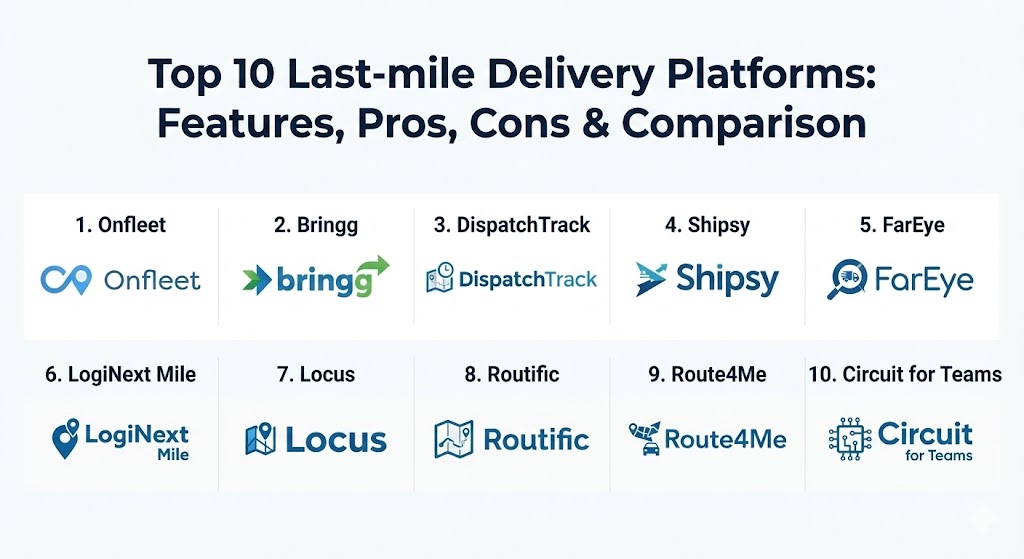
Top 10 Last-mile Delivery Platforms
1 — Onfleet
Onfleet is a leading delivery management platform known for its sleek user interface and robust API, making it a favorite for tech-savvy retailers and “on-demand” delivery services.
- Key features:
- Intuitive Dispatch Dashboard: A “single pane of glass” view for managing drivers and tasks in real-time.
- Automated Dispatching: Intelligent logic that assigns tasks to the best-positioned driver based on location and load.
- Route Optimization: Built-in engine that accounts for time, location, capacity, and traffic.
- Branded Tracking: Real-time customer tracking pages with live driver location and ETAs.
- Proof of Delivery: In-app collection of photos, signatures, barcodes, and notes.
- Anonymous Communications: Built-in chat that protects driver and customer privacy through masked phone numbers.
- Pros:
- Exceptional user experience for both dispatchers and drivers, leading to high adoption rates.
- Developer-friendly API and pre-built integrations with Shopify, Zapier, and more.
- Cons:
- Pricing can scale quickly for high-volume businesses, as it often charges per task.
- Some enterprise users report a need for more advanced “white-glove” service documentation.
- Security & compliance: SOC 2 Type II compliant, GDPR ready, and supports SSO (Single Sign-On).
- Support & community: High-quality documentation, 24/7 technical support, and an active community of technical users and developers.
2 — Bringg
Bringg is an enterprise-grade delivery orchestration platform designed for massive scalability, often used by global retailers like Walmart and Coca-Cola to manage hybrid fleets.
- Key features:
- Unified Orchestration: Manages internal fleets, 3PLs, and gig-economy drivers in one platform.
- Adaptive Auto-Dispatch: High-speed automation for allocating thousands of orders simultaneously.
- Customer Experience Tools: Fully customizable post-purchase interfaces including ratings and feedback.
- Inventory Visibility: Real-time tracking of item levels from the warehouse to the doorstep.
- Smart Capacity Planning: Forecasts driver needs based on historical trends and upcoming promotions.
- Pros:
- Unrivaled ability to manage “mixed fleets” (internal and external partners) across global regions.
- Deep customization options that allow large enterprises to tailor the workflow to their specific brand requirements.
- Cons:
- Implementation is complex and often takes weeks or months rather than days.
- The platform’s complexity can be overwhelming for small businesses.
- Security & compliance: ISO 27001, SOC 2, GDPR, and HIPAA compliant. Offers advanced audit logs and data encryption.
- Support & community: Dedicated customer success managers for enterprise clients, 24/7 global support, and a formal certification program for partners.
3 — DispatchTrack
DispatchTrack is a specialized platform with a strong heritage in scheduled and “big and bulky” delivery, particularly for furniture, appliances, and high-value retail.
- Key features:
- 98% ETA Accuracy: Advanced AI that predicts arrival times with incredible precision.
- Customer Self-Scheduling: Allows buyers to choose their own delivery windows during the checkout process.
- Service Documentation: Robust tools for documenting assembly, installation, and item condition.
- Automated Route Recalculation: Updates routes on the fly if a driver gets delayed or an appointment runs long.
- NPS Tracking: Automated feedback collection to monitor customer satisfaction at the point of delivery.
- Pros:
- The clear leader for “heavy” goods requiring specialized handling and appointment-based windows.
- Significantly reduces “Where is my order?” (WISMO) calls through superior customer communication.
- Cons:
- Less optimized for “instant” or “on-demand” food delivery workflows compared to Onfleet.
- Some users find the mobile app interface to be more utilitarian than modern.
- Security & compliance: SOC 2 Type II, GDPR, and PCI-DSS compliant.
- Support & community: Established training resources and a highly responsive support team with deep industry expertise in retail and distribution.
4 — Shipsy
Shipsy is an AI-powered logistics orchestration platform that excels in international and cross-border last-mile deliveries, particularly strong in the Asian and Middle Eastern markets.
- Key features:
- Cross-Border Intelligence: Automates documentation and compliance for international shipping.
- AI-Route Planning: Uses historical data to optimize routes in complex, high-density urban environments.
- Dynamic Slot Management: Manages delivery slots for high-volume grocery and retail operations.
- Unified Courier Management: Connects to hundreds of global and local courier partners through one API.
- Geocoding Engine: Corrects and validates addresses to prevent failed deliveries in regions with poor mapping data.
- Pros:
- Exceptionally strong for companies with substantial cross-border or international logistics needs.
- High level of automation in invoicing and billing, saving significant administrative time.
- Cons:
- Support and implementation are currently more geared toward the APAC and EMEA regions.
- The learning curve can be steep due to the sheer number of modules and settings.
- Security & compliance: ISO 27001, SOC 2, and GDPR compliant. Includes robust billing and compliance automation.
- Support & community: Comprehensive documentation, AI-driven help bots, and enterprise-grade support with local experts in major global hubs.
5 — FarEye
FarEye is an intelligent delivery management platform that turns delivery into a competitive advantage through predictive analytics and superior visibility.
- Key features:
- Predictive Logistics: Identifies potential delays and exceptions before they impact the customer.
- Branded Customer Portal: A high-end customer interface that includes real-time tracking and marketing opportunities.
- Loop Optimization: Manages complex return-logistics (reverse logistics) as efficiently as outbound deliveries.
- Low-Code Platform: Allows business users to customize workflows without heavy developer intervention.
- Performance Dashboards: Granular analytics on driver productivity, fuel efficiency, and carrier performance.
- Pros:
- The low-code approach allows for faster business agility and workflow changes.
- Excellent visibility into the “post-purchase” journey, which is critical for high-value e-commerce.
- Cons:
- Integration with legacy ERP systems can require more effort than with cloud-native counterparts.
- Premium pricing reflects its status as an enterprise-first solution.
- Security & compliance: ISO 27001, GDPR, and HIPAA compliant. End-to-end data encryption is standard.
- Support & community: Strong emphasis on customer success with regular business reviews and a detailed knowledge base.
6 — LogiNext Mile
LogiNext Mile is a cloud-native platform that leverages AI and real-time data to optimize large, multi-modal fleets including trucks, vans, bikes, and even drones.
- Key features:
- Multi-Modal Support: Orchestrates diverse fleets across bikes, cars, and heavy trucks in one system.
- Automated Scheduling: High-speed logic for scheduling and dispatching thousands of orders daily.
- Territory Management: Allows managers to define and optimize specific service regions.
- Workforce Productivity Tracking: Detailed metrics on driver breaks, idle time, and speed violations.
- Electronic Proof of Delivery (ePOD): Supports multiple formats including contactless signature and photo.
- Pros:
- Highly adaptable for various industries including QSR (Quick Service Restaurants), Retail, and Courier.
- Provides the widest possible network of delivery options through a simple, unified interface.
- Cons:
- The mobile app can occasionally experience “lag” in areas with poor cellular connectivity.
- Some reporting dashboards are less customizable than those of competitors like Bringg.
- Security & compliance: SOC 2, GDPR, and HIPAA compliant. Robust SSO and RBAC (Role-Based Access Control).
- Support & community: Global presence with support hubs in New York, Dubai, and Mumbai; extensive online training academy.
7 — Locus
Locus is a “smart” dispatch management platform that uses machine learning to process thousands of variables—from weather to driver skills—to create perfect routes.
- Key features:
- Dynamic Route Optimization: Recalculates routes in real-time based on live traffic and new orders.
- Intelligent Dispatcher: Automates 90% of dispatching decisions using proprietary AI.
- Capacity Planning: Optimizes the use of every cubic inch of vehicle space.
- Sustainability Metrics: Tracks and helps reduce the carbon footprint of the delivery fleet.
- Control Tower Visibility: A bird’s-eye view of all global delivery operations.
- Pros:
- One of the most advanced “AI engines” in the industry, particularly effective for high-complexity routing.
- Deep industry-agnostic capabilities that serve retail, CPG, and pharma equally well.
- Cons:
- The initial configuration requires a high level of “clean data” for the AI to be effective.
- Small businesses may find the AI features more complex than they need.
- Security & compliance: ISO 27001, SOC 2, and GDPR. Focuses heavily on data privacy and security audits.
- Support & community: High customer ratings for implementation support; detailed technical documentation and webinars.
8 — Routific
Routific is a “human-centric” route optimization platform designed specifically for small to mid-sized businesses that want to get started with professional delivery management quickly.
- Key features:
- One-Click Optimization: Optimized routes are generated in seconds for fleets of 5 to 50 drivers.
- Driver App (Routific Driver): A simple, battery-efficient app that gives drivers everything they need.
- Customer Notifications: Automated SMS and email alerts with tracking links.
- Drag-and-Drop Editing: Allows dispatchers to manually adjust AI-generated routes with ease.
- Delivery Analytics: Basic, clear reports on success rates and on-time performance.
- Pros:
- By far the easiest platform to set up and learn; you can be live in minutes.
- Extremely transparent pricing that is affordable for small, local delivery businesses.
- Cons:
- Lacks the enterprise orchestration features (like 3PL management) found in Bringg.
- API is less robust than Onfleet for complex, custom-built applications.
- Security & compliance: GDPR compliant and uses standard cloud security protocols. (Rating: N/A for SOC 2).
- Support & community: Friendly, responsive customer support; excellent blog and guide series for delivery business owners.
9 — Route4Me
Route4Me is a veteran in the space, offering the most extensive “marketplace” of add-on features, allowing businesses to pay only for the specific tools they need.
- Key features:
- Custom Add-on Marketplace: Over 100 modules for things like barcode scanning, voice navigation, and telematics.
- Territory Optimization: Specifically designed for field sales and service as well as delivery.
- Multi-Platform Support: Works seamlessly across iOS, Android, and web.
- High-Volume Routing: Capable of optimizing thousands of stops per route for massive distribution.
- Historical Route Playback: Allows managers to watch “replays” of driver routes to identify inefficiencies.
- Pros:
- Incredibly flexible “pay-for-what-you-need” model that scales with your specific needs.
- Supports a wider range of use cases beyond just delivery, including field service and sales.
- Cons:
- The interface can feel a bit fragmented due to the modular “add-on” nature of the product.
- Costs can add up quickly as you start adding multiple premium modules.
- Security & compliance: SOC 2, GDPR, and HIPAA compliant.
- Support & community: Massive user base, extensive video library, and 24/7 phone support.
10 — Circuit for Teams
Circuit for Teams is a modern, fast-growing platform that focuses on making the delivery experience better for the driver, which in turn leads to better customer outcomes.
- Key features:
- Driver-First Design: The mobile app is designed to be the fastest in the market for inputting stops.
- Real-Time Dispatch: Updates driver lists instantly when new orders are added.
- ETA Accuracy: Dynamic updates based on current progress and traffic conditions.
- Photo & Signature POD: Standard digital proof of delivery tools.
- Recipient Notifications: Simple, clear SMS alerts for customers.
- Pros:
- Very popular with driver teams due to the app’s speed and lack of “clutter.”
- Excellent for businesses that rely on “on-demand” or same-day delivery where speed is king.
- Cons:
- Reporting and analytics are less deep than enterprise platforms like FarEye or Locus.
- Not designed for complex B2B logistics or specialized white-glove service.
- Security & compliance: GDPR compliant. Uses industry-standard encryption for data storage.
- Support & community: Responsive chat and email support; strong user community of delivery entrepreneurs.
Comparison Table
| Tool Name | Best For | Platform(s) Supported | Standout Feature | Rating (Gartner/TrueReview) |
| Onfleet | Tech-Savvy Retailers | Web, iOS, Android | Developer-Friendly API | 4.6 / 5 |
| Bringg | Global Enterprise | Web, iOS, Android | Multi-Fleet Orchestration | 4.5 / 5 |
| DispatchTrack | Big & Bulky Retail | Web, iOS, Android | 98% ETA Accuracy | 4.5 / 5 |
| Shipsy | Cross-Border Logistics | Web, iOS, Android | International Compliance | 4.9 / 5 |
| FarEye | Post-Purchase CX | Web, iOS, Android | Low-Code Customization | 4.6 / 5 |
| LogiNext Mile | Multi-Modal Delivery | Web, iOS, Android | Courier Marketplace | 4.8 / 5 |
| Locus | AI-First Optimization | Web, iOS, Android | “Wave-less” Dispatching | 4.3 / 5 |
| Routific | Small Businesses (SMB) | Web, iOS, Android | One-Click Optimization | 4.7 / 5 |
| Route4Me | Modular Flexibility | Web, iOS, Android | Feature Marketplace | 4.5 / 5 |
| Circuit for Teams | Fast Same-Day Delivery | Web, iOS, Android | Driver-Centric Experience | 4.8 / 5 |
Evaluation & Scoring of Last-mile Delivery Platforms
To determine which platform reigns supreme in 2026, we evaluate them using the following weighted scoring rubric. This ensures we account for both the technical “engine” and the real-world operational experience.
| Category | Weight | Evaluation Criteria |
| Core Features | 25% | Route optimization, dispatching, POD, and customer notifications. |
| Ease of Use | 15% | Intuitiveness of the dispatcher dashboard and the driver mobile app. |
| Integrations | 15% | Strength of the API and availability of e-commerce/ERP connectors. |
| Security & Compliance | 10% | SOC 2, GDPR, HIPAA compliance, and data encryption standards. |
| Performance & Reliability | 10% | App stability, offline capabilities, and mapping accuracy. |
| Support & Community | 10% | Documentation, customer service speed, and user community size. |
| Price / Value | 15% | Transparency of the pricing model and the ROI delivered. |
Which Last-mile Delivery Platforms Tool Is Right for You?
Choosing a delivery platform is not about finding the “best” one on paper, but finding the one that matches your operational DNA.
- Solo Users vs. SMBs: Small local businesses should prioritize ease of setup and cost. Routific is the clear winner for local flower shops or bakeries. If your business is on-demand (like a local courier), Circuit for Teams offers the speed you need.
- Mid-Market Businesses: If you are a growing retailer that needs to connect with Shopify and manage your own small fleet, Onfleet is the gold standard for your size. If you move heavy items (furniture/appliances), DispatchTrack is the undisputed choice.
- Enterprises & Global Brands: Large organizations managing hundreds of drivers across different countries need orchestration, not just routing. Bringg and FarEye are built for this scale. If your business is heavily focused on APAC or cross-border logistics, Shipsy is your best bet.
- Budget-Conscious vs. Premium: If you want the lowest possible entry price, Route4Me’s modular approach allows you to build a cheap starter pack. If you view delivery as your primary brand differentiator, the premium cost of Bringg or Manhattan Active (for full supply chain) is a justified investment.
- Technical Needs: If you have an in-house development team and want to build a custom delivery experience, Onfleet and LogiNext offer the most reliable and well-documented APIs.
Frequently Asked Questions (FAQs)
1. What is the difference between a Delivery Platform and a Route Planner?
A route planner only tells you the best path. A full delivery platform manages the entire lifecycle—including customer communication, proof of delivery, dispatcher visibility, and post-delivery analytics.
2. Can these platforms integrate with Shopify or WooCommerce?
Yes, most top-tier platforms like Onfleet and Routific have one-click integrations or Zapier connectors that automatically import new orders into the delivery dashboard.
3. Do my drivers need specialized hardware to use these?
No. Modern last-mile platforms are designed to run on standard Android and iOS smartphones, saving you the massive cost of buying proprietary ruggedized scanners.
4. How does route optimization actually save me money?
By reducing “empty miles” and idling time, optimization can reduce fuel costs by 20–40% and allows a single driver to complete significantly more stops per shift.
5. What is “White-Glove” delivery service?
This refers to deliveries that require more than just a drop-off, such as furniture assembly, appliance installation, or hauling away old items. DispatchTrack is the leader in managing these workflows.
6. Is my customer data safe in these cloud-based platforms?
Enterprise platforms like Bringg and Onfleet are SOC 2 and GDPR compliant, meaning they undergo rigorous third-party audits to ensure your customer’s personal data is encrypted and handled securely.
7. Can these platforms handle return deliveries?
Yes, this is called “Reverse Logistics.” Platforms like FarEye and Shipsy have specific modules to ensure that returns are handled as efficiently as outbound orders.
8. What happens if my driver goes into a “dead zone” without internet?
The best platforms (like Onfleet and LogiNext) have offline capabilities where the driver can still collect signatures and photos, which then sync to the dashboard once a connection is restored.
9. How long does it take to get a new delivery platform up and running?
SMB tools like Routific can be live in hours. Enterprise solutions like Bringg usually require 1–3 months for full integration with your internal ERP and warehouse systems.
10. Do I need to be a programmer to use the API features?
Yes, for custom integrations. However, most businesses use pre-built connectors (like those for Shopify or QuickBooks) that require no coding at all.
Conclusion
As we move through 2026, the last mile has become the ultimate battlefield for customer experience. The “best” tool for your business depends on whether you value enterprise orchestration (Bringg), developer flexibility (Onfleet), or SMB simplicity (Routific). By investing in the right last-mile delivery platform, you aren’t just buying software; you are buying the ability to deliver on your brand’s promise with every single package.