Introduction
CAPA Management Tools are specialized software solutions designed to automate and streamline the lifecycle of corrective and preventive actions. These tools provide a centralized platform for capturing non-conformances, conducting Root Cause Analysis (RCA), implementing corrective plans, and verifying their effectiveness. By replacing manual workflows with automated routing and alerts, these systems ensure that no critical issue falls through the cracks.
The importance of these tools lies in their ability to ensure continuous improvement and regulatory compliance (such as ISO 9001, ISO 13485, and FDA 21 CFR Part 820). Key real-world use cases include resolving product defects in medical device manufacturing, addressing safety incidents in aviation, and managing audit findings in pharmaceutical labs. When choosing a tool, users should evaluate the software’s ability to support various RCA methodologies (like the 5 Whys or Fishbone diagrams), its workflow automation capabilities, and the robustness of its reporting and audit trails.
Best for: Quality assurance managers, compliance officers, and operations leads in life sciences, aerospace, automotive, and food & beverage. It is ideal for mid-sized to enterprise organizations that must adhere to strict international quality standards and require detailed documentation for audits.
Not ideal for: Small service-based businesses with no regulatory overhead or very small startups that can manage a low volume of internal improvements through standard project management software like Trello or Asana.
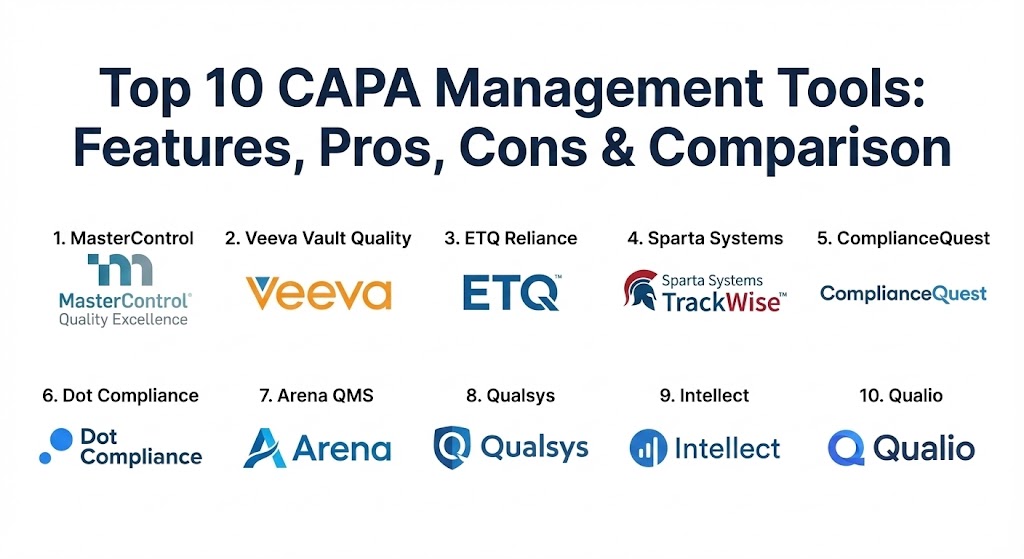
Top 10 CAPA Management Tools
1 — MasterControl Quality Excellence
MasterControl is a market leader in the QMS space, specifically known for its deep roots in the life sciences industry. Its CAPA module is designed to integrate seamlessly with other quality processes like training, document control, and audits.
- Key features:
- Automated routing and escalation of CAPA forms based on priority.
- Best-practice forms based on FDA and ISO requirements.
- Integrated Root Cause Analysis tools within the workflow.
- Real-time tracking of CAPA status via customizable dashboards.
- Automatic “closure” of training requirements when a CAPA triggers a process change.
- Advanced analytics for identifying cross-departmental quality trends.
- Pros:
- Exceptionally strong in audit preparedness; everything is linked and easy to present.
- Reduces the cycle time for CAPA completion through automated alerts.
- Cons:
- The system can be complex and requires significant training for administrators.
- Higher price point compared to entry-level or mid-market solutions.
- Security & compliance: FDA 21 CFR Part 11 compliant, SOC 2, ISO 27001, HIPAA, and GDPR support.
- Support & community: Extensive MasterControl University for training; dedicated technical account managers for enterprise tiers.
2 — Veeva Vault Quality
Veeva is a cloud-native powerhouse that has transformed how the pharmaceutical and biotech industries manage quality. Veeva Vault Quality provides a modern, intuitive interface for managing complex global CAPA processes.
- Key features:
- Unified platform that connects CAPA to document control and training.
- Mobile-friendly interface for reporting issues directly from the plant floor.
- “Quality Events” layer that filters minor issues before they become full CAPAs.
- Seamless collaboration with external contract manufacturers (CMOs).
- Pre-configured workflows that align with GxP standards.
- Dynamic reporting that allows for drill-down into specific root causes.
- Pros:
- The most modern user experience in the enterprise QMS market.
- Rapid deployment for companies already using the Veeva ecosystem.
- Cons:
- Primarily focused on life sciences; may lack the specific features needed for heavy manufacturing.
- Implementation often requires specialized Veeva consultants.
- Security & compliance: ISO 27001, ISO 27018, SOC 1 Type II, SOC 2 Type II, and HIPAA.
- Support & community: High-quality documentation and a robust global user community (Veeva Heroes).
3 — ETQ Reliance (by Hexagon)
ETQ Reliance is an incredibly flexible QMS platform that offers one of the most comprehensive CAPA modules available. It is favored by high-tech manufacturers and automotive companies for its scalability.
- Key features:
- “Agile” CAPA workflows that can be customized without coding.
- Integrated Fishbone and 5 Whys diagrams for visual RCA.
- Automated risk-scoring to determine if a CAPA is required.
- Centralized “Quality Hub” that pulls in data from ERP and CRM systems.
- Advanced “Impact Analysis” to see where else a defect might occur.
- Multi-language support for global manufacturing sites.
- Pros:
- Exceptional flexibility; the system can be molded to fit any existing business process.
- Strong integration capabilities with third-party industrial hardware.
- Cons:
- The sheer number of configuration options can be overwhelming for smaller teams.
- Upgrading from older versions can sometimes be a technical challenge.
- Security & compliance: SOC 2, GDPR, ISO 9001/13485 alignment, and SSO integration.
- Support & community: Active user community and a well-regarded “ETQ Academy” for certifications.
4 — Sparta Systems TrackWise Digital (by Honeywell)
TrackWise is a legacy name in the quality world that has successfully transitioned to the cloud. It is designed for large-scale enterprises that need to manage quality across dozens of global sites.
- Key features:
- Next-generation “QualityWise” AI that suggests root causes based on historical data.
- End-to-end visibility of quality events from intake to verification.
- Robust supplier quality management within the CAPA workflow.
- Integrated audit management to track findings directly to corrective actions.
- Automated regulatory reporting (e.g., MedWatch for medical devices).
- Secure external portal for vendor participation in investigations.
- Pros:
- The AI-assisted features can significantly speed up the investigation phase.
- Proven track record with the world’s largest regulatory bodies.
- Cons:
- The interface can feel less “agile” than newer cloud-only startups.
- Pricing is strictly in the enterprise tier.
- Security & compliance: FIPS 140-2, SOC 2, HIPAA, and FDA 21 CFR Part 11.
- Support & community: Global 24/7 support; extensive professional services for large-scale rollouts.
5 — ComplianceQuest
Built on the Salesforce platform, ComplianceQuest offers a modern, highly scalable CAPA solution. It is ideal for companies that want a “social” and collaborative feel to their quality management.
- Key features:
- Salesforce-native, meaning it inherits world-class mobile and chatter capabilities.
- AI-driven “Duplicate Detection” to prevent multiple CAPAs for the same issue.
- Executive-level dashboards for real-time risk visibility.
- Built-in Root Cause Analysis toolkit (Fishbone, 5 Whys, Pareto).
- Automated effectiveness checks with scheduled follow-ups.
- Integration with Salesforce’s Service Cloud for handling customer complaints.
- Pros:
- If your team already uses Salesforce, the learning curve is nearly zero.
- High level of “social” collaboration features for cross-functional teams.
- Cons:
- Requires a Salesforce instance, which may add to the total cost.
- Heavy reliance on the Salesforce ecosystem can limit some third-party integrations.
- Security & compliance: ISO 27001, SOC 2, GDPR, HIPAA, and FDA 21 CFR Part 11.
- Support & community: Excellent documentation and access to the massive Salesforce developer community.
6 — Dot Compliance
Dot Compliance is a “QMS-in-a-box” solution designed specifically for SMBs and growing startups in the life sciences sector. It offers a pre-configured CAPA module that allows for rapid go-live.
- Key features:
- Ready-to-use, pre-validated CAPA workflows for immediate compliance.
- Integrated document management and employee training.
- Automated task reminders and escalation paths.
- Simplified “non-conformance” to CAPA conversion.
- Cost-effective subscription model for small teams.
- Interactive dashboards for management review meetings.
- Pros:
- One of the fastest implementation timelines in the industry.
- No need for a dedicated IT team to manage the software.
- Cons:
- Less flexible than “platform” solutions for highly unique processes.
- May lack the deep AI features found in larger enterprise competitors.
- Security & compliance: SOC 2, GDPR, HIPAA, and 21 CFR Part 11.
- Support & community: Strong focus on onboarding support and customer success for small firms.
7 — Arena QMS (by PTC)
Arena is a favorite among electronics and high-tech manufacturers because it connects the CAPA process directly to the Bill of Materials (BOM) and Product Lifecycle Management (PLM).
- Key features:
- Links CAPAs directly to specific part numbers and assemblies.
- Collaborative environment for engineers, quality, and supply chain.
- Automated change order (ECO) generation from a CAPA resolution.
- Integrated non-conformance (NCMR) tracking.
- Visual dashboards for tracking quality trends across product lines.
- Cloud-based supplier collaboration for resolving hardware defects.
- Pros:
- The only choice for hardware companies that want CAPA tied to their actual parts.
- Reduces the risk of “fixing” a part that is already obsolete.
- Cons:
- Lacks the deep “clinical/pharma” focus of tools like Veeva or MasterControl.
- The interface is more “engineering-focused,” which may not appeal to all QA teams.
- Security & compliance: ISO 27001, SOC 2, ITAR, and FDA 21 CFR Part 11.
- Support & community: Professional support and a robust library of hardware-focused quality webinars.
8 — Qualsys (by Ideagen)
Qualsys provides a modular QMS that is widely used in the UK and Europe. It is known for its “Governance, Risk, and Compliance” (GRC) approach to quality management.
- Key features:
- Highly visual “CAPA Workflow” designer.
- Integrated risk module that weighs CAPAs against the corporate risk register.
- Automated reporting for ISO 9001 and ISO 14001 audits.
- Mobile app for offline reporting in remote environments.
- Customizable email notifications for task owners.
- Centralized “Evidence Store” for linking photos and videos to an investigation.
- Pros:
- Very strong at aligning quality management with broader corporate risk.
- Intuitive enough for use across the entire workforce, not just QA.
- Cons:
- Smaller presence in the US market compared to Veeva or MasterControl.
- Some users find the mobile app lacks the full functionality of the desktop version.
- Security & compliance: ISO 27001, GDPR, and Cyber Essentials Plus.
- Support & community: Strong UK-based support and a dedicated customer success portal.
9 — Intellect
Intellect is a “no-code” QMS platform that specializes in helping companies build extremeley specific CAPA workflows without needing a developer.
- Key features:
- No-code drag-and-drop builder for custom CAPA forms.
- Native mobile app with offline capabilities.
- Integrated Root Cause Analysis tools (5 Whys, Fishbone, 8D).
- Dynamic “Conditions” that change a workflow based on the type of issue.
- Built-in e-signature support for regulatory compliance.
- Multi-site management with centralized data aggregation.
- Pros:
- The most powerful tool for teams that want to build a “proprietary” quality process.
- The mobile experience is consistently rated as one of the best in the category.
- Cons:
- Higher setup effort because you are building rather than using pre-sets.
- The “no-code” flexibility can sometimes lead to inconsistent workflows if not managed.
- Security & compliance: SOC 2, GDPR, HIPAA, and FDA 21 CFR Part 11.
- Support & community: Strong onboarding program and a library of pre-built “templates” to start from.
10 — Qualio
Qualio is a modern QMS designed for the life sciences mid-market. It is known for its simplicity and its focus on helping companies pass their first ISO or FDA audit.
- Key features:
- Simplified “Event-to-CAPA” workflow.
- Automated notifications for effectiveness checks.
- Unified view of quality across documents, training, and CAPA.
- Pre-built reporting for management reviews.
- Collaborative commenting on investigation records.
- Automated audit trail that records every click and change.
- Pros:
- One of the best interfaces for non-technical users.
- Specifically designed for fast-growing startups that need to get compliant quickly.
- Cons:
- May lack some of the “deep” enterprise features needed for multi-billion dollar firms.
- Reporting is clean but not as customizable as ETQ or ComplianceQuest.
- Security & compliance: ISO 27001, GDPR, and FDA 21 CFR Part 11.
- Support & community: Highly praised customer success team and “Qualio University.”
Comparison Table
| Tool Name | Best For | Platform(s) Supported | Standout Feature | Rating (Gartner/TrueReview) |
| MasterControl | Enterprise Life Sciences | Windows, Web, Cloud | Cross-Module Sync | 4.6 / 5 |
| Veeva Vault | Phama & Biotech | Cloud-Native, Mobile | Global CMO Collaboration | 4.7 / 5 |
| ETQ Reliance | Flexible Manufacturing | Cloud, On-Premise | Visual RCA Diagrams | 4.5 / 5 |
| TrackWise Digital | Large-Scale Legacy | Cloud, Hybrid | AI-Assisted Root Cause | 4.3 / 5 |
| ComplianceQuest | Salesforce Users | Salesforce, Mobile | “Social” Collaboration | 4.7 / 5 |
| Dot Compliance | SMB Life Sciences | Cloud-Native | “QMS-in-a-box” Setup | 4.4 / 5 |
| Arena QMS | Electronics / Hardware | Cloud-Native | BOM & PLM Linking | 4.3 / 5 |
| Qualsys | European Compliance | Cloud, Mobile | GRC Risk Alignment | 4.2 / 5 |
| Intellect | Custom Workflows | No-Code, Mobile | Drag-and-Drop Builder | 4.6 / 5 |
| Qualio | Fast-Growth Startups | Cloud-Native | Audit-Ready Simplicity | 4.8 / 5 |
Evaluation & Scoring of CAPA Management Tools
To provide an objective scoring, we have evaluated these tools across seven dimensions based on a weighted rubric.
| Category | Weight | Score (Top Tier Avg) | Evaluation Notes |
| Core Features | 25% | 9.5 / 10 | Most tools offer RCA, workflows, and effectiveness checks. |
| Ease of Use | 15% | 8.0 / 10 | Cloud-native tools (Qualio, Veeva) score much higher here. |
| Integrations | 15% | 8.5 / 10 | ComplianceQuest (Salesforce) and Arena (PLM) lead the pack. |
| Security & Compliance | 10% | 10 / 10 | This is a “must-have” category for all top-10 tools. |
| Performance | 10% | 9.0 / 10 | Evaluates uptime and speed of global database queries. |
| Support & Community | 10% | 8.5 / 10 | MasterControl and Veeva offer the best formal training. |
| Price / Value | 15% | 7.5 / 10 | High-end tools provide great ROI but require high CapEx. |
Which CAPA Management Tool Is Right for You?
Choosing a CAPA tool is a strategic decision that depends on your industry, your regulatory risk, and your existing software ecosystem.
- Solo users vs SMB vs mid-market vs enterprise:
- SMB/Startups: Look at Qualio or Dot Compliance. These tools prioritize “getting it done” and passing your first audit over complex customizations.
- Mid-Market: Intellect or ComplianceQuest provide the balance of flexibility and power needed as your product lines expand.
- Enterprise: MasterControl, Veeva, or TrackWise are the heavyweights capable of handling thousands of quality events across multiple continents.
- Budget-conscious vs premium solutions:
- If budget is the primary constraint, avoid the “big three” (Veeva, TrackWise, MasterControl) and look at Dot Compliance or the modular versions of Qualsys.
- Feature depth vs ease of use:
- If you need deep Root Cause Analysis and risk-scoring, ETQ Reliance is the winner. If you need your shop floor workers to actually use the tool without a week of training, Qualio is superior.
- Integration and scalability needs:
- If you are a hardware company, choose Arena. If you are a sales-driven organization already on Salesforce, choose ComplianceQuest.
- Security and compliance requirements:
- If you are in a highly litigious life sciences niche (like medical implants), do not compromise. Choose a tool with a proven history of passing FDA inspections, such as MasterControl or Veeva.
Frequently Asked Questions (FAQs)
1. What is the difference between a Correction and a Corrective Action?
A correction is “fixing the problem” (e.g., throwing away a bad batch). A corrective action is “fixing the process” (e.g., recalibrating the machine so it doesn’t happen again). CAPA tools manage both, but focus on the latter.
2. Can I use these tools for non-regulated industries?
Yes. While built for compliance, tools like Intellect or ETQ are excellent for any business (like logistics or construction) that wants to reduce waste and improve efficiency through structured problem-solving.
3. Do these tools include Root Cause Analysis (RCA) templates?
Most top-tier tools include built-in templates for 5 Whys, Fishbone (Ishikawa) diagrams, and Pareto charts to guide investigators through the RCA process.
4. Is it possible to migrate my current Excel data to these tools?
Yes, most vendors offer migration services or CSV import tools. However, this is a great time to “clean” your data and only move over active or critical historical records.
5. How much do CAPA management tools cost?
Pricing is typically per-user or per-module. SMB solutions start around $5,000–$10,000/year, while enterprise platforms can exceed $100,000/year plus implementation fees.
6. What is “21 CFR Part 11” and why does it matter?
This is an FDA regulation regarding electronic records and signatures. If you are in life sciences, your CAPA tool must be compliant to ensure your electronic signatures are as legally binding as paper ones.
7. Can these tools help with supplier quality?
Yes. Tools like Arena and TrackWise allow you to issue “SCARs” (Supplier Corrective Action Reports) directly to your vendors and track their progress within your system.
8. How long does implementation take?
“In-a-box” tools like Qualio can be ready in 4–6 weeks. Highly customized enterprise rollouts for companies like ETQ or MasterControl can take 6 months to a year.
9. Do I need a full QMS, or can I just buy a CAPA module?
While some vendors sell CAPA as a standalone module, it is most effective when connected to document control and training, as corrective actions often result in updated SOPs and re-training.
10. What is an “Effectiveness Check” in CAPA?
This is a scheduled follow-up (e.g., 6 months later) to verify that the fix actually worked. CAPA tools automate this by sending a reminder to the quality lead to review the data.
Conclusion
The selection of a CAPA management tool is more than just a software purchase; it is a commitment to the “culture of quality.” In 2026, the market has bifurcated into highly specialized life sciences platforms like Veeva and MasterControl, and ultra-flexible no-code platforms like Intellect.
The “best” tool for your organization is the one that fits into your current workflow rather than fighting against it. If your engineers live in Salesforce, bring quality to them with ComplianceQuest. If you are a lean medical startup, go for the speed of Qualio. Regardless of the choice, the goal remains the same: transforming every mistake into a measurable, permanent improvement.
